We're excited to announce that two popular FUNDA Plays, GPU Rental Price Tracker and Thematic Sector Rotation, are now available to all our followers, with no login required.
GPU Rental Price Tracker
Compare GPU rental prices across providers and lease types, including spot, on-demand, reserved, and capacity block pricing. The dashboard brings cross-vendor price indices and historical trends together to provide a consistent reference for monitoring changes in compute costs.
Start here: https://t.co/jiUt6HVW5e
Thematic Sector Rotation
Track relative strength and momentum across thematic sectors, compare daily rankings, and monitor shifts in market leadership. The dashboard brings rotation charts, leadership maps, and market-style indicators together to help assess how sector trends are evolving.
Start here: https://t.co/2bndUcfYtj
If you find these Plays valuable, subscribe to FUNDA to unlock the full capabilities of our research platform.
Expectations for $GOOG ’s GCP revenue keep rising, yet the stock hasn’t moved higher over the past few months. What does that tell us? Does it make the stock more or less likely to rally on strong earnings?
Another interesting point is that, in the past, it was very difficult for Copilot to close the gap with OpenAI and Anthropic through extensive harness engineering. But as advanced models like GPT-5.6 come online, more and more of that work can simply be delegated to GPT-5.6 itself. This also narrows the gap in user experience.
Although Office Copilot may struggle to outperform OpenAI and Anthropic in product innovation and technical capabilities, its biggest advantage in enterprise deployments is a much shorter rollout timeline. It’s hard to tell whether this comes down to enterprises’ security preferences or capacity constraints deliberately created by Microsoft. After all, both OpenAI and Anthropic need to integrate with Office’s existing access controls when deploying their products in enterprise environments.
Although Office Copilot may struggle to outperform OpenAI and Anthropic in product innovation and technical capabilities, its biggest advantage in enterprise deployments is a much shorter rollout timeline. It’s hard to tell whether this comes down to enterprises’ security preferences or capacity constraints deliberately created by Microsoft. After all, both OpenAI and Anthropic need to integrate with Office’s existing access controls when deploying their products in enterprise environments.
Preview| $MSFT FY1Q27: GPT-5.6 Improves Copilot User Experience, Deployment Is Much Faster Than for Competing Products, and More Customers Are Adding Seats at Scale; Azure Expected to Beat Guidance
After several quarters of limited visible progress in Copilot and Azure, we saw a clear shift last quarter. For the first time, we saw some of the world’s largest multinational companies purchasing tens of thousands of additional Copilot seats, suggesting that Copilot was finally moving beyond the trial stage toward company-wide deployment among large enterprise customers. This shift fueled our enthusiasm in last quarter’s MSFT preview and prompted us to change our view on Copilot for the first time in a year. We believe this trend has continued this quarter.
We interviewed ten experts to update our research on the following topics for this quarter:
-M365 Copilot and E7 sales progress
-Copilot product experience, usage, Cowork progress and competition
-Copilot Studio progress
-Azure AI Foundry and enterprise use of multiple models
-GPU and CPU rental pricing, data center capacity, capital spending and traditional Azure services
Detailed Report
https://t.co/0XHexeglgf
$MSFT - Feedback we received from channels and enterprise users suggest that Copilot is becoming more useful for everyday Office tasks, yielding an improvement in usage, with some channels pointing to a noticeable change around July-August.
https://t.co/HJdtkJmqe9
$MSFT copilot is now as usable for me as Claude was around March of this year, but importantly that is from inside a big Canadian bank that is regulated to shit and has massive security risks/concerns and a gigantic legacy codebase, so the fact it’s as good as it is is impressive
Preview| $MSFT FY1Q27: GPT-5.6 Improves Copilot User Experience, Deployment Is Much Faster Than for Competing Products, and More Customers Are Adding Seats at Scale; Azure Expected to Beat Guidance
After several quarters of limited visible progress in Copilot and Azure, we saw a clear shift last quarter. For the first time, we saw some of the world’s largest multinational companies purchasing tens of thousands of additional Copilot seats, suggesting that Copilot was finally moving beyond the trial stage toward company-wide deployment among large enterprise customers. This shift fueled our enthusiasm in last quarter’s MSFT preview and prompted us to change our view on Copilot for the first time in a year. We believe this trend has continued this quarter.
We interviewed ten experts to update our research on the following topics for this quarter:
-M365 Copilot and E7 sales progress
-Copilot product experience, usage, Cowork progress and competition
-Copilot Studio progress
-Azure AI Foundry and enterprise use of multiple models
-GPU and CPU rental pricing, data center capacity, capital spending and traditional Azure services
Detailed Report
https://t.co/0XHexeglgf
I agree with the thesis, but there’s an important timing mismatch. In the near term, AI will find vulnerabilities faster than enterprises can fix them. That gap should drive more security spending, particularly on runtime protection, attack surface management, and threat response
Meet @YuDing32583, our co-founder and cybersecurity analyst. He offers a response to the @AnthropicAI warning about the coming surge in security work and explains who stands to win.
VulnZero (Zero Vulnerabilities) is the idea that AI scaling laws will eventually bring Mythos-class vulnerability detection and remediation to small, inexpensive models, making automated security checks a standard part of software development.
$now usual great stuff from funda. Good to see their checks confirm what I’m seeing though again the story here is how much retardo upside there still in this name
The PHP2Shell vulnerability is an important signal: AI is significantly lowering the barrier to discovering and analyzing sophisticated vulnerabilities. Over the next 12–24 months, we could see a wave of long-standing vulnerabilities that were previously too difficult to uncover.
This suggests that AI could create incremental demand for cybersecurity, rather than simply shifting existing spending.
AI labs excel at vulnerability discovery, while security platforms like $NET, $PANW, and $crwd specialize in detecting, preventing, and responding to threats in real-world environments.
Over the short to medium term, we see AI labs and security platforms as complementary rather than competitive.
The Cloudflare's writeup on our php2shell response is up.
Rules went live at 03:02 UTC, about 9 hours before disclosure. Unfortunately the vulnerability leaked early, so we were already watching attackers mutate payloads against the rules and updating as variants appeared.
New rules keep landing in the WAF changelog.
Expect updates through out the day. We will have a more thorough post of what we had to build to better protect people coming shortly.
PHP runs almost 70% of websites. The flaw is in the runtime, so updating plugins won't fix it. Patch PHP.
https://t.co/qzAiN2wGVl
Preview| $NOW 3Q26: Solid Checks and a Healthy 2027 Outlook, AICT Adoption Starts to Take Shape
Checks point to a modest 3Q beat, with renewals and AI tier upgrades supporting stronger 2027 growth.
We revisited three ServiceNow channel experts this quarter and spoke with customers in insurance and healthcare. Feedback remains solid, with two channels modestly ahead of their 3Q plans and the third tracking within expectations. Renewals, AI tier upgrades and module expansion support a healthy 4Q and 2027 outlook, extending our view from last quarter. On AI, AICT is moving beyond discussions into discovery, governance workflows and live-environment pilots. The strategic opportunity is becoming more tangible and could become a more meaningful revenue driver in 2027, despite its limited near-term contribution. NOW is not necessarily the outright governance winner, but success with AICT could make its role in the AI era more critical. Now Assist sales and deployment are improving; incremental consumption and customer ROI remain more uneven. We expect a 150-200bps beat on 3Q cRPO growth is reasonable, while 4Q cRPO growth guidance is likely to be in line with buyside expectations at around 20%.
Detailed Report
https://t.co/T1AgeFtbmV
In our OCP note, we discuss the $NVDA critique of NPO, the impact of micro-VCSEL on $lite, the impact of XPO and USFP on NPO and CPO, and constraints in the shape of light sources, fiber and testing.
https://t.co/bLAlvKdSxS
Research|Power and Liquid Cooling: OCP 2026 Sharpens Power Deployment Timelines; Single-Phase Cooling Has Room to Improve
OCP showed earlier 800V timing and a longer single-phase cooling runway, but no major architecture shift.
1. In power and liquid cooling, there were no major architectural changes at OCP this year; the movement is in specs, timing and detail.
2. The NVIDIA and AMD keynotes restated existing roadmaps, and AMD’s only new launch, the Helion agentic rack, is a product-line extension rather than an architectural change.
3. The break-out sessions did show finer changes: NVIDIA wants SST deployment readiness by 2028, earlier than investors generally expect; the runway for single-phase cold plates remains intact and should stay mainstream through 2030; capacitors inside the PSU may squeeze out the CBU before it ever scales; and the ±400 V versus 800 V argument has converged on voltage-to-ground, so tray-side specs are compatible and suppliers are not facing two product lines.
4. We attended the 2026 OCP Global Summit in San Jose from October 12 to 15. Our note on power and liquid cooling below draws on learnings from the show floor and 95 sessions, 22 of which we attended in person.
5. We identify three key themes in power and liquid cooling and discuss the debates surrounding each theme, before ending the note with a roundup of discussions with investors as well as some photographs from the show floor.
Detailed Report
https://t.co/Wi8f7TrATX
Deep|LLM: Enterprise AI Adoption Survey (Vol. 6) - In Our Sample: AI Spending Growth Expected to Slow; Routine Work Shifts to Lower-Cost Models
AI spending growth is expected to slow at most companies in this sample. The fintech group’s spending growth is expected to slow after a rapid initial AI rollout. At the pharmaceutical group, better model selection and procurement terms are expected to curb spending growth. Spending growth at the pharmacy and health insurance group is expected to remain broadly steady.
Claude-based workflows can replace specialist software for feature engineering. The subprime auto lender’s in-house workflow lets its team direct the search for variables, require explanations of their business meaning and account for compliance constraints. With that workflow meeting its needs, the lender plans to cancel or not renew a specialist tool costing ~$80K-100K a year.
Matching models to tasks can cut AI spending even as token use rises. After training, some teams at the fintech group roughly halved AI spending while using more tokens. The pharmacy and health insurance group’s expert estimates that better routing and model choice could reduce API costs by 20%-30% for the same workload; its automatic router is still under evaluation.
Some companies tie additional AI funding to expected cost savings, revenue gains or less manual work. The brewing group asks business owners to explain expected cost savings or additional revenue and whether they will commit to changing workflows and reducing headcount after full implementation. At the pharmacy and health insurance group, proposals to scale a use case must explain how it will reduce manual processing, handling time or rework.
Most companies in this sample have not adopted Fable for routine production; one interviewed company reports using Astra for cross-system commercial analysis. Cost, a lack of recurring tasks that justify it, and data-retention terms constrain broader Fable adoption. The mega brewing group uses Astra to combine market strategy, brand plans and financial information with customer-pricing information.
Self-hosted open-weight models already handle about half of API calls at one interviewed company. The pharmaceutical group has incorporated model downloading, scanning, verification and tuning into its internal process. Its expert roughly estimates model-use costs to be ~90% lower than with external APIs. These workloads avoid external per-token charges but still incur internal deployment and operating costs.
Detailed Report
https://t.co/0so4Zb6j3Y
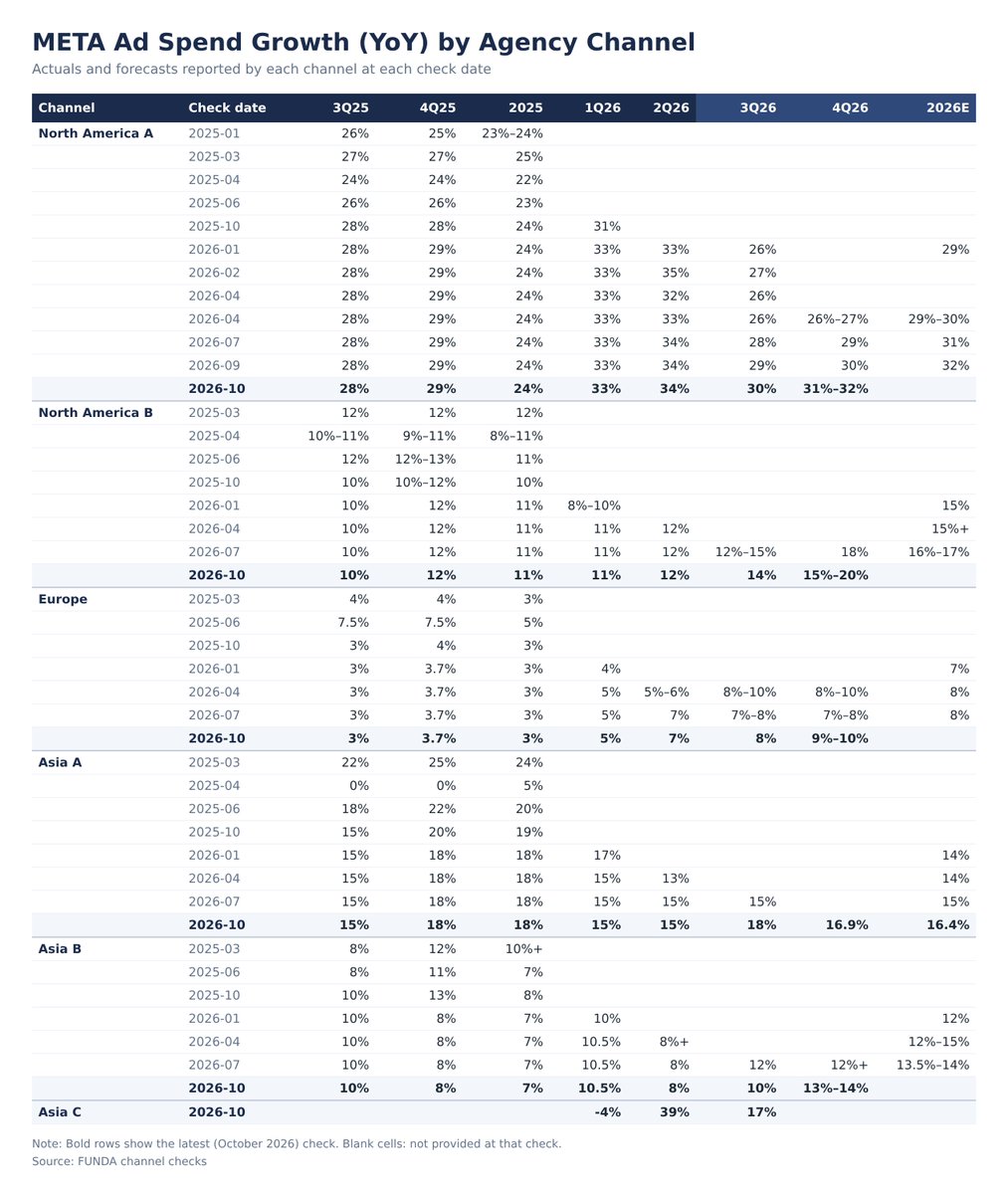
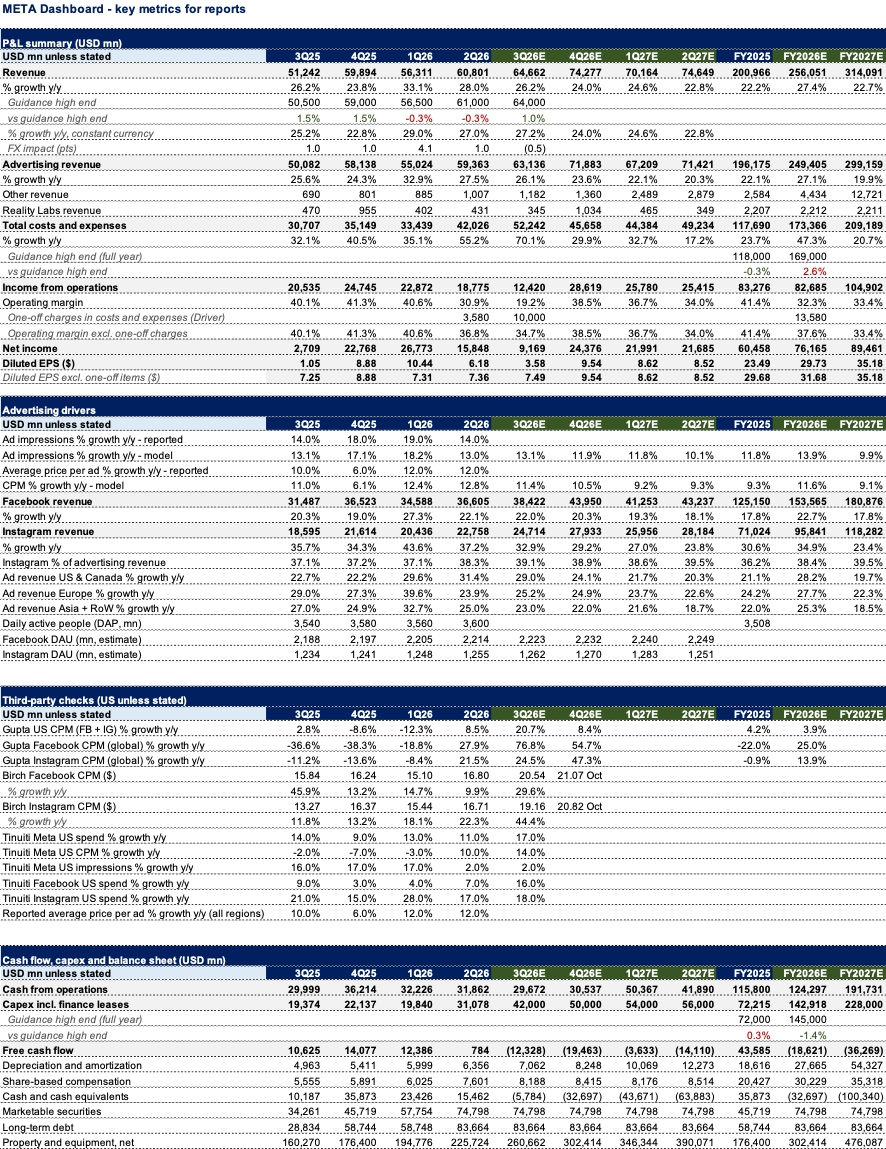
A few takeaways on ChatGPT advertising and what it means for Meta, based on FUNDA’s latest META preview and checks with 6 ad agencies:
1/ ChatGPT ads are growing quickly, but scale and budget impact are two different questions.
According to the report, ChatGPT’s ad revenue run-rate reached $1bn by August 31, following the start of testing in February. Ads were live in more than 60 countries by September 23.
The agency checks show adoption is rising, though from a small base:
A. North America Agency A: ~55–58 advertisers are testing ChatGPT ads, but only ~7–8 have moved into regular budgets. ChatGPT still represents less than 1% of the total digital ad budget the agency tracks.
B. Asia Agency A: ChatGPT spend rose from ~1/60 of Google spend in 2Q to ~1/10 in 3Q. The agency expects ~1/8–1/7 in 4Q.
C. Asia Agency C: ~170 advertisers are running ChatGPT ads, but results have yet to meet expectations.
The distinction is between advertisers trying the platform and advertisers committing recurring budgets. Adoption is moving faster than evidence of durable returns.
2/ For Meta, where the money comes from matters as much as how fast ChatGPT grows.
The report describes two phases:
A. Test budgets: These are generally fixed. Money allocated to ChatGPT can come out of spending that Meta, Google or another platform would otherwise receive.
B. Regular budgets: Once ChatGPT becomes an ongoing line item, agencies say clients generally seek additional funding. That would reduce the direct pressure on existing platform budgets.
Across the six agencies, Google has the most direct overlap. Traditional US advertisers tend to fund ChatGPT from search budgets, while smaller, more agile companies are more likely to treat it as additional spend.
There is an exception worth highlighting: Asia Agency A reports funding coming from several platforms, including Meta.
My read: the checks support limited visible impact on Meta so far, but they do not establish that all ChatGPT spending is incremental. The key question is how much test spending becomes recurring spend—and how that recurring spend gets funded.
3/ Performance is mixed, and measurement could change the picture.
A. Some encouraging early results: North America Agency A reports good ROI, though volume is limited. The European agency sees ChatGPT working as a complement to search and retail media.
B. Weak conversion in other accounts: Asia Agency A reports strong clicks but a sharp drop-off afterward. For one education client, cost per lead was ~1.8x Google’s and well above Meta’s. Asia Agency B reports poor returns and few repeat clients.
C. Possible under-attribution: Asia Agency C suspects some users discover products on ChatGPT but convert later through Meta or another channel. This remains an agency hypothesis; better measurement could change how advertisers allocate budgets.
FUNDA’s conclusion is that ChatGPT is beginning to affect the ad industry, with spending still mostly incremental or coming from Google. It does not include a ChatGPT drag in its Meta model.
My takeaway: ChatGPT is becoming a credible destination for ad budgets, but the competitive impact remains early and uneven. For Meta, the most useful indicators are repeat spending, conversion performance and the source of funding—not advertiser adoption alone.
Subscribe to FUNDA Institutional Solution to access more in-depth reports. [email protected].