It has not been a summer effect, currency markets have seen little volatility all of this year. Claire Dissaux discusses why this should not be taken for granted and which macro trends could disrupt that situation.
Read the research here: https://t.co/iMQJK2myuP
Claire Dissaux, Head of Global Economics & Strategy, discusses below what can drive a return of inflation and what will be the implications for currencies.
Download the report: https://t.co/oXROmvPcmX
Can QE stop AUD? asks Claire Dissaux
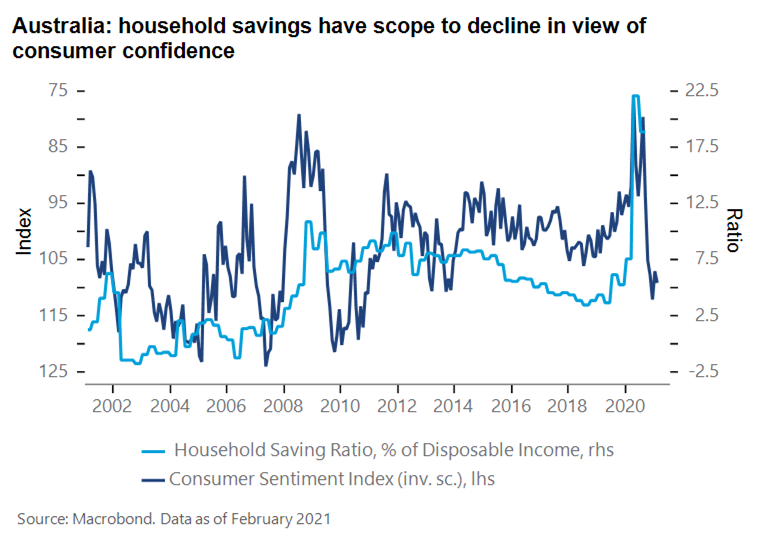
RBA Assistant Governor Christopher Kent stated that ‘’the Bank's policy measures have contributed to the Australian dollar being as much as 5 per cent lower than otherwise in trade-weighted terms (TWI) in his speech on Feb 17.
#AUD#Currency
@Denis_Ferrand @ericolivierlewi @Dembik_Chris@wgaland ce sont les indicateurs big data - donnees de cartes de crédit- qui donnaient le meilleur signal, pas le consensus BBG!
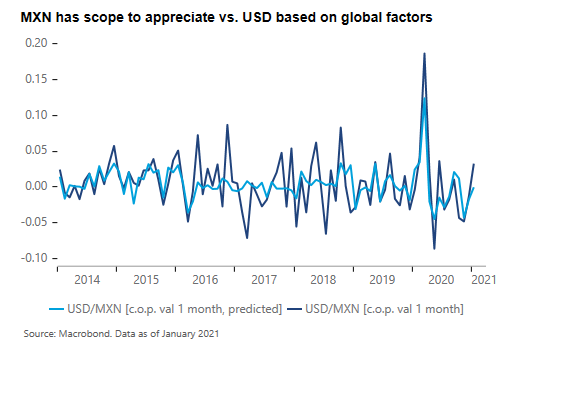
Another highly cyclical EM currency such as MXN has also lagged the improvement in global factors, based on our PCA analysis. While a headwind for growth, the still restrictive monetary stance of Banxico combined with a large trade surplus point to MXN gains vs. USD ahead. #fx
US and global growth expectations have been revised higher, but with rising US Treasury yields, could that end up as a mixed bag for EM currencies, as a large fiscal expansion unfolds in the US? Our PCA methodology helps us answer that question. #emergingmarkets#FX
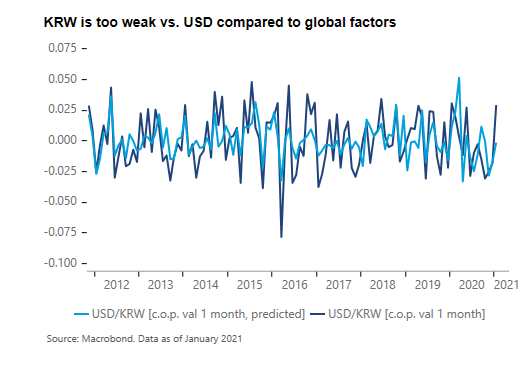
KRW has underperformed EM Asian currencies year-to-date, reflecting large resident equity outflows. This now leaves KRW vs. USD at a significant discount compared to global factors, making it attractive at a time when strong demand for semiconductors benefit Korean exports.
...(as currently is the case thanks to EU Recovery Fund, ECB PEPP and TLTROs) and if a subdued but positive growth outlook is maintained (now based on vaccination and fiscal support at national and EU levels instead of a premature return to fiscal consolidation as post-GFC).
Fiscal and monetary policy cooperation, FX adjustment
The tension between optimism on the medium-term outlook and near-term downside risks remains a key theme for markets. Central banks are set to help bridge the gap by creating fiscal space and accommodating the recovery. #FX
In turn this is likely to shape market inflation expectations, with the Fed gaining much more traction with its goal than the ECB. Of course such a Japanification of the Euro area can only persist as a support for EUR if financial fragmentation risks within EMU remain low...