An investment in the Innovation Fund is speculative and involves substantial risks, including possible loss of the entire investment. Carefully consider the Fund's investment objectives, risks, charges, and expenses before investing. The Fund's SEC filings, including any current prospectus and the Fund's annual and semi-annual reports, are available at https://t.co/kya4dKBVLk — review them carefully before investing.
NEW: Interview with Paul Adams, Chief Product Officer of Fin (formerly Intercom)
@Padday helped lead one of the most successful AI refoundings in software: @intercom bet a $300M/yr business to build @fin_ai, an AI customer service agent. We sat down on Onward to talk about what that bet looked like from the inside, and where he thinks AI takes knowledge work next.
Full disclosure: $VCX is a proud investor in Fin.
In this episode, we cover:
- The internal memo that called ChatGPT "the iPhone moment" and the $300M business Intercom bet on it
- Why going all-in on AI was the easy decision, and why the culture change nearly broke the company
- How the bet refortified the legacy business instead of killing it
- Customer service as the canary in the coal mine for AI and knowledge work
- The three layers Fin runs on, including the models Intercom trains itself
- Read vs. write: the line where an AI agent's risk and power both live
- Why we judge AI against a standard no human meets (a chaotic Vodafone call center)
- Claude Code as "magic": a non-coder turning one prompt into a finished video
- @Fundrise is a customer of Fin with: ~94% resolution and ~$600K in support cost reduced
- Why technology moves fast and people move slowly (and what retail's collapse teaches)
- Scenario planning the next few years: real pain and a wave of one-person companies
- Why Paul calls himself a "delusional optimist," not a doomer
Watch the full episode below →
𝐓𝐈𝐌𝐄𝐒𝐓𝐀𝐌𝐏𝐒
(00:00) Paul Adams, CPO of Fin (formerly Intercom)
(00:51) Competing with the AI labs, and the three layers Fin runs on
(05:46) Technology moves fast, people move slowly
(09:33) The Block layoffs
(12:24) Intercom's refounding: IPO, ChatGPT, all-in on AI
(15:31) Why the culture change was the hardest part
(15:59) How the AI bet refortified the legacy business
(20:20) Customer interview: Fundrise on Fin
(22:48) The economics (~$600K saved vs. ~$80K)
(24:45) Customer service as the canary in the coal mine
(26:12) New jobs that didn't exist, like agent orchestration
(30:11) Read vs. write to the database (the Delta story)
(31:53) Hallucinations and the Vodafone call center
(37:00) Claude Code as "magic"
(40:25) Scenario planning the next few years
(44:35) Europe vs. the US and China
(49:37) Cancer, optimism, and governing AI well
(52:40) Wrap
An investment in the Innovation Fund is speculative and involves substantial risks, including possible loss of the entire investment. Carefully consider the Fund's investment objectives, risks, charges, and expenses before investing. The Fund's SEC filings, including any current prospectus and the Fund's annual and semi-annual reports, are available at https://t.co/kya4dKBVLk — review them carefully before investing.
"A pill that makes dogs live longer...sounds like magic."
Excited to share my full conversation with @loyalfordogs CEO and founder @celinehalioua, tomorrow morning.
Fundrise CEO @BenMillerise says their new venture fund VCX is “super disruptive to the venture industry.”
“They’re going to want us and hate us at the same time.”
“To the private companies: we’re a venture fund.”
“There’s no difference except our capital is evergreen. It’s forever capital—low-cost and passive.”
“To me, as a founder and a builder—that’s the best money around. I’d rather have that than ‘value add.’”
“I think we get to a place where, structurally, an allocation to passive long-term money becomes—the best companies get it, and the best companies want it.”
SpaceX. OpenAI. Anthropic. Databricks. All onchain.
xStocks has partnered with @Fundrise to tokenize VCX, bringing tokenized exposure to some of the world's most sought-after private tech companies through a single asset.
Private markets, now onchain.
https://t.co/GbTEQ3KUOE
In 2011, I pitched a top securities attorney in New York on democratizing investing. After hearing me list all of the ways I believed retail investors were disadvantaged by the financial system, he just looked at me and said:
“Why would you bother with the little guy?”
Today, 15 later, we’re listing the @fundrise Innovation Fund on the NYSE under the ticker $VCX.
The financial system has a structural problem that most people can feel but few can name. The most valuable private technology companies are worth hundreds of billions, even over a trillion dollars, and they’ve never gone public. The wealth creation that used to flow through public markets—enabling everyone to participate—now happens behind a wall that excludes everyday investors.
AI compounds the urgency. The companies building the most transformative technology in a generation are growing at rates we’ve never seen before, and the gap between who owns that growth and who benefits from it widens every quarter.
We started working on the Fundrise Innovation Fund in 2021 to test whether a public venture capital fund could work. Over 100,000 investors now own a portfolio concentrated in the leading private AI and technology companies, making VCX one of the largest funds of its kind to ever list on a major exchange. No accredited investor requirement. Now available in any brokerage account.
When that attorney asked me why I’d bother with the little guy, I told him: because they’re getting screwed! But I believe today marks another step in building a better financial system for the individual investor.
Onward
For decades, venture capital was reserved for institutions and the ultra-wealthy. That changes today.
For the first time ever, @SoFi investors can invest in venture capital with @Fundrise, directly from the SoFi app.
"If you have neither the Trump put nor the Fed put, that would be an ingredient for a deep recession on top of the actual economics of it—which is that, when you have higher trade barriers, it leads to perhaps manufacturing inefficiency. And cost of production is higher. It slows down the potential GDP growth of the U.S. over the next 4-8 years."
-@AnnaEconomist
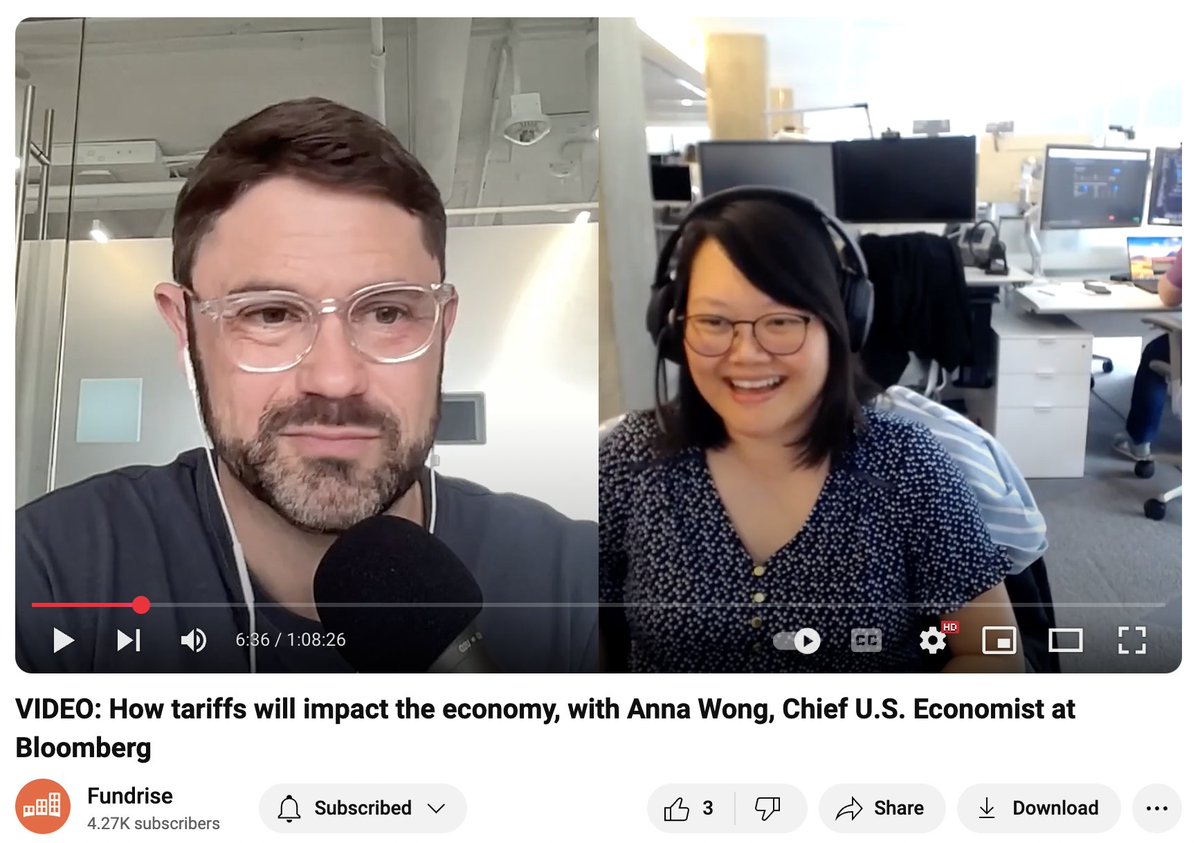
How will tariffs impact the US economy?
My latest podcast with @AnnaEconomist, Chief Economist for Bloomberg.
Anna Wong is one of the most balanced economists in the nation. She worked in the Trump White House, Obama Treasury Dept., and the Fed!
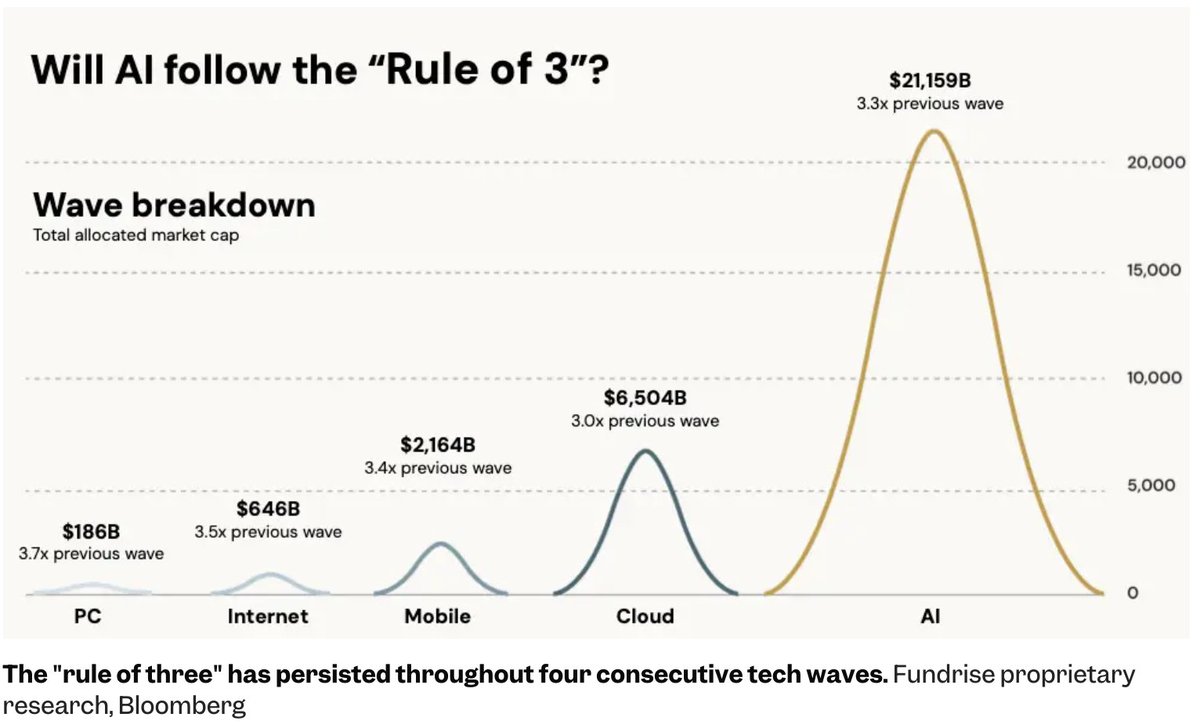
What will AI be worth?
Our team did a few months of research and found a surprising pattern in the financial data, which @BusinessInsider wrote an article about yesterday.
We agreed to wait 24 hours before we published the full results.
Business Insider: Everyone wants to know what AI is worth. One investor looked to the past for the $20 trillion answer.
Phenomenal writeup of our research by @emmacos.
https://t.co/8vtxzXdd35
@BusinessInsider
@BenMillerise Listen to the episode wherever you get your podcasts:
Apple Podcasts: https://t.co/ZJGfljmXGS
Spotify: https://t.co/6xKKRspTxV
YouTube: https://t.co/C8Cd2QGHbu
https://t.co/4cthxiooEk
“Stop infantilizing these people. I’m beginning to think that regulation was an attempt to sequester these assets to institutions”
Listen in to @benmillerise's most recent interview on the Prof G Markets podcast w/ Scott Galloway and Ed Elson.
“Literally, you are a masochist” —@profgalloway
I loved spending 25 minutes chatting with Scott and @edels0n on the Prof G Markets Podcast.
We discussed the evolution of private markets, and why entrepreneurs have to “embrace the suck.”
https://t.co/8bn35PnXSd
A couple hundred people in San Francisco may be on the cusp of inventing artificial general intelligence (AGI).
Yet most people are not paying close attention, are skeptical, and are certainly not in the room.
In this conversation from our podcast Onward with @BenMillerise, @dwarkesh_sp pulls back the curtain so that the broader public can understand what people who are actually building AI think is going to happen.
You can find this episode of Onward and more on Spotify, Apple Podcasts, YouTube, and wherever else you get your podcasts.