Stanford reinvented text generation.
(it’s neither autoregressive nor diffusion)
Autoregressive LLMs generate one token at a time. Longer answers require longer chains of sequential predictions.
Diffusion LLMs generate many tokens in parallel, but still need repeated refinement passes. Each pass processes the full sequence, and quality drops quickly when you cut the passes.
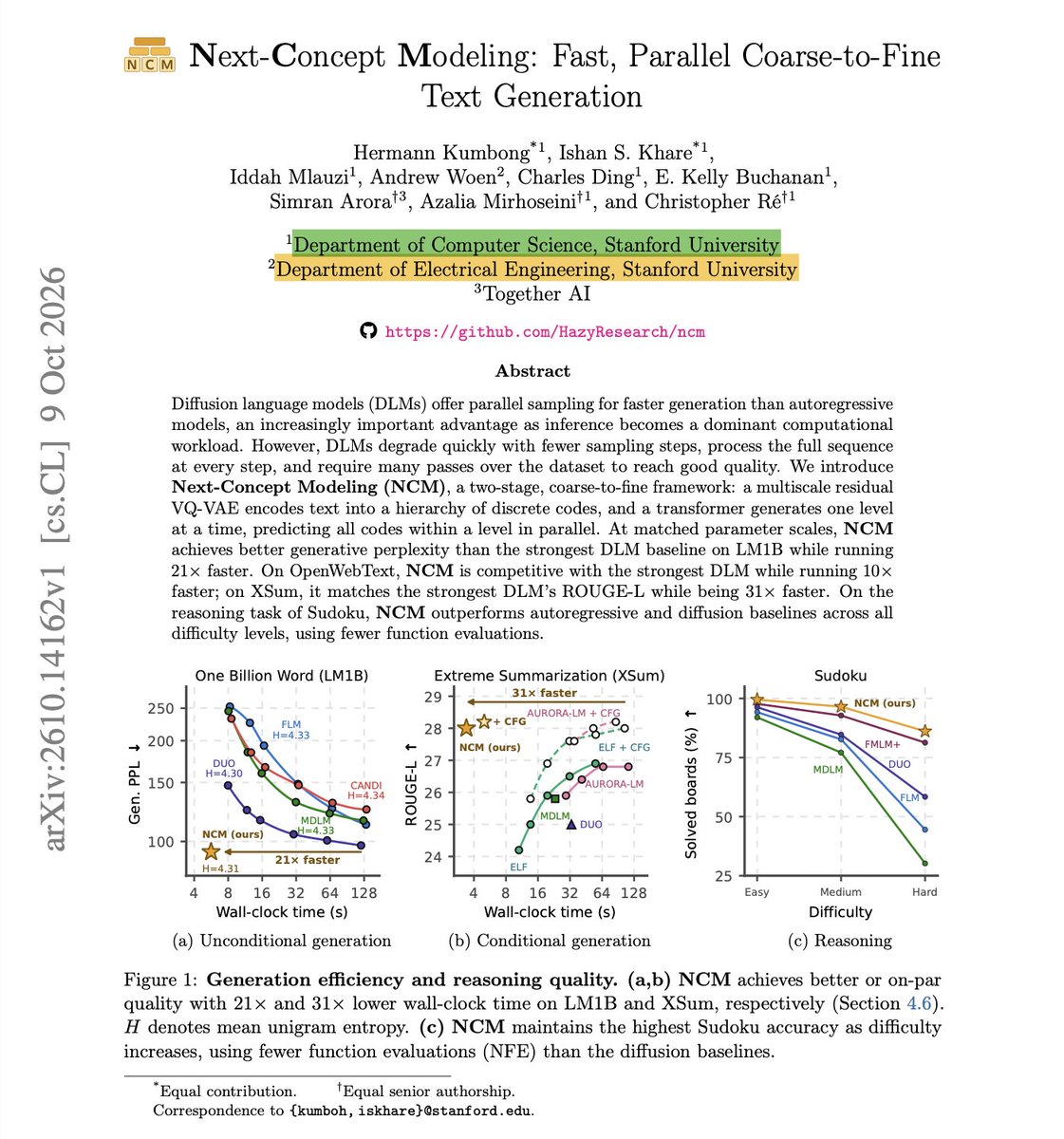
Stanford researchers proposed another approach, Next-Concept Modeling (NCM). It generates text from coarse structure to fine detail in roughly a dozen passes.
First, a tokenizer learns to represent text as layers of compressed information. Early layers capture broad structure, while later layers add details the earlier ones missed.
A transformer then learns to generate these layers in order, predicting everything within each layer simultaneously. A decoder converts the completed representation into text.
The advantage is that early layers are tiny. Generation needs fewer passes, and those early passes process much less information.
You can see this in the team’s translation example. Early layers produce rough, repetitive text, which later layers refine into a clean translation.
In the researchers’ tests, NCM generated text 10–31× faster than strong diffusion baselines, with comparable or better benchmark scores. On LM1B and OpenWebText, it also used roughly 4–5× fewer training tokens, including tokenizer training.
That speed can also improve quality. Generating several candidates and selecting one based on agreement outperformed diffusion baselines at the same sampling time budget.
The limits matter. Scaling experiments reach 725M parameters, tasks use separate tokenizers, and the release includes evaluation code and checkpoints without a training pipeline.
Some evaluations also use repetition penalties during final decoding, without additional model calls.
NCM shows that parallel generation can work by building increasingly detailed representations. Whether those gains hold at general-purpose LLM scale remains open.
- GitHub repo: https://t.co/gwR7gJHsNA
- Paper: https://t.co/oE7n7gh3Rt
Historically, with the state came the church, and with the church came the state. This insight is key to understanding the underappreciated role of religion in the American Revolution. | Joshua Mawhorter
https://t.co/P1dqyVCVNI
In ancient Rome, the law allowed girls to marry at 12 and boys at 14, and it was not them but their fathers who chose who they would marry.
Could they flirt? Yes. In 2 AD, the poet Ovid wrote a whole book about it: The Art of Love. His biggest tip for men was the chariot races. There, men and women could sit side by side. He told men to sit next to a girl, talk about the horses, and brush the dust off her lap, even if there wasn’t any.
When a couple got engaged, the man gave the woman a ring. She wore it on the fourth finger of her left hand. The writer Aulus Gellius explained why: Romans believed a nerve ran from that finger straight to the heart. Today, we still wear engagement rings on the same finger.
On her wedding day, the bride wore a bright orange veil. Her hair was parted with the tip of a spear and done in six braids. At the end of the day, the groom carried her into the house so she wouldn’t trip on the doorstep, because that was seen as bad luck.
Augustus wanted more Romans to marry and have children. He passed laws that punished single men and women and rewarded families with three or more children. The historian Cassius Dio noticed something funny: the two consuls who passed one of these laws in 9 AD were both unmarried.
Divorce was easy. There was no court and no judge. If the husband or wife said they wanted to end the marriage, that was enough, and the marriage was over.