AI just won't stop getting crazier 🤯
13 most incredible developments from OpenAI, META, Midjourney, StabilityAI, MoveAI, Grok that are taking the industry by STORM.
1. MoveAI now creates real-time CGI with just a single phone
This is Bill Campbell.
He was known as the trillion-dollar coach, and he’s one of the most important people you’ve never heard of.
His prodigious coaching influenced people from Steve Jobs to Jeff Bezos to Sheryl Sandberg, and here’s how…
In the foreword to the book “Trillion Dollar Coach: The Leadership Playbook of Silicon Valley’s Bill Campbell”, the authors (including Ex-CEO of Google, Eric Schmidt) share:
“Bill had become so influential that he went on a weekly Sunday walk with Steve Jobs, and the Google founders have said they couldn’t have made it without him.”
Bill had a gift for sharing advice with caring candor that elevated even the most brilliant people and teams.
As Ben Horowitz, Co-Founder of Andreessen Horowitz, shares:
"Bill would never tell me what to do. Instead he'd ask more and more questions, to get to what the real issue was."
So, how did Bill become revered by Silicon Valley’s best?
He mastered the arts of communication, leadership, and team-building.
Here’s what it looked like:
(1) Preference the best idea, not consensus
Bill advocated for a decision-making process that avoided “groupthink” and allowed all perspectives to be considered.
In practice, this looked like structured brainstorming where everyone had the chance to provide input.
(2) Leave no gap between statements and fact
Bill’s method of giving feedback was simple yet profound:
- Give feedback as soon as possible
- Be relentlessly honest and candid
- Share negative feedback privately, and do it with care (and a hug if required)
(3) Believe in people more than they believe in themselves
Talent and competence are not in short supply, but belief is.
Bill knew this, and he made it a priority to lift up every coachee by instilling outsized belief in them.
The greatest gift you can give someone else is often belief.
(4) Team first, then problem
Before any problem-solving would occur, Bill focused on helping leaders get the right people in place to solve the problem.
Bill knew this was the highest-leverage approach to solving problems and empowering teams.
(5) Master the art of indirect advice
When people come for advice, they’re often seeking approval on their chosen pathway.
Rather than giving prescriptive advice, Bill offered stories and analogies to illuminate the problem differently.
The effect? People could solve the problem on their own.
(6) Only coach the coachable
One of Bill’s favourite questions was, “Are you coachable?”
As the saying goes, “you can lead a horse to water but you can’t make them drink it,” knowing when to invest in someone because they’re willing to do the work is a critical skill for leaders.
(7) Pick the right players
Bill had a simple hiring philosophy: “Look for smarts and hearts.”
The top characteristics he looked for were:
- The ability to learn quickly
- A willingness to work hard
- Integrity—an alignment between actions and words
- Grit—the ability to stick with it
(8) Start with trip reports
At the start of every meeting, ‘trip reports’ were required by the teams Bill coached.
These included updates from every team member on personal or non-business topics and had the effect of building rapport and stronger relationships.
Bill not only created trillions of dollars in value but inspired those who worked with him.
As Sundar Pichai, Google's CEO, said, “He showed me that what really matters at the end of the day is how you live your life and the people in your life. It was always a lovely reset.”
Bob Iger, CEO of Disney, said the following, “Everything Bill brought to the boardroom came from a place in his heart.”
If this resonates, repost to share with others ♻️.
And follow @alexbrogan for more.
P.S. What is your favourite lesson?
Share in the comments.
📌 Interested in business, leadership & self-mastery?
Try my free newsletter: https://t.co/m7ppsw5qI6
You'll get more stories and my best content for free
3.1 To be right a lot, you have to listen a lot.
Most of being right a lot is about gathering as much data as possible. Good leaders listen. They develop the ability to ask good questions and to challenge bias. They seek out people with different perspectives.
Our very own @djmcnut and @Catherine_Price started a podcast - How to make work more fun! I hope this conversation gives you some new insight on how playfulness, connection and flow (aka FUN) help make work more effective and enjoyable.
https://t.co/S7SDrpOpIH
"The simplest way to clarify your thinking is to write a full page about whatever you are dealing with and then delete everything except the 1-2 sentences that explain it best."
-@JamesClear
Some things I believe about the education system:
1. Parents say they care about learning, but credentials are really what they value.
2. Education should feel more like a video game than a movie. The current system forces kids to sit back and listen. Better to gamify the experience and make it interactive.
3. Poor pedagogy is a bigger problem than a lack of funding.
4. If teaching kids was the real priority, schools would look a lot different from how they look today.
5. To teach critical thinking, have students argue for perspectives they disagree with and expose their writing to criticism so they have to defend their core beliefs.
6. A major blindspot in education is that the people running the system see the value in learning, so they assume students do too. And so, not enough energy goes into motivating students to learn in the first place.
7. Homework should be the exception, not the rule. Kids are forced to do it every day because the time they spend in school is so unfocused and unproductive.
8. The biggest problem with writing education is teaching kids that good writing comes from big words and long papers.
9. Sorting kids by grade-level works on the playground, but not in the classroom, where kids should be sorted by skill-level. If the material is too easy, they won't learn anything. If it's too hard, they check out. Meet kids where they are (adaptive learning apps are the only way to do this at scale).
10. Almost every kid is absolutely obsessed with something, and if you can frame their studies through the lens of whatever it is, they’ll learn much faster.
11. If you’re trying to build something ambitious in education, get the parents of wealthy children to fund it by building an ultra-high-end product for them. If your product works, they’ll pay exorbitant amounts of money for their kids’ education, and you can use the high profit margin to build a solution for the masses. Elon Musk is doing this with Tesla. Schools can do the same.
12. The modern education system is designed for girls, not boys. Just look at the trends in college graduation rates.
13. The problem with school isn’t the system itself. Rather, the problem is that every school basically teaches people to learn in the same way. Kids around the country are stuck learning at the same speed, with the same tools, and in the same ways.
14. One of the great tragedies of the education system is how many students graduate thinking that learning is boring.
15. The best teachers are increasingly on the Internet, and they're already making millions of dollars per year.
16. 1-on-1 tutoring is the best way to learn. But until recently, it was too expensive and people-intensive to scale to the masses. AI and learning apps have changed that.
17. We are wrong to throw so much shade at the Liberal Arts, but right to criticize the politicization of them. The stories, ideas, and art at the core of Western civilization are the seeds of tremendous wisdom. We should relish them.
18. The idea that it's cool to get good grades without trying hard is a cultural weed that infects nearly every K-12 school in America.
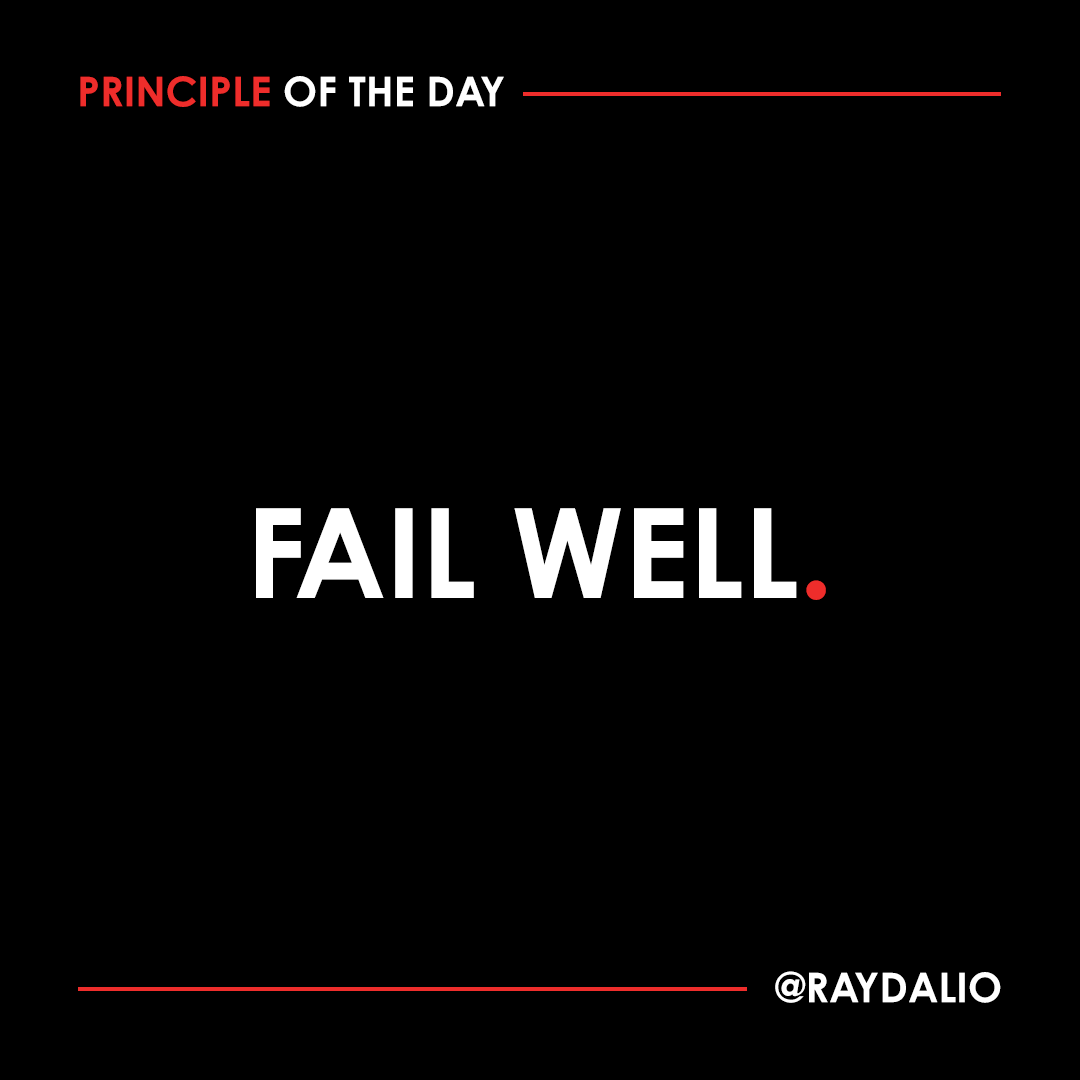
Everyone fails. Anyone you see succeeding is only succeeding at the things you're paying attention to--I guarantee they are also failing at lots of other things. The people I respect most are those who fail well. I respect them even more than those who succeed. That is because failing is a painful experience while succeeding is a joyous one, so it requires much more character to fail, change, and then succeed than to just succeed. People who are just succeeding must not be pushing their limits. Of course the worst are those who fail and don't recognize it and don't change. #principleoftheday
I've been collecting @JamesClear quotes about focus for years, and these are my favorites:
1. Focus collapses your options in the short-term, but expands them in the long-term.
2. There are many capable people in the world, but relatively few that focus on what matters.
3. You need focus to become exceptional at anything. You have to be great at saying no. Massive amounts of time and energy are wasted optimizing things that should be left undone.
4. Do less, but better.
5. What looks like a talent gap is often a focus gap. The "all-star" is often an average to above-average performer who spends more time working on what is important and less time on distractions.
6. It sounds so simple, but every project I’ve ever really succeeded on started to come together when I made it my primary focus. “All In” vs “Kinda In."
7. The Paradox of Focus: Make the most of one opportunity and more opportunities come your way. Moving boldly in one direction and more paths will unfold before you. To get more, focus on less.
8. I have a suspicion that most adults (75%+) could pick any skill—excluding sports—and work their way into the top 10% in the world simply by working exclusively on it every day for two years. But almost nobody displays that degree of focus, so we will never know.
9. Highly focused people do not leave their options open. They make choices. If you commit to nothing, you’ll be distracted by everything. The great irony of this is that by limiting your options and remaining focused until you master a skill, you actually expand your options in the long run. Life-changing optionality is a byproduct of providing great value, which can only be achieved through focus.
All direct quotes.
In school, time pressure on tests favors the fastest sprinters. But in life, success is a marathon.
The students with the greatest potential aren’t always the ones who rapidly spit out the right answers.
They’re often the ones who take the time to ask the right questions.
https://t.co/RCtvEMYwqA
Want to know the secret formula for hiring top performers for your team?
Imagine your team as a sports squad.
Think chemistry and character.
Seek these 5 power traits:
- Relentlessly resourceful
- Fun to be around
- Constant learner
- Optimism
- Grit
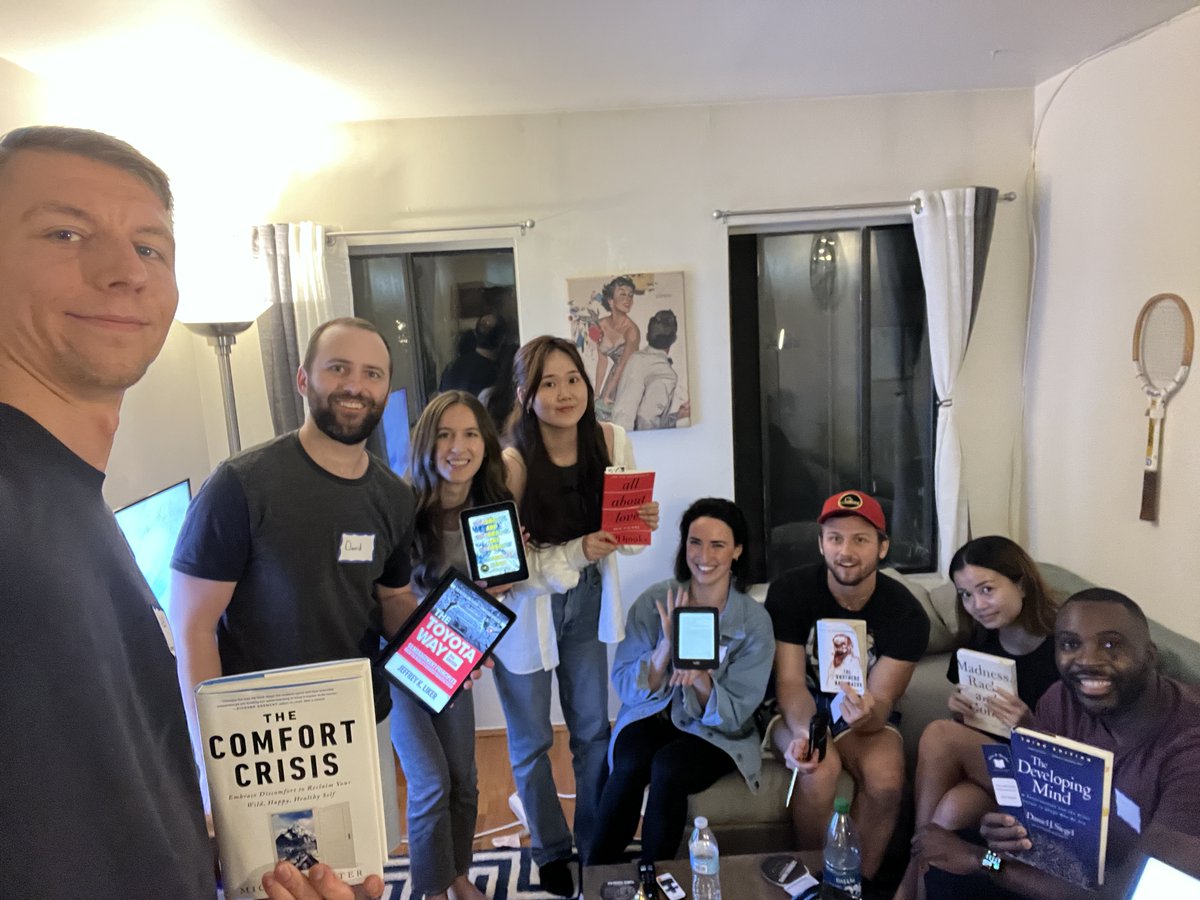
Hosted a 2-Hour Reading Party last night!
If you're introverted, it's a great way to meet new people and discover awesome books.
Here's how to host your own 2-hour reading party:
1) Set up an event page using Partiful (it's free).
2) Pick a 2-hour time slot on a weekday like Thursday 7-9pm.
3) Use Partiful to message everyone the time and place for the event and have people RSVP.
4) You can keep your first event small and invite 15-20 people since about 50% of people won't be able to make it.
5) Buy name tags, water, and snacks for the event.
6) People will be running late so from 7-7:30pm use this time to meet new people, chat, or eat a snack.
7) At 7:30pm, ask people to silence their phones and begin the first 30-minute reading session. Put on some relaxing reading music so it isn't completely silent.
8) At 8pm, break out into 2-3 person groups. Give each person 2-3 minutes to share what they're reading and one lesson they learned from their book.
9) At 8:10pm, begin the second 30-minute reading session.
10) At 8:40pm, have people break out into different 2-3 person groups (that way they meet new people and discover new books).
11) After people are done talking about their books they can use the remaining time to network, talk about work, or just meet new people.
12) At 9pm, thank everyone for coming and wrap up the event.
- - -
A few ideas for future reading parties:
1) Make it a themed-reading party:
Tell everyone to bring a literature book and make it a classic lit night. Or have everyone bring a self-help book to make it a productivity hacking night. You can make it as broad or specific as you wish.
2) Put more emphasis on the party side of things:
If you're hosting a reading party with your close friends, feel free to make it more of a party. Have a few bottles of wine and make it into a wine-tasting night. Or have a few bottles of whiskey and make it a whiskey-tasting night. You can even use the reading party as a pre-game event before going out with friends on the weekend.
3) Make it more of a networking event:
If your main goal is to meet more people, you can just have one main reading session and spend more time in breakout groups and have people rotate groups after 10 minutes. That way people have more time to talk and meet new people.
Use this post as a general guide for hosting a reading party but feel free to switch things up to your preference and liking!