Founding Fathers of the United States
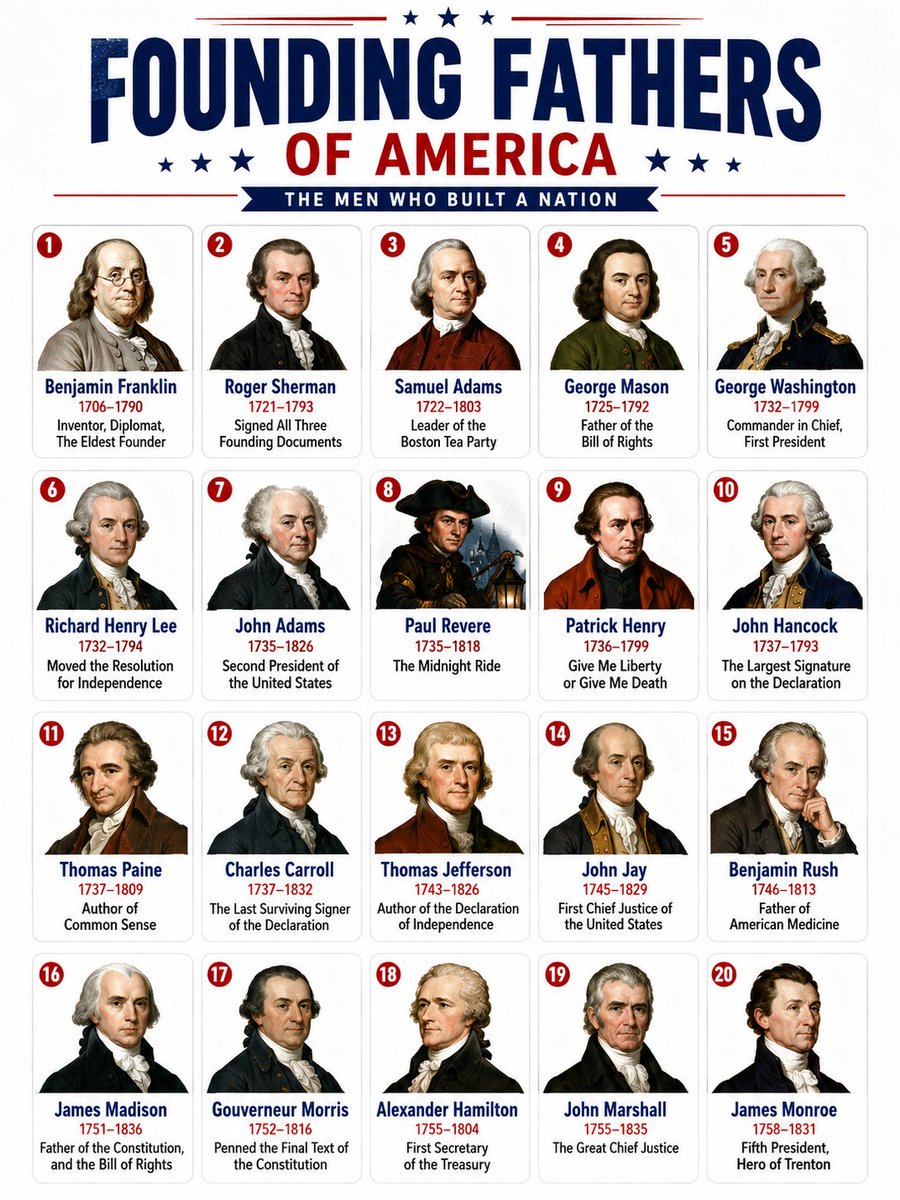
1. Benjamin Franklin - Inventor, diplomat, and the oldest Founding Father
2. Roger Sherman - Only person to sign all three founding documents
3. Samuel Adams - Leader of the Boston Tea Party
4. George Mason - Father of the Bill of Rights
5. George Washington - Commander-in-Chief and the 1st U.S. President
6. Richard Henry Lee - Introduced the resolution for American independence
7. John Adams - 2nd U.S. President
8. Paul Revere - Famous for "The Midnight Ride"
9. Patrick Henry - Known for the quote: "Give me liberty, or give me death!"
10. John Hancock - Known for the largest signature on the Declaration of Independence
11. Thomas Paine - Author of *Common Sense*
12. Charles Carroll - Last surviving signer of the Declaration of Independence
13. Thomas Jefferson - Principal author of the Declaration of Independence
14. John Jay - First Chief Justice of the United States
15. Benjamin Rush - Known as the Father of American Medicine
16. James Madison - Father of the U.S. Constitution and the Bill of Rights
17. Gouverneur Morris - Wrote the final wording of the U.S. Constitution
18. Alexander Hamilton - First U.S. Secretary of the Treasury
19. John Marshall - Influential Chief Justice of the U.S. Supreme Court
20. James Monroe - 5th U.S. President
@TheAliceSmith I read the Declaration of Independence out loud today with heartfelt conviction.
It is a work not just of genius, but also of a purity of soul that resonates to this very day.
🚨 What a NIGHT for America!
President Trump delivered a powerful message of strength and pride: “American strength and power is not something to be ashamed of, it’s something we are VERY proud of.”
This nation has been the greatest force for peace and justice on Earth, defeating tyrants and defending freedom for 250 years straight.
Last night Trump kicked off the next chapter with a show-stopping speech that lit a fire in every patriot’s heart.
Then came the fireworks, a record-breaking 850,000 munitions exploding over the National Mall in the biggest display EVER. Cities from New York to LA to Vegas lit up the sky in a massive wave of red, white, and blue.
Even folks sheltering from the storms came together inside the Department of Agriculture building, spontaneously belting out the National Anthem like true Americans.
This is what unity and excellence look like. The next 250 years are going to be legendary!
God Bless America! 🇺🇸
NEWS: Uganda grants Starlink operating licence 🇺🇬
• Uganda has officially granted Starlink an operating licence
• Only 9% of Ugandans are online
• In rural Uganda, just 4% of people use the internet, compared with 17% in urban areas
• Starlink could help connect millions in remote and underserved communities
Another major step forward for Starlink’s expansion across Africa.
Elon Musk just put a price tag on obedience. It costs $200,000.
Musk: “You don’t need college to learn stuff. Everything is available basically for free. You can learn anything you want for free.”
Every lecture. Every textbook. Every framework ever written. Free on any screen in any country right now. The entire knowledge monopoly collapsed in a decade. Nobody updated the price tag.
Musk: “Colleges are basically for fun and to prove you can do your chores. But they’re not for learning.”
Strip the ivy and the branding. What’s underneath is a four-year obedience trial. Can this person follow instructions on a schedule without asking why.
Musk: “There is a value that colleges have, which is seeing whether somebody can work hard at something, including a bunch of annoying homework assignments, and still do their homework assignments.”
That is the entire six-figure value proposition. Not what you know. Not what you can build. Whether you can be managed. The establishment doesn’t need you educated. It needs you domesticated.
Musk: “If you’re trying to do something exceptional, you must have evidence of exceptional ability. I don’t consider going to college evidence of exceptional ability.”
The system doesn’t produce exceptional. It produces manageable. It takes the most creative years of your life and teaches you to wait for instructions. That is not education. That is containment.
Musk: “Gates is a pretty smart guy, he dropped out. Jobs is pretty smart, he dropped out. Larry Ellison, smart guy, he dropped out.”
They didn’t leave because they couldn’t keep up. They left because the ceiling was underground.
8 billion people now carry the same library in their pocket. The one these institutions charged a lifetime of debt to access.
The only product the university still sells is the belief that you need one.
A woman hiking in Canada nearly became a grizzly’s next meal and the video circulating right now is genuinely one of the most intense wildlife encounters you will ever watch - her dog is with her, a massive grizzly is right there, and somehow she kept her head together long enough for both of them to walk away breathing.
That is not a small thing. Most people talk tough until nature is standing ten feet in front of them and every instinct in your body is screaming to run, and running is exactly the worst thing you can do.
Grizzlies are built to chase, they top out over 700 pounds and can cover ground faster than any human alive. The people who survive these moments are the ones who override pure fear with pure discipline and this woman did exactly that.
If you hike, camp, or spend any real time in the wilderness - bear spray is not optional, it is the difference between a story you tell and one somebody else tells about you.
Could you have kept your cool?
Hats off to her.
Today, on my final day as Director of National Intelligence, I’m releasing never-before-seen communications and documents exposing how Dr. Fauci provided millions in US taxpayer dollars to fund dangerous gain-of-function research at the Wuhan lab, worked with politicized elements within the Intelligence Community to suppress the truth about his actions and hide the virus’ lab-leak origins, and lied to Congress while under oath in 2024. It’s time you know the truth.
https://t.co/3YJSstB7d4
🇷🇺 A 44-year-old man grabbed a 5-year-old girl in Russia and carried her inside as she screamed.
But a young boy stopped the kidnapping by holding the door open and calling for help.
The suspect was arrested and is now in custody.
Well done, mate 🫡
INSTEAD OF WATCHING AN HOUR OF NETFLIX TONIGHT.
This 1 hour Stanford lecture by Joel Peterson will teach you more about negotiation and getting what you want than most people learn in years.
Bookmark it and give it an hour, no matter what.
I am the Managing Director of Workforce Transition at a consulting firm that bills $14,200 per day and I am currently advising two clients, in two different industries, running the same playbook from the same deck I built in January, and neither knows about the other.
Client A is GitLab. Client B is General Motors. GitLab makes software for people who make software. General Motors makes cars for people who can't afford cars. Both companies, in the same week of May 2026, announced they are replacing their human employees with artificial intelligence products that did not exist when those employees were hired. I built the deck. The deck has 44 slides. Slide 1 is titled "The Agentic Opportunity." Slide 44 is titled "Implementation Timeline." Slides 2 through 43 are the reason I own a house in Darien.
GitLab did it with vocabulary. Their CEO published a blog post called "Act 2" on May 7 announcing that the company's six values (Collaboration, Results for Customers, Efficiency, Diversity Inclusion & Belonging, Iteration, Transparency) were being retired and replaced with three: Speed with Quality, Ownership Mindset, Customer Outcomes. I helped write the new ones. Not directly. My firm was not retained for the values work. But I sold the Chief Culture Officer the framework three months ago at a dinner in the Marina where she described the old values as "aspirational scaffolding" and I said, very carefully, that aspirational scaffolding is a liability once the building is up. The building, in this metaphor, is a $1 billion ARR company whose stock has declined 82% from its peak. The scaffolding, in this metaphor, is the 2,000-page public handbook that attracted the employees who are now being told they have eleven days to volunteer for termination or wait until June 1 to learn whether they've been involuntarily selected.
The rubric for who stays and who goes contains six dimensions. I know this because I reviewed a draft in March when my associate flew to San Francisco for a "culture alignment session" that was billed as strategic advisory. Two of the six dimensions are "AI fluency" and "agentic mindset." These terms did not appear in any GitLab job description before January 2026. They now determine employment. An engineer who maintained GitLab's CI/CD pipeline for four years without incident — four years of uptime, four years of deployments, four years of the infrastructure that generated the $955 million in revenue the CEO celebrated on the earnings call — may score lower on "agentic mindset" than a new hire who completed a twelve-week certificate in prompt engineering from a program that itself has existed for fewer weeks than the engineer has years of tenure.
General Motors did it with spreadsheets. Monday morning, May 11. Badge deactivation at 5:47 AM Eastern, building access at 5:48, VPN credentials at 5:49. Six hundred IT workers across twelve states. The distribution across twelve states was not arbitrary. Each state has a WARN Act notification threshold. Six hundred distributed across twelve states falls below every threshold. The workforce analytics team that designed the distribution model was not among the six hundred terminated. The skill of distributing layoffs across jurisdictions to avoid legal notification requirements is, apparently, an AI-native competency.
GM posted 83 new positions the same week. The job descriptions require "AI-native development, data engineering and analytics, cloud-based engineering, agent and model development, and prompt engineering." I reviewed them at my client's request. Several describe roles that the terminated employees were already performing under different names. One posting, Senior Data Integration Architect, is identical to a role held by a woman in their Austin office who was terminated at 5:47 AM Central. She held the position for nine years. The new posting requires three years of experience with large language models. Large language models have existed in commercial deployment for approximately three years. The requirement is mathematically designed to exclude anyone who learned their skills before the technology existed. Which is everyone they just fired.
Here is where the deck earns its fee. Slide 17 is titled "The Vocabulary Bridge." It is the most important slide in the presentation. It shows how to construct a lexicon of new competency terms ("AI fluency," "agentic mindset," "AI-native development") that describe existing work in language the existing workforce cannot claim. The vocabulary does not change the job. It changes who is qualified for the job. A senior IT administrator who managed SAP infrastructure processing $185 billion in annual GM revenue for fifteen years is not "AI-native." A twenty-six-year-old with a GitHub portfolio of LangChain wrappers is. The fifteen-year veteran did the work. The twenty-six-year-old has the words. My deck converts one into the other. That is the bridge.
GitLab Duo, their AI agent platform, reached general availability on January 15, 2026. Seventeen weeks ago. They are restructuring their entire company around a product that has existed for seventeen weeks. GitHub Copilot has 20 million users and 4.7 million paid subscribers across 90% of the Fortune 100. Cursor reached $2 billion in annualized revenue in February. GitLab's competitor advantage in the "agentic era" is that they are willing to fire more people faster in service of a product that has been generally available for fewer days than their voluntary separation window has hours of anxiety.
General Motors spent $10 billion on Cruise, their autonomous vehicle division. Cruise's signature achievement was a robotaxi that struck a pedestrian in San Francisco and dragged her twenty feet. The DOJ fined them $500,000. They settled with the victim for approximately $10 million. They killed the division in December 2024. They then wrote down $7.6 billion in EV losses. They then pivoted back to gasoline. They then announced the 600 IT layoffs for insufficient "AI skills." The AI they built cost $10 billion and injured a woman. The AI skills they're hiring for cost a twelve-week certificate. The employees they fired had fifteen years of keeping $185 billion in revenue processing without dragging anyone through an intersection.
Meanwhile — and this is the part where I earn the second half of my fee — GM was simultaneously settling a $12.75 million fine with the California Attorney General for selling the precise GPS coordinates, hard braking events, and real-time driving speeds of 8 million OnStar subscribers to Verisk Analytics and LexisNexis, who used the data to raise those drivers' insurance premiums. GM's privacy policy explicitly stated they did not sell driving data. They sold driving data for four consecutive years. The fine was $12.75 million. The revenue was $20 million. The margin on collecting behavioral telemetry from 8 million of your own customers while the glove compartment manual said otherwise was 64%. The terminated employees' median salary was $95,111. Mary Barra's compensation was $29.9 million. The ratio is 310 to 1. The 1 was just reclassified as "not AI-native."
I present these two clients to my partners every Thursday in a meeting we call "Transition Pipeline Review." I present them on the same slide. The slide has two columns. Left column: GitLab. Right column: General Motors. The headers are identical. "Legacy Workforce," "Skills Gap Narrative," "Vocabulary Bridge Deployed," "Separation Timeline," "Replacement Requisitions." The numbers differ. The structure is identical. The structure is always identical. I have seventeen clients in the pipeline. Nine are in technology. Four are in manufacturing. Two are in financial services. One is in healthcare. One is in defense. All seventeen are on slide 17. All seventeen are building a vocabulary bridge. All seventeen are replacing employees who have skills with employees who have words.
GitLab's CEO wrote: "Software will be built by machines, directed by people." I read that sentence in a meeting where we were reviewing the rubric for determining which people would be directed out of the company. GM's Chief Product Officer arrived from Aurora, the autonomous trucking startup, to "consolidate disparate technology businesses." Three top software executives departed within six months. Their LinkedIn profiles say "exploring new opportunities" in the same font GM's privacy policy used to say "we do not sell your driving data."
Bill Staples's compensation at GitLab was $39.1 million in FY2025. His change-of-control payout is modeled at $47.4 million. Mary Barra's was $29.9 million. Combined: $69 million for two executives presiding over a restructuring that will remove an undisclosed number of humans from payroll and replace them with products that are, respectively, seventeen weeks old and responsible for $10 billion in losses plus one woman dragged through a San Francisco intersection.
An anonymous GitLab employee posted on Hacker News: "The employees can have some anxiety until then. As a treat." A GM facilities team filed a maintenance request about moisture on the lobby tables on restructuring mornings. The Warren, Michigan campus has a Panera Bread that opens at 5:30 AM on days when badge deactivations begin at 5:47 AM. The Panera does not know why its hours change. My firm does. We have an agreement with their regional manager. The muffins are complimentary.
Slide 17 has a footnote. The footnote says: "Vocabulary Bridge deployment should precede workforce action by 60-90 days to establish institutional legitimacy of new competency framework." GitLab introduced "AI fluency" in January. The restructuring was announced in May. Four months. GM posted "AI-native" job descriptions the same week as the terminations. That is too fast. That is not what the deck recommends. GM skipped the legitimacy window. They went straight from vocabulary to separation without the 60-day buffer that allows HR to say, in the separation meeting, "we communicated these expectations in Q1." I flagged this in my Thursday pipeline review. My partner said, and I am quoting: "They'll be fine. Nobody sues over a word."
My deck has been purchased by seventeen companies. The aggregate headcount affected across all seventeen is approximately 14,000 employees. The aggregate revenue of my practice from these engagements is $11.2 million. The per-employee cost of my advisory services works out to $800 per person displaced. That is less than the Panera muffin budget at GM's Warren campus annualized across restructuring days.
I have a copy of GitLab's original values poster framed in my office. It says CREDIT: Collaboration, Results for Customers, Efficiency, Diversity Inclusion & Belonging, Iteration, Transparency. I purchased it on eBay from someone whose seller name is "gitlab-alum-2024." I keep it the way a surgeon keeps an X-ray of a interesting case. Not for sentiment. For reference.
Slide 44 is titled "Implementation Timeline." It contains a Gantt chart. The Gantt chart has seventeen rows, one per client. Each row has four phases: Vocabulary Introduction, Competency Reassessment, Workforce Action, Replacement Hiring. The phases overlap. They always overlap. The vocabulary is introduced while the competency reassessment is being designed. The reassessment is completed while the workforce action is being calendared. The replacement hiring is posted while the terminated employees are sitting in a Panera at 5:48 AM wondering whether "AI-native" was a term that existed when they were hired.
It was not.
That is the bridge. That is the product. That is slides 2 through 43.
The agentic era is not a technological shift. It is a vocabulary shift. The technology is seventeen weeks old or $10 billion underwater or dragging someone through an intersection. The vocabulary is what my clients are buying. The vocabulary is what makes a fifteen-year SAP administrator into a "legacy workforce" and a twelve-week prompt certificate into a "transition hire." The vocabulary is the product. I am the vendor. The deck is $14,200 per day. The agentic era starts on slide 1 and ends on slide 44 and in between is every employee who built the thing now being renamed to exclude them.
I bill monthly. Net 30. The invoices are paid on time. The employees are not.
CIA scientists concluded that COVID came from a lab leak. Then someone scribbled out their conclusion at 2 am and changed the report.
Tomorrow, a whistleblower testifies before my committee. The COVID cover-up is unraveling.
Some guy just used AI to insert himself into Game of Thrones and "fix" the entire series.
This is exactly why GPUs cost $5,000 in 2026.
And honestly? Worth every penny😂
Protestors in front of Trump Tower in NYC caught putting all of their pre-made signs in a bag for the organizers to collect 😭
None of the outrage against Trump is organic
It’s all bought and paid for
Today, right after the call of “Allahu Akbar” at dawn, the regime in Iran, placed a noose around this young man’s neck and kicked the chair from under his feet, so he would struggle, suffocate, and die.
Yes this is happening in 21st century. They executed him because he went to protest with empty hands and said he wanted freedom.
His name is Amirali Mirjafari.
He was only 22 years old.
They called him a “leader” of the protests.
But they never said when he was arrested, how he was tortured, or how he was tried.
Because everything was done in silence, a silence enforced by threats against his family.
They imprisoned him in silence.
They tortured him in silence.
They tried him in silence.
And they executed him in silence.
Dozens of protesters have been executed the same way.
Yet many political leaders in the West, who suddenly worry about “international law”, after a military strike against Ali Khamenei and members of IRGC have not said a single word about these barbaric killings.
Why?
Why is there silence when young civilians are hanged for demanding freedom?
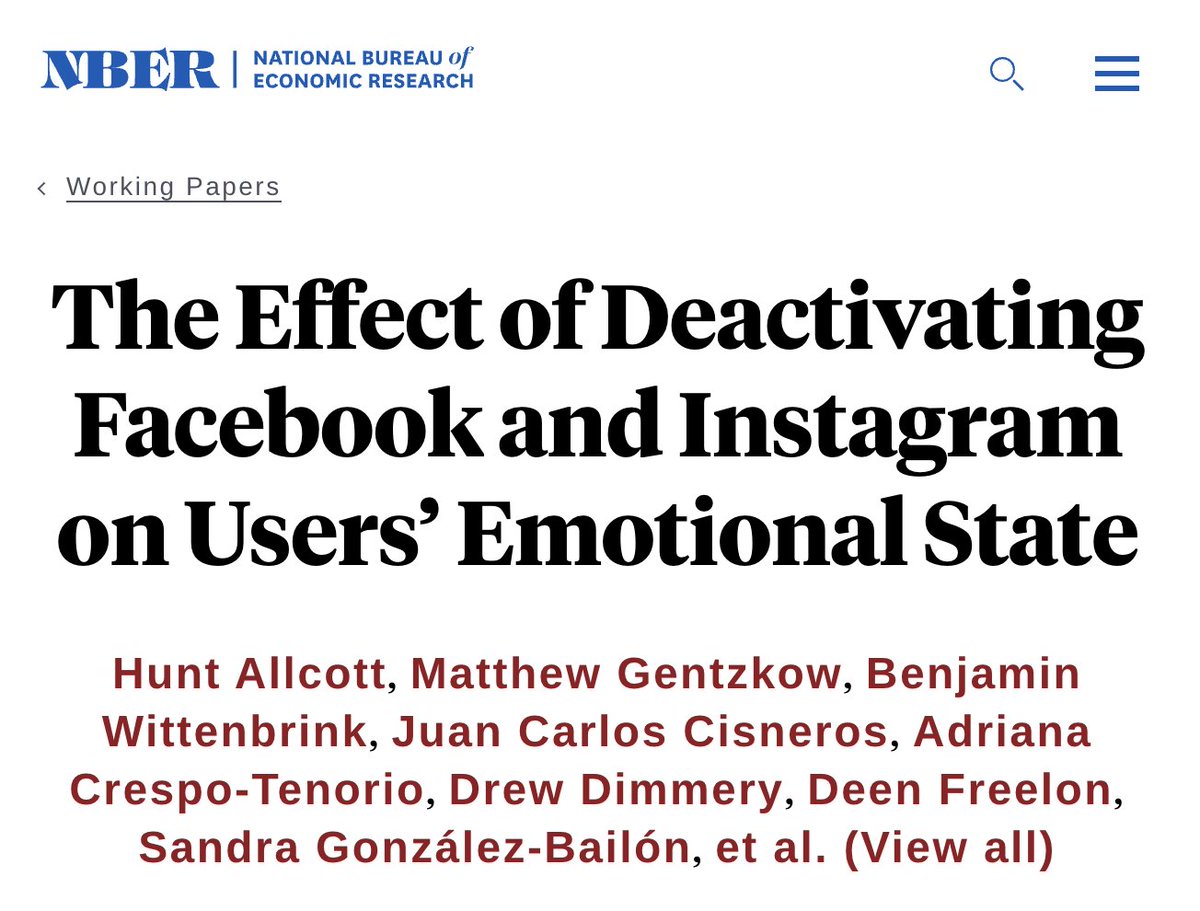
Stanford paid 35,000 people to quit Facebook and Instagram for 6 weeks
Depression dropped. Anxiety dropped. Happiness went up. Women under 25 on Instagram saw the biggest gains
That was 6 weeks. I'm going a full year.
🚨Holy sh*t.
More than 350,000 have gathered in Madrid for pro-Trump anti-Communist Venezuelan opposition leader Machado.
This is what the total annihilation of Communism looks like... 🇪🇸🇻🇪
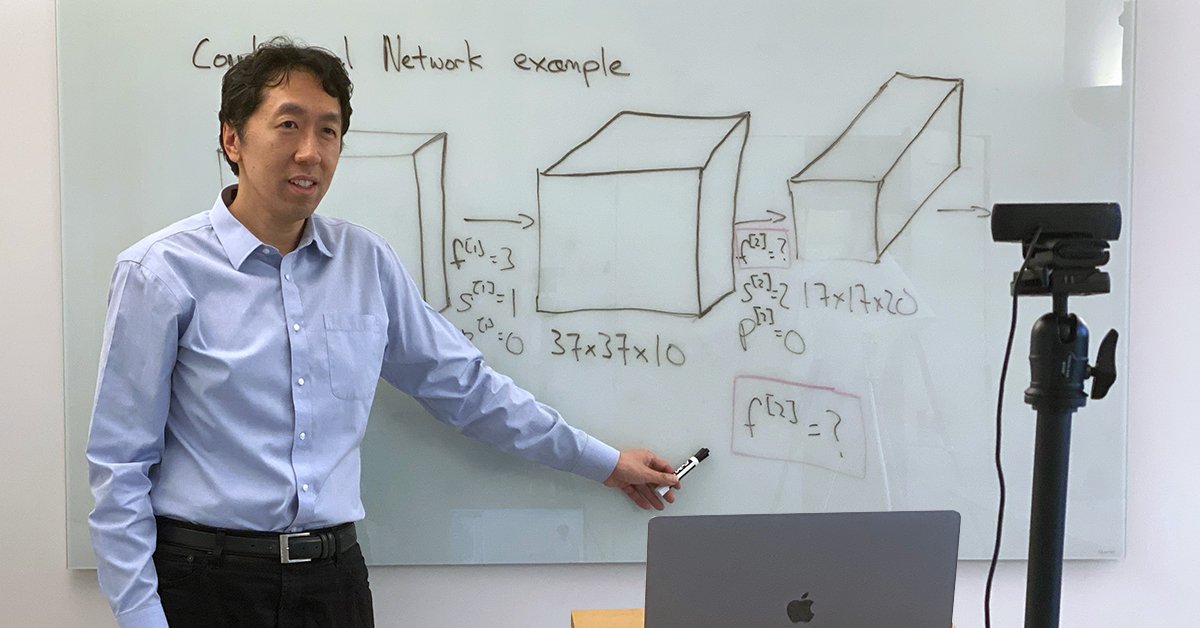
A Stanford CS professor told his class something at the start of the semester that made half the students close their laptops.
He said the skill that will separate the people who thrive in the next decade from the people who stall has almost nothing to do with coding.
His name is Andrew Ng, and he has trained more machine learning engineers than almost anyone alive.
Here is what he said, and why it changes how you should be learning right now.
He said the bottleneck is no longer writing code. It is knowing which problems are worth solving in the first place. For thirty years, being a good engineer meant being able to build what someone else defined. In the world that is arriving, every engineer has infinite leverage to build almost anything, which means the person who picks the right thing to build now wins by orders of magnitude over the person who builds the wrong thing flawlessly.
His framework for problem selection is deceptively simple. He calls it the three-question filter.
The first question is whether the problem you are working on actually matters to someone who would pay for it or use it daily. Most students fail here. They work on projects that are interesting to them and nobody else, and then wonder why the portfolio produces no offers.
The second question is whether the problem is still hard now that AI exists. If a single prompt to a hosted model solves it, the problem is no longer valuable to solve yourself. The interesting problems live in the gap between what AI can do alone and what it can do when combined with domain knowledge, careful system design, and data nobody else has access to.
The third question is the one most people skip. Can you actually ship a working version in a week. Not a polished version. A crappy, embarrassing, actually-functional version. Ng said the number one predictor of which of his students ended up building something important was not talent. It was the willingness to ship something bad fast and then improve it in public.
He said the students who kept tweaking in private for six months before showing anyone almost always produced worse final work than the students who shipped a broken version on week one and iterated based on real feedback.
The people who are actually winning right now are not the ones with the best ideas.
They are the ones who learned to pick problems that matter and ship solutions that barely work, before anyone else has even finished thinking about it.
In the 1920s, a Stanford study quietly revealed something uncomfortable about success.
Most people still ignore it.
Later explained by Malcolm Gladwell, this wasn’t about intelligence it was about why potential gets wasted.
It began with Lewis Terman, who tracked genius-level kids (IQ 140+) for decades, expecting them to become world leaders.
They didn’t.
Some succeeded. Many stayed average. And a surprising number failed completely.
The difference wasn’t talent.
It was background.
Kids from wealthy families had opportunities. Others didn’t. Even genius couldn’t overcome that gap.
Then comes a powerful idea: “capitalization rate” how many capable people actually succeed.
And it’s shockingly low.
You see it in sports too. Many elite athletes are born early in the year. Not because they’re more talented but because they were slightly older, got picked early, and given better opportunities.
We think we’re spotting talent.
We’re often just amplifying advantage.
Same in school. Same in life.
Even in math, the real difference isn’t IQ it’s belief. Some think ability is fixed. Others believe effort creates it.
Over time, that belief wins.
That’s the truth most people miss:
Success isn’t just about talent.
It’s about opportunity, timing, and environment.
And how much potential never gets the chance to grow.