Ingeniero, emprendedor, profesor universitario y rockero. Viendo el mundo desde mi Harley-Davidson. Me apasiona la política. Ex-Cs, ahora sólo ciudadano.
@profsecundario D. Camilo, yo todavía lo conservo porque no soy famoso.
Le deseo lo mejor en esta nueva etapa y no ceje en hacer mejor este nido de víboras
i want to bring to the attention of people outside spain what i think is a pretty sad hijacking of a public institution, one that should serve everyone, to favour the party in government.
the CIS (centro de investigaciones sociológicas, or centre for sociological research) is spain's public polling institute. it goes back to 1963, when its predecessor was founded, and it took its current name in 1977. its president is appointed and removed by the government, but by law it must act with "objectivity and neutrality". this institution is a big provider of public goods: besides its flagship product (the monthly political barometer), it runs dozens of surveys a year on things few private firms would pay to ask about, from taxes and inequality to sexual health or love and relationships, and it makes the microdata freely available. it has resources no private pollster has, and researchers and journalists (me included) use its data all the time.
in june 2018, a few weeks after pedro sánchez became prime minister, his government appointed josé félix tezanos as president of the CIS. tezanos is a sociology professor and has been a member of the socialist party (PSOE), the party that leads the government, since 1973. when he was appointed he sat on the party's national executive (its top leadership body) as head of research and policy programmes, which put him in charge of the party's election manifestos (he left that post about ten days later, after criticism from the opposition). since then, the CIS's vote estimates have leaned systematically towards the socialists.
one can show this with a very simple exercise. for each general election, wikipedia compiles the results of every published opinion poll (for the 2026 election, they are here: https://t.co/e91jvSrjnC). using those tables, for every CIS vote estimate since 1997 i take the PSOE lead over the centre-right people's party (PP) and subtract the average lead in the private polls whose fieldwork ended within 21 days of the CIS's. i leave out polls commissioned by the parties themselves and the re-estimates that other analysts make with the CIS's own raw data. each firm counts once, even if it published several polls in the window (in that case, i take the average of its polls). from 1997 to 2018 the CIS was in line with everyone else: on average, a difference of about zero (+0.1 points). but since tezanos was appointed, the CIS has given the PSOE a lead 8.4 points larger than the average of private pollsters. in 91% of its estimates it gives the PSOE a bigger lead than every single private pollster in its window.
if i showed this chart at an economics seminar, i think most people would find it pretty convincing evidence that something changed at the CIS in 2018. but let's go through some potential objections. suppose private pollsters have drifted to the right since 2018 (it would be odd for them to jump so sharply just after tezanos was appointed, but for the sake of argument let's treat it as a real possibility). in that case, a CIS that stayed put would look more and more pro-PSOE simply because everyone else moved. or the mirror image: everyone, the CIS included, leaned to the right before 2018, and the CIS was the one that fixed it after that.
the data suggest this is not what happened. first, the gap holds no matter who you compare the CIS with. against 40dB alone, el país's pollster (el país being a centre-left newspaper), it is 7 points since march 2019, compared with 9.2 with all firms on the same dates. dropping five firms that mostly work for right-leaning outlets (sociométrica for el español, nc report for la razón, data10 for okdiario, target point for el debate and hamalgama métrica for vozpópuli), it is 7.9. second, if private pollsters had drifted right, then their final polls would miss towards the PP more often after 2018. across the 90 general, regional and european elections since 2008 for which the CIS ran a pre-election survey, that is not what we see. private final polls missed the PSOE-PP lead by 0.1 points in the PP's favour on average before 2018 and by 0.4 points in the PSOE's favour after. in both periods they erred towards the PP about half the time. the CIS's average miss, meanwhile, went from 0.8 before tezanos to 3.5 points in the PSOE's favour after. this also rules out the mirror story. before 2018 there was no right-wing bias to fix, since private polls were mostly on target, and after 2018 it is the CIS that ends up further from the results.
needless to say, the result does not depend on the time window used to pick the private polls the CIS is compared with. with 7, 15 or 30 days, or comparing with the polls of the same calendar month, the gap since 2018 stays between 8.2 and 8.4 points, and the one before 2018 stays at about zero.
so what changed? kiko llaneras (@kikollan) has looked at this in depth. since tezanos arrived, the CIS has overestimated the left in practically every election (general, regional and european). even in the two general elections where "it did well" (april 2019 and 2023), its only merit was that it overestimated the left when everyone else underestimated it (and it still missed, just in the other direction). for instance, in 2023 the PSOE and sumar (another left-wing party) won 152 seats. the polling average gave them 142, and the CIS gave them 171. that fits what i find. a large part of the bias seems to come straight from the sample, which overrepresents PSOE voters.
for example, take the CIS's huge pre-election survey for the 29 november election (45,000 interviews). among respondents who report how they voted in 2023, 41.8% say they voted PSOE, when the PSOE actually got 31.7% of the vote. PP voters, meanwhile, make up 23.6% of the sample, compared with an actual 33.1%. in other words, PSOE voters are overrepresented by 10 percentage points, and PP voters underrepresented by almost as much. until 2018 the CIS corrected this kind of imbalance in its estimate by weighting the data according to what respondents say they voted last time (you can check its own methodological notes here: https://t.co/LmeOdCC4VK). in september 2018, less than three months after tezanos arrived, it stopped doing that (compare the note on the vote estimate in july, https://t.co/vlgHCMdfsq, with the one in september, https://t.co/iWtgtdfSag). i am not a political scientist, and i don't know what tezanos's intentions are, or whether this even helps the PSOE win votes. but missing in the same direction in almost every election for eight years looks like a deliberate choice.
i hope this reaches as many people as possible. the CIS does a lot of valuable work and it should belong to all spaniards, whoever they vote for. running a public institution this way should not be acceptable, and watching its credibility erode is genuinely sad, especially because that gives people a cheap excuse to distrust every other statistical body whose work depends on being seen as independent and reliable.
Pedazo de exclusiva de Ketty Garat en ABC.
Hace dos semanas Adif dijo que este informe "no existe" y que nunca llegó a su presidente. Pues aquí está.
Lo hizo su propia gente de mantenimiento en septiembre de 2025, meses antes de Adamuz, y avisaba de un agujero de 780 millones en el mantenimiento de la alta velocidad.
Hablamos del ministerio del caso Koldo, el de Ábalos, el ministerio de la corrupción del PSOE.
El dinero que se iba en chanchullos no iba a las vías. Y eso ha costado vidas.
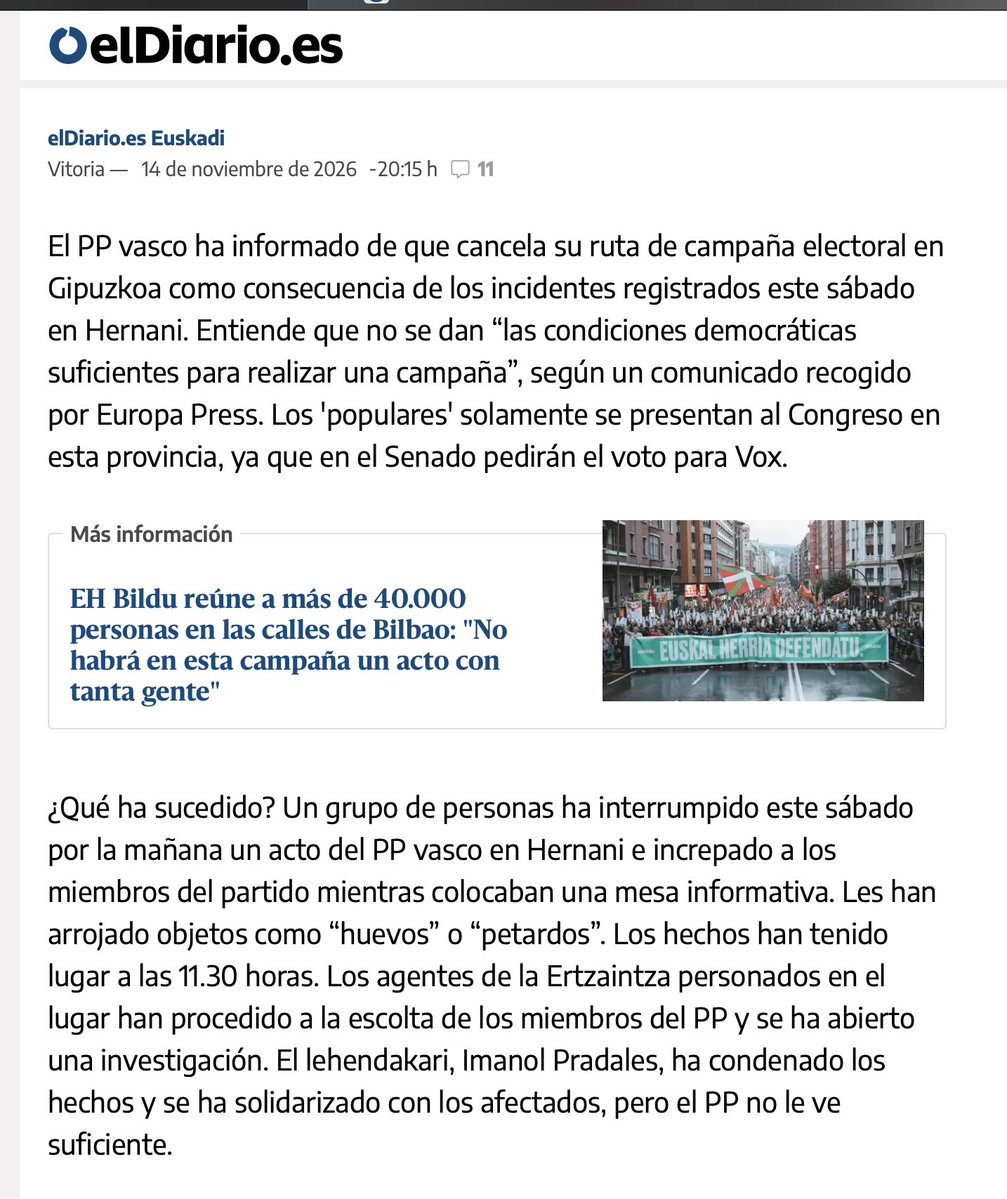
Quiero mostrarles hasta dónde ha llegado una parte de la prensa española en su dejación de funciones y toma de partido. Presten atención. La noticia no es que unos ciudadanos, políticos y militantes, hayan sido agredidos mientras ejercían algo tan democrático como hacer campaña en un lugar de España. La noticia es otra: que el PP suspende sus actos. Y porque quiere, además. No se destaca la gravedad de lo ocurrido. El autor, anónimo, dice: «El PP entiende» que no hay condiciones democráticas. ¡Entiende! Como si fuera una interpretación discutible y no hubiera imágenes y testimonios de lo sucedido. Y, para rematar, las comillas en «huevos» y «petardos». Hasta los objetos arrojados se presentan con distancia, como quien no se lo cree. No hace falta falsear los hechos para desvirtuarlos, basta solo con elegir cuidadosamente las palabras, el orden y el sujeto de la noticia. Y estos son los que nos dan lecciones de ética a los demás.
En abril de 2023 el chófer de Sánchez en las primarias le contó a Aldama por WhatsApp que acababa de estar "unos 35 minutos a solas" con el presidente en Córdoba, y que la reunión se la había pedido Óscar López.
Me han llegado los dos documentos de la UCO que hay detrás de las detenciones del 5 de noviembre en la nueva pieza del caso Koldo.
Uno es el informe 168/2026, que la Guardia Civil entregó al juez el 3 de noviembre y que es el que puso en marcha la operación. El otro es el atestado del 10 de noviembre, con lo que pasó ese día en los registros y en las detenciones.
Entre los dos suman casi 400 páginas, con Cristian Corvillo de protagonista, el militante socialista de Peñarroya-Pueblonuevo que condujo el coche de Pedro Sánchez por Andalucía en las primarias de 2017.
Os lo voy a intentar resumir todo, porque hay mucha tela y casi todo sale de los WhatsApp de Koldo, Ábalos y Aldama.
Corvillo no es nuevo en la causa. Ya salía en informes de 2023 y 2024 por sus negocios con Aldama y por sus encuentros con Koldo y con Ábalos, que lo tenía guardado en el móvil como "Cristian Corbillo Córdoba".
Lo nuevo es lo que le atribuye ahora la UCO: que hizo llegar dinero a la pareja de Ábalos para comprarse un inmueble en 2024, que hizo de intermediario en una entrega de dinero en efectivo de Aldama a Ábalos en diciembre de 2022, que Aldama le pagó la casa en la que vive en Córdoba, que usaba a su hermano y a otras personas para no aparecer en las sociedades, y que en 2018 y 2019 se valió de Koldo para influir en tres adjudicaciones de ADIF y de la Sociedad Estatal de Infraestructuras del Transporte Terrestre (SEITT).
Hay que decir que el propio informe dice que todo se tiene que entender "en términos de presunción". Son indicios, no hechos probados.
Para situarnos y que no se pierda nadie: en junio el Supremo condenó a Ábalos a 24 años y tres meses de cárcel por el caso mascarillas, a Koldo a 19 años y ocho meses y a Aldama a cuatro años y medio, que no tiene que cumplir en prisión por haber colaborado. Ábalos está en la cárcel desde noviembre de 2025.
Lo que se investiga ahora es lo que no entró en aquel juicio, sobre todo la obra pública y dónde fue el dinero.
Lo lleva el juez Ismael Moreno en la Audiencia Nacional, porque la causa volvió del Supremo cuando Ábalos dejó el escaño en enero.
El 4 de noviembre el juez autorizó seis registros, las detenciones y los requerimientos de documentación a ADIF, ADIF Alta Velocidad, la SEITT y cinco empresas.
Al día siguiente la UCO detuvo a seis personas, y a todas las soltó ese mismo día: a Corvillo, por tráfico de influencias, cohecho, blanqueo de capitales y pertenencia a organización criminal. A su hermano Rubén, a Santiago Barrera, a Rafael Bascón y a Jorge Pérez Marqués, por blanqueo y organización criminal. Y finalmente a la conocida Andrea de la Torre, la pareja de Ábalos, por blanqueo.
Se registraron la casa de Corvillo en Córdoba, otra suya en Peñarroya donde no apareció nada de interés, las dos sedes de una constructora llamada DEPLAN-WORKS en Montilla y en Sevilla, y la casa de Ábalos en Valencia, que es donde vive Andrea y donde la detuvieron a las siete de la mañana.
Dato curioso: el piso de Andrea en Madrid no se llegó a registrar, porque estaba alquilado por Airbnb a dos turistas.
En casa de Corvillo los agentes entraron a las 7:30.
Él dijo que no quería declarar, y a las ocho entregó por su cuenta 3.600 euros en 72 billetes de 50 que tenía en un despacho a la entrada.
Después pasaron por toda la casa un perro adiestrado para encontrar papel moneda, y el acta no recoge que encontrara nada más.
Se llevaron siete teléfonos, un disco duro, un iPad, un portátil, varias libretas con anotaciones a mano y dos agendas con el logo de ITEA, una empresa de Rafael Bascón, con anotaciones y documentos mercantiles, bancarios e inmobiliarios.
El registro acabó a las 15:11 y a Corvillo lo soltaron a las 18:25.
Tener 3.600 euros en casa no es delito pero que fueran con un perro de billetes indica que la UCO iba buscando efectivo.
Sigo en el hilo por partes: el piso de la pareja de Ábalos, la casa de Corvillo, los bolígrafos y la reunión con Sánchez, los contratos de ADIF y, al final, mi opinión.
🧵👇
Cuando Broncano dice que tendrían que recortar un poco el programa…. Le propongo que si recortan todos los tartamudeos que hace el programa se queda en la mitad de tiempo
Venga, voy a responder a la Comisaria Intxaurrondo.
A la primera pregunta: sí, deben tener cabida TODOS los partidos legales. Por eso tenemos a Bildu también en los medios públicos y en las instituciones, y eso que ha llevado a gente condenada por terrorismo en sus listas. Ahí no veo tan indignada a Silvia. Además, creo que Vox encaja poco en eso de "extrema" derecha, pero eso es otro debate.
A la segunda pregunta: la televisión pública tiene que ser políticamente neutral con los candidatos, por supuesto. El problema es que no lo es, y de ahí la tensión. Mientras a Sánchez, Rufián y Montero le hicieron un programa de humor en La Revuelta, a Abascal le intentaron hacer una encerrona. Se soluciona muy fácilmente: hay que cerrar RTVE, algo que deseo fervientemente. Y si no, dedicar el ente a emitir programas educativos, dibujos o documentales.
A la tercera pregunta: depende de quién decida qué es un discurso discriminatorio y qué no. A mí por ejemplo, me parece discriminatorio lo que hace este Gobierno de coalición con las familias que han tenido hijos por gestación subrogada, y como no nos vamos a poner de acuerdo, me remito a la solución ofrecida en la respuesta anterior: hay que cerrar RTVE.