after 3 years unemployed, my friend finally got a job offer today.
all he did was politely ask if there was room for a slightly higher salary to match market pay.
they RESCINDED the entire offer.
job market is actually insane right now.
@manicmelora It is. A 4-star review that's all praise is a good review by any normal standard. Hosts feel pressure because anything under 5 can hurt their ranking, but that's a problem to take up with the platform, not with a guest's personal phone number.
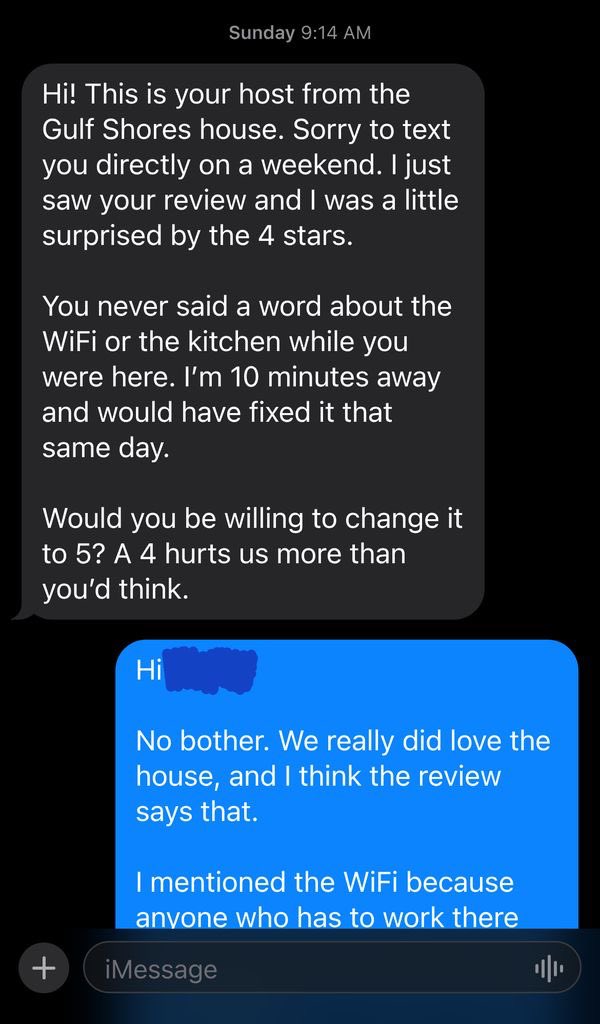
Left an Airbnb in Gulf Shores a 4 star review that was basically all praise, and 3 weeks later the host texted my personal cell asking me to change it to 5. Is 4 stars a bad review now? Has a host ever done this to you?
Left an Airbnb in Gulf Shores a 4 star review that was basically all praise, and 3 weeks later the host texted my personal cell asking me to change it to 5. Is 4 stars a bad review now? Has a host ever done this to you?
And this was my review! I was nice because she left salty replies to anyone who said anything negative. Still got a text on my personal cell asking me to make it 5 stars. Is 4 stars a bad review now?
🔴 Jensen Resigned Nov 12. He was Reinstated Nov 23.
😅 What a ride. What comes next is far from certain.
🤔 Are you bullish, or is the headline risk too much?
Here's the full Jensen Huang timeline in 40 seconds, with $NVDA's price alongside. No gossip, just the record. 🎥
@fOx1257067 Good Tuesday my friend 😀
The premise was basically “make fun of terrible movies so you don’t lose your mind,” and somehow that turned into one of the most rewatchable things on TV. Still works better than a lot of what passes for comedy now.
Good Tuesday 𝕏 📺
38 years ago today, on November 24, 1988, Mystery Science Theater 3000 made its television debut on a little local station in Minneapolis.
Created by comedian Joel Hodgson, the show had a pretty simple premise. A man trapped aboard a satellite with his robot companions was forced to watch bad movies as part of a mad scientist's experiment.
To keep their sanity, they made fun of the movies as they watched them.
Those familiar silhouettes at the bottom of the screen became the show's trademark, and what started as a local television production eventually developed a national cult following.
Sometimes the commentary was more entertaining than the movie itself!
Who remembers watching Mystery Science Theater 3000?
Generosity looks different when you already have more than enough. The people who can give freely without it hurting them tend to be the ones who figured out how to keep money in its place a long time ago.
I’ve seen the opposite too. people who treat giving like a personality trait and then wonder why their own life stays tight. It isn’t that generosity bankrupts people.
It’s that some people never built anything solid enough for generosity to come from a place of strength instead of guilt or performance.
I've never met anyone who went broke because they were too generous.
Giving has a way of keeping money in its place. It reminds you that it's a tool, not the point.
The happiest successful people I know also tend to be the most generous. I don't think that's an accident.
How to win financially:
1. Earn money doing work you're proud of.
2. Spend less of it than you earn.
3. Invest the difference in assets.
4. Let asset income compound.
5. Let new money help buy back time.
6. Stop needing to earn so much money.
Real wealth isn't about having a million dollars in the bank.
It's about waking up every day knowing your TIME belongs to you.
THIS is top tier wealth:
-Waking up without an alarm.
Five asset classes, explained simply.
1. Cash and money market funds. Safe, liquid, low growth. For emergencies.
2. Fixed income. T-bills and bonds. You lend to the government or a company for a set return.
3. Stocks. You own part of a business. The most growth over long periods, and the most volatility.
4. Real estate. Rent plus appreciation, but expensive to enter and slow to sell.
5. Alternatives. Gold, crypto, commodities. They rarely pay you anything while you hold them.
Most people need the first three sorted before they touch the last two.
Schools already struggle to teach basic math and reading. Expecting them to suddenly produce competent investors feels optimistic.
Most people who actually build wealth through the market figure it out on their own or from family, not because a teacher covered compound interest in 11th grade.
The bigger gap is that nobody wants to talk about the discipline and delayed gratification it actually requires.