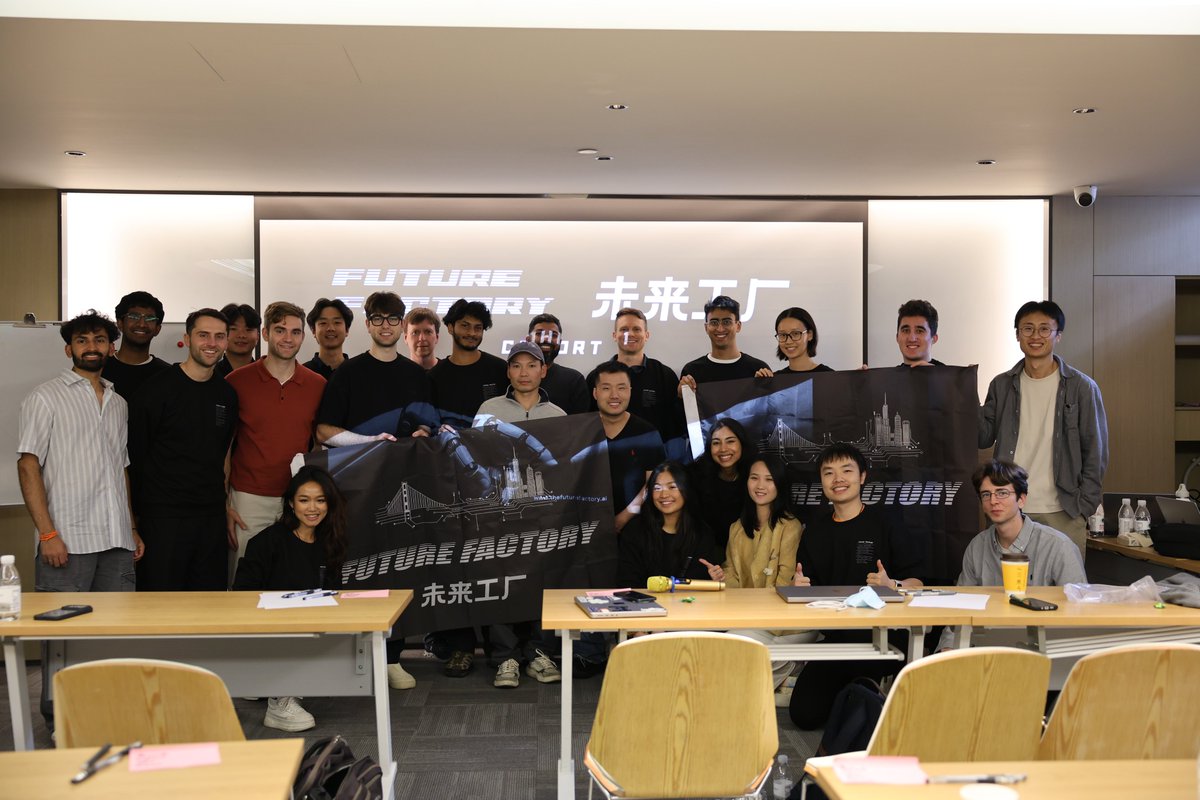
Our hardware founders are officially on the ground in Shenzhen! The Future Factory Cohort 1 has landed and we're all super excited to discover Shenzhen's hardware manufacturing ecosystem!!!
Stay tuned for live updates!
Learn more: https://t.co/uqKXDZgZPy #Hardware
This week alone $2B+ has been invested into robotics, between Sunday, Rhoda, AMI Labs.
With this comes the necessity on the hardware supply chain that converges in Shenzhen
Join the physical AI race by coming with us to visit humanoid companies and CMs in China. Reply below.
As part of our $600B commitment, Mac mini will be produced in the US for the first time later this year!
We're accelerating our progress even further— producing more AI servers and opening an all-new Apple Advanced Manufacturing Center for hands-on training.
@aililiuu Come with Future Factory to Shenzhen and see for yourself what it takes to move from prototype to production.
Cohort 2 (Mar 15-20): Robotics-focused
Cohort 3 (Mar 29-Apr 3): Robotics + Medtech
Limited to 15 founders per cohort. Apply now:
https://t.co/uqKXDZgZPy
There’s a lot of online discussions about the technology development and life in China. But if you actually care to understand and work with the people here you need to come and experience the country yourself.
Thanks for coming to Shenzhen with us @pattssun!
Just came back from China, some early thoughts:
Life observations:
- the great firewall is not that great, so easy to get a vpn or an e-sim that has one
- hongkong is surprisingly really run-down, locals have said it’s way past its prime
- everyone of all ages in china doomscrolls (douyin/xiaohongshu for gen z, wechat for boomers)
- chinese immigration is hella efficient and automated with face recognition (i look chinese and have a 10-year visa tho)
- shenzhen has 18M+ people but the city does not feel dense at all
- china loves heavy packaging (delivery food, consumer goods, etc.)
- life is generally more convenient than in the US (safety, delivery food, transport, etc.)
Tech observations:
- speed is everything in china
- for software, consumer > b2b because chinese companies don’t trust each other for enterprise deals + labor is cheap so b2b software can just be built in-house
- chinese VCs are super risk averse, that’s why the US is still the king of 0-1, while China thrives in the 1-100 (master of scale and second mover advantage)
- fierce national competition, copying each other is a given, most industries seem winner-takes-all
- chinese app UIs maximize optionality, that’s why they feel so dense and chaotic
- big culture of after-lunch naps in the workplace
- big companies have special trade schools right next to their factories to create a direct pipeline of loyal specialized workers
Our hardware founders are officially on the ground in Shenzhen! The Future Factory Cohort 1 has landed and we're all super excited to discover Shenzhen's hardware manufacturing ecosystem!!!
Stay tuned for live updates!
Learn more: https://t.co/uqKXDZgZPy #Hardware