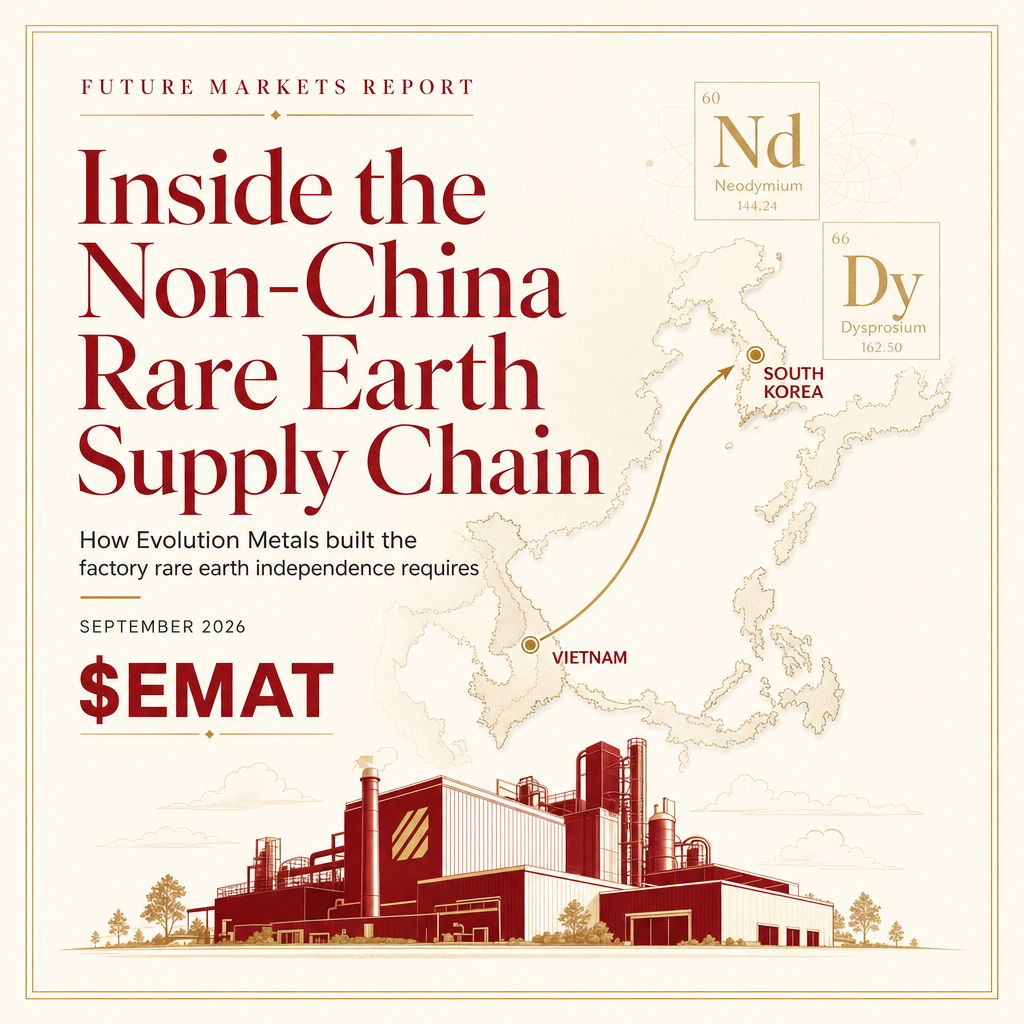
$EMAT has now assembled every element that historically prevented Western rare earth magnet companies from scaling: the machines, the power, the land, the certified supply chain, and the OEM qualification.
📦 13 ULVAC sintered magnet machines on binding PO, November 2026 delivery.
📈 FY2027 revenue guidance: $400M to $460M, up from $5M to $8M in FY2026.
⚡ KEPCO power deal: 130 MW expanding to 750 MW at Pohang, South Korea.
🌐 Non-China NdPr supply: SRE Vietnam via Senri Trading, first shipment July 2026.
🏭 OEM certifications: six sintered magnet grades certified by two global Tier-1 firms.
https://t.co/18v0qa1aJi
Since May 2026, Evolution Metals has executed a coordinated sequence of disclosures that describe something genuinely unusual: a non-Chinese sintered rare earth magnet company that has closed the gap between capable and at scale. The May ULVAC purchase order established the hardware roadmap. June's multi-grade Tier-1 OEM certification established market credibility. July's first NdPr delivery from SRE Vietnam established feedstock independence. August's 750 MW KEPCO agreement established the power infrastructure for sustained high-throughput production. September's $400M-$460M FY2027 revenue guidance translated the physical build into financial language. The Benzinga article surfaces a demand channel that most existing coverage has underweighted: hard disk drives.
The AI hard drive connection is underappreciated. The rare earth magnet conversation in financial media has been dominated by EVs and defense. But Seagate just reported $12.2 billion in fiscal 2026 revenue, up 34%, on cloud data-center demand. Western Digital's commissioned IDC research found 94.7% of organizations storing more data because of AI. Hard disk drives use neodymium-based permanent magnets, and the U.S. Department of Energy identifies hard drives as an established NdFeB application. EMAT already holds quality certifications with Tier-1 electronics OEMs. The article does not establish a direct supply relationship with Seagate, Western Digital, or Microsoft, and neither does the company's disclosure. But the direction of demand is clear and the certification infrastructure is in place.
The competitive positioning argument is made most cleanly by the ULVAC allocation itself. ULVAC, the global standard-setter for sintered magnet production machinery, typically requires 24 months from order to delivery. It compressed that timeline to months for Evolution Metals, which management has characterized as external validation of technical credibility and commercial standing. Combined with 18 years of commercial-scale operating history in Pohang and a pre-DFARS certification record with Tier-1 OEMs, this is not a company assembling credentials for a future pitch. It is converting an existing operating base into a larger one, on a timeline set by a regulatory deadline that removes the market's largest current supplier on January 1, 2027.
The critical uncertainties are real and disclosed. The FY2027 guidance of $400M-$460M is not based on contracted volumes. It requires equipment commissioning, power infrastructure online, feedstock flowing at production rates, customer conversions, and working capital. Execution across all five simultaneously is the ask. The company joined the Russell 3000 and Russell 2000 indexes on September 21, 2026, changing the fund-flow landscape and setting a new baseline for institutional attention as EMAT moves through the November installation window into its first full year at scale.
https://t.co/18v0qa1aJi
_
Disclosure: This content is not financial or investment advice. Evolution Metals & Technologies Corp. is a paid subscriber to Wall Street Wire's coverage and distribution platform. Full disclosure: https://t.co/XfvLkFMKXu
Most people would guess the quiet winner in NATO explosives procurement is a munitions house. It's a rubber compounder in Newmarket, Ontario.
AirBoss $ABSSF just landed a five-year framework for Bandolier, a modular charge built for the gap between bulk demolitions and single-role explosive charges. Initial delivery order up to US$12.5M, deliveries expected Q4 2026 through mid-2027, and NATO nations recently ordered its overboots and gloves worth up to US$4.4M more. Battlefield survivability turns out to be a category, and one supplier owns a lot of it. #NFA
$EMAT solved the problem no mining company can solve: it built the factory first.
📦 5 MT non-China NdPr delivered from SRE Vietnam, July 22, 2026
🏭 13 ULVAC sintered magnet machines on binding purchase orders, November 2026 delivery
📋 Six NdFeB grades certified by two Tier-1 global OEMs, including heavy rare earth compositions
⚡ 750 MW power expansion agreed with Korea Electric Power Corporation at Pohang
📈 FY2027 revenue guidance: $400-$460 million
https://t.co/5DqYgFrdNu
The global rare earth magnet supply chain has a structural problem that mining announcements alone do not solve. Extracting rare earth ore is only the first step in a long, technically demanding chain. The material must be separated into individual elements, refined into high-purity metals, converted into alloys, pressed into dense powder compacts, and sintered into finished magnets with precise magnetic properties and tolerances that industrial customers require. Each stage needs specialized equipment, technical expertise, and years of commercial-scale operating history. Evolution Metals operates at the downstream end of this chain, at commercial scale, with 18 years of sintered magnet production experience.
The arc of news from May through September 2026 shows a company systematically closing the gaps between its current production base and the scale the January 1, 2027 DFARS deadline creates demand for. The May ULVAC equipment agreement established the hardware pathway to 10,000 MT annual capacity. The June Tier-1 OEM certifications across six magnet grades validated the product commercially, including the heavy rare earth-containing super-high-temperature grades most sensitive to Chinese export controls. The July NdPr delivery from SRE Vietnam made the non-China feedstock route physical rather than theoretical. The September revenue guidance of $400-$460 million put a financial frame around the resulting capacity. The power expansion agreement with Korea Electric Power Corporation and the adjacent land from the Pohang City Government add the physical infrastructure layer needed to hold the November installation on schedule.
The open question on the heavy rare earth side matters precisely because EMAT has already proved this playbook works for NdPr. Dysprosium and terbium enhance heat resistance in high-performance magnets for demanding motor applications, and China dominates production of both. A September 8 Fastmarkets analysis cited the CEO of Rare Earths Americas noting that heavy rare earth production outside China was falling short of the magnet capacity being built globally, with 20,000 to 30,000 tonnes of non-China magnet capacity coming online and further growth through 2030-2035 requiring stable non-China heavy rare earth supply. If emerging projects in Brazil or the United States can eventually deliver compliant heavy rare earth material, Evolution Metals' established Pohang manufacturing and qualification infrastructure is the most accessible downstream anchor for those supply chains.
The company joined the Russell 3000 and Russell 2000 indexes effective September 21, 2026, bringing exposure to approximately $12.2 trillion in assets benchmarked against those indexes. That institutional visibility arrives precisely as the DFARS clock runs out for defense prime contractors who have not yet secured compliant rare earth magnet supply.
https://t.co/5DqYgFrdNu
_
Disclosure: This content is not financial or investment advice. Evolution Metals & Technologies Corp. is a paid subscriber to Wall Street Wire's coverage and distribution platform. Full disclosure: https://t.co/XfvLkFMKXu
The Air Force just more than doubled its reconnaissance contract with Ondas $ONDS subsidiary DZYNE to $85.6M, extending testing through 2031.
An 80-hour motor-glider drone lowers flying-hour costs compared to larger combat aircraft, but the multi-year evaluation is not just about endurance. The hurdle is proving whether austere logistics and sensor integration hold up outside permissive airspace.
https://t.co/Ii2Li73v84
$LEU secured a deal to supply domestic HALEU for Radiant's microreactors.
The fuel is unobligated, qualifying it for defense sites where foreign uranium cannot go. Advanced reactors are useless if the enrichment line does not exist.
https://t.co/JcVue7xHKu
$BOIL.TO just pulled off its third consecutive ownership-group approval at a top-30 North American food retailer, adding 41 new supermarket locations in a single wave. The U.S. food retail vertical is no longer a pilot. It is a scaling commercial operation.
🛒 Third wave approved: 41 new high-volume stores, same top-tier U.S. supermarket brand.
📈 Running total: at least 68 locations across three ownership groups since March 2026.
⚡ Fast-food chain system-wide approval landed just 11 days earlier, on September 17.
💰 Q2 2026 record revenue: $1.4 million, up 28% year-over-year.
🏬 Brand ranked top-30 North American food retailer per Progressive Grocer 2026.
https://t.co/b7YFGZ9ybe
What is actually happening in today's announcement is the third proof point in a deliberately sequenced commercial strategy that Beyond Oil began executing in March 2026. The first ownership group validated the model across 13 locations. The second group added 14 more in July with four already live at announcement. Today's third wave brings 41 locations across two ownership groups in a single announcement, the largest single addition in the series. The acceleration is structurally meaningful: this is not a company with a single beta customer. It is a company with a repeating approval mechanism inside a named top-tier brand.
The significance of the supermarket vertical lies in its usage economics. Unlike restaurant equipment upgrades or one-time installations, Beyond Oil's patented filter powder is consumed on every shift. A high-volume prepared-food kitchen in a supermarket runs fryers for multiple shifts daily, which means each committed location becomes a recurring revenue source rather than a capital sale. Management cited the potential to scale across hundreds of supermarkets in multiple states within this single brand's network, and the third wave approval is evidence the operating model is converting systematically rather than episodically.
Place today's release against the broader arc from Beyond Oil's recent history. In May 2026 the company formally announced its revenue execution phase and direct-account commercial model. In August it posted record Q2 revenue of $1.4 million, up 28% year-over-year, even while investing heavily in U.S. commercial infrastructure. On September 17 it secured system-wide approval at a fast-food chain with hundreds of franchise locations. Eleven days later comes this third supermarket wave. The velocity across two channels simultaneously, food retail and quick-service, is building in a way that matches what the May 2026 strategy described as the objective.
The key question ahead is execution pace. The onboarding, training, and initial installation process across 41 locations will determine when commitments convert to active recurring shipments and to Q3 and Q4 revenue contribution. Q2 results showed the model works at small scale. The next meaningful data point is whether the multi-channel, multi-wave commercial build translates into a step-change at the top line when full-year 2026 results are reported.
https://t.co/b7YFGZ9ybe
_
Disclosure: This content is not financial or investment advice and is distributed on behalf of Beyond Oil Ltd., a paid subscriber to Wall Street Wire’s coverage and distribution platform. Full disclosure: https://t.co/XfvLkFMKXu
Delivering cancer drugs into solid liver tumors faces a tough barrier: high tumor pressure blocks standard catheters, causing drugs to leak into healthy tissue.
TriSalus Life Sciences $TLSI just received FDA 510(k) clearance for TriNav Advance.
The device modulates vascular pressure to push therapeutics deeper into small, hard-to-reach vessels while protecting surrounding organs from toxic spillover.
https://t.co/C2htfYKfEo
Mining rare earths is only half the battle. Chemically separating 17 near-identical elements from raw rock is where China controls over 90% of global refining.
Pasqal $PSQL is deploying neutral-atom quantum computing to model molecular bonds at the atomic level, partnering with USA Rare Earth to optimize separation chemistry and boost Western extraction yields up to 10x.
https://t.co/CZy450XYVv
New F-35s are leaving the factory with ballast in the nose, because the radar they were built for is not ready.
Northrop $NOC just got $124M for long-lead parts on 67 of those APG-85s. Work runs to 2031. The program director already told the Senate the first six Marine jets do not count as mission capable.
https://t.co/jIVQ4yJGEX
AI data centers are hitting a hard physical wall: copper cables cannot move data between GPU clusters fast enough without burning massive power.
Tower Semiconductor $TSEM and Japan's government are co-investing $4 billion to turn its Japanese fabs into a silicon photonics hub.
The buildout aims to scale optical wafer output 40x by 2029 to replace copper wiring with light.
https://t.co/m9AodXASDq
Endovascular surgeons spend hours bedside under continuous X-ray radiation wearing 20-pound lead aprons.
Microbot Medical $MBOT is pulling surgeons out of the radiation field with LIBERTY, the first FDA-cleared, single-use robotic system for vascular procedures.
Remote console controls deliver precision catheter steering, with the company expanding to 12 U.S. sales territories by year-end.
https://t.co/LndompvoKr
Long-haul autonomous trucking has spent years stuck in supervised highway testing, struggling to navigate complex surface streets without human backup.
Kodiak AI $KDK is changing that math. The company just announced it will launch unsupervised, driverless freight runs between Dallas and Houston by year-end.
Its trucks are already completing end-to-end runs without human intervention, building on 40,000 hours of commercial driverless hauling.
https://t.co/iKwjWStZ9s
The U.S. Navy is rushing SPY-6 radars onto destroyers and carriers, but full production hit an overlooked bottleneck: wedgelock assemblies that hold and cool array electronics.
Defense tech maker Lyntris $LYNX and Raytheon just completed a two-year qualification to bring manufacturing in-house across California and Nevada.
The milestone creates a scalable domestic source to eliminate long supplier lead times.
https://t.co/cZhEWWuRPX
Alpha-1 Antitrypsin Deficiency leaves 100,000 Americans with lung damage and liver disease, but standard treatments only offer weekly infusions that cannot fix the liver.
Prime Medicine $PRME just received FDA clearance to begin clinical trials for PM647.
Its in vivo prime editor rewrites the genetic error directly inside liver cells without cutting double-strand DNA breaks, treating both organs with a single infusion.
https://t.co/7CArhikXj5
AI data centers need gigawatts of power right now, but waiting for local grid connections can take years.
Energy Vault $NRGV is bypassing that queue by building off-grid microgrids for hyperscalers.
The company just ordered 275 MW of modular, containerized power generation systems paired with battery storage to bring AI campuses online much faster.
https://t.co/EsxmepLxMk
Building long-range cruise missiles has a quiet bottleneck: small turbofan engines are expensive, slow to build, and often rely on a single supplier.
Kratos $KTOS and GE Aerospace just achieved first ignition of their new GEK800 turbofan.
Designed as a second-source engine for the Air Force's JASSM, the 800-pound thrust system is built specifically for affordable mass production.
https://t.co/jhHuWCL5wm
Special operations forces face huge risks clearing tight indoor spaces. XTEND AI Robotics $XTND just won Phase III of the U.S. SOCOM Modular Kinetic Lethal Drone program.
Its XOS software lets operators fly reusable drone swarms through GPS-denied buildings and urban mazes, keeping soldiers out of the danger zone.
https://t.co/LZxO1ixe7Q
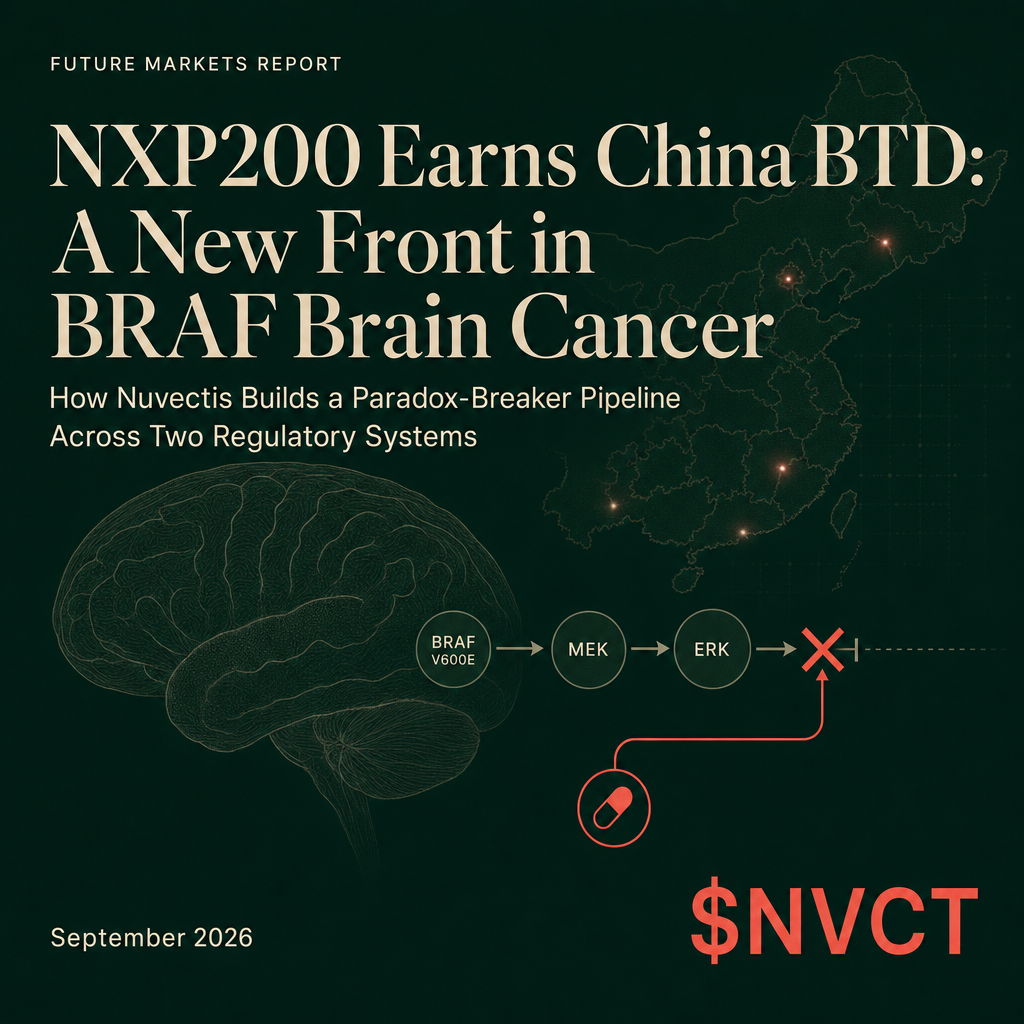
$NVCT's pipeline just delivered its second Chinese regulatory milestone in three months. Today's Breakthrough Therapy Designation from China's CDE for NXP200 in BRAF V600-mutant recurrent high-grade glioma is confirmation that the June 2026 Haisco licensing deal was a structural upgrade of the company, and that the regulatory cadence this partnership is producing is real.
🧠 NXP200 granted China BTD for BRAF V600-mutant recurrent high-grade glioma.
🔬 Paradox-breaker mechanism: active in patients already refractory to prior BRAF drugs.
📅 U.S. IND for NXP200 targeted Q4 2026, ESMO data oral presentation October 23-27.
🤝 Partner Haisco delivered NXP100 China approval and NXP200 BTD in the same quarter.
💰 $115M follow-on closed July 2026, cash runway extended into 1H 2029.
https://t.co/k82SPi9DnU
Today's BTD from China's CDE must be read in sequence. In June 2026, Nuvectis signed a license agreement with Haisco for ex-China rights to two drugs: ciprocopan (NXP100, a Complement Factor B inhibitor) and NXP200 (HSK42360, a BRAF inhibitor). The deal carried up to $40 million in upfront and near-term payments, with up to $1.421 billion in potential milestone payments to Haisco. Within five weeks of signing, NXP100 received its first marketing approval in China for PNH in treatment-naive patients. Now, three months after deal close, NXP200 has received Breakthrough Therapy Designation from the CDE for BRAF V600-mutant high-grade glioma. The Haisco partnership is producing regulatory deliverables at a pace that most licensing deals do not sustain.
The NXP200 designation carries its own weight on scientific grounds. BRAF V600-mutant high-grade glioma is a recurrent brain cancer indication with limited salvage options after initial therapeutic failure. First-generation BRAF inhibitors have a known mechanistic limitation: in certain cellular contexts, inhibiting BRAF can paradoxically amplify the downstream pathway, a counterproductive effect that has constrained their utility in CNS malignancies. NXP200 was designed as a paradox-breaker, engineered to suppress BRAF without triggering that rebound. The CDE's BTD validates that Haisco's Phase 1b data showed sufficient single-agent activity in this hard indication to warrant prioritized review, notably in patients already refractory to prior BRAF inhibitor therapy.
Strategically, this BTD adds a second regulatory recognition in China across a different therapeutic area than NXP100. NXP100 sits in rare complement-mediated disease. NXP200 is in solid tumor oncology. The two assets draw on entirely different therapeutic expertise at Haisco, which means the partnership provides Nuvectis with regulatory leverage across two distinct segments of the biopharmaceutical market. The U.S. IND for NXP200, targeted Q4 2026, is when this China regulatory story becomes a global clinical development narrative. The NXP200 data oral presentation at ESMO in October 2026 will be the context investors need to read that IND filing intelligently.
https://t.co/k82SPi9DnU
_
Disclosure: This content is not financial or investment advice. Nuvectis Pharma, Inc. is a paid subscriber to Wall Street Wire's coverage and distribution platform. Full disclosure: https://t.co/XfvLkFMKXu
Nuclear power has a notorious waste problem: thousands of tons of radioactive spent fuel sitting in cooling pools.
Next-gen reactor developer newcleo $NWCL just began trading on Nasdaq after raising $247M.
Instead of enriched mined uranium, its lead-cooled fast reactors run on fuel made from reprocessed nuclear waste, closing the fuel cycle.
https://t.co/IHEnOp9WTk
Caesium is essential for atomic clocks, GPS satellites, and defense systems, but China controls almost all downstream refining.
PMET Resources $PMETF and Koch Technology Solutions just completed testing on a new extraction flowsheet.
The process bypasses traditional impurity removal stages to produce high-purity caesium chemicals at significantly lower costs.
https://t.co/C5cbok3p5n