What apps are really being built on BSV? @shadilayvision has created a complete directory that shows the strength of our ecosystem in motion.
Is your favourite app listed? Check for yourself, or sign up to add it & join the leaderboard: https://t.co/P7wEST0Wvt
People keep repeating the same tired complaint: “It’s a problem that Calvin is the only funder.”
No. It isn’t. And the fact that this keeps being said shows a complete failure to understand both the situation and responsibility.
First, the premise is wrong. He is not the only funder. He is the major funder. That distinction matters. Others exist—but they are smaller, quieter, and, notably, not the ones complaining.
Second, the idea that he should somehow “relinquish control” betrays a deeper confusion. Control over what, exactly? Funding does not magically grant protocol control. And even if influence follows capital—as it does in every system ever created—the answer is not to demand that the person funding things withdraw.
The answer is competition.
If you believe the funding base is too concentrated, then expand it. Raise capital. Bring in new participants. Build something worth funding. Crowdsource if necessary. Structure it properly. Do the work.
What you do not get to do is sit on the sidelines, contribute nothing, and complain that someone else has contributed too much.
Funding is not assigned. It is earned, attracted, and built.
If you dislike the current distribution, the solution is straightforward: change it. Not by rhetoric, not by complaint, but by action.
Otherwise, what you are offering is not a critique.
It is noise from people unwilling to do the one thing that would actually solve the problem.
The proclamation that “nobody uses gold as money” lands with all the gravitas of a man announcing that nobody uses carrier pigeons anymore—true, but catastrophically irrelevant to the argument he thinks he is making. Gold ceased functioning as money because it became technologically impractical at scale. It could not handle the velocity or volume of modern commerce. Its physical constraints throttled its utility.
Which brings us, with exquisite irony, to BTC.
The same people who mock gold for being unusable as money in a modern economy proudly worship a system that manages a heroic five transactions per second—a throughput so pitiful it would struggle to handle the payment queue at a provincial bakery, let alone a global financial network. To call this “money” is to call a fork a bulldozer.
And then there is Lightning, the talisman clutched by those too numerically illiterate to recognise the trap they are celebrating. Lightning is not a scaling solution; it is a centralising funnel masquerading as innovation. The original 2015 paper laid it out plainly: once widely adopted, payment channels coalesce into large hubs—banking institutions in all but name. They control flows. They intermediate. They extract rent. They become precisely the thing the cypherpunk romantics claimed to rebel against, except now with worse accounting and no consumer protections.
Worse still, Lightning does not eliminate the need for a scalable blockchain—it intensifies it. Channels open and close on-chain. Hubs rebalance on-chain. Capacity adjusts on-chain. If Lightning were actually used by more than a handful of hobbyists and ideological holdouts, BTC’s anaemic block space would collapse instantly. To support global usage, the base layer would require block sizes hundreds of times larger than the delicate, artisanal, hand-crafted kilobyte scraps the cult defends as sacred.
So yes—gold is unusable as money today. But BTC is not “the replacement.” It is gold with worse physics, wrapped in a mythology so dense it bends reason like gravity around a black hole of ignorance.
Gold died because it couldn’t scale.
BTC never lived because it can’t.
Private Keys, Proofs, and the Illusion of Ownership in Digital Cash Systems
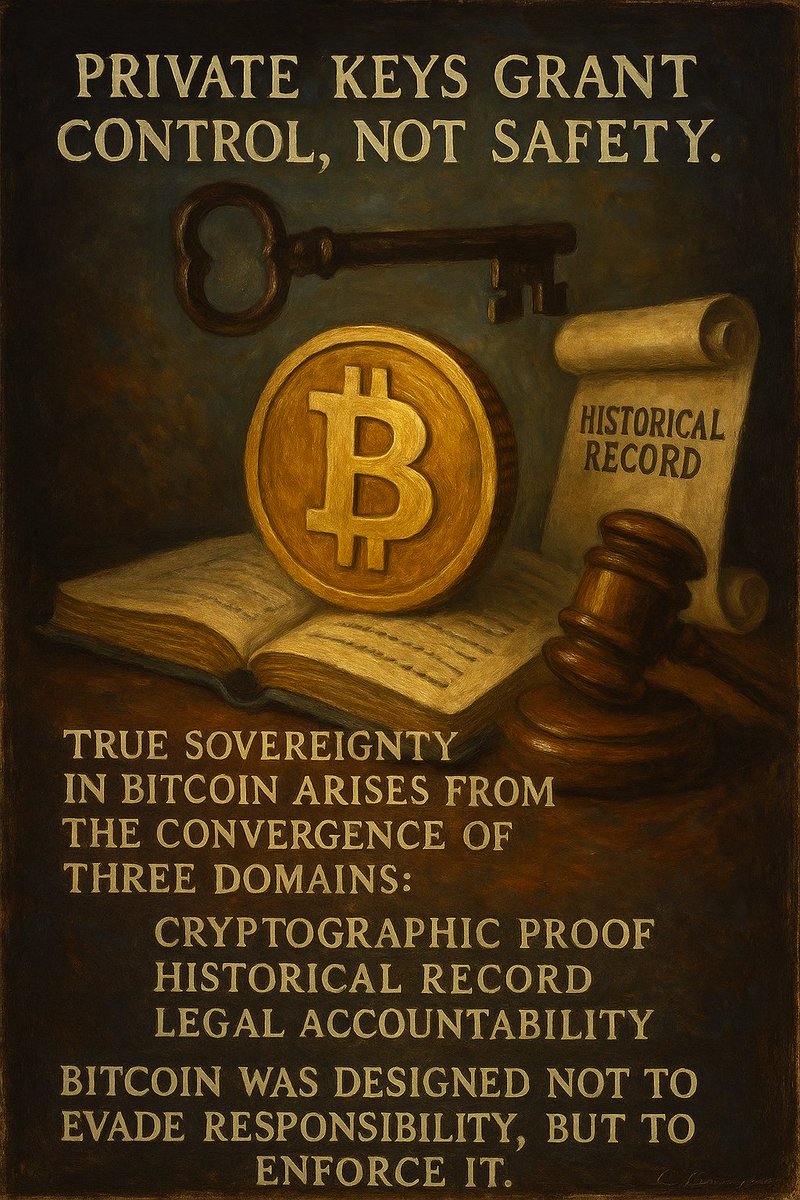
I’ve spent years watching people mistake control for ownership. Holding a private key doesn’t make you sovereign any more than holding a car key makes you the manufacturer. Bitcoin was never about escaping accountability — it was about proving it, mathematically.
https://t.co/RSZ4jVjAHW
Satoshi was clear—crystal clear—about the purpose of Bitcoin when it came to micropayments and the recovery of lost coins.
One of the specific use cases he pointed to was the sale of intellectual property.
That’s right: intellectual property, the very concept that today’s collectivists love to deny has any place in Satoshi’s writings.
Yet it’s right there.
Satoshi’s vision wasn’t some utopian fantasy of free-for-all data sharing and the abolition of ownership. It was about empowering creators, enabling fair transactions, and providing a system where the fruits of intellectual labour could be traded and valued in a decentralised, efficient way.
The argument that Bitcoin somehow excludes intellectual property is not just baseless—it’s a deliberate twisting of Satoshi’s words.
The white paper and subsequent writings envisioned a world where Bitcoin facilitated the sale of digital content, the exchange of ideas, and yes, the protection of property rights. To deny this is to ignore the fundamental utility that Bitcoin was designed to provide: micropayments for digital goods, intellectual property, and beyond.
So here’s the problem for the collectivists: when you claim that intellectual property has no place in Satoshi’s vision, you’re contradicting the very purpose of Bitcoin.
The system wasn’t built to erase ownership or reward theft—it was designed to make ownership stronger, to give creators and innovators a tool to monetise their work without intermediaries. Satoshi recognised that value comes from labour and creation, not from taking or collectivising.
To use Bitcoin while denying this principle is to fundamentally misunderstand what it is and why it was created.
As I’ve said many times, #BSV will start to shine only AFTER the big #Crypto crash, which will also coincide with the stock market crash. Blow off top of ALL assets, then a deep correction. #BSV at $30 is a joke and even if it “crashes” to $10 or whatever, when ##Crypto crashes - who cares. True #BSV value won’t be coming around for a while…
Keep building viable apps on the #BSV platform and garnering clients who actually use the #BitcoinBSV platform. That is what will “eventually” make #BSV wildly successful.
Decentralisation has never been about the mob raising its hands in some parody of democracy. It is not about the endless chatter of “governance,” nor about how many individuals can click a button in a pseudo-vote. To reduce the idea to ballots and polling is to strip it of all substance and reforge it into a toy for those who crave power. The mob has no sovereignty here.
The mob does not build.
The mob does not create.
The mob exists in silence, and its silence is not weakness—it is the very strength of civilisation.
The silent majority does not run nodes. The silent majority does not sit in forums and committees, drafting proposals to change the very bones of a system. They do not waste themselves on slogans and conferences. They work. They live. They simply demand that the system works. And it works precisely when it does not change. Permanence is their shield. Stability is their fortress. The rules that are set in stone protect the individual from the arbitrary whims of rulers, demagogues, and mobs.
This is why #BTC has betrayed the very principle it pretends to embody. Its self-proclaimed “decentralisation” is a farce. What you have is not the silent majority, but a politburo—a small, self-appointed elite, playing the part of revolutionary commissars. They sit in their committees and declare new rules, new edicts, new “improvements.” They dress their power grabs in the language of progress. They are not decentralised. They are the communist controllers of a digital gulag, perpetually revising the law to suit their interests, their envy, their craving for control.
True decentralisation is not a mob’s consensus. It is not a show of hands. It is not mutable at the whim of a committee, however large or small. True decentralisation is permanence. A system that cannot be bent, altered, or redefined to suit the fashions of the age—that is decentralisation. When rules are fixed, no party can manipulate them. When the foundation is stable, no faction can seize it and twist it to punish its enemies or enrich its allies. The fixed law liberates the individual precisely because no one—not even a majority—can use it as a weapon against him.
Here lies the paradox the modern mind refuses to grasp: mutability is control. Change is tyranny. The mob calls for flexibility, but what it truly asks for is power over others. The politburo cloaks its edicts in the rhetoric of decentralisation, but in reality, it centralises everything into its own hands. Only permanence, only the refusal to bend, ensures freedom.
The silent majority does not cry out for endless revisions. They do not hunger for technocratic committees. They do not even care for the petty theatre of “nodes.” They care for stability. They care for a system that simply works, year after year, decade after decade. They are the true decentralised force, because their will is for permanence, not power.
And this is what terrifies the politburo. For within permanence, their ambitions suffocate. They cannot bend stone. They cannot rewrite what is set in place. They cannot weaponise a system that refuses to yield. It is only when mutability is permitted, when “governance” is enthroned, that their hunger for domination can be fed.
The truth is stark. A system that changes is not decentralised. A system with a politburo is not free. A system that yields to committees is not stable. Decentralisation belongs not to those who shout the loudest, nor to those who tinker endlessly, but to those who refuse compromise, who enshrine rules beyond the reach of mobs and rulers alike. It belongs to permanence. It belongs to stability. It belongs to the silent majority whose strength lies not in endless noise, but in the quiet demand that things work—and keep working.
This is why real Bitcoin was set in stone. And this is why the impostors, the pretenders, the self-proclaimed revolutionaries in their digital politburos, will forever betray the very principle they pretend to serve. Because they cannot stop changing, and every change is a new chain clamped on the neck of freedom.
Decentralisation is not noise. It is not power. It is not the mob. Decentralisation is silence. It is permanence. It is the immutable stone that no politburo can ever bend. That is its beauty. That is its terror. That is its truth.
This is why #BitCoin was set in stone.