Runway: open-weight 27B robot action model Praxis-1
Runway released Praxis-1, a 27.2B-parameter world action model for robots, under Apache 2.0, with weights on Hugging Face and fine-tuning code on GitHub. It is built on Runway's video foundation model: a 26.9B MoE backbone (about 2.8B active per token) plus a ~314M-parameter action expert.
Each call predicts the next chunk of video and 1.6 seconds of robot actions (24 steps at 15 Hz). Runway says the DROID-tuned version ranks #1 among world action models and open-source robot foundation models on NVIDIA's RoboLab-120 leaderboard, with checkpoints for single-arm Franka and bimanual YAM rigs.
The bet is that general video, not costly teleoperation data, can carry most of the pretraining load for robot control.
https://t.co/QJ9hNRX15s
Anthropic IPO: banks were capped at four senior bankers and asked to accept six-month rival bans
Reuters reports that Anthropic told some of its 22 IPO underwriters to limit deal teams to four senior bankers. It also asked senior bank officers to sign documents barring core deal-team members from working with rivals including OpenAI, Cursor, DeepSeek and Hugging Face for six months after the listing.
Banks still earned more than half a billion dollars in fees on the record IPO. Like SpaceX, Anthropic negotiated a zero underwriting spread on the greenshoe shares. Deal documents were shared through NetRoadshow with per-banker watermarks to limit leaks.
https://t.co/TawJI2QYTz
AMD / Google: Gemini 4 Neon agent writes AMD kernels that nearly double Inkling 2 Mini decode speed
An AMD engineer used Google's Gemini 4 Neon as a coding agent with AMD's Loom toolkit to tune kernels for Thinking Machines' new open-weight Inkling 2 Mini on a Strix Halo (Radeon 8060S) machine. The agent took the unmodified GGUF to a package that passed correctness checks against llama.cpp in about 4.3 hours and ~490 tool calls.
Versus the best llama.cpp build: decode 44.8 tok/s vs 23.8 (1.88x), prefill up to 5.9x faster at an 18k-token prompt (1,465 vs 249 tok/s), and 1.86x aggregate throughput with 4 streams. Decode hit about 80% of the memory-bandwidth roofline.
llama.cpp's day-one support for the model is still early, so the gap should narrow. Still, it shows AI agents can close part of AMD's software gap on new model architectures within hours.
https://t.co/S686DBZibC
NVIDIA / China chips: FT and NYT trace Alice Huang network that moved Nvidia chips into China
The Financial Times reported Saturday that Alice Huang, the former Megaspeed executive at the center of the Nvidia scandal, was part of a network of gaming investors and shell companies that made billions moving Nvidia chips into China. Megaspeed's Malaysian unit, Speedmatrix, declared about $4.6 billion of imports from Aivres, the former US unit of entity-listed Inspur, in the year to December 2025, according to trade data cited by the FT.
The New York Times, citing an analysis by Strider Technologies, said about $3.6 billion of Chinese state money flowed through companies tied to Huang's family or associates, funding projects including data centers with Nvidia chips. Shanghai-based Century Litong, which the FT describes as a key distributor of smuggled Nvidia chips, is owned by a group that also controls a maker of radar and missile parts.
House committee license files show Nvidia sought permission to sell more than 40,000 H200s to Century Litong's Hong Kong unit. Nvidia says it has stopped shipping H200s to China, never shipped to that firm, blocked Megaspeed in 2025 and restricted sales to Aivres. Megaspeed, Century Litong and Prince Group deny wrongdoing.
https://t.co/5ovABTtzg0
White House: Trump floats ban or "tremendous tax" on US companies building data centers overseas
President Trump said he wants to stop US companies from building data centers in other countries, or charge them a "tremendous tax" if they go ahead, Axios reported. He said he had not yet discussed the idea with his cabinet or advisors. His stated reason is China: "We're not allowing data centers to go into other countries because China will take all of them." Chinese AI labs have been using overseas data centers to reach NVIDIA chips that are banned for export to China.
Trump also told communities to negotiate hard with hyperscalers that want to build locally: "They have plenty of money. Take it." Local pushback is already rising in the US, with data center moratoriums now above 500 nationwide, and New York State recommending towns ask for $1M of community investment per MW. Any new federal tax would need Congress to pass it.
https://t.co/Qif12YZxIQ
Goldman Sachs Weekly Summary: Liquidity Tightens as AI Investing Shifts from Buildout to Payoff
The central question: AI financing and capital spending remain enormous, but markets are asking when that investment will produce durable earnings. Tighter liquidity is amplifying equity volatility.
1. Liquidity is the immediate pressure. The dollar is strengthening and financial conditions are tightening. The author estimates that a rapid 100-basis-point tightening could reduce economic growth over the next year by roughly 50 basis points.
2. AI capex is not AI productivity. Building infrastructure requires vast investment; lasting value depends on deploying the technology profitably. Investors need to distinguish durable demand from spending that pulls future demand forward.
3. The opportunity is broadening. Crowded AI infrastructure trades have unwound. The author sees potential upside from AI adoption and lower energy costs in the UK and Europe, while cautioning that productivity gains still need to prove durable.
4. Earnings expectations remain high—and hedging matters. Goldman Sachs forecasts 18% adjusted S&P 500 EPS growth in 2027. The author believes the liquidity-driven selloff may be in its later stages, though further downside remains possible, and sees renewed value in long bonds as an equity hedge.
AI adoption is rising. Measurable productivity gains are harder to find. 🧵
1/6 HSBC analyzed earnings calls from 2,176 companies across 52 economies. Of those companies, 59% said they were actively implementing AI. Only 33% of the full sample described any AI-related productivity benefit.
2/6 Time savings dominate: 80% of companies describing a benefit mentioned saving time. But completing a task faster does not automatically mean producing more, earning more, or working fewer hours.
3/6 Across the full sample, 19% described an AI-related cost benefit, 16% a production benefit, and 13% a revenue benefit. These categories overlap; they should not be added together.
4/6 The gains may take time to develop. Among companies that had discussed AI productivity benefits since 2025, cost savings became more common in 2026. Clear gains in output and revenue remain less established.
5/6 IT and communications companies described the broadest benefits. UK companies frequently cited time savings, but their apparent lead over mainland Europe faded when HSBC excluded claims based solely on saved time.
6/6 The conclusion: AI investment is already visible in construction and chip demand, but a broad economy-wide productivity boost is harder to see. HSBC considers a major boost as early as 2027 unlikely.
AI’s trillion-dollar buildout: the credit story 🧵
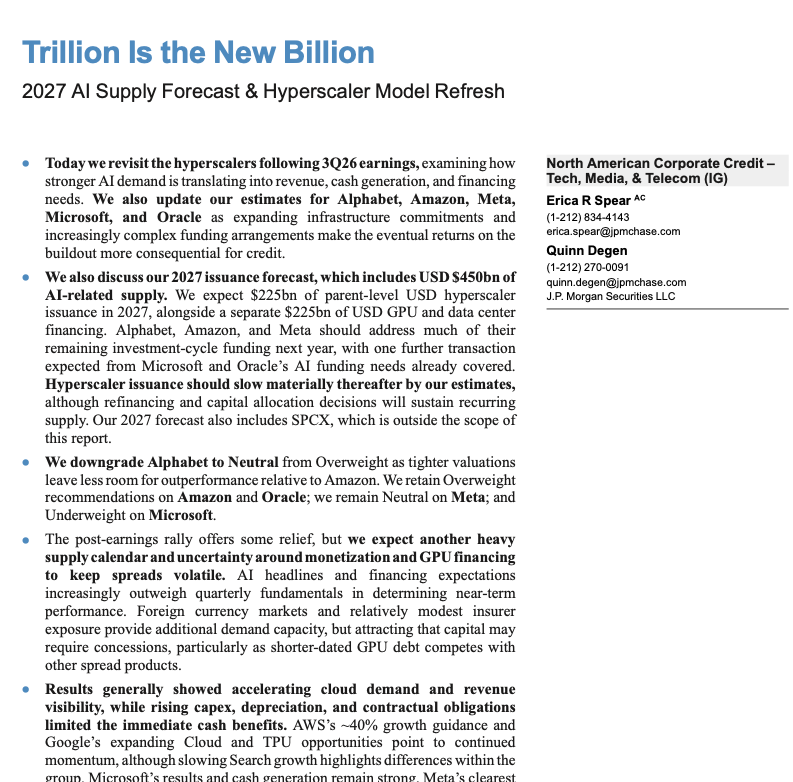
1/7 J.P. Morgan estimates that Alphabet, Amazon, Meta, Microsoft, and Oracle will spend $1.27 trillion on capex in 2027. AI demand is growing. The question is how quickly that investment turns into cash.
2/7 It forecasts $450 billion of AI-related dollar financing in 2027: $225 billion of hyperscaler parent-level issuance and $225 billion of GPU and data center financing. The timing and size of project financing are less certain.
3/7 In the base case, the five companies face a combined $595 billion funding gap across 2027–28. That is a cash shortfall before new financing or use of existing liquidity—not a forecast for debt issuance.
4/7 The pivotal assumption is a spending slowdown: capex growth falls from 58% in 2027 to 14% in 2028. Every additional 10 percentage points of 2028 capex growth would add roughly $127 billion to that year’s funding gap.
5/7 The companies have different cushions. Amazon can draw on retail and advertising earnings. Alphabet’s cloud business is accelerating, while Search monetization remains a question. Meta’s clearest AI returns still come through advertising.
6/7 Microsoft generates positive free cash flow in the base case, though capex and shareholder returns create funding needs. Oracle has largely completed its AI funding plan; its next test is delivering capacity and converting contracted demand into cash.
7/7 The takeaway: strong demand does not guarantee strong near-term cash flow. Watch the pace of capex, AI monetization, lease obligations, and the terms on which GPU projects can raise money.
Oracle: says OpenAI contract is fully funded, reaffirms $30B+ FCF target for FY29
Oracle said it has secured all the funding it needs to deliver its OpenAI infrastructure contract. It said its final capital raise earlier this month made it the first hyperscaler fully funded for this investment cycle, and that the financing outlined at its October Investor Day, including vendor financing, is in place. Further talks with vendors are only extra options, and media reports saying otherwise are wrong, the company said.
On the buildout, Oracle said the Abilene campus is nearly complete. Shackelford, its next gigawatt-scale campus, is fully permitted, and handover of NVIDIA Vera Rubin racks there is on track for the coming weeks. Oracle still expects positive free cash flow in 2H FY28, targets more than $30B of FCF in FY29, and expects to self-fund growth from that year.
https://t.co/VG0ns8XfEs
SK / AWS: Ulsan AI data center gets presidential push, ~900 workers on site
South Korean President Lee Jae Myung toured SK Group's AI data center construction site in Ulsan on Saturday, saying "speed is vital" in the global AI race and that the project should draw more investment from global AI companies. He said the government will look at ways to ease a shortage of construction workers for chip fabs and data centers. About 900 people are working on the Ulsan site.
SK is building the campus jointly with Amazon Web Services. The science ministry estimated the cost at 7 trillion won (about $5.2B) through 2029. Initial capacity is 103MW by 2029, with plans to add nearly 900MW later. Operations are scheduled to start in 2H 2027.
https://t.co/Ht5PLJ43bv
Anthropic: IPO closes at $93.5B after greenshoe, $119.5B including private placement
Anthropic's underwriters fully exercised the greenshoe, buying an extra 147M Class A shares at $83. That adds $12.2B to the $81.3B raised Wednesday, for $93.5B total from 1.127B shares sold, the largest IPO on record, ahead of SpaceX in June.
A concurrent $26B Class N private placement at the IPO price, with AMD, Google, Microsoft, Nvidia and others, brings total gross proceeds to $119.5B before expenses.
The stock is giving back its debut gains in the tech sell-off. ANT opened at $111.50 Thursday and closed at $97.17, then fell to about $87 late Friday, roughly 5% above the IPO price.
https://t.co/AoaV7AgzOr
NVIDIA: stock drops 14%, seventh straight weekly loss, longest streak since 2008
NVIDIA shares fell 14% on Friday and closed lower for a seventh straight week, the longest such run since the 2008 financial crisis. The stock is down 46% over that stretch, about $2.6 trillion of market cap gone. At roughly $3 trillion, NVIDIA now ranks fourth behind Apple, Microsoft and Alphabet.
Selling picked up after Reuters reported the SEC is looking into potential accounting issues at the company, on top of the fallout from Jensen Huang's exit. The stock now trades at about 8.4x forward earnings, vs about 29x for AMD. That's despite a better-than-expected quarter and a higher fiscal 2028 outlook: interim CEO Colette Kress guided to 75% revenue growth next fiscal year.
https://t.co/WJb9fjcTlP
Microsoft: files for a 316.7-acre, five-building data center campus in southern Virginia
Microsoft has applied to the US Army Corps of Engineers (Norfolk District) to build its LVL-16 Datacenter Campus on three parcels totaling 316.7 acres near Boydton, Mecklenburg County, Virginia. The plan includes five single-story data center buildings plus an on-site electrical substation, water storage, industrial wastewater, fiber and stormwater systems.
The filing says the campus is needed to meet growing demand for cloud platform services in the region. Public comments are open until Dec 19, 2026. It follows a 490-acre, three-building Mecklenburg filing earlier this year and three other campus filings in the county in 2022-23. Microsoft also has a 24/7 nuclear power deal with Constellation for its Boydton campus.
https://t.co/CYa1nN4IrA
SpaceX / NVIDIA: $32B of AI chip debt sold, most at yields above 8%
SpaceX sold $32B of debt tied to Nvidia chips in three parts. The largest piece, about $25.2B of Class A3 notes, priced at 8.259%, versus a 5.95% average yield on U.S. investment-grade bonds. Goldman Sachs and Apollo ran the deal, with BlackRock, Goldman Sachs Asset Management and KKR among the cornerstone buyers.
The chips are bought by Saturn Funding Trust, an Apollo-managed SPV, and leased to SpaceX for about five years, which keeps the debt off SpaceX's books. The sale is part of a financing of more than $40B including bank loans, covering about $47.3B of GPU equipment, mostly Nvidia Rubin, with deliveries starting in January.
https://t.co/Xr1b1p9k48
TeraWulf / Anthropic: Vertical construction starts at 480MW Kentucky AI campus
TeraWulf has started vertical construction at its Justified Data Campus in Hawesville, Kentucky. Structural steel is going up for the first building (CB-1), with most CB-1 steel and substantial CB-2 steel already delivered on site.
The 480MW, three-building campus sits on a 790-acre former Century Aluminum site and is purpose-built for Anthropic, which has about $19B of contracted 20-year lease commitments there. Google provides credit support for the project's debt financing, and Fluor is the EPC contractor. Phased ready-for-service dates start in late 2027 and run through Q2 2028.
https://t.co/X5XI0eG2oW
Goldman Sachs is bullish on China’s semiconductor supply chain. Its core thesis: rising domestic AI investment and the localization of chip supply chains are advancing together.
As AI spending grows, demand could spread across the value chain: chip design → foundries → equipment and materials → memory and EDA.
1/6 | Start with semiconductor capex.
Goldman Sachs expects China’s semiconductor capital expenditure to reach $82.2 billion by 2030. Expanding advanced-node capacity is the foundation for growth across the supply chain.
2/6 | Equipment could benefit first.
China’s wafer fabrication equipment market is projected to grow from $39.1 billion in 2025 to $60.7 billion in 2028. Over the same period, local suppliers’ revenue share is expected to rise from 26% to 38%. The report highlights NAURA, AMEC and Anji Micro.
3/6 | The AI chip opportunity is large, but the forecasts vary widely.
Goldman Sachs’ base case puts China’s AI chip market at about $677.6 billion in 2030. Its bear and bull cases are roughly $65.7 billion and $4.12 trillion, respectively. The outcome depends heavily on AI demand, advanced-node capacity and manufacturing yields. The base case should not be treated as guaranteed revenue.
4/6 | Foundries are the supply-side bottleneck.
Local foundries are moving toward 7nm and below, using chiplets and advanced packaging to improve yields. Goldman Sachs favors SMIC and Hua Hong among foundries, and highlights Cambricon, Biren, Iluvatar and MetaX among AI chip designers.
5/6 | The memory demand mix is shifting.
Goldman Sachs expects AI servers and HBM to account for 49% of China’s DRAM demand by 2028, up from 15% in 2025. The report therefore favors CXMT’s capacity expansion and product upgrades, while expecting local EDA suppliers to benefit from growing chip design and manufacturing demand.