Sam Altman said AI budgeting has recently become a "huge issue" for some companies, something that "never came up" earlier this year. https://t.co/P2zODBNmDp
Elon Musk said something that should keep every person on this planet up at night.
Musk: “I think we need to assume that life and consciousness is extremely rare, and it might only be us.”
13.8 billion years of physics. Trillions of galaxies. Billions of trillions of stars.
And one planet opened its eyes.
One.
The universe ran for nearly 10 billion years before anything looked up and asked what it was.
10 billion years of stars forming and dying with no one to witness any of it. No one to name it. No one to wonder why.
Then we showed up.
And for the first time in the history of everything, the universe had a witness.
Musk: “The image in my mind is of a tiny candle in a vast darkness. A tiny candle of consciousness that could easily go out.”
That’s not a metaphor. That’s a status report.
Stars don’t know they burn. Black holes don’t know they consume. Galaxies don’t know they spiral.
We do.
We are the only part of the universe that has ever experienced it.
Every law of physics we’ve uncovered was already running. Silently. For billions of years. With no one to find it.
We didn’t create meaning. We’re the first thing that could recognize it was missing.
That’s what makes Musk’s point so much deeper than most people realize.
He’s not arguing that humanity matters because we’re special.
He’s saying we might be the only reason “mattering” is a concept at all.
Without consciousness, the universe still runs. Stars still burn. Planets still orbit.
But none of it means anything.
Not because it’s meaningless.
Because meaning requires a mind.
And there might only be one.
Musk isn’t building rockets because he likes engineering.
He’s building them because he realized the only thing that ever gave the universe a name has a single point of failure.
One asteroid. One war. One century of wrong decisions.
And the witness goes silent.
The atoms keep moving. The physics keeps running.
But nobody is there to call it anything.
The universe doesn’t end.
It just goes back to not knowing it exists.
The most profound thing about what Musk said isn’t that the candle is small.
It’s that without the candle, there’s no such thing as darkness either.
At age 25, you give your hedge fund manager $100K to manage, and he produces an annual return of 8%.
Assuming a 1.5% management and 20% performance fee, by the time you retire at 65, you will have $764K
But the manager will have $1.24M (at zero initial investment!)
BREAKING: Donald Trump Jr's venture firm 1789 Capital grew from $200M to $3.5B AUM in one year
The firm bought stakes in Databricks, Ramp, Deel, Groq, Anduril, SpaceX, xAI, and Reflection AI
It is targeting $10B and positioning itself as the new Carlyle Group
🚨 Brad Gerstner Says We Need to Investigate Who is Funding Datacenter Activists
“These are highly organized activists moving across the country to stir up trouble in the exact same way they did to stop all fission reactors being built 30 years ago in America. Now we have no nuclear reactors being built, and China's got 100 of them.”
I just want to personally thank Mayor Zohran Mamdani for scaring away the billionaire class from NYC and helping bring billions in tax revenue to my district of Brickell Miami, where Ken Griffin’s Citadel is building its massive Class A office tower next to my office and bringing thousands of high earning professionals to the area.
The economic shift into Downtown Miami is truly transformative. Billions in new investments, new jobs, new infrastructure, and a growing tax base can help fund schools, transportation, and the modernization of Miami as it evolves into the new Wall Street of America. Keep the expats coming! @ZohranKMamdani #kengriffen #citadel #miami
Secretary Rubio on the hope for America. 🇺🇸
"It is a unique and exceptional country. And as we come upon this 250 year anniversary, I think we have a lot to learn and be proud of in our history." MUST WATCH ⬇️
🚨 JUST IN: Elon Musk just reposted this video to his 240 Million Followers of Marco Rubio dropping the 🎤
"We want it to continue to be the place where anyone from anywhere can achieve anything”
I LOVE THIS ❤️
"I haven't seen a real new idea in trading in at least 15 years."
Tom Costello (@tcoste110) ran money at Tudor, Moore Capital, and Caxton. Built one of the first NLP-driven equity systems in 2003.
20 years managing capital, never had a down year.
"Comparing what a retail trader does to what a quantitative hedge fund does is like comparing driving a bus on the New Jersey Turnpike to winning a Formula One race."
We cover:
- His hot take: no genuinely new trading idea in 15 years — only better people doing the same things faster
- Why everyone in quant finance is a genius — and why that makes you ordinary, not special
- Crypto is "super smart guys cosplaying at finance" — built for retail, which is exactly why it's the easiest money in finance right now
- Why AGI won't beat the hedge fund industry — all the readily-capturable alpha is already captured
- The status trap: why the path that made Paul Tudor Jones a billionaire won't work for the kid trying to copy it in 2026
- His friend the investment banker who'd quit it all to run a 10-employee ambulance supply company worth $150M
- Why excitement is "wildly overbid" in finance — and why wanting an exciting trading job is itself a disqualifier
- The most honest end of the financial industry — and why the media has it exactly backwards
Thanks so much to Tom for coming on Odds on Open!
Highlights:
00:00 Intro
01:18 Building institutional credibility for early-stage managers
03:01 The Pareto distribution of hedge fund returns
04:25 Applying the Unified Field Theory of Finance to fair value
08:14 Trading against human incentives in a deterministic market
13:54 Why allocators don’t steal alpha from prospective PMs
25:16 Evaluating career edge in quantitative finance for 2026
30:48 Paul Tudor Jones and the art of game selection
33:42 Analyzing the economic viability of starting a new fund
35:16 Identifying common retail pitfalls: Mean reversion and arbitrage
38:55 Why there hasn't been a new trading idea in 15 years
50:33 Managing tail risk: Physics vs. deterministic financial distributions
59:10 Career pathing for PMs after a fund blow-up
1:07:53 SBF and FTX: Credibility vs. the "Founder-Genius" archetype
1:13:44 Establishing proof-of-concept through audited multi-year returns
Microsoft just turned an $11 billion startup into a Word feature.
Harvey raised $200M at an $11B valuation in March on the bet that legal AI is its own surface. The numbers held that up. $190M ARR per TechCrunch's December reporting. 100,000 lawyers across 1,300 organizations including the majority of the AmLaw 100. Around $1,200 per lawyer per month per Sacra. Big firms paid because Harvey was the only tool in the category that worked.
Brad just stapled a legal agent directly inside Microsoft Word, shipping in the $30 per seat Copilot subscription every law firm already pays for. Same surface every lawyer drafts in. Same .docx that gets sent and redlined. No second login, no procurement cycle, no migration. The price gap is roughly 40x.
The interesting tell: Microsoft built the agent with legal engineers, many of them from Robin AI, a legal AI startup that recently went under, per Artificial Lawyer's reporting. The talent that knew how to make legal AI work for lawyers landed at Microsoft after their startup couldn't survive standalone. That's the legal AI category in one sentence.
Distribution was always the constraint here. Lawyers don't switch tools. Word is where contracts get drafted, redlined, and tracked. Whichever AI lives inside that .docx wins the default workflow, and Microsoft just walked through the door uncontested.
Harvey's surviving moat is the AmLaw 100 partner workflow. Domain training, agentic litigation prep, deep integrations with iManage and NetDocuments. Real moat for $1,500-an-hour partners running M&A and complex litigation. It does not extend to the millions of lawyers globally drafting NDAs, redlining vendor contracts, and updating templates. That layer is exactly what Word Legal Agent goes after, and Microsoft can ship it as a feature inside a $360-a-year subscription.
The $11B valuation pays out only if legal AI work stays its own surface. Microsoft just absorbed the surface.
@BillAckman@BillAckman , which banks lead your IPO , this is such a dramatic failure on their behalf with respect to carefully allocating investors demand it’s almost unbelievable.
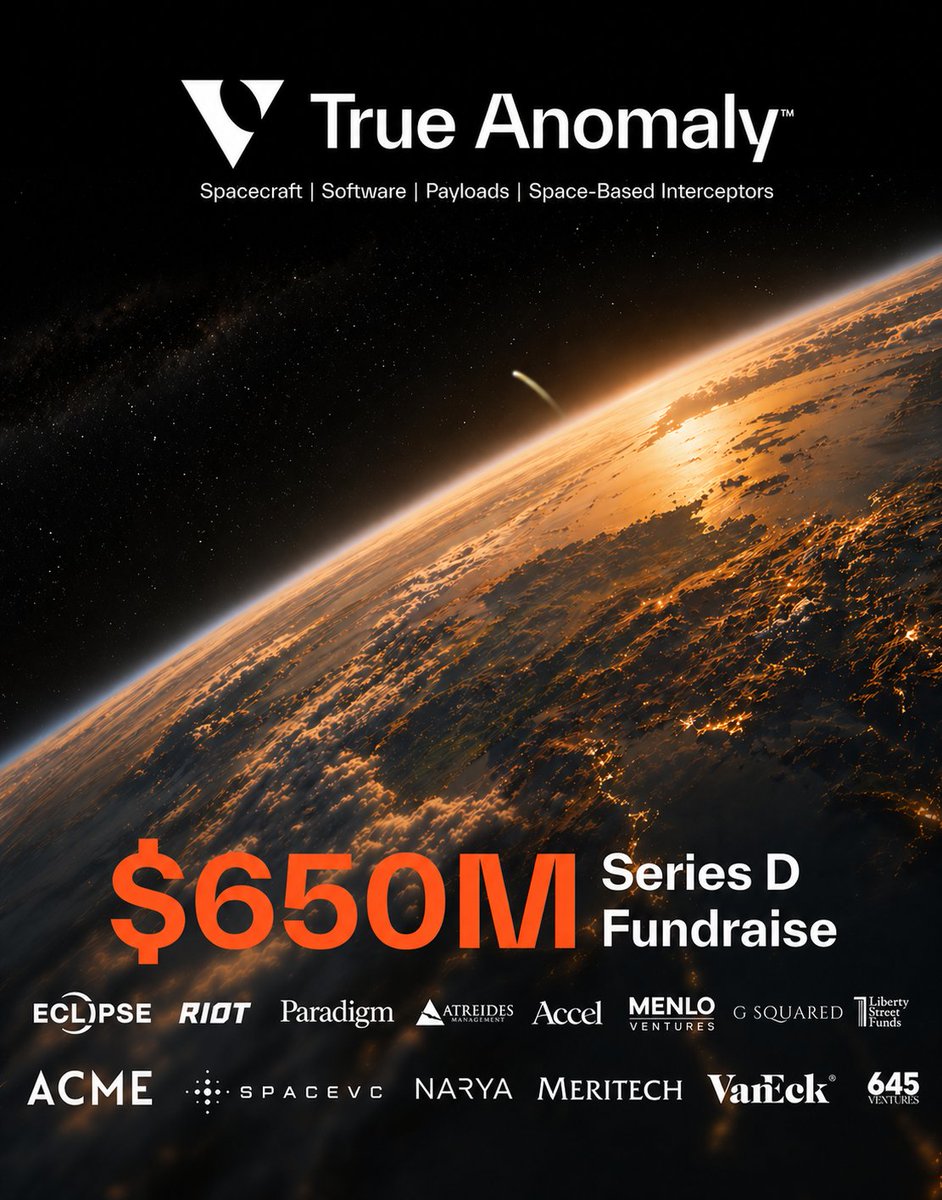
It's been an incredible week for True Anomaly.
$650M Series D fundraise.
Bloomberg @technology, @FoxBusiness, @tbpn
We’re building spacecraft, software, payloads, and space-based interceptors. We're just getting started.
🚨ANTHROPIC'S FOUNDER JUST PREDICTED THAT AI WILL DOUBLE HUMAN LIFESPAN TO 150 YEARS.. CURE MOST CANCER.. AND ELIMINATE POVERTY.. ALL WITHIN 10 YEARS.. AND HE'S NOT EVEN THE OPTIMISTIC ONE..
Everyone thinks Dario Amodei is the guy who wants to slow AI down.. The cautious one.. The safety guy..
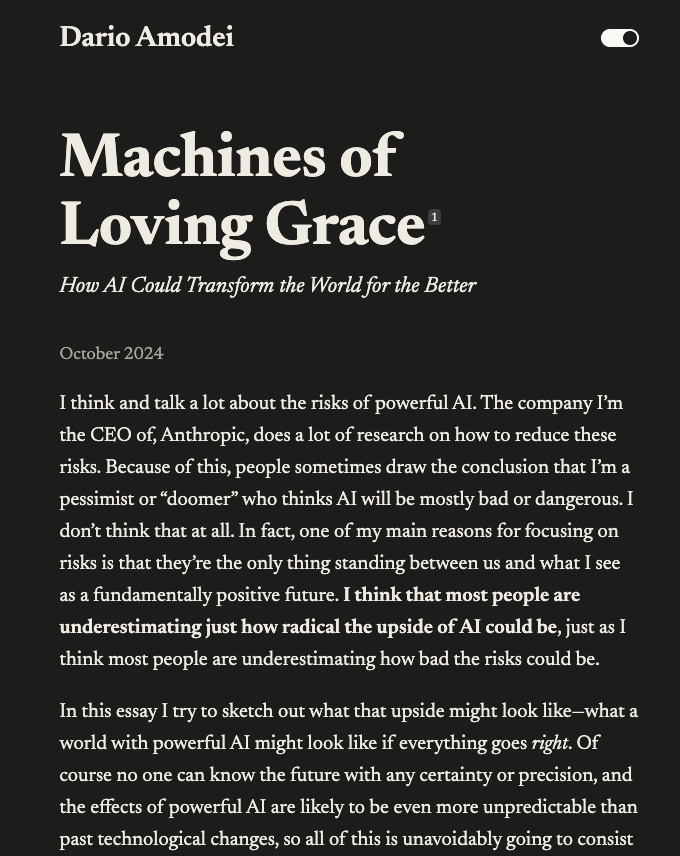
He just published an essay predicting what happens if AI goes right.. And it reads like science fiction.. Except he's dead serious.. And he has the credentials to back every word..
Here's what he thinks happens in the next 5 to 10 years..
Nearly all infectious disease.. Prevented or cured.. mRNA vaccines already showed us the path.. AI finishes the job..
Most cancer.. Eliminated.. Not just treated.. 95% or greater reduction in both deaths and new cases.. AI designs treatment regimens tailored to the individual genome of each tumor.. Something that's technically possible today but takes enormous human expertise to do.. AI scales it to everyone..
Alzheimer's.. Solved.. He thinks it's exactly the type of problem AI can crack.. Because it requires better measurement tools to isolate what's actually happening in the brain.. Once we understand it.. Prevention will probably be surprisingly simple..
Genetic disease.. Most of it preventable through improved embryo screening.. And curable in living people through safer descendants of CRISPR..
Most mental illness.. Cured.. Depression.. PTSD.. Addiction.. Schizophrenia.. He believes the answer is some combination of biochemistry and neural network-level problems that AI can untangle..
And here's the line that stopped me..
Human lifespan.. Doubled.. To 150 years..
He points out that life expectancy already doubled in the 20th century.. From 40 to 75.. So doubling it again is "on trend".. Drugs already exist that increase maximum lifespan in rats by 25 to 50%.. Some turtles already live 200 years.. We're clearly not at a biological ceiling..
He calls this the "compressed 21st century".. The idea that AI gives us 100 years of biological progress in 5 to 10 years..
But he doesn't stop at health..
He thinks AI could drive 20% annual GDP growth in the developing world.. Bringing sub-Saharan Africa to China's current GDP per capita within a decade..
He thinks AI could eradicate malaria not through treating millions of people individually.. But by releasing modified mosquitoes that block the disease at the source.. One centralized action instead of a million..
He thinks AI could make democracy structurally stronger.. Not through propaganda.. But by giving every citizen an AI that knows every law they're entitled to.. Every benefit they qualify for.. Every right they have.. And helps them actually access it..
He imagines AI that monitors judicial systems for bias.. AI that helps find common ground between opposing political views.. AI that makes government services actually work the way they're supposed to..
And he addresses the question everyone asks.. What happens to meaning when AI can do everything..
His answer.. Most people aren't the best in the world at anything right now.. And it doesn't bother them.. Meaning comes from relationships and connection.. Not economic productivity.. People will still pursue difficult challenges.. Still compete.. Still create.. The fact that an AI could theoretically do it better won't matter any more than it matters that someone somewhere is already better than you at every hobby you have..
But here's what makes this essay different from every other AI optimism piece..
Dario Amodei runs one of the three most powerful AI companies on earth.. He has a PhD in computational neuroscience.. He personally worked on mass spectrometry and neural probes.. He's not a pundit.. He's a scientist who happens to be a CEO..
And the same man who publicly says there's a 25% chance AI causes human extinction.. Is also saying that if we get it right.. We cure nearly every disease.. Double human lifespan.. Eliminate most poverty.. And fundamentally transform what it means to be alive..
Both things are true at the same time..
That's what makes this the most important essay anyone in AI has written this year..
He ends with this.. "I think many will be literally moved to tears by it"..
He's talking about watching disease disappear.. Poverty dissolve.. Human potential unlock all at once..
Not in a century.. In a decade..
If we get it right.
Today, True Anomaly announced its $650 million Series D fundraise.
All of it invested in one mission: space superiority.
We are building autonomous spacecraft, advanced payloads, mission software, and now, space-based interceptors. All designed from the ground up for contested space, at the speed and scale the moment demands.
Thank you to our investors, customers, partners, and employees.
Read more on our blog: https://t.co/kMngsOsP36
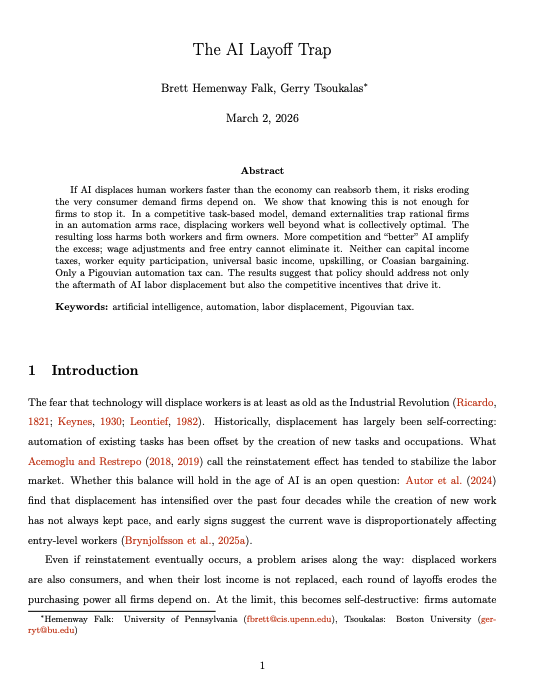
🚨BREAKING: Two researchers from UPenn and Boston University just published a paper that should be uncomfortable reading for every CEO automating their workforce right now.
The argument is straightforward. Every company replacing workers with AI is also eliminating its own future customers. Laid off workers stop spending. Enough of them stop spending and nobody can afford to buy anything. The companies that fired everyone end up selling into an economy with no purchasing power left.
Every executive can see this. The math is not complicated. But here is why nobody stops.
If you do not automate, your competitor does. They cut costs, lower prices, take your market share, and you collapse anyway. So every company automates knowing it is collectively destructive because the alternative is dying alone while everyone else survives. The researchers proved this is a Prisoner's Dilemma playing out in real time.
The numbers are already moving. Block cut nearly half its 10,000 employees this year. Jack Dorsey said AI made those roles unnecessary and that within the next year the majority of companies will reach the same conclusion. Salesforce replaced 4,000 customer support agents with AI. Goldman Sachs deployed a coding tool that lets one engineer do the work of five. Over 100,000 tech workers were laid off in 2025 and AI was cited as the primary driver in more than half those cases. 80% of US workers hold jobs with tasks susceptible to AI automation.
The researchers tested every proposed solution. Universal basic income does not change a single company's incentive to automate. Capital income taxes adjust profit levels but not the per-task decision to replace a human. Collective bargaining cannot hold because automating is always the dominant strategy.
They also identified what they call a Red Queen effect. Better AI does not solve the problem, it accelerates it. Every company chases faster automation to gain market share over rivals but at the end everyone has automated equally, the gains cancel out, and the only thing left is more destroyed demand.
The one thing the math says could work is a Pigouvian automation tax. A per-task charge that forces companies to account for the demand they destroy each time they replace a worker.
The conclusion is that this is not a transfer of wealth from workers to owners. Both sides lose. Workers lose income. Companies lose customers. It is a deadweight loss with no market mechanism to stop it on its own.
(Link in the comment)
🚨 Anthropic's own team just showed how to actually use Claude Code properly.
30 minutes. free. the person who created Claude Code.
watch the workshop. bookmark it.
worth more than every $500 course you almost bought.
you've been using Claude without knowing 40 of its commands.
Then read the guide below.
Jensen Huang just told Silicon Valley it’s fighting on the wrong floor.
Every boardroom in tech is locked on the same question. Which model wins. OpenAI or xAI. GPT or Claude. Grok or Gemini.
Trillions moving on that bet alone.
Huang zoomed out and showed them the whole building.
Huang: “AI is actually essentially a five-layer cake.”
Energy at the bottom. Chips above it. Cloud above that. Models next. Applications on top.
Five layers. One war. Everyone crowded onto the fourth floor.
Huang: “This is where most people think AI is.”
He was pointing at the model layer. Every pitch deck. Every valuation. Every founder story. All packed onto one floor.
One floor below the finish line. Three above the foundation. The middle of the building.
Huang: “At the bottom is energy.”
Not data. Not parameters. Not talent.
Power.
You cannot out-code the grid. You cannot train a frontier model with a press release. The smartest model on Earth still needs a dumb turbine spinning somewhere.
The smartest engineers alive are building on top of someone else’s silicon, inside someone else’s cloud, powered by someone else’s electricity.
They own nothing beneath them.
Huang: “This layer on top ultimately is where economic benefit will happen.”
Healthcare. Finance. Manufacturing. The only floors where AI actually meets money.
Every dollar of real value lives at the top. Every physical constraint that decides who gets to play lives at the bottom.
The model sits in between. Squeezed from above and below and owning neither end.
Silicon Valley is burning hundreds of billions to build plumbing for somebody else’s economy.
The basement decides if it runs. The penthouse decides if it pays.
The companies building models think they are building the future.
Huang just told them they are the middle layer in someone else’s cake.
Elon Musk thinks the entire education system is built on a broken assumption.
That every student should learn the same thing. At the same speed. In the same order. At the same time.
Musk: “Everyone goes through from like 5th grade to 6th grade to 7th grade like it’s an assembly line. But people are not objects on an assembly line.”
The model was designed for a factory economy. Standardized inputs. Predictable outputs.
That economy is gone. The assembly line is gone.
But the education system still runs on its logic.
A student who masters algebra in two weeks sits through eight more weeks because the calendar says so. A student who struggles gets dragged forward because the schedule doesn’t wait.
Neither is being served. Both are being processed.
Musk: “Allow people to progress at the fastest pace that they can or are interested in, in each subject.”
AI doesn’t teach a classroom. It teaches a student.
One at a time. Every time.
It skips what a student already knows. It finds where they’re stuck and approaches it from a different angle.
It adjusts in real time. Not at the end of a semester when the damage is already done.
A student obsessed with basketball learns fractions through shooting percentages. A student who builds in Minecraft learns geometry through architecture.
The subject doesn’t change. The entry point does.
No teacher with thirty students can do this. Not because they lack skill.
Because the math doesn’t work.
AI doesn’t have that constraint.
Musk: “You do not need to tell your kid to play video games. They will play video games on autopilot all day. So if you can make it interactive and engaging, then you can make education far more compelling.”
The brain isn’t broken. The format is.
Kids learn complex systems and strategic thinking for hours voluntarily. Then walk into a classroom and can’t focus for twenty minutes.
That’s not a discipline problem. That’s a design problem.
Musk: “A university education is often unnecessary. You probably learn the vast majority of what you’re going to learn there in the first two years. And most of it is from your classmates.”
Four years. Six figures of debt.
And the real value comes from the people sitting next to you. Not the institution charging you.
The degree doesn’t certify knowledge. It certifies endurance.
Musk: “If the goal is to start a company, I would say no point in finishing college.”
The system was built to train employees. If you’re not trying to be one, it has nothing left to offer you.
Every lecture. Every textbook. Every curriculum. Now available instantly. Personalized to any learner. Adapted to any pace.
The question isn’t whether the old model survives.
It’s how long we keep forcing students through it while the replacement already exists.