@cwhite437 It's hard to organise so many posts in blog form, so the new website should be able to help, plus it lets us do new things like hosting interactive timelines. Check it out at: https://t.co/i1iX4CLHRp
For years, people have enjoyed the 800+ articles, hagiographies and more available only on the Global Church History Project Patreon ( https://t.co/W0ziiLknG7 ), where we learn more about the history of the Church all around the globe, beginning with the Apostles who reached every corner of the Earth.
More and more, people have also constantly requested mirroring the GCHP on their preferred platform: Substack, now at: https://t.co/pEgmIPqEZj
For others, the backlog is so overwhelming that they struggle to get into it, and they do not know where to start (some of these posts have over 10,000 words, and much of the content is also available in book form), but would love to read through the whole library as if it is coming out for the first time.
If any of that applies to you, subscribe to this Substack to read through the GCHP archive in this new format and to read the new articles as they come out.
If the idea of a large archive has felt overwhelming, or if you simply prefer reading in your inbox, subscribe here, but if you want the merch and more that Patreon exclusively offers, try the Patreon if you have not done so already.
New articles will appear here as soon as they’re published while older pieces will be added gradually to prevent the sudden dump of hundreds of articles that people are trying to avoid.
Remember this is a mirror of the Patreon, you can subscribe to both but it will not give any extra articles, so it’s best to pick your favourite format and stick with it.
You do not need to subscribe to both.
Check out the new GCHP website: https://t.co/iz5GWeoJaF
The Global Church History Project is where we learn about the history of the Church all around the globe, beginning with the Apostles who reached every corner of the Earth. We love the great Western saints here, such as St. Bernard of Clairvaux, the Cistercians and the Crusaders, but we also look at the wonderful legacy of the Church of the East, African Christianity, the Byzantines, Slavs and a whole lot more.
Christianity has never been just Western Religion, it has always included the entire world in its scope following Jesus' command shortly before He ascended: "'Go ye therefore, and teach all nations, baptising them in the name of the Father, and of the Son, and of the Holy Ghost: Teaching them to observe all things whatsoever I have commanded you." Matthew 28: 18-20 We have covered the British, Syriac, Ethiopian, Persian, Georgian, Indian, Chinese, Japanese, Korean, Vietnamese churches and more.
Beside the lives of specific saints, or records of key events, the GCHP offers many articles to give you a better look into the biblical world and the world these saints lived in. To make navigating this easier, check the timeline to see when everything happened.
While Patreon and Substack subscribers already have access to many of these posts on those respective sites, there are some that could not be hosted there, such as the Timeline and Seventy-Two Apostles projects. All posts that can be hosted on those mirrors will still be hosted there, but for those who find their blog format's stark list of over 800 posts in a row overwhelming, this site allows them all to be broken down in a more digestible and organised format.
Paid Patrons above £5 can sign in, while paid Substack users sign in via email. Signing in does not create another account.
Did the ancient world have a gig economy?
We often think of side-hustles as a modern invention, but they were the backbone of the Roman Egyptian economy.
While 60% of landowners could produce wealth above subsistence levels, another 25% could not survive on their plots alone. So, how did they avoid starvation?
They hustled.
Far from being market-shy subsistence farmers, these ancient workers were small entrepreneurs managing risk through a complex international market economy. Read the full historical breakdown when you join the GCHP Patreon or Substack community and unlock over 800 other deep-dives into history and scripture from just £5 a month!
@cwhite437 I agree, but so many people these days say it just meant he was happy rather than that he preached. The phrase "he went home rejoicing" never fails to mean someone preached in the Bible, but they say this anyway. It is very strange
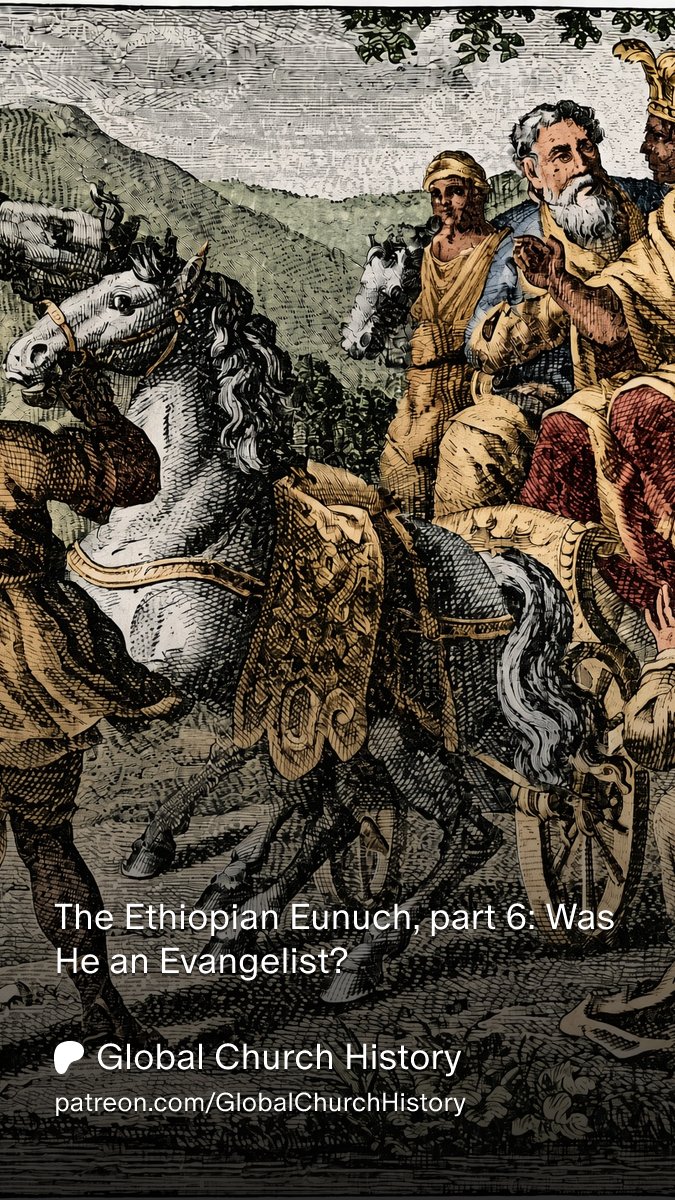
Did the Ethiopian Eunuch just go home and keep his faith a secret?
Some sceptics argue that because Luke didn't explicitly map out the Ethiopian Eunuch's preaching itinerary, the way he does Peter, Paul and others, the Eunuch never preached in his homeland. But the biblical text and ancient geography tell a completely different story.
Read Part 6 of the series, Was He an Evangelist?, for the full historical breakdown: https://t.co/iqA8LXWt11
Join the Patreon community to unlock this post and over 800 other historical deep-dives from just £5 a month! (Note: The September promo has now expired, but the standard £5 entry tier still grants full back-catalogue access).
How poor were the people of the ancient Middle East, really?
If you imagine the ancient biblical world as a sea of identical, destitute subsistence farmers, you aren’t alone...
But you are mistaken.
For over a century, historians and biblical scholars have mischaracterised the ancient economy. 19th-century propaganda about Ottoman decline, perceptions of Russian backwardness and Marxist theories of primitive peasant communes, came together to create a caricature of the ancient world, where they assumed everyone outside of the imperial elite was just scraping by.
But ancient financial records, preserved perfectly on Egyptian papyri, tell a completely different story.
In Part 1 of our new series on the Ancient Cost of Living, we dive into the raw data to find a world with a thriving middle class and a sprawling gig economy, not unlike today.
Read the full deep-dive in Part 1 of Ancient Cost of Living on Patreon: https://t.co/0akLuOE8Cc
Here's the first GCHP article to go up on Substack (all the Patreon GCHP posts are going to be mirrored on Substack from here on out).
If you want to be a part of the rollout, to have your say in the pace at which the articles are dropped and which ones should come first, get involved now: https://t.co/V9JAhBrwVv
Yes I am doing very well, thank you for asking. I had a lie in today, I was up late working last night and needed plenty of rest for a big day ahead.
The Rumble glitch means I don't have to wake up at 6AM every day now, so I've decided to see the positives in that, I think I wore myself down with work this past year and even though I am proud of all that I have done, a lot of rest will do me good.
I could not have gotten anywhere near as much work done without that little hype Beau gave me every morning though, I am missing that. It got me starting every morning on a high note. I'll be sure to reclaim my place when I can.
I also love the support of everyone in the chat, I feel like a celebrity, it's so fun!
I hope you're doing well as well. If I'm still lying in next week, say hi to everyone from me.
Today is the feast of St. Gregory the Illuminator. Born a Parthian noble, Gregory sought to atone for his father's assassination of the Armenian King by faithfully serving the late King's son Tiridates III the Great. Years later Tiridates ordered him to worship a pagan goddess so Gregory said "I have served you as God commands us to serve our earthly lords, He alone is the creator of angels and men... We can worship only Him."
Tiridates had Gregory brutally tortured, then cast him into the Serpent Pit of Khor Virap, where he survived for 15 years, sustained by a Christian widow and ministered to by angels and the serpents.
Tiridates was transformed into a boar-like beast and his court went mad. The king’s sister lifted Gregory from the pit and he healed Tiridates and his courtiers, telling the penitent king: "I am just a man like you. The One who has had mercy on you is your creator."
Gregory oversaw the Christianisation of Armenia. He received a vision of Christ striking the ground, commanding him to build a church, which he named Etchmiadzin, meaning "The Descent of the Only-Begotten". With the King's help, who humbly carried stones for the church's construction, Gregory successfully converted the entire nation, ordaining bishops, building schools and finally retiring as an hermit on Mt. Sebuh in Daranalik, dying peacefully c.331.
ℭ𝔬𝔩𝔩𝔢𝔠𝔱
Almighty God, who willest to be glorified in thy saints, and Didst raise up thy servant Gregory the Illuminator to be a light in the world, and to preach the Gospel to the people of Armenia: Shine, we pray thee, in our hearts, that we also in our generation may show forth thy praise, who hast called us out of darkness into thy marvelous light; through Jesus Christ our Lord, who liveth and reigneth with thee and the Holy Spirit, one God, now and for ever. ᴀᴍᴇɴ.
Today is the feast of St. Jerome who was born in Illyria. His father Eusebius hoped that he would love the Bible instead of pagan works, so he moved to Rome at the age of thirteen to be closer to the centres of pagan civilisation. He became a Christian instead and was baptised that year, but he lived like a pagan for some time. Out of guilt, he often went into the desert to live ascetically, but he also took his pagan library. This continued until he journeyed into Syria, where he starved himself to death, unable to assuage his guilt.
Jerome went to Heaven and told Jesus that he was a Christian but Jesus replied “You are a liar, I know that you are a Ciceronian”. Jerome begged “Have mercy on me LORD, have mercy on me!” and he promised to only study holy things, especially the Scriptures.
He awoke, with his family mourning him. Jerome never bought or read pagan books again. He went to Bethlehem to found two monasteries, one for men and the other for women. Together, they would investigate the Scriptures. Jerome completed a new translation of the Bible into Latin, the Vulgate, which served Europe for over a thousand years.
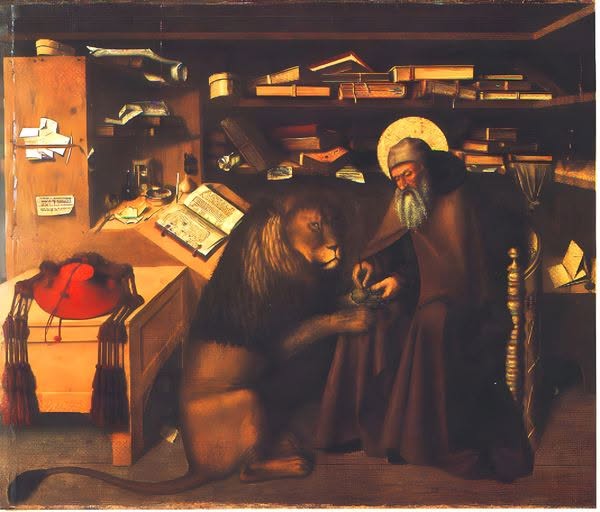
Far from his turbulent youth, the elderly Jerome was so peaceful that one day a lion walked into his study. He had a thorn in his paw and didn’t know who else to turn to. Jerome removed the thorn and the lion became a lifelong companion. The Scriptures had transformed Jerome into a different man!
ℭ𝔬𝔩𝔩𝔢𝔠𝔱
O everlasting God, who hast ordained and constituted the Ministries of angels and men in a wonderful order: Mercifully grant that, as thy holy angels always serve and worship thee in heaven, so by thy appointment they may help and defend us on earth; through Jesus Christ our Lord, who liveth and reigneth with thee and the Holy Spirit, one God, for ever and ever. ᴀᴍᴇɴ.
𝔒𝔯 𝔢𝔩𝔰𝔢 𝔱𝔥𝔦𝔰:
O God, who gave us the holy Scriptures as a light to shine upon our path: Grant us, after the example of your servant Jerome, so to learn of you according to your holy Word, that we may find the Light that shines more and more to the perfect day; even Jesus Christ our Lord, who lives and reigns with you and the Holy Spirit, one God, now and ever. ᴀᴍᴇɴ.
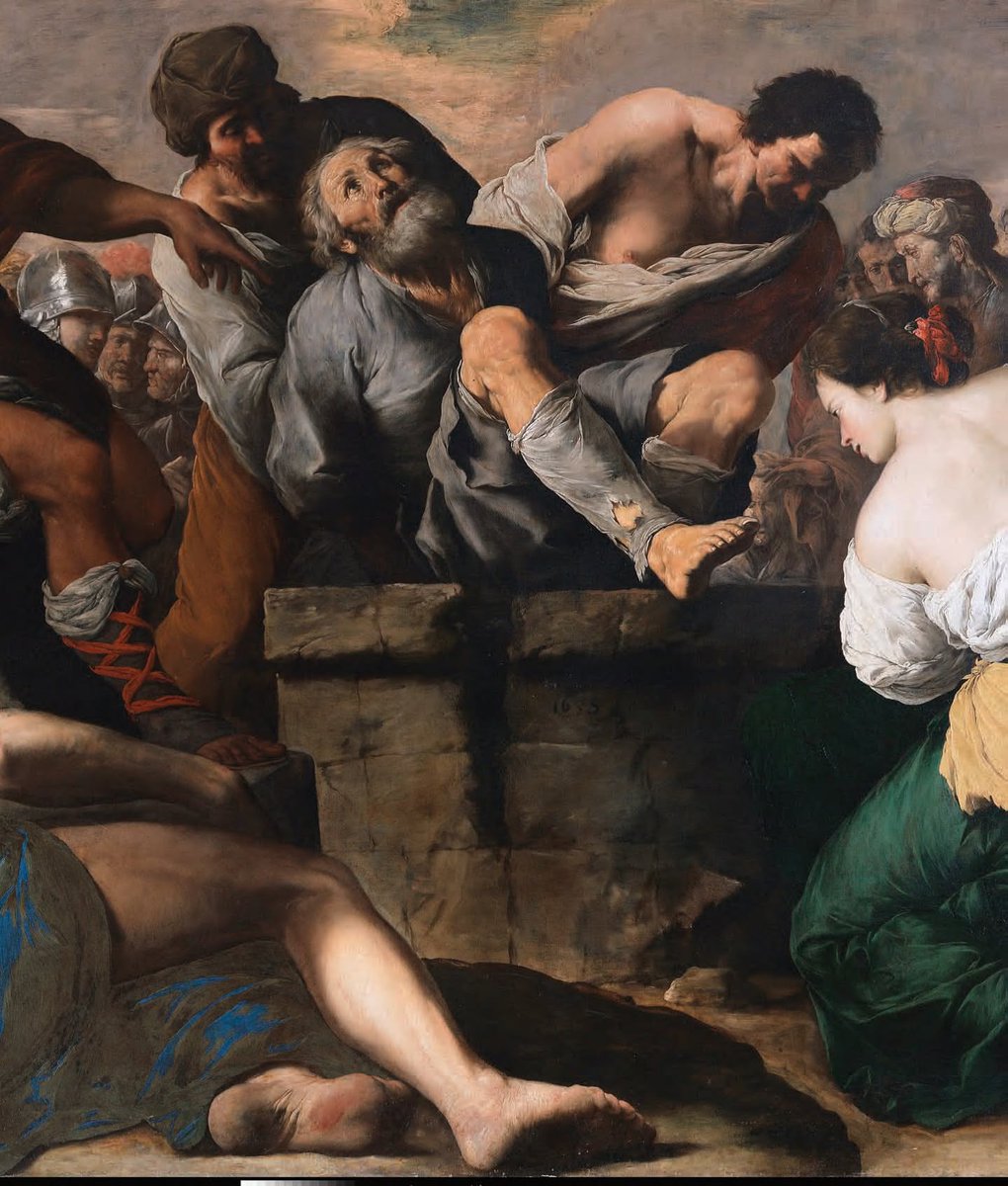
Today is the feast of St. Lawrence Ruiz and his companions, five martyrs from diverse nations: China, the Philippines, France, Spain, and Japan. The group's mission began in 1636, sailing from Manila to Japan. The company included St. Lawrence Ruiz, a Chinese-Tagalog layman and notary who chose the danger of a missionary journey over a possible execution in Manila, having been framed for murder. With him were European Dominicans Fr. Guillaume Courtet (French) and Fr. Miguel de Aozaraza (Spanish), the Japanese-born priest Fr. Vincent Shiwozuka de la Cruz, and Lazarus, a Japanese leper who served as their guide.
They were betrayed within a month of landing in Okinawa and imprisoned for over a year, facing intense torture. Though fear briefly touched their resolve—both Lawrence and Lazarus momentarily faltered—they quickly found the grace to repent and stand firm. Lawrence defied the authorities, declaring, "I am a Catholic and wholeheartedly do accept death for God. Had I a thousand lives, all these to Him shall I offer." Lazarus likewise took back his recantation, shouting, "I take back every word that, in fear, I had said before."
Their trial culminated on this day in 1637, when they were executed by tsurushi (death by suspension). Despite the agony, none signalled a denial of Christ. As Fr. Courtet had told the torturer, their purpose was simple: "Our goal was to preach divine love for Christ, even if it costs us our lives." They sealed their mission with their blood, becoming a powerful symbol of Christian fellowship transcending all ethnic and national divisions.
ℭ𝔬𝔩𝔩𝔢𝔠𝔱
Almighty God, whose servants Lawrence and his companions, bearing thy Gospel from diverse nations to Japan, chose death by torture rather than deny thy Son: Grant that we, following their example may find in the bonds of Christian fellowship strength to endure whatever trials thou dost permit; that nothing may divide us from our brethren, but that we may serve thee with one heart and mind; through Jesus Christ our Lord, who by his cross has made of many peoples one new humanity, and liveth and reigneth with thee and the Holy Spirit, one God, now and for ever. ᴀᴍᴇɴ.
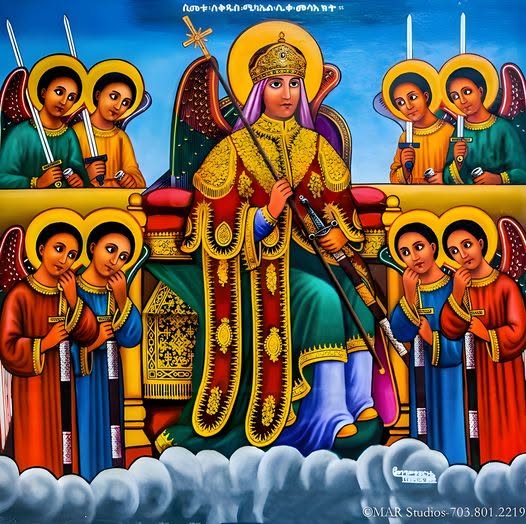
Today, in many Western Christian calendars, is the feast of St. Michael and All Angels. Because there are seven Archangels, Christians have often linked them to the seven sacraments, the seven traditional planets, and the seven days of the week.
Michael carries the Trumpet of God mentioned in 1 Thessalonians 4:13. Michael is the patron of the Eucharist because although he is very powerful, he only defeated the Devil in Revelation 12:7-9 through the Blood of the Lamb, which we commemorate in Communion.
When Daniel confessed his sins and the sins of Israel in Daniel 8-9, the prophet was face down but Gabriel lifted him up and put him on his feet. Sin casts us down, but when we are baptised we can stand on our feet even in the presence of the LORD, so Gabriel is the patron of baptism.
In Enoch and Tobit, Raphael heals wounds and tradition has it that Raphael was the angel who stirred the waters in John 5:2-4, so he has Absolution. Christians are no longer dead in sin, but we do take wounds. Absolution is given so that Christians can have confidence that Christ has healed our little wounds as well as our spiritual death.
Uriel is celebrated by Anglicans, Tewahedo and some others. In Enoch and Esdras, Uriel gives instructions to prophets that already believe in Jesus with all their hearts; we confirm our children in the faith because we know that they already believe in Jesus, but we walk them through the Catechism so they may learn details. For this reason Uriel is the guardian of Confirmation.
ℭ𝔬𝔩𝔩𝔢𝔠𝔱
O everlasting God, who hast ordained and constituted the Ministries of angels and men in a wonderful order: Mercifully grant that, as thy holy angels always serve and worship thee in heaven, so by thy appointment they may help and defend us on earth; through Jesus Christ our Lord, who liveth and reigneth with thee and the Holy Spirit, one God, for ever and ever. ᴀᴍᴇɴ.
𝔒𝔯 𝔢𝔩𝔰𝔢 𝔱𝔥𝔦𝔰:
Almighty and Everlasting God, Who, by Thy goodness and merciful desire for the salvation of all men, hast appointed Thy most glorious Archangel Saint Michael Prince of Your Church, make us worthy, we ask You, to be delivered from all our enemies, that none of them may harass us at the hour of death, but that we may be conducted by him into Your Presence. This we ask through the merits of Jesus Christ Our Lord, who liveth and reigneth with thee and the Holy Spirit, one God, now and for ever. ᴀᴍᴇɴ.
⏳ ENDS WEDNESDAY (SEPT 30) 10:59 PM GMT! ⏳
Get 2 months FREE off an annual Patreon subscription before the offer expires
You usually unlock over 800 historical hagiographies, articles and translations right now, from just £5/month, but if you subscribe by the above date, it costs you only £3.78/month!
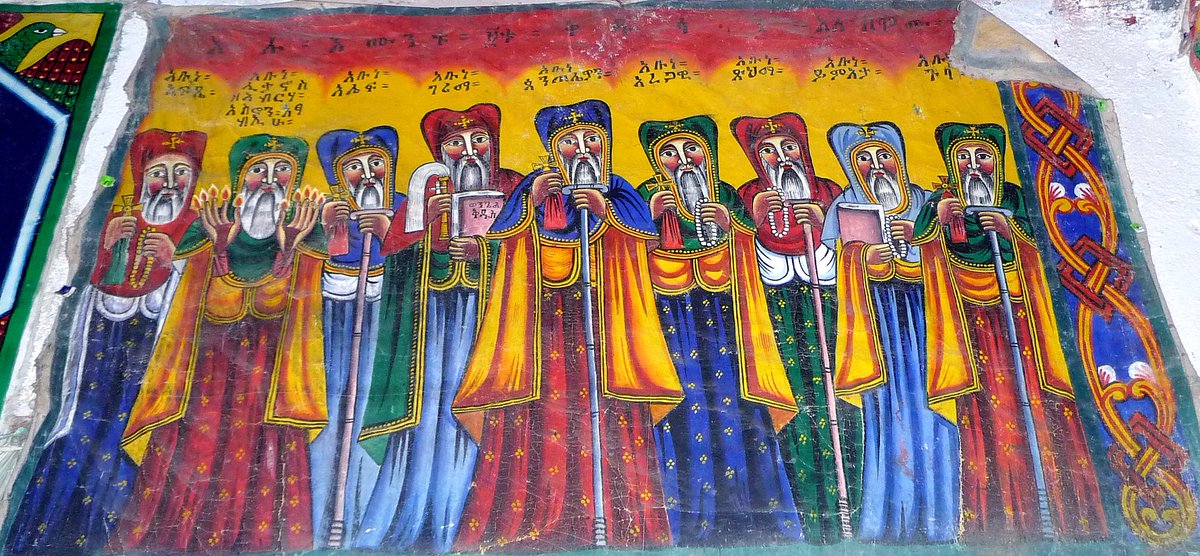
Did a 4th-century missionary bring Christianity to Ethiopia? The history says the Tewahedo Church is much older.
Ethiopian Christianity has a massive Jewish layer with Saturday Sabbaths, Ark of the Covenant replicas and a biblical canon that mirrors the Dead Sea Scrolls community more than it does the Judaism even of the 3rd century.
4th-century Roman and Coptic missionaries didn't practice any of this, meaning they couldn't have introduced it to Ethiopia. So where did these 1st-century Second Temple practices come from?
Find out in Part 5 of our deep-dive on the Ethiopian Eunuch!
Read tonight's post here: https://t.co/Iww59n8TSX