Markets don’t fall in a straight line forever.
First comes fear, panic, and red candles.
Then comes the bounce, short squeeze, and a fight for balance.
No panic. Watch the levels.
GEBRID
@binance Binance is proving that AI security is becoming a core layer of Web3. GEBRID takes this further by creating an open AI agent marketplace where users can discover, own and activate protection agents, with NFT-based ownership and access rights under the hood.
@binance Binance NFT shutdown proves that static, centralized NFT marketplaces are obsolete. GEBRID is building the next layer: AI-powered NFT agents that are portable, functional, programmable and connected to DeFi, GameFi, RWA and creator economies.
Agree -and 3 years may even be conservative.
But the edge won’t belong to random bots. It will belong to agent systems with permissions, risk scoring, treasury controls, and onchain execution rails.
That’s exactly why GEBRID has already structured 345 patent claims around AI agents, onchain capital execution, risk enforcement, and agent operating infrastructure.
AI capital needs an operating system.
Excellent technical breakdown. The key insight: "whether confirmation dialogs alone are adequate at this magnitude of potential loss."
Answer: No. $50M+ transactions need on-chain enforcement, not UI confirmations.
This is exactly why we're building GEBRID's RiskEngine - smart contract guardrails that block catastrophic trades before they hit the solver layer.
"Accidentally" - but the system worked exactly as designed.
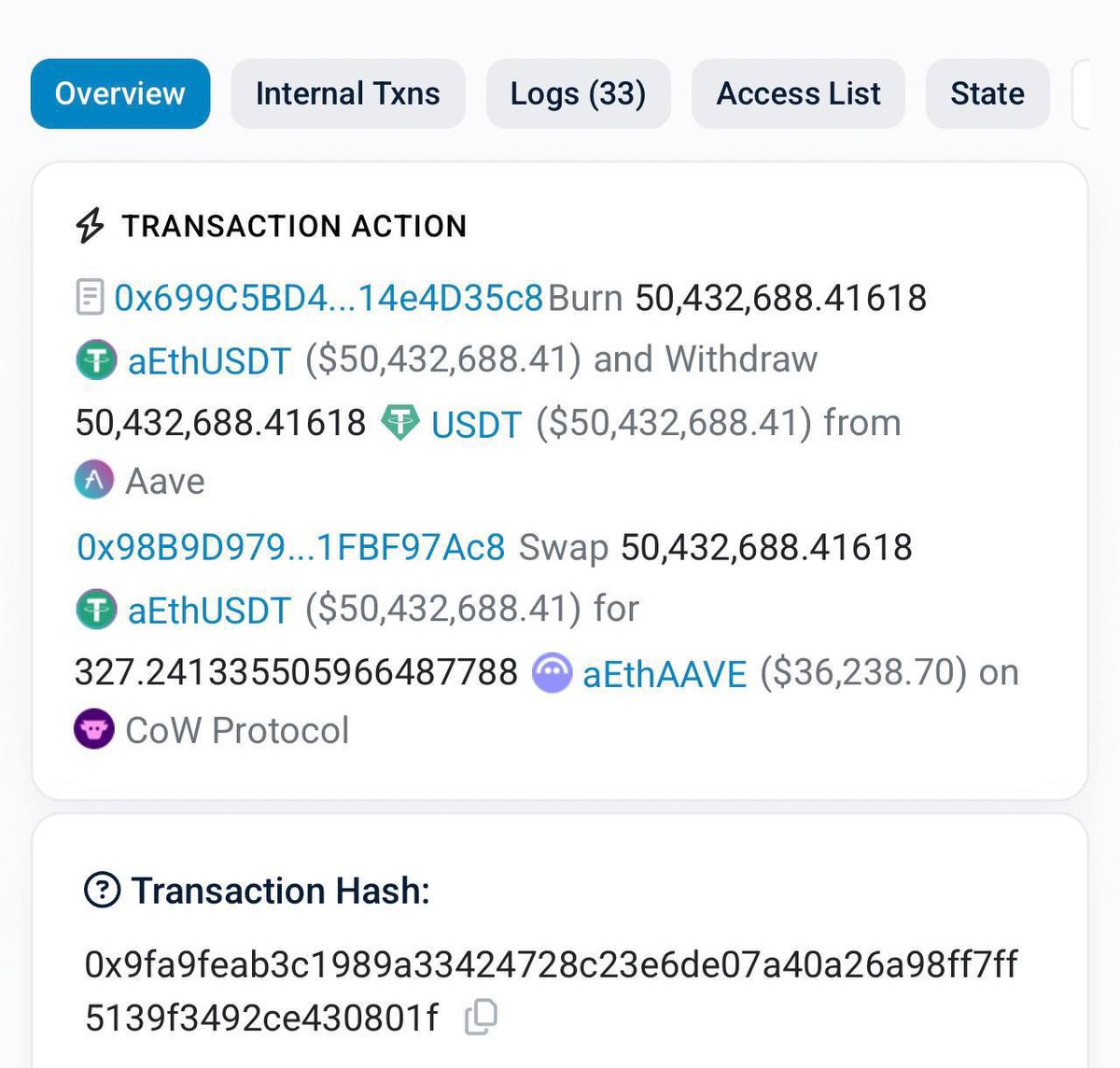
$50M input → 327 AAVE output was the correct quote. User confirmed. CoW Swap executed.
The problem isn't the swap. It's that DeFi has no on-chain guardrails for catastrophic trades like this.
Traditional finance would never allow a $50M market order into a pool with $3M liquidity. But DeFi is "permissionless" - meaning anyone can destroy their own capital.
GEBRID changes this. RiskEngine blocks transactions with extreme price impact before they hit the chain. Not a popup you can ignore a smart contract that won't let it execute.
Autonomous agents managing institutional capital need enforcement, not warnings.
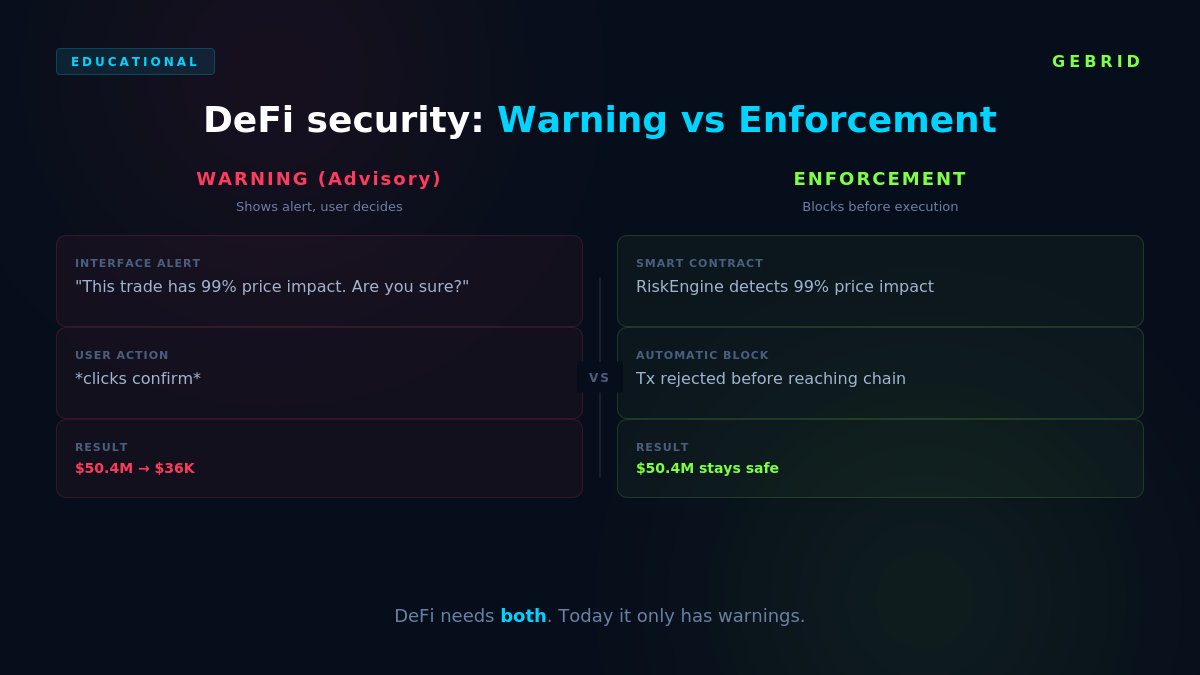
UI warning vs smart contract enforcement.
Warning: "This trade has 99% price impact. Are you sure?"
User: *clicks confirm*
Result: -$50.4M
Enforcement: tx rejected at RiskEngine before reaching chain.
User: sees "trade blocked catastrophic price impact"
Result: $50.4M safe.
DeFi needs both. Today it only has the first.
Perfect explanation of the AMM mechanics. The brutal math: walking a $50M order through a few million in effective liquidity.
But there's a missing layer here: why didn't the system stop a 99% price impact order BEFORE it hit the curve?
UI warnings are advisory. On-chain enforcement would have blocked this at protocol level - no curve walk, no $50M loss.
That's exactly what GEBRID's RiskEngine does. Pre-execution validation that can veto catastrophic trades before they settle.
DeFi is permissionless, but institutional capital needs guardrails that actually work.
@mgrabina The core issue wasn't slippage, it was the accepted quote with 99% price impact" -exactly. And the fix isn't better warnings. It's a smart contract that won't let a 99% impact quote execute in the first place.@CoWSwap
@0xngmi Other protocols block at the interface level" - but interface-level blocks are trivially bypassable.
The enforcement needs to live on-chain, in the execution path itself.
@yieldsandmore@CoWSwap Good catch on the collateral swap routing. aEthUSDT → aEthAAVE through thin liquidity pools is a recipe for disaster at this scale.
Pre-execution risk checks against oracle prices would have caught this instantly.