Do Not Ignore P/E De-rating Risks
BofA Survey says foreign fund managers are most underweight on India among 12 Asian markets. REASON: At 21x trailing PE, Indian equities remain one of the most expensive in Asia. Guard against PE de-rating risks.
Asia’s Least Preferred
a. Bank of America’s survey of 98 global fund managers ($272B AUM) shows India is the least preferred among 12 Asian markets. Taiwan, Korea, Japan remain the most preferred.
b. Most analysts say the reason is India’s absence from the AI story. But where is AI boom in Malaysia, Thailand, Philippines, and Indonesia? Why are they all more favoured than India?
c. Why have FIIs pulled out $25B from Indian equities in 2026 even though they turned marginal net buyers recently? Why is India the worst-performing Asian market in 2026 with Nifty down 8% year-to-date?
Asia’s Most Expensive
a. Nifty 50 trailing P/E, even after a prolonged phase of market correction, is about 21x, one of the highest in Asia. (Even though it is now 12% below Nifty’s 10-yr average of 23.4x)
b. Buffett Indicator (Market Cap ÷ GDP): Even after market correction, India’s Buffett ratio at 133% remains highly elevated. (India’s 2000-2024 average was 87%).
c. Exit Liquidity: Even though global capital is moving out, Indian market remains sideways due to SIP inflows. So, the retail investor’s own capital is now its own saviour, while providing an exit to FIIs.
Corporate Earnings Growth
Nifty 50 EPS:
Last 20 Yrs: 12.6% CAGR
Last 10 Yrs: 10.8% CAGR
FY22 to FY25: 21.1% CAGR
Notice the mega boom in EPS growth for 4 years from FY22 to FY25 of 21.1% CAGR (EPS doubled from ₹503 to ₹1,071.)
This growth was massive in the first 3 years post-Covid (FY22 to FY24). As a result, investors rewarded India with high PE multiples of 23x as they anticipated this huge growth to continue.
Corporate Earnings Slowdown
Investors assumed India’s EPS growth boom to continue, but reality hit hard as follows:
FY25: Nifty 50 EPS Growth
Consensus Forecast: 15% CAGR
Actual EPS Growth: 3.4% CAGR
FY26: Nifty 50 EPS Growth
Consensus Forecast: 12% CAGR
Actual EPS Growth: 4.5% CAGR
FY27: Nifty 50 EPS Growth
BofA Forecast: 8.5% CAGR
Actual: awaited (ongoing)
Q1 FY27
Nifty 50 EPS Growth: 18%
Not Broad-Based Growth
The headline growth in Q1 FY27 looks strong, but 60% of the entire index’s incremental earnings in this quarter came from just 5 companies (ONGC, Hindalco, RIL, JSW Steel, and Bharti Airtel).
This means:
Assume Total Nifty 50 Earning:
Q1 FY26: ₹100
Q1 FY27: ₹118
Incremental Earning: ₹18
5 Companies Contributed: ₹10.8
45 Companies Contributed: ₹7.2
So, just five cyclical and commodity stocks did the index’s heavy lifting.
More importantly, India’s corporate earnings growth has under-performed nominal GDP growth in FY24, FY25, and FY26.
Indian companies are not keeping pace with the overall economy's growth. That puts a question mark on future EPS growth, even if the GDP is growing.
P/E Contraction Risks
a. If Nifty 50’s terminal P/E in 5 years remains unchanged at 20.5x (same as today’s PE), then for the index to double in 5 years (purely on earnings growth, with no P/E expansion), EPS must grow at 15% CAGR for 5 consecutive years without fail.
b. In other words, you will be able to double your money only if 15% EPS growth compounding does not get interrupted for the next 5 years. There is no bubble burst, no new wars, no major rupee depreciation, and no AI threat to Indian jobs and IT exports, etc.
c. Now think of the downside risk (worst-case scenario). If EPS growth fails to accelerate for another one or two years, P/E de-rating may happen.
Global capital may not be willing to pay the same multiple it is paying for that growth today. If that happens, your investment in equities may not earn a single rupee for next 5 years.
d. Poor Risk-Reward Ratio: The upside (2x your money in 5 yrs) comes only in a near-perfect scenario because you are purely dependent on EPS growth (not PE expansion). But the downside comes fast and easy, if PE contracts due to FII exits.
e. Earlier this week, Motilal Oswal’s Raamdeo Agrawal predicted on TV that India’s index will double in next 5 years. But foreign funds are not going to do “hope trade” based on Motilal’s astrology.
FIIs know in the last two years, the consensus forecast of “15% EPS growth” failed miserably. Even FY27 BofA EPS growth forecast is only 8.5%.
Defend Your Portfolio
Stay conservative and diversify into gold, bonds, and cash. Don’t overdose on high PE momentum stocks or solely on midcaps and smallcaps.
If the AI bubble bursts in the US, FIIs could turn heavy sellers in India to raise cash and rebalance portfolios.
India’s single-engine aircraft is flying on SIPs. The market is over-leveraged, and it will not survive domestic redemptions.
It is your family’s money. Stay optimistic, but stay practical. These are challenging times for investors, no matter what Motilal-ji says.
@arabicatrader
It’s not QE and it’s not yield-curve control. But if Treasury increasingly buys back long-duration debt and replaces it with bills, it is effectively conducting a Treasury-led Operation Twist: removing duration from the market to put downward pressure on long-term borrowing costs.
Combine that with Bessent’s push to expand the Fed’s FIMA repo facility, allowing foreign governments to pledge their US Treasuries as collateral and borrow dollars rather than having to sell those Treasuries outright.
The message is becoming abundantly clear: the US Treasury does not want higher long-term rates. More importantly, it wants to prevent forced or destabilizing selling of US government bonds, especially at the long end.
Gold understands the message.
It’s up more than 3% today.
@ZeptoNow Order # PQLVJHAZC15886
Wrong item delivered. Your customer care is giving a standard reply that there is no anamoly. After a lot of back and forth on mails, someone called & abruptly disconnected the call without providing any solution. This is highly unprofessional.
@zeptocares@aadit_palicha@v0hra This is turning out to be the worst experience. Despite sharing the image of the wrong item and requesting them to replace the item with the correct one, Zepto is turning a blind eye by not admitting their mistake and writing that there is no anamoly.
In 2003, the Sensex was at 2,900.
By January 2008 it was 21,207.
Seven times your money in five years.
And the story behind it was completely true.
India's GDP was growing 8.6% a year.
Roads were being built.
Power plants were coming up.
That's what made it dangerous.
At the peak, the Nifty PE was 28.
In plain terms, people were paying ₹28 for every ₹1 the companies earned.
Normally that number sits around 18 to 22.
Why did anyone pay 28?
Because earnings had actually grown 21% a year for five straight years.
So the price wasn't crazy. It just quietly assumed that pace would continue forever with nothing ever going wrong.
Then Reliance Power came with its IPO.
It wanted to raise ₹11,563 crore. It got bids worth ₹7.5 lakh crore.
Sold out in the first minute.
The company had no plants running. No revenue. Nothing.
₹10,000 put into that IPO was worth ₹1,636 ten years later.
By December 2008 the Sensex was at 9,647. Down 60% in one year.
Now the part nobody talks about.
India didn't stop growing.
The roads got built. The power came online.
DLF is still India's biggest developer today. Suzlon still makes wind turbines.
So the people who said the India story was fake were wrong.
And the people who paid any price for that story were also wrong.
The story was real. The price wasn't.
Those are two different questions. In 2008, everyone answered them as one.
They still do.
This is one part from our recent blog. Full piece linked below.
A few weeks ago, the RBI gave local banks the green light to offer NRIs up to 7% interest on dollar deposits. Those same deposits paid around 3-4% until then.
When the banking system suddenly starts paying a steep premium to get its hands on foreign currency, it's a sign that something is wrong.🧵👇
The Nifty Next 50 promises something very few indices can.
The stability of Large Caps.
The return potential of Mid Caps.
But does it really deliver the BEST of both worlds?
We analysed 20 years of data to find out. 🧵👇
🇮🇳 India's Net FDI: From $28 Billion to Just $1 Billion in 2 Years — What Happened?
🧵 Key Takeaways:
1️⃣ Net FDI collapsed from ~$28 billion in FY23 to around $1 billion in FY25, despite India continuing to attract large foreign investments
India’s inflation scorecard is getting a major upgrade.
After decades of relying on WPI, India is introducing a new Producer Price Index framework that aims to capture price movements more accurately across the economy.
Swipe through to understand what’s changing and why economists are paying attention. →📊
A major change is coming to India's inflation framework!
India is preparing to move from WPI to PPI, a shift that could offer a more accurate picture of producer prices, inflation trends and economic activity.
Why does it matter for growth, inflation and policymaking?
@RaghavKalra2710 #ETNdigitalfirst #PPI #WPI #Economy #Inflation
When just a couple of companies create most of the returns, it is called a structural growth story.
When it happens elsewhere, it is called concentration risk.
Interesting how concentration risk suddenly becomes a "national success story" when the stocks are going up. 😉
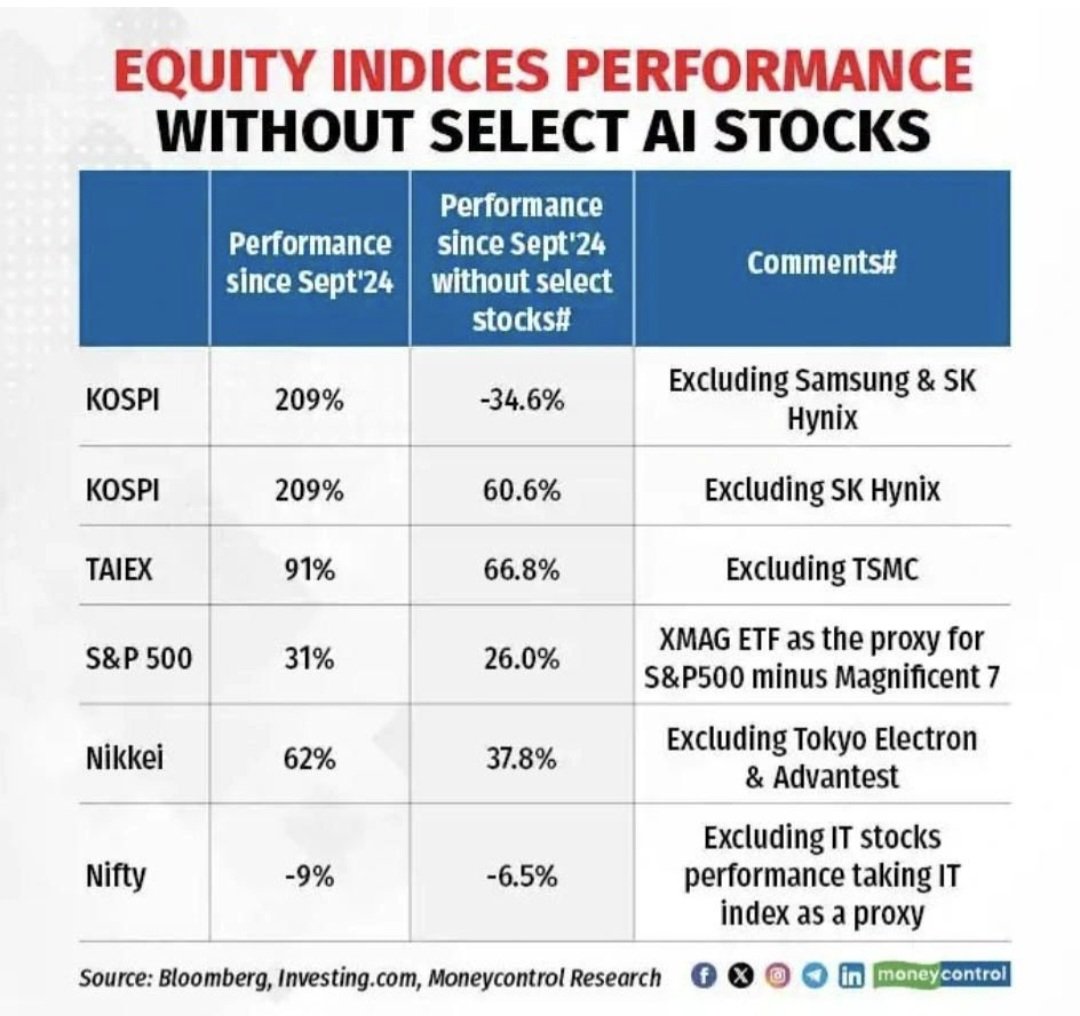
India has not exactly delivered any returns (NIFTY & SENSEX) in the last 2 odd years, yes literally ZERO returns. But before writing off India and declaring Korea or Taiwan the only places worth investing in, it is worth looking a little deeper.
The biggest investing theme in the world right now is AI. Korea has Samsung & SK Hynix. Taiwan has TSMC. Global money has poured into these companies because they sit right at the centre of the AI supply chain. Since September 2024, KOSPI is up 209%. Sounds phenomenal.
But remove Samsung and SK Hynix from the calculation and the rest of the market is down nearly 35%.
To be clear, I am not calling AI a bubble. Samsung, SK Hynix and TSMC are world class businesses and they may continue creating enormous wealth for shareholders. But when almost all the returns are coming from a handful of companies, investors should at least acknowledge what is really driving performance.
Markets are funny. Just when everyone becomes convinced they have found the winners for the next decade, leadership changes. In 2021 everyone wanted technology. In 2023 everyone wanted defence. Today everyone wants AI. The story always looks obvious after the money has already been made.
For now, India is paying the price for not having a Samsung, SK Hynix or TSMC. But cycles change. If the next big opportunity emerges outside AI, the same investors celebrating concentration today may suddenly rediscover the benefits of diversification.
Funny how that works, isn't it ?
What's your take?
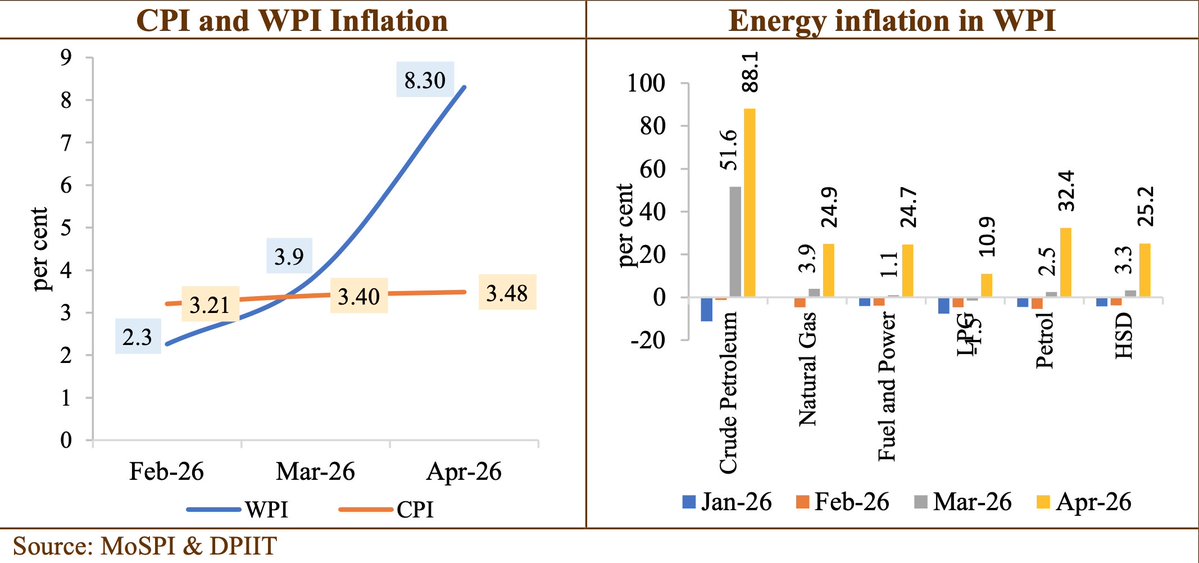
🇮🇳 The WPI-CPI divergence
The most important number in India's May 2026 MER isn't inflation. It's the gap.
🔹 CPI (retail): 3.48% in April - below the RBI's 4% target.
🔹 WPI (wholesale): 8.3% in April - 42 month high.
A 4.8 percentage point gap between what companies pay and what consumers pay. The largest divergence in nearly four years.
The driver:
WPI energy inflation hit 24.7%.
Crude petroleum: 88.1%.
Wholesale prices have absorbed the Iran war shock.
Retail prices haven't - yet.
Petrol and diesel were hiked four times (₹7.38 and ₹7.52 per litre). The pass-through has barely begun.
The MER explicitly warns: "the divergence suggests upstream cost pressures are building" and "may not be far behind" on the consumer side.
CPI looks calm. WPI is screaming. One of these prints is leading; the other is lagging.
Source: Monthly Economic Review, May 2026 (Ministry of Finance)
#RBI Balance Sheet Expands 20% In FY26 Amid Gold Revaluation Boost
Gold value jumps 66% YoY, significantly boosting income
RBI transfers Rs 1.09 lakh cr to Contingency Fund, due to higher charges to the fund from MTM losses
@latha_venkatesh explains more key take aways from @RBI Annual Report
#RBI #IndianEconomy #Gold
Ever noticed how some companies report modest sales growth… …but massive profit growth?
That’s the magic — and risk — of operating leverage. From multiplexes and hotels to cement companies, this concept explains why scale changes everything. In this episode of Cut the B/S, we decode the same.
Watch:
https://t.co/wb4AZaTaDj
Respected @nsitharaman ji and @FinMinIndia,
Suggestion 2 of 3 for strengthening India's capital markets:
Dividend income on listed equities should not be subjected to double taxation.
A business can raise capital in only two ways: debt or equity.
When a company raises debt, the interest paid to lenders is treated as a business expense and deducted before tax. The lender may then pay tax on the interest received.
However, when a company raises equity capital, dividends are paid out of profits that have already suffered corporate tax. The shareholder is then taxed again on the same stream of income.
More importantly, equity capital bears far greater risk than debt capital. A lender has a contractual right to interest and principal repayment. A shareholder has no such guarantee. Dividends are discretionary, capital is fully at risk, and the shareholder stands last in line if a business fails.
If debt providers receive tax-deductible compensation despite bearing lower risk, there is a strong case for more favourable treatment of equity providers who supply the permanent capital that fuels entrepreneurship, innovation, employment and economic growth.
India needs to encourage long-term risk capital and greater participation in equity markets. Tax policy should reward those who provide patient equity capital to Indian enterprises rather than place them at a relative disadvantage compared to debt capital.
Respectfully submitted.
RBI is trapped.
Rupee at 96.96 to the dollar. CPI heading to 5%. Growth slowing. Oil sticky above $110. And the central bank, through sourced leaks to Reuters this week, is telling markets it will not hike rates to defend the currency.
This is the most interesting macro story in India right now.