@mkaristianou Συνεπώς, η ουσία του ζητήματος δεν είναι μόνο νομική, αλλά και πολιτική: αφορά την ισορροπία των εξουσιών και την ανάγκη διασφάλισης της αμεροληψίας και της ανεξαρτησίας της Δικαιοσύνης σε ένα κράτος δικαίου.
(part 6)
@mkaristianou Αν βάλετε το 1ο ερώτημα σας στο chatgpt απαντάει το παρακάτω --> Η αρχή της διάκρισης των εξουσιών είναι θεμελιώδης σε κάθε φιλελεύθερη δημοκρατία και επιτάσσει την ανεξαρτησία της Δικαστικής Εξουσίας από την Εκτελεστική (part 1).
@mkaristianou μιας υπόθεσης. Ειδικά όταν η εκάστοτε κυβέρνηση έχει ρόλο στο διορισμό ανώτατων δικαστικών λειτουργών, κάθε μορφή επικοινωνίας μεταξύ Εκτελεστικής και Δικαστικής Εξουσίας πρέπει να γίνεται με απόλυτη διαφάνεια και εντός του συνταγματικού πλαισίου (part 5)
@mkaristianou Σε ένα δημοκρατικό πολίτευμα, οι κυβερνητικοί αξιωματούχοι οφείλουν να απέχουν από οποιαδήποτε ενέργεια που μπορεί να ερμηνευθεί ως παρέμβαση στην ανεξαρτησία των δικαστικών αρχών, ακόμα και αν γίνεται με την επίκληση της ανάγκης για ταχύτερη και αποτελεσματικότερη διερεύνηση.
@mkaristianou Η ανάθεση μιας υπόθεσης σε ανώτερο ανακριτικό επίπεδο είναι πράξη που ορίζεται από τις διατάξεις της Ποινικής Δικονομίας και κρίνεται από τα αρμόδια όργανα της Δικαιοσύνης, χωρίς κυβερνητική παρέμβαση (part 4)
@mkaristianou Η επιστολή του Πρωθυπουργού προς τον Εισαγγελέα του Αρείου Πάγου σχετικά με την υπόθεση των Τεμπών εγείρει νομικά και συνταγματικά ζητήματα, καθώς ενδέχεται να θεωρηθεί ως παρέμβαση στο έργο της Δικαιοσύνης. (part 3)
@mkaristianou Στο πλαίσιο αυτό, οποιαδήποτε παρέμβαση της Εκτελεστικής Εξουσίας στο έργο της Δικαιοσύνης πρέπει να είναι εξαιρετικά περιορισμένη και θεσμικά κατοχυρωμένη, ώστε να μην παραβιάζει την ανεξαρτησία των δικαστών και των εισαγγελικών λειτουργών. (part 2)
.
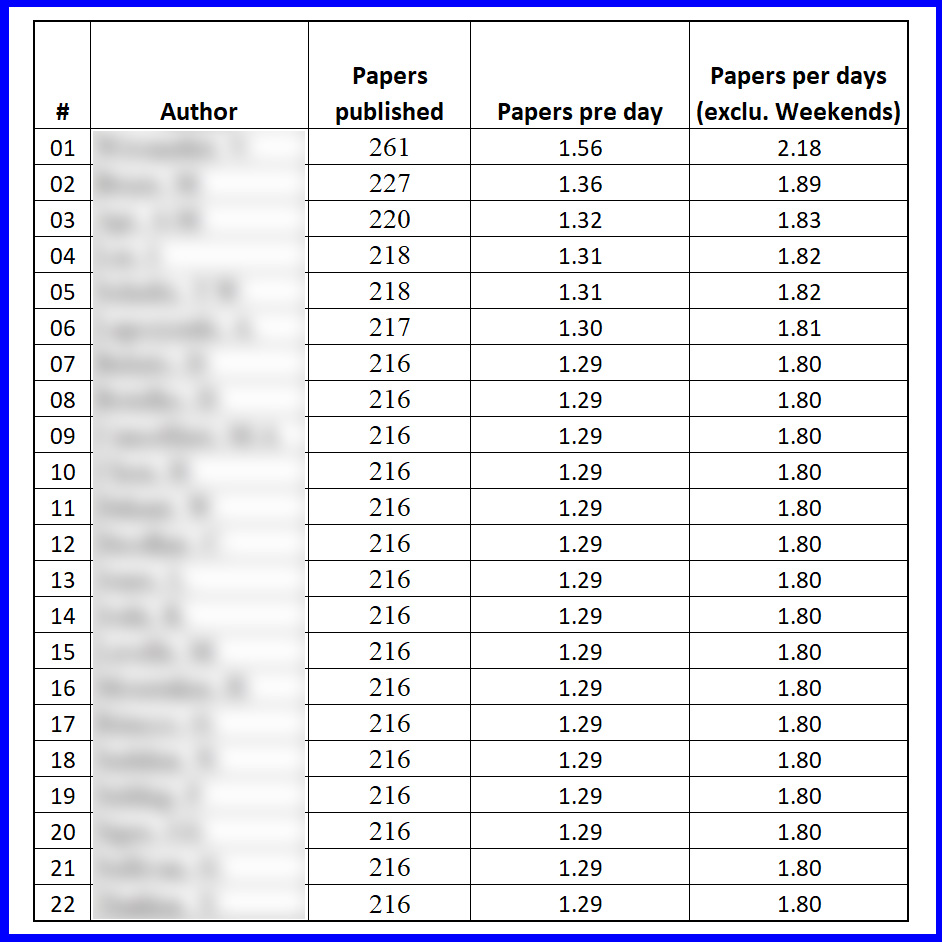
22 people have published more than 200 papers in 2024 (so far, we still have another six months to go)
We have been doing some research on another project and saw something that we found interesting. We'd be interested to know what you think.
In 2024, 22 authors (according to @Scopus) have published over 200 papers. The table below shows the details (we decided not to show author names at this time).
The author who has published the most papers has authored 261 papers (as at 15 Jun 2024) meaning that he/she has published 1.56 papers every day this year (and counting).
If we exclude weekends (everybody has to rest, right?), then they have published 2.18 papers every day.
Serious question: Is it possible for anybody to contribute in a meaningful way (at least to warrant being at author) when they are publishing a paper every day?
A transient approach reduces the time required for transgene-free gene editing (Nature Plants) (Summary by Kamal Kumar Malukani) https://t.co/RkvX9BvqXL
#PlantaePSRW
Ο Πρόεδρος του ΕΛΓΟ-ΔΗΜΗΤΡΑ καθηγητής Σέρκος Χαρουτουνιάν,o πρώτος Έλληνας εκπρόσωπος που καταλαμβάνει θέση στη Διοίκηση του FAO. Εκλέχθηκε στη θέση του Α΄ Αντιπροέδρου της Εκτελεστικής Επιτροπής της Ευρωπαϊκής Επιτροπής για τη Γεωργία (ECA, European Commission on Agriculture)
Nature rejected her paper for not being original,
University of Pennsylvania (her employer) demoted her,
and yesterday Katalin Karikó won the Noble Prize in physiology.
In mid-2000s, Karikó and her Drew Weismann submitted their paper on mRNA (messenger Ribonucleic Acid) to Nature.
Nature desk rejected their paper for being "an incremental contribution" only. The paper was later published in another journal, Immunity.
Earlier in her career at the University of Pennsylvania, Karikó was demoted because her applications for grants kept getting rejected.
But Karikó persevered and kept on going.
In 2013, she joined BioNTech, a German company founded by two scientists, Uğur Şahin and Özlem Türeci. In 2018, BioNTech partnered with Pfizer to develop mRNA vaccines against the influenza virus.
When the COVID-19 hit the world, Karikó's research helped Pfizer to produce the first vaccine against the disease.
I don't know how the Nature editors who desk rejected Karikó's paper and the Penn administration who demoted her feel about Karikó Nobel Prize.
Takeaway: Many academics and scientists worry about getting published in "prestigious" journals. Instead of worrying about prestige, we should try to put our work out as quickly as possible like Karikó did.
Once you put your work out without caring about prestige, two good things happen:
1. Your work will lead to newer opportunities.
2. You will start getting feedback from the scholarly community, which you can use to iterate and improve.
Here's another interesting Nobel Prize story.
Peter Higgs, a British physicist, joined the University of Edinburgh in 1956. By 1964, Higgs has published his groundbreaking work about subatomic particles.
After 1964, Higgs published less than 10 papers.
When his department would ask him how many papers, he published in a given year, he would reply "None."
It happened so often that he stared feeling like an "embarrassment to the department."
The University of Edinburgh, however, never fired Higgs because in 1980 he had been nominated for the Nobel Prize.
Higgs retired in 1996 and stayed on as an emeritus professor at Edinburg.
In 2012, experiments conducted at the CERN laboratory confirmed Higgs work and the existence of Higgs Particle.
And in 2013, Higgs was awarded the Noble Prize in physics and the University of Edinburgh got rewarded for being patient.
A paper in @NatureGenet reports the assembly of 12 genomes of fruits from the orange subfamily. The findings provide insights into the origin and evolution of this subfamily and the genetic basis of flavour in citrus fruits. https://t.co/ahJRZQjWkD
New publication from @PomologyAUTh entitled "Screening the Citrus Greek National Germplasm Collection for fruit quality and metabolic footprint" in Food Chemistry! 🍊🍋
https://t.co/pnjgdrI93M
🍒 What are the physiological, anatomical, metabolic, and transcriptomic impacts of pre-flowering boron supply on the sweet cherry fruit set and development?
Read more https://t.co/6QKzGFoTpf @PomologyAUTh@MICHAILSMichai1