"Ghanaians are gone now, 300 of them. How many 300 jobs were created after the Ghanaians left."
Julius Malema says blaming migrants for job losses deepens colonial divisions and that Ghana’s response risks blaming entire societies for the actions of a few people.
This is so disingenuous of you, @WehliyeMohamed.
It is not in contention that Adan is brilliant and brings tons of experience.
What is in contention is assuming that his expertise can override the provisions of the law on the cutoff age of 60 years.
Adan is 62 years old.
He should respectfully reject the position, or his legacy will end with his last dance being in court defending an unlawful appointment.
I’d hate to see Adan become another wasted mind who wakes up daily to defend an unlawful position like Ndii.
Just avoid exposing yourself politically .
Be alert.
Do not say and do what will upset the room .
Because kenyans have completely refused to get out of this primitive tribal retrogressive politics.
You do not need to lose your life because of political sycophancy. These guys will eventually meet after you have died and slaughtered each other and continue ruling the country as if nothing happened .
Mwenye masikio asikiie .
Mwenye upumbavu aendelee .
#ripRachelWandeto
#Wantam
Kenya needs a renaissance
There are places we pass through in life… and there are places that become part of who we are.
Manchester will forever be my home.
To the city, the club, and every supporter, my sincerest thank you. These past four years have been unforgettable, filled with moments my family and I will carry with us for the rest of our lives. There simply aren’t enough words to describe the happiness and warmth we’ve felt here.
Thank you for every cheer, every memory, and for making us feel at home from the very first day.
Forever a Red Devil ❤️
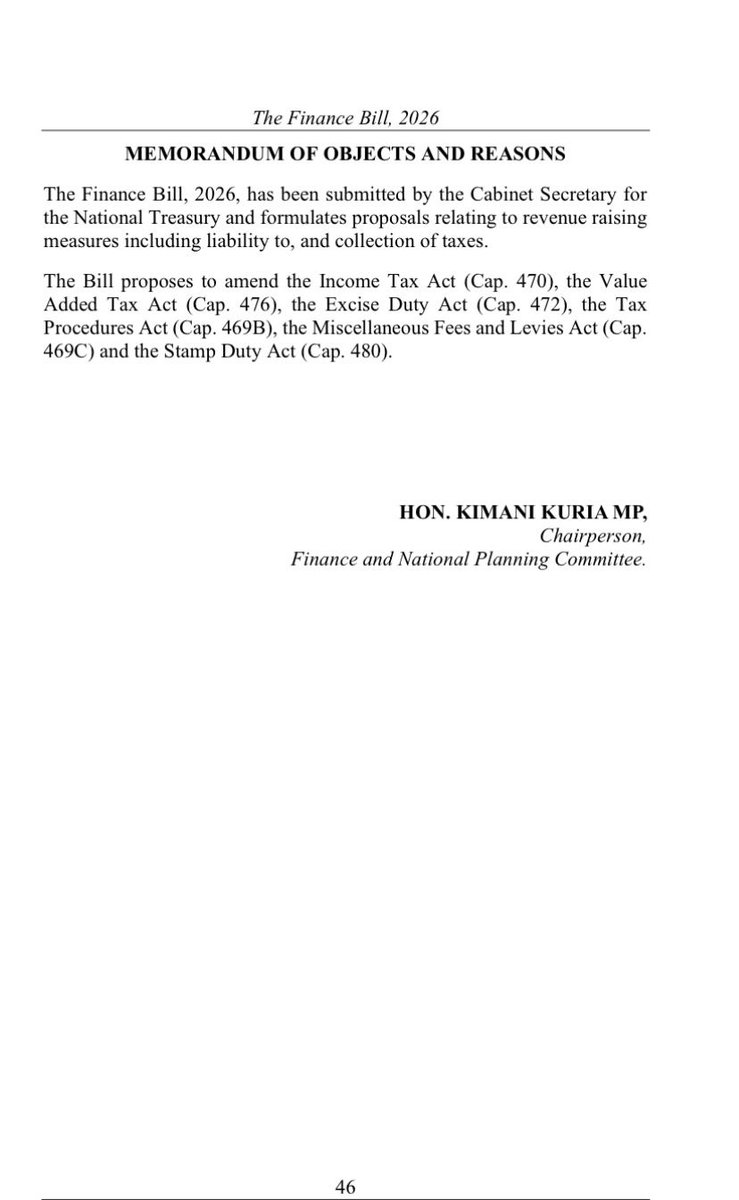
The Finance Bill, 2026 was published on 30th April and is now before Parliament and every Kenyan deserves to know what is in it.
The government targets Ksh3.63 trillion in revenue for 2026/27 and a wider budget deficit of 5.3% of GDP in the 2026/27 fiscal year (July-June) up from 4.7% in 2025/26. These are not unreasonable fiscal objectives but the manner in which the burden of achieving them is distributed is a cause for serious concern.
On tax filing timelines, the Bill moves the income tax return deadline to April 30th which is two months earlier than the current June 30th and compresses nil return filing to January 31st. This reduces the time available for audit completion, cash flow planning and compliance. For small businesses and individual traders, this is not administrative reform. It is an additional compliance cost they can ill afford.
On mitumba, the Bill inserts a new Section 12H into the Income Tax Act which deems profit at 5% of customs value payable upfront before goods are released by KRA as a final tax. A trader importing a bale worth Ksh1 million pays Ksh50,000 regardless of whether they make a profit or a loss. I cannot in good conscience describe this as equitable.
The Bill increases residential rental income tax from 7.5% to 10%. Absent a serious enforcement framework, this will drive non-compliance rather than revenue. The government must fix the enforcement gap before it increases the rate. One without the other is burden-shifting.
On digital financial services, the Bill removes existing VAT exemptions on money transfers and payment processing. These are the tools of financial inclusion that millions of Kenyans including the very people this government says it wants to reach rely on daily. Making them more expensive will not serve the objective of a broader tax base.
By including interchange and merchant service fees within the definition of management or professional fees for withholding tax purposes, the Bill introduces a compliance burden into automated banking processes. That burden will be passed on to businesses and ultimately to consumers.
The amendment to Section 24 of the Income Tax Act empowers KRA to deem at least 60% of a company's undistributed income as dividends for tax purposes. This fails to account for legitimate decisions on reinvestment, working capital and business growth. It is a retrogressive measure that sends the wrong signal to the investors Kenya needs.
A 25% excise duty on telephones for cellular and wireless networks is proposed. A phone is not a luxury. It is how Kenyans bank, communicate, conduct business and access government services. Parliament must interrogate this carefully.
On PAYE, Kenyans were led to expect relief and a restructuring of the tax bands to ease the burden on salaried workers. That proposal does not appear in this Bill. That is not a minor omission. An explanation is owed to every employed Kenyan who was waiting for it.
To be fair, the Bill is not without merit. The reduction of corporate tax for non-resident companies from 37.5% to 30% improves our investment climate. The extension of the tax amnesty to cover liabilities up to 31st December 2025 provides a genuine and welcome pathway to compliance. VAT exemptions on electric buses, bicycles, dialysers, animal feed raw materials and PPP infrastructure are sensible measures. The clarity introduced on trust taxation ensuring beneficiaries are not taxed on income already taxed at the trust level and the recognition of gratuity contributions as exempt income are also steps in the right direction.
Be that as it may, we cannot afford a repeat of June 2024. Parliament must discharge its oversight role with the seriousness this moment demands. They should not merely rubber-stamp what the Treasury has placed before it. Every clause must be scrutinised. Every punitive or ambiguous provision must be rejected or amended.
#FinanceBill2026 #PublicParticipation
A Kenyan by the name Elias Wekesa has taken Safaricom to court, and every Kenyan should pay attention.
He says Safaricom deactivated his line after it stayed inactive for a few months, then reassigned it to another person.
When he tried using it again, he was met with a shock.
The number was gone.
Worse, he says he could no longer receive OTPs from his bank and other platforms tied to that number.
This case matters because it touches every Kenyan.
Because your phone number is no longer just a number.
It is tied to your bank account.
Your email.
Your work accounts.
Your private life.
The moment that number is handed to someone else, the risks begin.
OTPs can go elsewhere.
Recovery codes can land in another person’s hands.
Account alerts can reach a stranger.
That person is not just holding a SIM card.
They may be holding access to parts of your digital life.
And if they have bad intentions, the damage can be immediate.
And for families who have lost loved ones, it cuts even deeper.
A parent’s number.
A sibling’s number.
A loved one’s number.
One day, it holds memories.
The next day, it belongs to a stranger.
This is why Safaricom must be forced to create stronger safeguards before reassigning numbers.
Because in today’s world, a phone number is not disposable.
It is identity.
And identity should never be reassigned without protection.
Couldn't catch him! 🔥 Congratulations to Sabastian Sawe on his fastest marathon (male) at 1:59:30. He also beats Eliud Kipchoge’s fastest marathon distance #londonmarathon@LondonMarathon
BREAKING: Kenya's Sabastian Sawe has broken the marathon world record at the London Marathon, winning the race with a time of 1:59:30.
His victory marks the first time a marathon has been completed in under two hours.
https://t.co/qG53HgvFZu
📺 Sky 501, Virgin 602
HISTORY HAS BEEN MADE 🫨
Sabastian Sawe becomes the first person ever to break the 2-hour barrier in official race conditions, storming to a historic 1:59:30‼️
@KejelchaYomif, on his marathon debut, also breaks 2 hours with a stunning 1:59:41 and @jacobkiplimo2 clocks 2:00:28, also faster than the previous world record 😤