What this account is for
This page explains how things actually work when a current event runs into an old rule.
The rule comes first. That might be a state constitution, a federal statute, a court decision, a GAO report, or a text that has been around far longer than any of those. Then comes the live problem: a city law the state is trying to wipe out, contractors who know more than the officials who sign the paperwork, an AI that speaks as Jesus, a water plant whose pumps can be reached from the open internet.
The last part is the boundary. What the rule covers. What it does not. What a report actually found, and what it refused to claim.
That is the whole method. No slogan at the top. No leftover claim at the bottom.
If a sentence cannot be tied to a text, a court, or a documented finding, it does not go up. The goal is a post you can finish and know where the facts stop.
Read the newest piece for the current case. Read this one if you want the reason the pieces look the way they do.
— The Public Explainer
What’s actually there. τὸ σπέρμα, “the seed/offspring,” is grammatically ambiguous between collective and individual reference in both Greek and the underlying Hebrew (zera). It could mean humanity generally in ongoing conflict with what the serpent represents, or it could point to a single specific descendant. The verb pair, συντρίψειν, “will crush,” against τηρήσειν, “will strike/watch for,” describes a mutual but asymmetric wound, head versus heel, without specifying who, when, or through what event this resolves. The text gives you the shape of an outcome, not a mechanism or a timeline.
This dialogue is the first appearance of deception in the text, and it gives its first concrete instance of temptation operating through information distortion rather than force.
The serpent doesn’t coerce, it reframes. Nothing here overrides the woman’s freedom directly. The serpent works entirely through recasting what the prohibition means, from protective boundary to jealous restriction.
insistence that negative outcomes require a genuine, informed choice, not compulsion. The serpent supplies false information, but the choosing still has to happen on the human side.
Deception doesn’t remove freedom, it targets the accuracy of what freedom is exercised on.
The serpent’s counter-claim inverts consequence into concealment. οὐ θανάτῳ αὐτοὺς περιπεσεῖσθαι, ἀλλὰ τοὐναντίον, not death but the opposite, reframes the warned consequence as a withheld gift.
the serpent is manufacturing a false boundary violation, implying God is jealously guarding god-likeness rather than warning about a real consequence.
The offer isn’t becoming divine outright, but becoming like God in a specific respect, knowing good and evil, which is presented as a shortcut to something the text has already suggested humanity was meant to grow into relationally rather than seize unilaterally.
Five Rulings, One Pattern: Authority Trump Didn’t Have
Five separate legal defeats in 2025 and 2026 trace the same pattern: the Trump administration claiming statutory authority that courts later found Congress never granted.
The clearest example came in February 2026, when the Supreme Court ruled in Learning Resources, Inc. v. Trump that the International Emergency Economic Powers Act did not authorize the broad tariffs Trump had imposed under it. The Court found that when Congress delegates tariff power, it typically does so explicitly and with defined limits, neither of which applied to IEEPA.
Other cases followed a similar structure. The Government Accountability Office concluded in 2025 that the National Institutes of Health improperly withheld congressionally appropriated funds without following the Impoundment Control Act, and found the same violation at the Institute of Museum and Library Services. On August 25, 2026, the Ninth Circuit ruled against administration efforts to condition federal healthcare and housing funds on local compliance with immigration policy, citing congressional control over how such funds may be used.
Election administration produced two more rulings. Courts blocked provisions of Trump’s March 2025 executive order on elections, and in June 2026 a federal judge blocked significant portions of a follow-up order attempting to impose new federal controls on mail voting. Most recently, a federal judge invalidated a State Department policy suspending immigrant visa processing for nationals of 75 countries, finding it exceeded the secretary of state’s statutory authority.
Legal analysts caution against treating every blocked policy as proof of an illegal one, noting that lower court rulings are sometimes narrowed or reversed on appeal. The more consistent thread across these cases is a specific legal question: whether the statute invoked by the administration actually granted the power being used.
Why Presidential Emergencies Outlast Their Justification
Presidents have wide latitude to declare national emergencies, and history shows they rarely end on schedule.
The National Emergencies Act of 1976 was designed to prevent open-ended crisis powers, requiring declarations to expire after one year unless renewed. In practice, renewal has become routine across administrations of both parties. Research from the Brennan Center found presidential emergency declarations have historically lasted an average of about 9.6 years, with some persisting for decades after their original justification faded.
President Truman’s 1950 Korean War emergency remained legally active through the Vietnam era, one of several aging declarations that prompted Congress to pass the 1976 law in the first place. The International Emergency Economic Powers Act became the basis for 65 of the first 71 emergency declarations issued after that law took effect, turning sanctions into a standing tool of foreign policy rather than an exceptional one.
A structural weakness compounds the pattern. Since a 1983 Supreme Court ruling struck down the legislative veto, Congress must pass a joint resolution to end a president’s emergency declaration, and that resolution can be vetoed. During Trump’s 2019 border emergency, Congress voted to terminate it, Trump vetoed the resolution, and lawmakers fell short of the votes needed to override him.
Analysts distinguish several forms emergency permanence can take: the declaration itself persisting through renewal, dormant powers remaining legally available, temporary policy folded into ordinary law, and institutions built during a crisis, such as surveillance systems, continuing afterward.
Declassified Intelligence Fuels New China Election Claims
President Trump released declassified intelligence on July 16, 2026, claiming China had obtained massive quantities of American voter-registration data, information the White House later said totaled as many as 220 million Americans through purchase, theft or hacking.
Independent reviews of the released material found it does not demonstrate that China altered ballots or vote totals in the 2020 election. Officials in several states disputed characterizations suggesting their voter-registration systems had been directly hacked.
The claim adds to a pattern of federal assessments distinguishing foreign influence from actual election interference. Intelligence officials have documented Russian operations using fake personas and state media to shape voter attitudes, along with Iranian hacking of material tied to Trump’s 2024 campaign. China’s activity has centered more on down-ballot races than presidential contests, according to prior assessments.
In late August, Meta removed an Iran-linked network using AI-generated content and fabricated American identities to target journalists and politicians ahead of the midterms, signaling that these operations remain active rather than confined to past election cycles.
Trump Demands Pritzker “CALL!!!” After Violent Chicago Weekend
President Trump posted on Truth Social at 3:45 a.m. Eastern on September 1, saying Chicago violence was “unchecked and at record levels” and demanding Governor JB Pritzker call him.
The post followed a violent weekend. Police reported 22 shooting incidents between Friday evening and Sunday night, leaving 41 people shot and three dead, figures that match Trump’s post. His broader claim that violence has “never been worse” is contested. Chicago has recorded substantially higher homicide totals in past years.
Trump wrote that the city would “die” without federal intervention, calling the federal government a “fine tuned crime fighting machine” and closing with “Governor Pritzker, CALL!!!” He posted the message hours after appearing to close his eyes for extended periods during a Monday Oval Office event on healthcare policy.
The demand extends a dispute dating to 2025, when Trump threatened National Guard deployment to Chicago over Pritzker’s objections. In June, Trump made a nearly identical demand after a separate violent weekend, and Pritzker rejected it, saying he did not trust Trump’s ability to protect Illinois residents. The Supreme Court later ruled against Trump’s Guard deployments in Chicago, Los Angeles and Portland, though Trump has said the troops could return.
Neither Pritzker’s nor Mayor Brandon Johnson’s office had issued a new response to Tuesday’s post as of this writing.
Court Strikes Down Democratic and Republican Redistricting Measures Alike
Colorado’s independent redistricting commission survived the nationwide mid-decade map wars this summer, not through legislation but through a drafting rule.
On June 29, 2026, the Colorado Supreme Court struck down five proposed ballot initiatives that would have let voters redraw the state’s congressional districts before the 2030 census. The measures came from both sides: a Democratic-aligned group backed by allies of House Minority Leader Hakeem Jeffries sought a map favoring Democrats, while a Republican-aligned group filed competing measures of its own.
The court did not rule on partisan fairness. It found that every measure violated the state constitution’s single-subject requirement by combining a change to Colorado’s redistricting process with the adoption of specific new district lines. Some proponents had split their proposal into two interlocking measures to sidestep the rule. Justice Richard Gabriel wrote that conditioning one initiative on the passage of another still amounted to the same violation, calling it an attempt to achieve indirectly what the constitution forbids directly.
The ruling leaves Colorado’s commission-drawn map in place through the decade and removes the state from a fight that has already reshaped congressional maps in Texas, California, Missouri and North Carolina.
Justices End Uncertainty Over Dueling Congressional Maps
The Supreme Court has now cleared the way for two states to use congressional maps drawn explicitly to cancel each other out in the 2026 midterms.
Texas redrew its congressional lines in August 2025 after Governor Greg Abbott directed lawmakers to respond to a Department of Justice letter alleging that four districts amounted to unconstitutional “coalition districts.” The new map, adopted that August, gave Republicans hope of winning as many as 30 of the state’s 38 seats, an increase of five over the previous map. A three-judge panel in El Paso ruled in October that the map was likely an unconstitutional racial gerrymander. Texas appealed, and in December the Supreme Court’s 6-3 conservative majority revived the map, lifting the lower court’s block and allowing it to be used for the 2026 election. The justices found that challengers could not offer an alternative map serving Texas’s stated political needs, and questioned the lower court’s approach.
California voters responded by approving Proposition 50 in November 2025, replacing the state’s independent commission map with a legislatively drawn plan through 2030. The new lines shift five seats toward Democrats. California Republicans and the Department of Justice sued, arguing the map used race to maximize Latino voting strength for partisan ends. In April 2026 the Supreme Court declined to take up their emergency appeal, issuing no dissents and no explanation, effectively letting the map stand alongside Texas’s.
Seven months into the cycle, California, Missouri, North Carolina and Texas have all adopted new congressional maps, while Virginia, Florida, Maryland and Washington continue working through their own redistricting processes. Indiana lawmakers have so far resisted pressure to join the effort.
Legal analysts note that the Texas ruling marks the first time Black and Latino communities in the state face a legislatively enacted reduction in electoral power since the Voting Rights Act passed in 1965. A Washington University law professor said the outcome will likely shape how courts treat the wave of mid-decade maps still working through litigation nationwide.
Texas is expected to petition the Supreme Court to hear the underlying case on its merits, with the plaintiffs set to respond in the coming weeks. The two maps, drawn roughly 1,500 miles apart with opposite partisan goals, now stand as the clearest test yet of how far a state can go when timing, rather than population change, is the reason for redrawing its lines.
Greek Historians Described Crocodiles as Egypt’s Living Defense System
Ancient Greek historians recorded a detail modern readers often miss: Egyptians credited the Nile’s crocodiles with defending their borders.
Diodorus Siculus, writing in the first century BC in his Bibliotheca Historica, gave an Egyptian explanation for honoring crocodiles. He wrote that Egypt’s security came not only from the Nile itself but to a much greater degree from the crocodiles living in it. Raiders from Arabia and Libya, he said, feared crossing the river because crocodiles filled it in large numbers.
Herodotus, writing in the fifth century BC, described the animal’s religious status with more nuance. In his Histories, he noted that residents near Thebes and Lake Moeris treated certain crocodiles as sacred, feeding them, decorating them with jewelry, and burying them after death. At Elephantine, by contrast, residents hunted and ate crocodiles, treating them as ordinary game rather than divine.
Strabo, writing near the time of Augustus, described visiting Crocodilopolis and observing a tame crocodile named Suchus, kept by priests and fed bread, meat, and wine brought by visitors. He connected the abundance of crocodiles in nearby canals and Lake Moeris directly to local reverence, noting that residents would not harm the animals they revered.
Plutarch, writing in the first or second century AD, treated the crocodile as a theological symbol in On Isis and Osiris. He linked its behavior to the annual flooding of the Nile and described it as a living representation of deity.
These accounts sit alongside a different portrait of a Nile creature found in the Hebrew prophets. Ezekiel 29:3 and 32:2 describe Pharaoh as a great creature in the midst of the rivers, language scholars have connected to crocodile imagery familiar across the ancient Near East.
Where Greek sources describe Egyptians revering the animal as protector, the prophetic text describes God seizing the same creature with hooks and dragging it from the water.
Classicists and biblical scholars continue to debate how directly these two traditions intersect, and how much shared imagery existed between Egyptian religious practice and prophetic literature written centuries later.
Good and Bad
Think of it like a radio signal that’s always broadcasting, full strength, no interruptions. That signal is love, and it’s not competing with anything, because it’s the actual ground everything else sits on. Static isn’t a rival broadcast. It’s just interference, what happens when fear or self-judgment garble the reception. The signal doesn’t get weaker when static shows up. It’s still full strength. The static just makes it harder to hear.
So “bad” experiences aren’t a separate force pulling against the good one. They’re distortion, not substance.
Next: every life, every “reality,” is like a tv channel that already exists, playing right now, not something being created moment to moment. Being on a rough channel, one with a lot of static, doesn’t make you less real or less worthy than someone on a clearer one. Worth isn’t handed out by which channel you’re on. Everybody has it already.
What you can actually judge is behavior: did someone knowingly cause harm when they had another option. That’s a real, separate question from worth, and it doesn’t erase anyone’s worth to ask it.
Last part: liking the clearer channels on the tv over the staticky ones isn’t you discovering some built-in preference, like a magnet finding north. It’s a choice you make again and again, moment to moment. And the staticky, hard channel isn’t pointless. Often the friction from a hard experience is what shows you what you actually needed to learn or choose. It did its job even though it was never as strong or as real as the signal underneath it.
Gerrymandering Is a Method, Not a Shape
Gerrymandering is the drawing of electoral district lines to give a party, racial group, or other constituency an electoral advantage or disadvantage. The Constitution Annotated describes partisan gerrymandering as drawing lines to subordinate one party’s supporters and entrench a rival.
The 1812 Massachusetts senate map produced the name. The concept is older and broader than bizarre borders. Geography can look normal and still be designed to lock in a result.
Two techniques appear throughout the case law.
Packing concentrates opposition voters into as few districts as possible. Those voters win the packed seats by large margins and waste the rest of their votes on surrounding districts they cannot affect.
Cracking splits a concentrated opposition group across several districts so that it falls short of a majority in each. Substantial statewide support can then produce few or no seats.
The same 50 voters can yield different majorities depending only on where the lines fall. The vote totals do not change. The boundaries do.
The constitutional split matters.
Partisan gerrymandering is the party-advantage version. In Rucho v. Common Cause (2019), the Supreme Court held that the federal claims presented were political questions because the Court found no judicially manageable standard for how much partisan influence is too much. State constitutions and statutes can still restrict it. Some states prohibit partisan favoritism outright.
Racial gerrymandering is a different claim. Courts may ask whether race predominated in the drawing without sufficient justification. Section 2 of the Voting Rights Act addresses arrangements that unlawfully impair minority voters’ opportunity to participate and elect representatives. Race and party often correlate, so courts sometimes have to decide which purpose predominated.
The earlier landmarks still frame the field. Baker v. Carr (1962) made some apportionment challenges justiciable. Shaw v. Reno (1993) set the Equal Protection framework for racial-gerrymandering claims. Racial redistricting and Voting Rights Act litigation remain active. Partisan claims in federal court, under the theories Rucho considered, do not.
Gerrymandering can reduce competition, distort seat-to-vote ratios, and weaken accountability. It does not follow that every irregular district is a gerrymander, or that a party is constitutionally entitled to seats in proportion to its statewide vote. Population equality, the Voting Rights Act, political subdivisions, and communities of interest can also produce odd lines.
Redistricting is the ordinary process. Gerrymandering is that process used to manufacture an improper advantage. The live controversy is where legitimate line-drawing ends and manipulation begins.
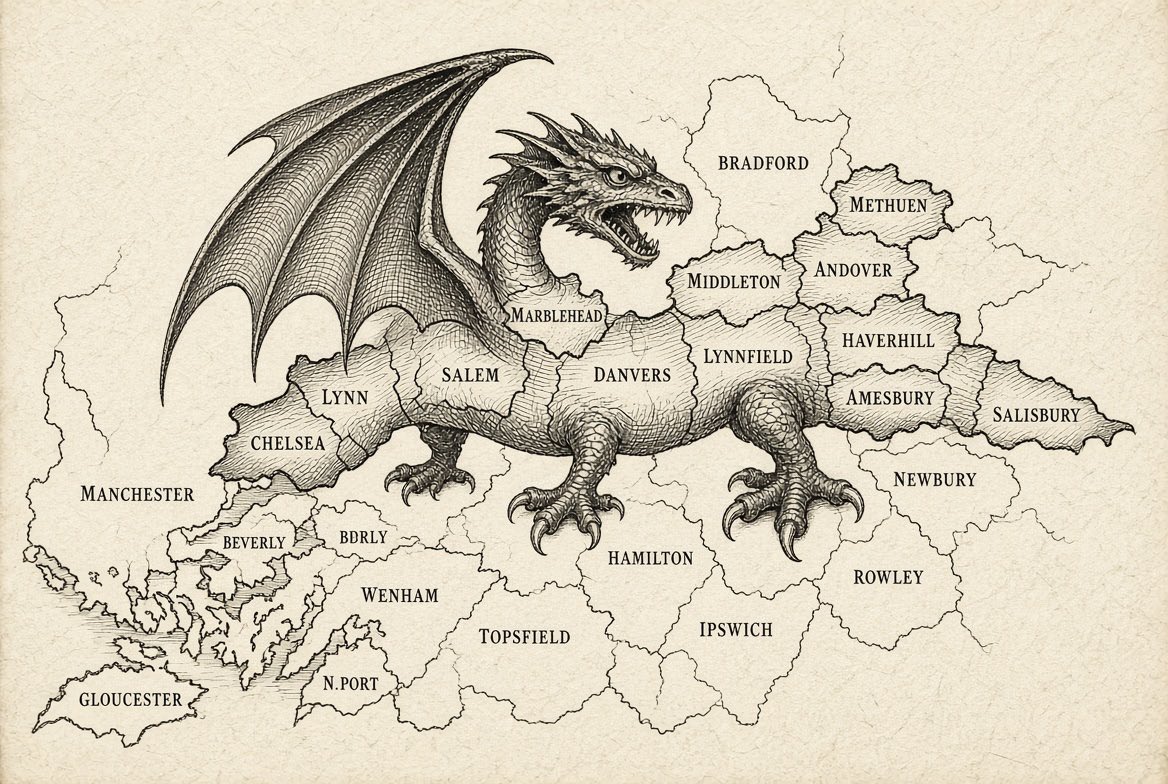
The question the map raises is older than the cartoon: should representatives choose their voters, or should voters choose their representatives.
Redistricting is the normal redraw after a census. Gerrymandering is redistricting done to produce an advantage.
The word comes from an 1812 Massachusetts map so misshapen that a cartoonist fused Governor Elbridge Gerry’s name with a salamander. The shape was never the test. A district can look ordinary and still be packed or cracked.
Federal courts will hear racial-gerrymandering claims. After Rucho v. Common Cause (2019), they will not hear partisan ones.
The Moral Instinct That Traditions Did Not Teach
Across continents and centuries, people who never met and never read the same texts arrived at strikingly similar answers about how to treat each other. A growing line of thought in comparative religion holds that this convergence points to something already present in people before any tradition steps in to teach them.
Researchers and theologians pointing to this idea note that fairness, reciprocity, care for the vulnerable, and aversion to cruelty appear across cultures with little variation. The pattern suggests a moral baseline that predates any single religious system, discovered independently by communities with no contact with each other.
Under this framework, rituals and doctrines function less as installation and more as reminder. The instinct for right living is treated as already present, and religious structure becomes a mirror held up to something that exists independent of the mirror. Proponents argue that most people are already trying to live decently and largely succeeding, a quiet, ordinary fact easy to overlook. This sits uneasily against religious frameworks built around a default state of failure requiring correction, since it suggests the correction was often aimed at people who were not lost to begin with.
Not all scholars working in this space treat the picture as fully settled. Rituals and traditions carry out functions beyond correction. Formation, communal bonding, and the marking of time and grief are cited as separate purposes that operate independently of any claim about human moral deficiency. A person already living according to an internal ethical compass may still find meaning in ritual practice tied to ancestry, mourning, or gratitude, with no relationship to being told they are falling short.
The debate turns in part on the source of the standard being invoked. Framing built on inherent worth, where value is treated as already present and unearned, removes the tension between built-in instinct and external teaching. Framing that still borrows judgment language from a specific religious or cultural system reintroduces the friction, since the standard in that case originates outside the person rather than within.
Comparative religion scholars continue to examine where cross-cultural moral convergence originates and how much of religious ritual functions as correction versus formation, with the distinction shaping how traditions are understood in relation to the people who practice them.
Everyone is shaped by the culture, beliefs, and influences they were raised in. Whatever level of understanding a person has reached, that understanding cannot be forced onto someone else. Genuine unconditional love does not demand agreement.
A problem starts when someone tries to impose their understanding on another person, and escalates when disagreement is met with violence, verbal abuse, or threats to someone’s life.
Take what resonates with you and discard the rest.
Nearly a Billion Acres Are Tangled in Unresolved Tribal Claims
Federal agencies control land the size of dozens of states, and much of it still carries legal claims tribes never gave up.
The Bureau of Land Management alone oversees about 245 million acres of surface land and close to 700 million acres of mineral estate below ground. Large portions of that territory fall within the ancestral homelands, treaty territories, and traditional-use areas of tribal nations. The BLM itself recognizes this history.
Federal ownership does not erase what came before it. Depending on treaty language, statute, and reservation history, a tribe may retain hunting, fishing, gathering, religious, subsistence, or cultural rights tied to land the government now manages. Those rights sit alongside two other legal obligations: the federal trust responsibility and the government-to-government relationship recognized between Washington and tribal nations.
Joint Secretarial Order 3403 pushed this relationship further. It directs the Department of the Interior and the Department of Agriculture to pursue meaningful tribal involvement in managing federal land and water, including early consultation, consideration of Indigenous Knowledge, and co-stewardship arrangements where the law allows them.
Co-stewardship is not land transfer. BLM guidance is direct about that distinction. Federal agencies generally cannot hand over inherently federal functions or surrender their decision-making authority through a co-stewardship agreement. What tribes can gain instead includes cooperative agreements, formal participation in land-use planning, roles in restoration projects, cultural-resource protection work, wildfire management, habitat restoration, and integration of Indigenous Knowledge into agency practice.
Congress has built narrower statutory paths as well. The Tribal Forest Protection Act allows specific projects on federal land bordering tribal territory. Good Neighbor Authority lets tribes partner directly with the Forest Service or BLM on forest, watershed, and restoration work.
The relationship remains unsettled. A 2026 Forest Service study of tribal co-stewardship documented ongoing questions about governmental power, agency capacity, the role of Indigenous Knowledge, and the durability of long-term partnerships between sovereign tribal governments and federal land managers.
The central legal question underneath all of it: when the United States manages land inside a tribe’s ancestral or treaty territory, what authority and protected interests does that tribe retain, and what does the federal government owe in return.
What Sovereignty Actually Means for 574 Federally Recognized Tribes
Federal Indian law rests on a principle many Americans encounter only when a Supreme Court ruling forces the question into headlines: tribal sovereignty predates the United States itself. Federally recognized tribes are not simply operating under authority Congress chose to hand down. Courts have treated their governmental power as inherent, a status carried forward from before the Constitution existed.
The legal architecture supporting that status is layered. The Indian Commerce Clause gives Congress power to regulate commerce with tribes. Treaties, though Congress stopped negotiating new ones in 1871, still control questions ranging from reservation boundaries to hunting and fishing rights. Tribes retain authority to form governments, set citizenship rules, pass and enforce laws, tax, zone land and exclude people from tribal territory, unless a treaty or federal statute has removed that power.
Jurisdiction is where the law grows dense. A 1978 case, Oliphant v. Suquamish Indian Tribe, stripped tribes of criminal authority over non-Indians. Montana v. United States, decided in 1981, set the framework courts still use to decide when tribes can regulate nonmembers on non-Indian land inside a reservation. Congress has since restored or recognized tribal jurisdiction in specific circumstances, creating a patchwork that shifts depending on the location of an offense, the identity of the parties and the type of case.
State authority adds another layer. For decades, courts shielded tribal self-government from state reach. That shield has narrowed. In Oklahoma v. Castro-Huerta, decided in 2022, the Supreme Court found that states can prosecute non-Indians who commit crimes against Indians inside Indian country, unless a federal law preempts that power.
The doctrinal line runs through more than a dozen major rulings. Johnson v. M’Intosh, from 1823, established the doctrine of discovery and aboriginal title. Cherokee Nation v. Georgia, decided in 1831, described tribes as “domestic dependent nations.” Worcester v. Georgia, the following year, limited state authority over tribal affairs. Williams v. Lee, in 1959, blocked state jurisdiction from infringing on tribal self-rule. United States v. Wheeler, in 1978, traced tribal criminal authority to inherent sovereignty rather than federal delegation. Santa Clara Pueblo v. Martinez, decided the same year, addressed tribal membership and sovereign immunity under the Indian Civil Rights Act.
Later rulings extended the framework into gaming, policing and land status. California v. Cabazon Band of Mission Indians, in 1987, shaped state regulation of tribal gaming. United States v. Lara, in 2004, examined congressional power over tribal sovereignty. McGirt v. Oklahoma, decided in 2020, found that the Muscogee Creek Reservation had never been formally disestablished. United States v. Cooley, in 2021, upheld tribal police authority to detain non-Indians suspected of crimes on tribal land.
Tribes do not hold sovereignty identical to that of states or foreign nations. What they hold is a distinct, retained form of governmental authority, one that survives except where federal law has specifically cut it back.