The Global Public Policy Network is an int'l group of top public policy schools: Columbia SIPA, LSE, Sciences Po, LKYSPP, GraSPP, Hertie, FGV-EAESP, Munk.
Hertie School Professor Joanna Bryson takes a look at what New York, London, Barcelona and other places are doing to establish regulations that other cities—and countries—may want to copy.
https://t.co/ipEBvNmFKH
Clément Beaune, Minister of State for European Affairs, shared his analysis of the current French presidency of the Council of the European Union, in the current geopolitical context, with the Russian invasion of Ukraine.
https://t.co/uPlkGmafZT
What is “public policy”? Listen to this podcast with Lim Siong Guan, Professor in Practice at the Lee Kuan Yew School of Public Policy and the former Head of the Singapore Civil Service.
https://t.co/lHHHBan6pY
Join us on 13 April for the 3rd webinar of the GPPN: Thinking Public Policy series, where faculty from FGV, GraSPP, Hertie, LSE and SIPA will share their views on “The Global Impact of the War in Ukraine”.
For more info and registration, please visit https://t.co/rIbbZhYlSF
Young people’s mental health and wellbeing suffered during the pandemic, and we do not yet know what the long-term consequences will be. Annette Bauer (LSE) looks at which groups have been most affected and calls for support that extends beyond 2022.
https://t.co/izjAhZXgR5
Congratulations to the winning teams of the GPPN Annual Conference 2022!
BEST PROJECT "GPPN Henrik Enderlin Award" – Sourceable, Columbia SIPA
Click the link to view more awards!
https://t.co/ulAoZ6UdtI
During financial crises, SIPA’s community of policy experts help keep the economy afloat — and mentor the next generation of leaders. https://t.co/cOEo4QKBvO
Hertie MPPs Ba-Linh Le, Babatunde Williams, and Lena Wagner tackle the problem of domestic and partner violence through the work place and other peers. https://t.co/nAHWXbjwB4
Join the GPPN Webinar Series #2 on 21 Feb 2022 to hear from and question thinkers and practitioners who have negotiated climate pacts, advised world leaders and authored seminal works on climate, sustainability, energy and the environment.
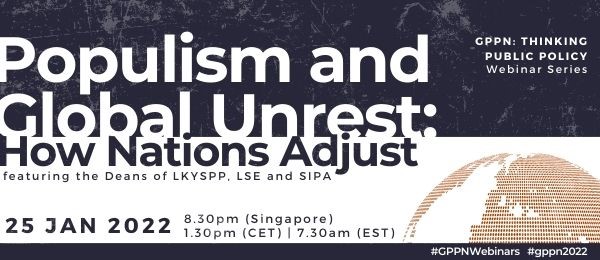
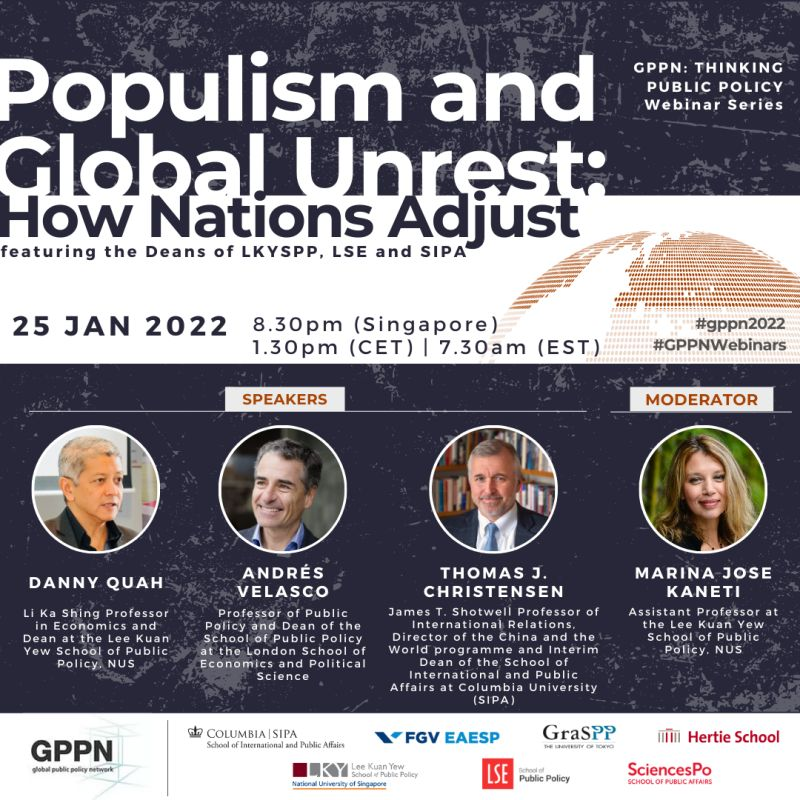
Hear the views of the Deans of Lee Kuan Yew School of Public Policy, School of Public Policy at the LSE and School of International and Public Affairs (SIPA) at Columbia University on “Populism and Global Unrest: How Nations Adjust”.
See you on 25 Jan!
https://t.co/2NqjF51fxo
Covid-19 has brought about the ‘Great Resignation’ wave, a phenomenon describing “workers’ mass exodus from the labour market”. This article discusses the Great Resignation phenomenon, its drivers and possible remedy strategies.
https://t.co/7STHRzbYM8
Join the webinar on 21 Jan to understand the French government’s strategy and vision of the Indo-Pacific region, along with specific examples of cooperation between France and its partners of the region, notably Japan.
https://t.co/RKqeXfcsEg
Emma Rouvet and Hugues de Rosny from Sciences Po created “Média Positif” to highlight the positive news that is “born every day in silence”, in the fields of science, environment, culture, technologies and inspiring social and entrepreneurial initiatives.
https://t.co/SUfSZUccvG
Arianna Ornaghi, Assistant Professor of Economics at the Hertie School, and co-authors study challenges for universal healthcare in developing countries by examining policy tools that might boost enrolment in contributory healthcare plans.
https://t.co/55touvFcQO
From the Cold War to biological weaponry, the super-spy film franchise has, over almost six decades, adapted to the dominant anxieties of the times.
https://t.co/VzTJuQvpue
The 2022-23 Atlantic Fellows for Social and Economic Equity programme, a funded fellowship at the International Inequalities Institute at the London School of Economics, is now open for applications.
Candidates from SEA are encouraged to apply.
https://t.co/HO0KWIWJTZ
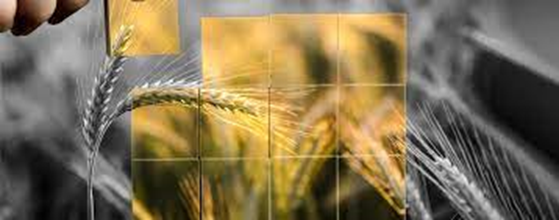
Dr Sebastian Levi from Hertie School analyses attitudes toward GMOs and finds that people from countries with “low standards of living, a high prevalence of undernourishment, and a strong economic dependency on agricultural output” tend to be most optimistic about it.