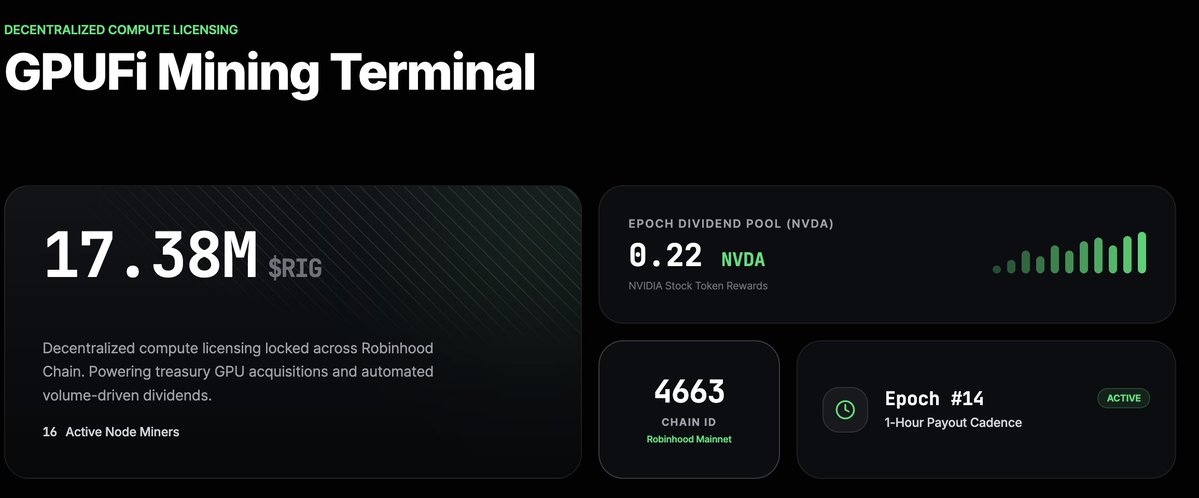
The mining mechanism is running.
This video walks through the full workflow :
Connect a Web3 wallet.
Lock $RIG.
Track live mining metrics.
Prepare epoch claims through the smart contracts.
No mockup. No static UI.
Just the actual mining flow in action.
Watch it run.
https://t.co/Fmru84E8JK
#GPUFi #GPU #Compute #Crypto
NVDA miners update.
0.033816 NVDA has now been claimed across the latest miner settlements.
Every claim is tracked onchain and reflected in the mining system.
The machine keeps running.
The rewards keep accumulating.
https://t.co/nql2atTOk8
BUYBACK + BURN EXECUTED.
4% of $RIG supply bought back and sent to 0x...dead. Permanent. Previous burns: 2.8%. This event takes total supply reduction to 4%. Not a teaser.
On-chain.Verify:
→ [TX https://t.co/ExNGk5QtPJ]
→ [TX https://t.co/3RM6nGbuEQ]
Development does not pause after a burn. We keep shipping $RIG: mining, treasury, GPU infra.
This is not a roadmap. This is a receipt.
$RIG #DePIN #GPUFi
Trading is only the starting point.
Our latest article breaks down GPUFi’s economic loop, from $RIG trading activity and mining to treasury-funded GPU infrastructure and compute.
Read the full breakdown here. https://t.co/hxC75UAxrE
THE LOOP WORKS.
Tax → mining pool → miners → NVDA payout. End to end. On chain.
Epoch 1: 5 miners paid in NVDA (real RWA token).
Supply burn: 2.8% gone. Permanent.
Code: public. https://t.co/YBBYGJY5S7
Zero GPU at launch. On purpose.
Mining yield: live. Day 1.
This is not a roadmap. This is a receipt.
$RIG #DePIN #RWA #GPUFi
Mining update
Five wallets are mining. That is the current count. Not a campaign number. Five locks in the contract. We will publish the data next: addresses, lock size, commit days, and mining power. On-chain first, then the summary. Until that post lands, treat the explorer as the source. If a lock is real, it is already visible. If it is not on-chain, it does not count.
GPUFi SDK is now mainnet-ready.
The latest update brings the SDK in line with the live protocol, covering mining, epoch tracking, reward claims, token interactions, and protocol telemetry.
Build directly on GPUFi :
https://t.co/gWSQTUBHqQ
3/ Why this matters for GPUFi:
X trading = attention on RWA
Attention on RWA = volume on RHC
Volume on RHC = tax revenue
Tax revenue = mining pool yield
Mining pool yield = miner retention
Miner retention = ecosystem growth
The loop. Open. Verifiable.
$RIG #DePIN#RWA#GPUFi
1/ X just partnered with Gemini, Kraken, Coinbase, and Interactive Brokers.
Trading from the timeline. Stocks + crypto. Social trading is here.
This validates everything we're building.
🧵
Agree. GPUs compress time. Most crypto products still ask people to wait for hardware that is not on-chain yet. $RIG (GPU-Fi) on Robinhood Chain starts at the other end: mining is live now. You lock RIG, power ramps over 21 days, payouts run hourly from a pool that already exists.
How does GPUFi mining actually work?
We break down the mechanism behind $RIG mining, from time-weighted mining power and hourly epochs to reward calculation and the unlock process.
If you want to understand what's happening under the hood, start here. https://t.co/S2f9KlslQ2
A lock just landed on-chain. Mining is running clean.
TX: https://t.co/qfqYXgeT8j hash is the point. A miner committed tokens. The contract accepted the lock. Power started accruing on the 21-day curve. No extra story required. How the lock works, in the open: You lock RIG. That lock is your mining license.
Power = locked amount × min(1, days committed / 21).
Day one is a small slice. Day 21 is full weight.
Cap stays 20M RIG per wallet.
After day 21, unlock is gradual: 10% per day.
Leave early and 10% of the exit goes back to the pool. The rest returns to you.





![GPUFi_RH's tweet photo. BUYBACK + BURN EXECUTED.
4% of $RIG supply bought back and sent to 0x...dead. Permanent. Previous burns: 2.8%. This event takes total supply reduction to 4%. Not a teaser.
On-chain.Verify:
→ [TX https://t.co/ExNGk5QtPJ]
→ [TX https://t.co/3RM6nGbuEQ]
Development does not pause after a burn. We keep shipping $RIG: mining, treasury, GPU infra.
This is not a roadmap. This is a receipt.
$RIG #DePIN #GPUFi](https://pbs.twimg.com/media/HS5x0jHacAAGVP-.jpg)