24/7 Markets Are Becoming Infrastructure
Markets were built around opening hours.
Liquidity wasn’t.
For decades, access to traditional markets followed a fixed schedule.
Opening bell.
Trading session.
Closing bell.
But that structure is beginning to change.
Robinhood is moving toward 24-hour weekend trading for select U.S. stocks and ETFs.
Tokenized equities are bringing traditional assets into markets designed for continuous access.
And new onchain trading frameworks are beginning to connect execution, liquidity, and settlement beyond traditional market hours.
This is more than an extension of the trading day.
It is a change in market structure.
Because once markets become continuous, everything around them has to evolve as well.
Liquidity provision.
Price discovery.
Settlement.
Risk management.
Market making.
The transition looks increasingly clear:
Limited Hours
→ Extended Access
→ Continuous Trading
→ Continuous Liquidity
→ Always-On Market Infrastructure
The challenge is that 24/7 access does not automatically create 24/7 liquidity.
A market can remain open while depth becomes thinner.
Spreads can widen.
Risk can accumulate outside traditional trading hours.
Settlement and collateral systems must adapt.
And market makers must manage inventory across a market that never truly closes.
That is why the next phase of 24/7 markets will not be defined simply by access.
It will be defined by market quality.
🏛 GQ Perspective
Continuous markets require continuous infrastructure.
The winners will not simply be the platforms that stay open the longest.
They will be the ones that can maintain liquidity, execution quality, settlement, and risk management around the clock.
24/7 trading is the product.
24/7 market structure is the infrastructure.
GQ
Built for builders. Liquidity for the future.
Not Every Market Is A Full Moon.
Markets move through cycles.
Expansion.
Consolidation.
Uncertainty.
Recovery.
The strongest participants understand that no phase lasts forever.
Liquidity changes.
Risk appetite shifts.
Capital rotates.
But disciplined market structure matters through every cycle.
This Mid-Autumn Festival, we’re reminded that long-term markets are not built around a single moment of brightness.
They’re built through consistency, resilience, and the ability to navigate every phase.
From all of us at GQ,
Happy Mid-Autumn Festival.
GQ
Built for builders. Liquidity for the future.
Tokenization Is Entering Its Utility Phase
For the past few years, most conversations around tokenization focused on issuance.
Can real-world assets move onchain?
Can equities, funds, and credit products be represented as tokens?
That phase is increasingly becoming the baseline.
The more important question now is:
What can those assets actually do once they are onchain?
We are beginning to see the answer.
Tokenized assets are moving beyond passive ownership and into broader financial use cases:
• Collateral
• Lending
• Liquidity pools
• Settlement
• Cross-market trading
• Onchain distribution
This marks an important shift.
Issuance was Phase One.
Utility is Phase Two.
The real value of tokenization does not come from creating a digital wrapper around an existing asset.
It comes from making that asset programmable, composable, and usable across a wider financial stack.
The progression looks increasingly clear:
Issuance
→ Distribution
→ Liquidity
→ Utility
→ Capital Efficiency
As more assets move onchain, the competitive advantage will no longer be simply who tokenizes first.
It will be who creates the deepest utility around those assets.
Because assets become more valuable when they can move, settle, collateralize, and interact with other markets more efficiently.
🏛 GQ Perspective
Tokenization is beginning to move from infrastructure to application.
The first phase proved that assets could exist onchain.
The next phase will determine whether they can become true financial primitives.
Issuance creates access. Utility creates markets.
GQ
Built for builders. Liquidity for the future.
The Hike Is Priced In.
The Path Isn’t.
🏛 Markets are entering one of the most important FOMC meetings of the year.
A 25bp rate hike is now largely reflected in expectations.
That means the immediate decision may not be the most important part of tonight’s meeting.
The real question is what comes next.
Does the Fed view this as a one-off adjustment?
Or the beginning of a renewed tightening cycle?
That distinction matters far more for markets.
📊 The transmission mechanism is straightforward:
Fed Path
→ Treasury Yields
→ Dollar
→ Financial Conditions
→ Risk Appetite
→ Liquidity
With the U.S. 10-year yield recently testing the 5% level, financial conditions are already tightening before the decision itself.
For crypto and other high-duration assets, the next move will therefore depend less on the headline rate change and more on how markets reprice the path of policy.
💧 What matters tonight:
→ The updated dot plot
→ Inflation expectations
→ The Fed’s view on future hikes
→ Treasury yield reaction
→ Dollar strength
→ Risk-asset liquidity
A hawkish hike accompanied by higher projected rates could keep pressure on liquidity.
A hike paired with a more limited forward path would tell a very different story.
The rate decision is an event.
The liquidity path is the signal.
🏛 GQ Perspective
Markets rarely move because of the number everyone expected.
They move when expectations about the future change.
Tonight, the question isn’t simply whether rates rise
It’s how expensive liquidity will be from here.
GQ
Built for builders. Liquidity for the future.
Clarity Is A Liquidity Catalyst
Markets don't rally simply because new regulation is introduced.
They rally because uncertainty begins to disappear.
The recent momentum around the CLARITY Act isn't just another policy headline.
It represents something markets value far more: predictability.
📈 Regulatory clarity reduces friction.
It gives exchanges greater confidence to build.
It gives institutions greater confidence to allocate.
It gives market participants a clearer framework for long-term decision making.
That's why regulatory progress often has an impact far beyond sentiment.
It improves the conditions under which capital is willing to participate.
💧 Liquidity follows confidence.
When uncertainty falls, market makers can price risk more efficiently.
Institutions can deploy capital with greater conviction.
Exchanges can expand new products with clearer expectations.
Markets become easier to build—not just easier to trade.
The long-term opportunity isn't simply regulatory approval.
It's the foundation that regulation creates for broader market participation.
Because clarity doesn't guarantee liquidity.
But it makes liquidity far more likely.
GQ
Built for builders. Liquidity for the future.
The Next ETF Moment May Happen Onchain
The launch of spot Bitcoin ETFs changed how institutions entered crypto.
But ETFs may only be the beginning.
The next evolution isn't simply about accessing crypto.
It's about bringing capital markets onchain.
• 📈 Tokenized Stocks
• 📊 Tokenized ETFs
• 💵 Stablecoin Settlement
• 🌍 Global Distribution
These aren't isolated products.
They're pieces of the same financial infrastructure.
Traditional ETFs gave investors exposure.
Onchain assets add programmability, composability, and continuous liquidity.
The real competition isn't about who tokenizes assets first.
It's about who builds the deepest, most efficient markets around them.
Because tokenization creates assets.
Liquidity creates markets.
GQ
Built for builders. Liquidity for the future.
Distribution Is Becoming the New Moat
Robinhood’s role in the Trump Accounts initiative isn’t just another product launch.
It reflects a broader shift in financial markets.
📌 Distribution is becoming one of the industry’s strongest competitive advantages.
Today, the industry’s leading players are taking different paths:
🏦 Robinhood — expanding beyond brokerage into tokenized assets, blockchain infrastructure, and digital investing.
🌐 Coinbase — building an integrated ecosystem across trading, payments, wallets, and Base.
📊 BlackRock — extending digital asset access through ETFs and tokenized investment products.
Different strategies.
The same objective.
To become the primary interface through which capital enters financial markets.
As investment accounts, wallets, tokenized assets, and on-chain infrastructure continue to converge, competitive advantage is no longer defined only by the products a platform offers.
It is increasingly defined by distribution.
💡 The platform that owns the first financial relationship is more likely to shape where capital moves next.
The next competitive edge may not come from launching more financial products.
It may come from owning the distribution layer that connects investors, liquidity, and markets.
GQ
Built for builders. Liquidity for the future.
Bitcoin Treasury Financing Test
Strategy’s STRC preferred stock has come under pressure as BTC trades near recent lows.
This is not only a Bitcoin price story.
It is a capital structure story.
STRC was designed to support Strategy’s Bitcoin treasury model by offering income-oriented exposure while helping fund BTC accumulation.
But when preferred shares trade below par, the financing loop becomes harder to sustain.
Key questions for the market:
• Can dividend costs remain manageable?
• Can preferred equity still support BTC accumulation efficiently?
• Does common equity issuance create dilution pressure?
• Does BTC volatility weaken access to capital?
• How much confidence remains in the treasury model?
Bitcoin treasury companies are not only exposed to BTC price.
They are exposed to the financing conditions around BTC.
When the asset falls, the capital stack gets tested.
GQ
Built for builders. Liquidity for the future.
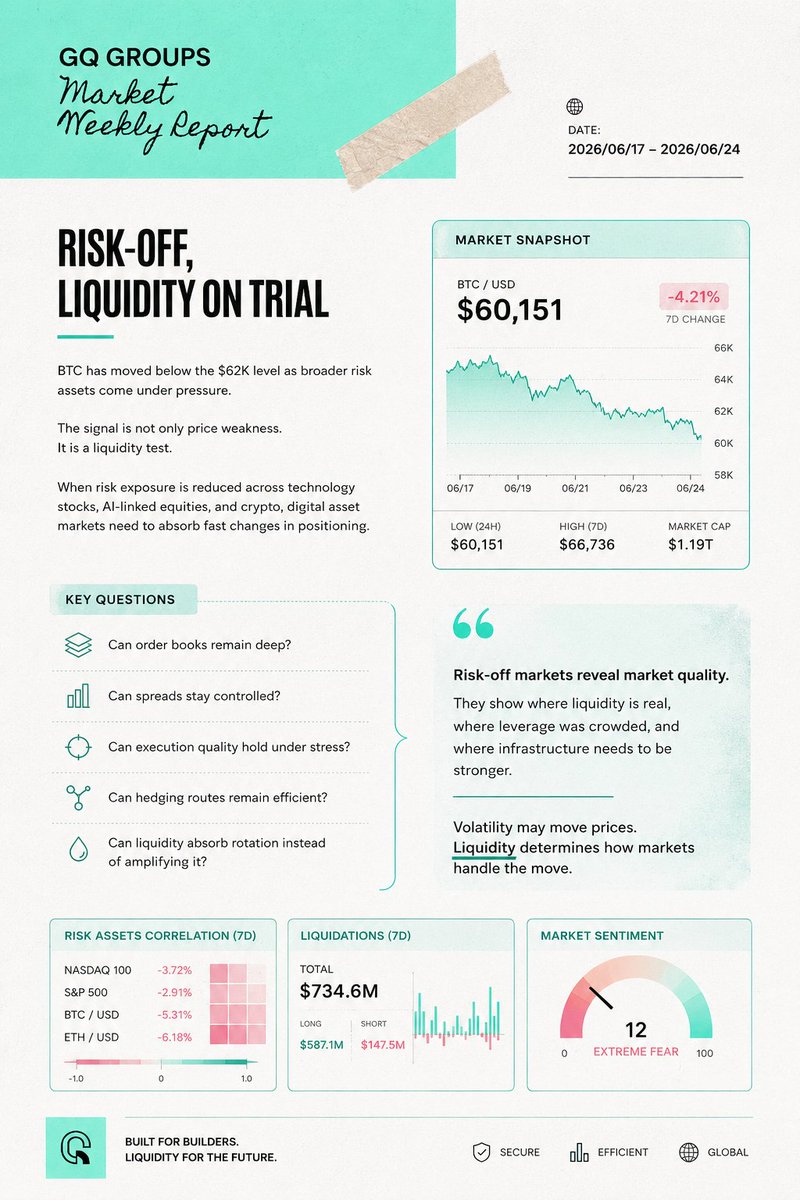
Risk-Off, Liquidity On Trial
BTC has moved below the $62K level as broader risk assets come under pressure.
The signal is not only price weakness.
It is a test of market quality:
• depth
• spreads
• execution
• hedging
• leverage reset
Risk-off markets reveal where liquidity is real and where positioning was crowded.
Volatility moves prices.
Liquidity determines how markets handle the move.
GQ
Built for builders. Liquidity for the future.
Institutional Rails Keep Expanding
Institutional crypto is moving beyond simple exposure.
Franklin Templeton’s expansion of Franklin Crypto reflects a broader shift in how traditional asset managers are approaching digital assets.
The focus is no longer only:
• spot ETFs
• directional allocation
• passive exposure
It is increasingly about infrastructure:
• active crypto strategies
• tokenized funds
• collateral efficiency
• institutional execution
• custody and risk controls
• regulated market access
For BTC and ETH markets, this matters because institutional participation requires more than investment products.
It requires reliable rails.
As traditional asset managers build across tokenization, collateral, and digital asset strategies, crypto liquidity becomes part of a larger market stack.
The next phase of institutional adoption may not be defined only by inflows.
It may be defined by the infrastructure that allows capital to move, hedge, settle, and scale.
GQ
Built for builders. Liquidity for the future.
Institutional Allocation Signal
Institutional crypto allocation is no longer only about ETFs.
The next discussion is portfolio construction.
Whether it comes from pension funds, wealth platforms, corporate treasuries, or long-duration capital pools, the signal is the same:
crypto is moving from trade exposure to allocation exposure.
Even small allocation percentages can matter when the capital base is large.
But for BTC and ETH, the question is not only inflow size.
It is whether market depth, spread stability, and execution quality can support larger, slower-moving institutional capital.
Long-term allocators do not only need access.
They need liquidity they can trust.
As crypto enters more portfolios, liquidity becomes more than trading infrastructure.
It becomes allocation infrastructure.
GQ
Built for builders. Liquidity for the future.
Liquidity Wait Mode
BTC is holding near the upper end of its recent range as markets wait for fresh macro direction.
Tonight, investors are watching Kevin Warsh’s first Fed policy decision and press conference as Chair.
The rate decision may not be the main event.
The signal is in the language:
➡️ inflation risk
➡️ rate-path guidance
➡️ Treasury yields
➡️ dollar strength
➡️ risk appetite
➡️ liquidity conditions
For large-cap crypto, range-bound markets are not inactive markets.
They are waiting markets.
When policy signals shift, volatility can return quickly.
That is why depth, spread stability, and reliable execution matter before the next move begins.
GQ
Built for builders. Liquidity for the future.