Web3 neobanks have reached the point where the card itself is no longer the moat.
Most teams either already have a card or have access to the infrastructure needed to launch one quickly. The harder part is turning that card into something people trust, fund, and use more than once.
That is where most products start to separate.
A partner logo, a referral campaign, or a cashback headline might look strong from the outside, but they do not always translate into real usage. Many users sign up, test the product once, claim the reward, and then never build a habit around it.
For a Web3 neobank to become part of someone’s daily money flow, the value needs to be clear from day one:
→ good cashback
→ yield on balances
→ easy stablecoin spending
→ fewer onboarding steps
→ visible proof that real people use it daily
That last point matters a lot.
In crypto, launch campaigns often make products look more active than they really are. Real UGC changes that because it gives people proof outside of a landing page or paid post. Screenshots of spending, receipts, cashback rewards, and daily card usage make the product feel more believable.
Payment rails like @Visa or @Mastercard also help close that trust gap.
For crypto-native users, stablecoins, wallets, off-ramps, and yield already make sense. For users outside the crypto bubble, familiar payment names make the product feel closer to something they already understand.
That is the real GTM challenge for Web3 neobanks.
The winners will not be the teams that only launch a card. They will be the ones that make the full user journey feel easy to trust, easy to start, and useful enough to become part of daily money habits.
Full story ↓
https://t.co/gfx3YPfQpe
Web3 neobanks have reached the point where the card itself is no longer the moat.
Most teams either already have a card or have access to the infrastructure needed to launch one quickly. The harder part is turning that card into something people trust, fund, and use more than once.
That is where most products start to separate.
A partner logo, a referral campaign, or a cashback headline might look strong from the outside, but they do not always translate into real usage. Many users sign up, test the product once, claim the reward, and then never build a habit around it.
For a Web3 neobank to become part of someone’s daily money flow, the value needs to be clear from day one:
→ good cashback
→ yield on balances
→ easy stablecoin spending
→ fewer onboarding steps
→ visible proof that real people use it daily
That last point matters a lot.
In crypto, launch campaigns often make products look more active than they really are. Real UGC changes that because it gives people proof outside of a landing page or paid post. Screenshots of spending, receipts, cashback rewards, and daily card usage make the product feel more believable.
Payment rails like @Visa or @Mastercard also help close that trust gap.
For crypto-native users, stablecoins, wallets, off-ramps, and yield already make sense. For users outside the crypto bubble, familiar payment names make the product feel closer to something they already understand.
That is the real GTM challenge for Web3 neobanks.
The winners will not be the teams that only launch a card. They will be the ones that make the full user journey feel easy to trust, easy to start, and useful enough to become part of daily money habits.
Full story ↓
https://t.co/gfx3YPfQpe
Median cost per install, by category.
For finance, the median Apple Ads search-results CPI was $1.80. U.S. finance apps had a median CPI of $8.23 and a median CPT of $3.55.
That cost covers only the install stage – before signup, KYC, funding, and first-use drop-off.
If I had to bet $100K on raising $3M+ in pre-seed for my startup this year, here’s exactly what I’d do:
1. Start your X founder page. Yes, this is step 1. Yes, this is important. Founder persona = your main edge in 2026.
We did a deep GTM analysis of Web3 neobanks.
The strongest teams are not winning through better cards alone.
They are winning through payment trust, referral mechanics, creator-led distribution, public proof, and activation design.
If you are building a Web3 consumer product, this is worth reading ↓
https://t.co/gfx3YPfQpe
Since inception, @stacy_muur has always insisted that @GREEND0TS should rely on data and research.
Data → Knowledge.
And our knowledge is public.
Sign up for Green Dots Research ↓
https://t.co/YvPbJbLsLo
In 2026, founder growth is becoming one of the clearest marketing advantages for companies that sell complex products, create new categories, or operate in low-trust markets.
Not because every founder needs to become an influencer.
Most should not.
The real reason is simpler: people need a source of trust that feels harder to copy than a feature set.
This is what founder persona gives.
Influencer marketing is here to stay.
Here are 5 reasons why ↓
1. It is now part of a broader marketing mix.
2. Strong KOLs still bring trust, attention, and mindshare that ads alone often do not.
3. A good KOL can deliver multiple times across a campaign, not only once.
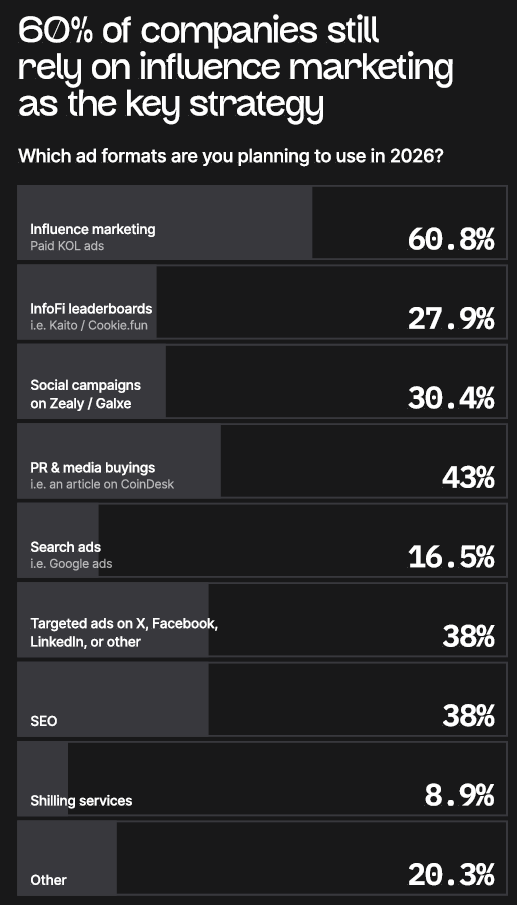
4. Teams are pairing influencer campaigns with SEO, targeted ads, and PR.
5. Influencer marketing is shifting from short-term visibility to a repeatable growth layer.
Influencer marketing still matters, but the strongest teams are no longer using it alone.
Some DeFi products are difficult to understand.
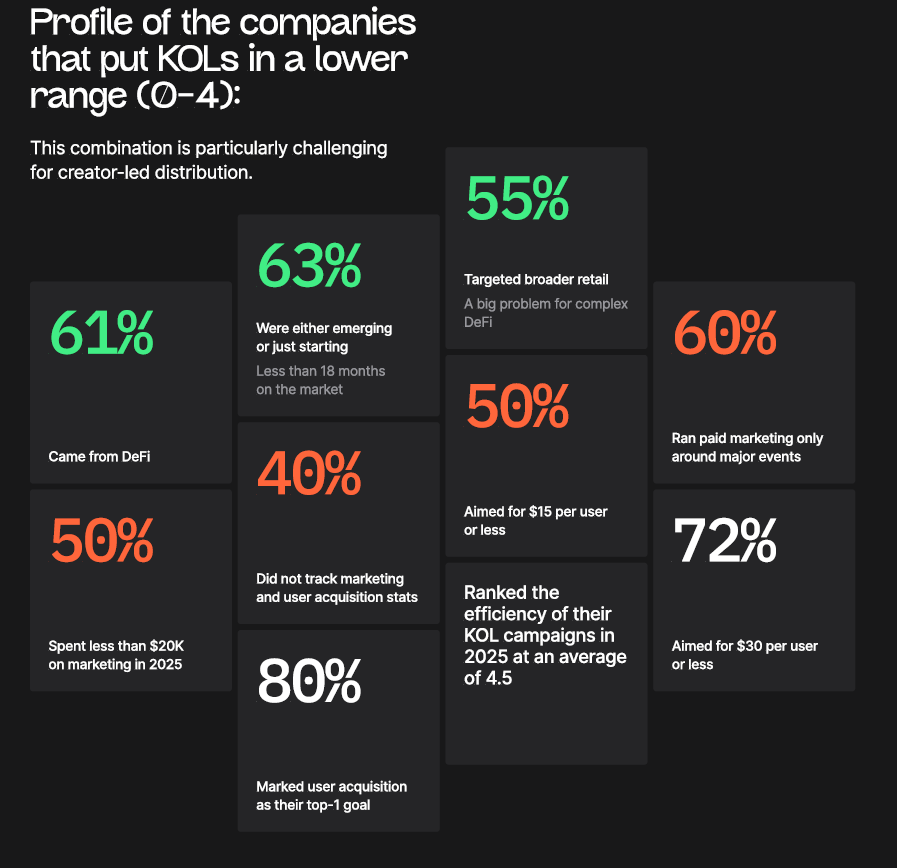
Many teams still market them to broad retail audiences, which creates a product-audience mismatch from the start.
That makes KOL campaigns underperform, not because creators are ineffective, but because the strategy is often too broad, too short-term, and poorly measured.
The pattern usually looks like this:
→ 55% targeted broader retail
→ 60% only ran paid marketing around major events
→ 40% did not track acquisition costs
That is why low KOL efficiency often says more about campaign design than creator marketing itself.
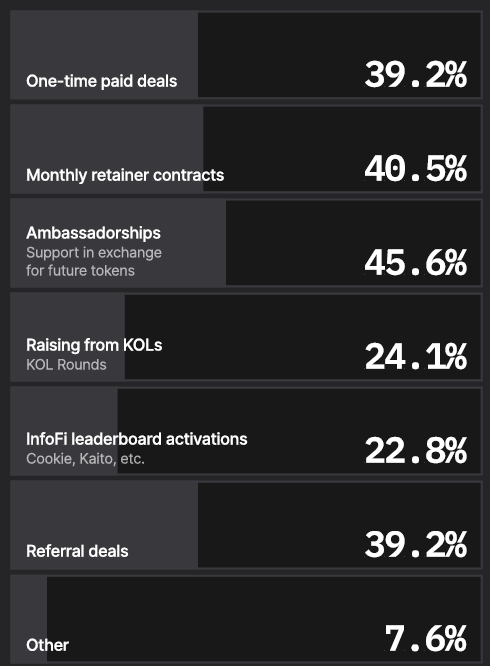
Marketers are leaning toward long-term KOL relationships over short-term ones.
Monthly retainers and ambassadorships are now among the most common ways teams work with creators.
There’s so much information moving across X every day that single posts get forgotten fast.
If you want to build attention, repeated exposure matters.
Longer-term structures give projects:
→ consistent visibility
→ room to build familiarity
→ more repeat exposure
What do teams really look at when choosing KOLs?
In our marketing study, 66% of projects said they focus on a KOL’s reputation, while 56.6% said they look closely at the quality of the content and research already posted on the profile.
Reputation usually signals trust. Strong content shows that a creator has built an audience for the right reasons—not just by farming engagement.
Smart followers matter too.
37.7% of teams said they look at this as well, because it helps show whether a creator resonates with real, relevant people—not bots, inactive followers, or parody accounts.
We’ll share a separate list of crypto-focused tools for this soon.