GSX Monthly Coffee Report | July 2026
Coffee markets delivered another volatile month, with Arabica surging to $3.57 in early July before settling into a $3.10–$3.45 range. In our latest Monthly Coffee Report, we cover:
With tightening certified stocks, significant weather risks and a changing global balance sheet, there’s plenty for the coffee market to navigate in the months ahead.
https://t.co/2RLlzuDSgi
We're pleased to officially welcome Sean Karlson to GSX as our Junior Commodity Analyst.
After interning with GSX over the past three months, Sean has now joined the team full-time and is supporting the continued development of our research platform and backend data infrastructure, helping strengthen the analytical capabilities that underpin our market research.
We're excited to have Sean on board as we continue to expand our research capabilities.
Welcome to the team, Sean.
Our latest GSX Weekly Commodity Comment is now available.
If you're not already subscribed, now is a great time to sign up. Over the coming months we'll be launching an enhanced research offering, and subscribers will be the first to receive updates, early access, and exclusive launch offers.
This week's key themes:
• Cotton remains a weather-driven market, with Texas continuing to be the key risk despite higher U.S. production forecasts and softer export demand.
• Coffee is trading in a high-volatility range, supported by historically low ICE arabica stocks while large Brazilian crop estimates continue to cap upside.
• Macro markets remain focused on inflation, rising bond yields, China's slowing economy, and escalating geopolitical tensions in the Middle East.
Read the full report and subscribe here:https://t.co/IUjCYZYyhf
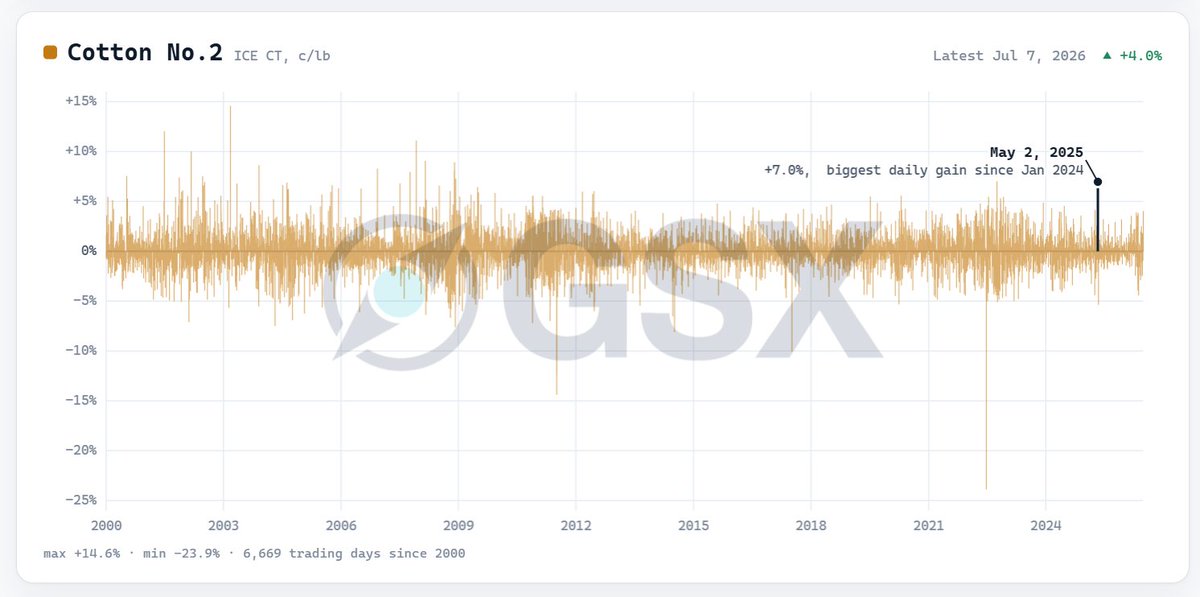
Cotton continues to trade as a weather market, with Texas conditions remaining the key variable. While the board has begun pricing in weather risk, higher planted acreage and softer export demand continue to temper the upside.
Coffee goes crazy in one-day price shock, a 48.75 cent move followed by a pullback of around 32 cents. Weather concern, Brazil's record crop expectations or tightening nearby supply? Volatility is here and elevated despite the larger production outlook.
Our latest Weekly Commodity Comment explores what these developments mean for price direction and the key risks to watch in the weeks ahead.
Read the full commentary and subscribe to receive our market insights directly in your inbox. https://t.co/rHKHV97r9e
• Cotton remains a weather market, with deteriorating Texas conditions providing support, although larger U.S. planted acreage continues to cap rallies.
• Coffee prices remain underpinned by harvest disruption in Brazil and historically tight certified stocks, despite expectations for a record crop.
• The market's shift towards a higher-for-longer U.S. interest rate outlook and a stronger U.S. dollar continues to weigh on commodity markets.
Our latest commentary explores what these developments mean across cotton, coffee and the broader macro environment, and the key risks to watch in the weeks ahead.
Read the full Weekly Commodity Comment and subscribe to receive it directly in your inbox each week.
https://t.co/rMj7YLP9ZQ
Technical analysis is one piece of the puzzle, helping identify key price levels, market structure, and potential trading scenarios alongside the fundamental outlook.
Our latest GSX Technical Analysis is now available:
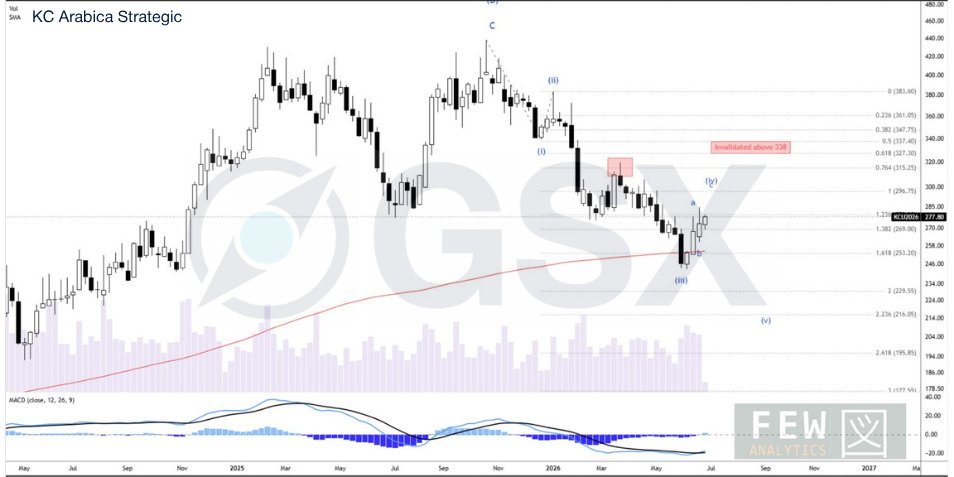
• KC Arabica Coffee – Our base case remains for macro wave (C) lower, with a minimum downside target of 215. The current wave (iv) rally is progressing toward the 295-300 region, which we see as a potential short-entry zone ahead of the next wave (v) decline.
• CT Cotton – The long-term bullish structure continues to strengthen, with waves 1 and 2 now in place as the start of a larger five-wave advance. Wave 3 targets will be disclosed once price breaks above the 2026 high of 89.
Read the full analysis and graphs in detail: https://t.co/9H80GRPmLk
Subscribe to receive this research on a weekly basis.
Markets don't move in straight lines. From coffee to cotton, technical indicators can help identify key support and resistance levels, changing momentum and potential turning points before they become obvious.
Our latest Technical Analysis update breaks down the charts, technical signals and levels we are watching across both markets.
Read the latest update and subscribe to our weekly newsletter:
https://t.co/vNWu5AhGOR
This week's GSX Commodity Comment is now live.
This week we look at:
• Why cotton remains a weather market despite improving crop conditions
• The impact of tighter USDA cotton balances on the outlook
• Record Brazilian coffee production and what it means for prices
• How higher crude oil prices are influencing commodity markets
Read the full update and our latest market insights below.
https://t.co/siFfhtl8Qp
We have a new GSX Podcast episode now live and this is a special one.
In this conversation, Henry sits down with an old friend of his, Susan Stroud, founder of No Bull Ag, to discuss the evolution of agricultural markets, biofuel policy, global grain flows, and the changing economics of soybean oil, canola, and meal demand.
The discussion also covers:
• U.S. Grain logistics and Mississippi River trade
• The growth of No Bull Ag from market commentary to global industry platform
• How renewable diesel policy is reshaping agricultural markets
• Why soybean meal exports are surging
• The growing role of protein demand and feedstocks in global trade flows
A highly insightful discussion on the intersection of agriculture, energy, policy, and global commodities.
Listen to this one when you have the chance - https://t.co/QBFmUP4Rrg
Check out our weekly commentary that we have just published.
Markets are no longer pricing fresh shock, they’re pricing endurance.
The Strait of Hormuz remains the key macro driver, with elevated oil continuing to push up freight, fuel and synthetic fibre costs across soft commodities.
Cotton still has a constructive setup through tighter balance sheets, West Texas weather risk and expensive polyester, but demand has yet to fully confirm the rally.
Coffee remains caught between nearby tightness and improving forward supply.
The key question now: does the inflationary pressure from energy last long enough to drive another leg higher, or does demand rationing start to cap the move?
https://t.co/V6gvkFxJjm
A big announcement today:
GSX is continuing to expand its presence in Brazil as we see increasing long-term importance in the region across coffee, cotton, and broader agricultural commodity markets.
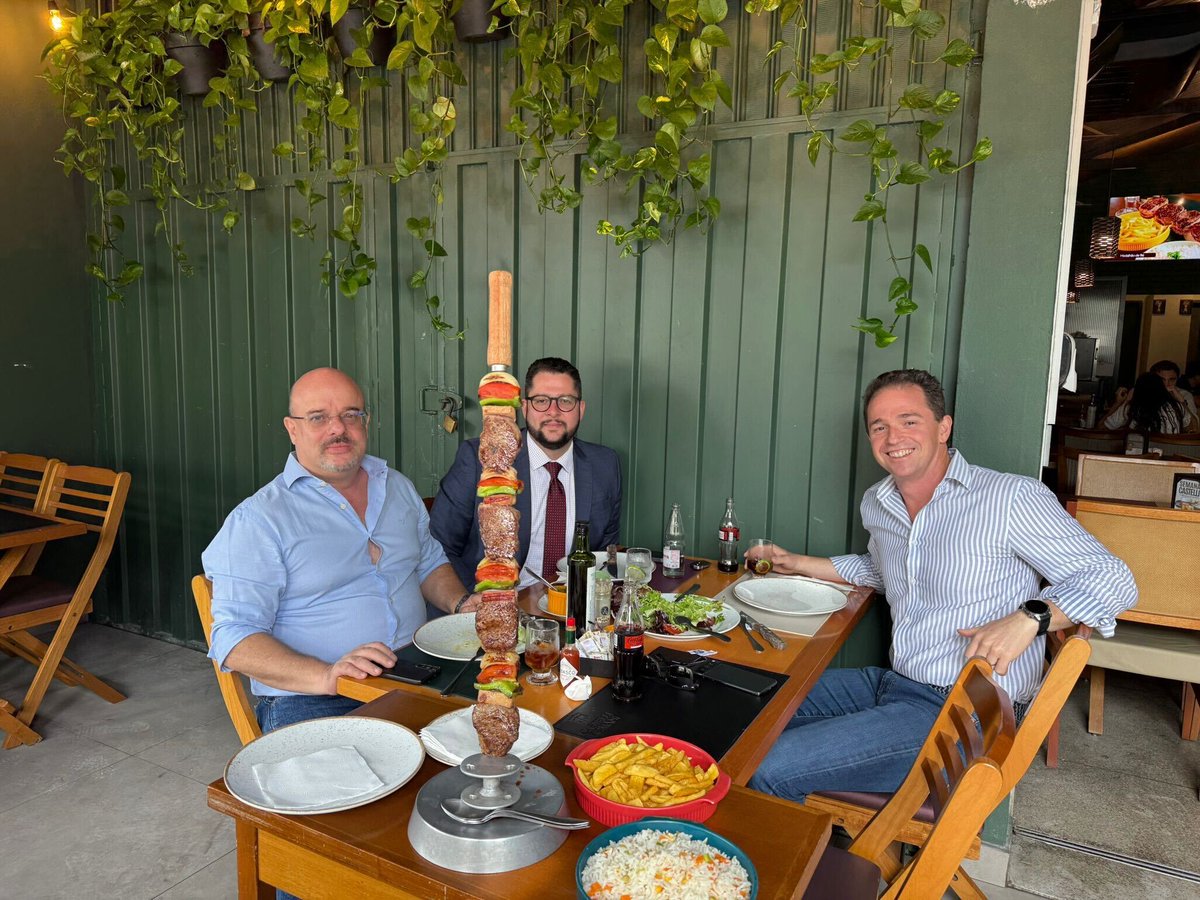
This week, our Managing Director Henry Walsh has been in Varginha in Minas Gerais visiting coffee operations and building on the ground relationships with producers, exporters, traders and participants from across the global supply chain. He will then head to Santos tomorrow to attend the International Café Santos Coffee Seminar.
Brazil is already the world’s leading coffee producer and exporter, but what stands out is the broader trend developing over the next 10–20 years. The country continues to strengthen its position across multiple commodity markets while deepening trade relationships globally and increasing its geopolitical importance within the Western Hemisphere.
For GSX, being closer to origin matters. Expanding our presence in Brazil allows us to build stronger relationships across supply chains, improve market intelligence, and position the business alongside one of the most strategically important agricultural markets globally.
We’re also pleased to announce that Luiz Guilherme Coelho will be joining the team. Luiz brings deep expertise across coffee markets and financial management and previously worked closely with Henry during the restructure of Mercon Coffee and the Mercon Brazil assets.
An exciting period ahead as we continue to invest in relationships, capability, and long-term growth across the region.
If you are interested in engaging our services, please reach out at: [email protected]
📢 NEW PODCAST EPISODE 📢 https://t.co/a7cs4bBZV9
Henri-Jean Bardon, founder of Global Biodiesel, joins Henry Walsh to discuss the evolution of global biofuels markets, the rise of renewable diesel and sustainable aviation fuel, and the geopolitical importance of domestic energy security.
👉 Our latest weekly commodity market commentary is now live.
Key themes this week:
• Markets are pricing persistent energy and supply chain risk, not just a short-term geopolitical shock.
• The Strait of Hormuz continues to drive higher freight, fuel, and input costs across soft commodities.
• Cotton remains supported by drought risk, elevated crude oil, and tighter forward balances.
• Coffee markets remain split between nearby tightness and expectations for larger future supply.
• Inflation pressures continue to spread through freight, food logistics, and packaging, reinforcing the higher-for-longer rates environment.
Subscribe now for the full report and weekly market insights.
#Commodities #Cotton #Coffee #Macro #Inflation
https://t.co/34oBirwpxq
Commodity markets are entering another period where macro, geopolitics, and supply dynamics are colliding in real time.
Volatility remains elevated, but so does opportunity.
Subscribe for our weekly commodity market update and macro insights.
https://t.co/CYSvFMF6pL
#Commodities #Macro #Oil #Gold #EnergyMarkets
Commodity markets are entering another period where macro, geopolitics, and supply dynamics are colliding in real time.
Volatility remains elevated, but so does opportunity.
Subscribe for our weekly commodity market update and macro insights.
https://t.co/CYSvFMF6pL
#Commodities #Macro #Oil #Gold #EnergyMarkets
At GSX, we’ve been analyzing cotton markets using monthly WASDE data (2010–present), and in the current market environment we are seeing a meaningful shift in the fundamentals of the market and subsequent price movements.
The gap appears to be driven by the market pricing in elevated abandonment risk in Texas. With 5.5M of the 9.3M planted acres located there, a move from the historical ~20% abandonment rate toward 60% (as seen in 2022) would materially tighten supply. Under that scenario, we estimate ~2.76M bales of lost production, reducing carryout to ~1.64M bales. Even a more moderate 40% abandonment would still bring carryout down to ~3.02M bales.
This helps explain current price support. At the same time, macro inputs are reinforcing the move: higher crude oil is feeding into the polyester chain (paraxylene → PTA → fibres), while geopolitical disruptions and drought conditions in Texas are accelerating the unwind of last year’s managed money net short. Positioning has shifted quickly, with flows now rebuilding on the long side.
That said, the current structure leaves the market sensitive to reversal. If weather conditions improve or geopolitical risks ease, the supply narrative could soften quickly. In that case, a return to the USDA base case would likely see the market reverse.
We're continuing to watch the situation and are continuing to improve our analysis of the market. If you're interested If you're interested in reading more on this analysis - subscribe to our weekly commodities comment here https://t.co/4yh7BZ0RBo
#GSX #Commodities #Cotton #Agriculture #Markets
We’ve published a case study on our work with Mercon Coffee during its Chapter 11 restructuring.
A complex situation - high debt, market volatility, global pressure. This wasn’t about a perfect outcome, but navigating uncertainty and making critical decisions in real time.
GSX played a key role in the sales of Mercafe Vietnam and Mercon Specialty—coordinating across negotiations, legal processes, and ongoing operations to maximise value.
In restructurings, success isn’t clean. It’s progress, preserving value, maintaining momentum, and guiding teams through uncertainty.
Execution matters more than theory. If your business is facing similar pressure, the right support can make a real difference. Reach out. https://t.co/GIB5NmH3Ud