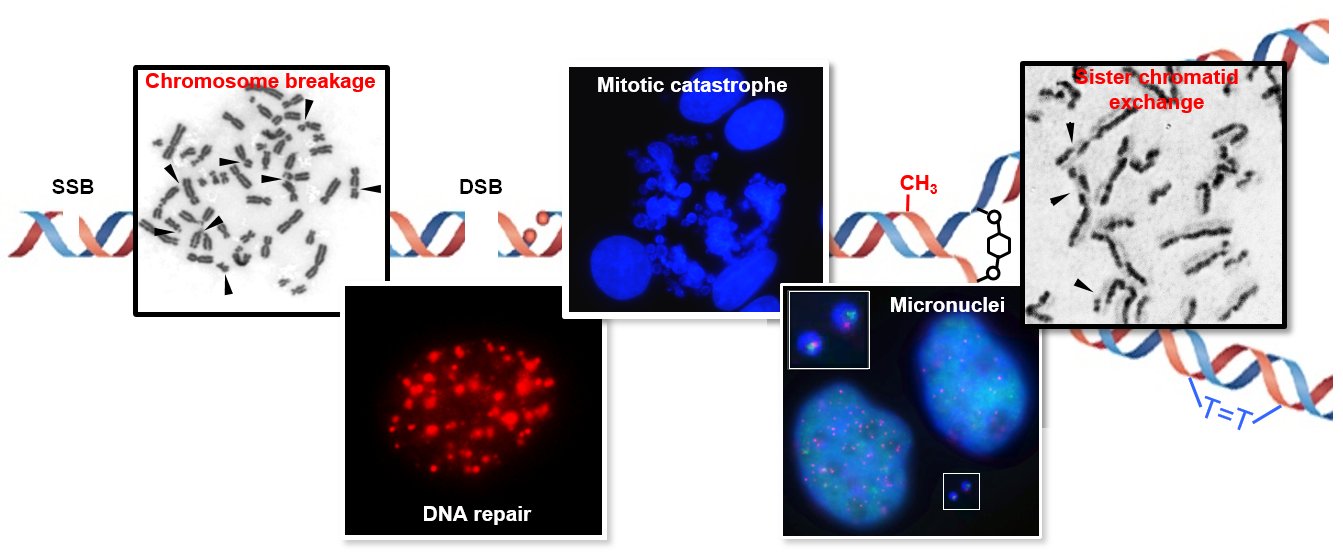
Amazing collaboration with the @DrAndyBlackford@OchsFena and Zafar Iqbal on the identification of DDIAS as a new mitotic repair factor that is mutated in a novel chromosomal instability syndrome. https://t.co/aNH7IFcZ3m
For years, the prevailing model has been simple:
DNA damage → micronuclei → cGAS activation → inflammation.
A new study in Nature Cell Biology challenges that framework with a powerful new tool that directly measures cGAMP production—the earliest and most specific readout of cGAS activation—at single-cell resolution.
The authors engineered an improved FRET-based cGAMP reporter compatible with microscopy, flow cytometry, cell lysates, and biochemical assays. Unlike downstream markers such as IRF3, STAT1, or STING translocation, this biosensor reports the actual product synthesized by cGAS, providing a much more sensitive and direct measure of pathway activation.
What they discovered was surprising.
Across multiple forms of genotoxic stress—including ionizing radiation, doxorubicin, etoposide, PARP inhibition, and chromosome mis-segregation—only a small minority of cells (~10%) actually activated cGAS, and even those responses were relatively weak compared with direct DNA stimulation.
Even more striking was what didn't correlate with activation.
Although cGAS frequently accumulated on micronuclei, most micronuclei never generated cGAMP. Likewise, many cells producing cGAMP contained no micronuclei at all. These findings argue that simple cGAS localization to micronuclei is neither necessary nor sufficient for activation.
Chromosome bridges told a more nuanced story.
Following chromosome mis-segregation induced by MPS1 inhibition, cells that activated cGAS were much more likely to have experienced cGAS-positive chromosome bridges, whereas this relationship disappeared after ionizing radiation. Thus, chromosome bridges contribute only under specific forms of genomic instability rather than serving as a universal trigger.
The study also revisits another controversial idea: DNA:RNA hybrids.
Purified cGAS bound both DNA:RNA hybrids and R-loops with similar affinity, but binding alone did not predict signaling.
Simple DNA:RNA hybrids were essentially inert.
In contrast, R-loops, which contain more complex nucleic acid architecture, consistently activated cGAS both in cells and in biochemical reconstitution assays. This suggests that structural complexity—not simply hybrid composition—is what licenses cGAS activation.
Another fascinating observation is that activated cells often formed local clusters.
Rather than reflecting simultaneous activation, these clusters resulted from cGAMP transfer through gap junctions, allowing neighboring cells to become activated without producing cGAMP themselves. The inflammatory signal therefore spreads beyond the original sensing cell.
The conceptual shift is important.
Instead of a uniform tissue-wide response after DNA damage, cGAS activation appears to occur as rare, localized signaling hubs that subsequently amplify inflammation through intercellular cGAMP transfer. This may help explain why previous studies produced conflicting conclusions regarding micronuclei and cGAS biology.
Beyond its biological insights, the paper introduces a versatile platform that should become widely useful for studying innate immunity, chromosomal instability, aging, radiotherapy responses, and cancer immunology with single-cell precision.
Reference
Lebrec V, Kanellou A, Davies LR, et al. A versatile cGAMP reporter reveals principles of cGAS activation by DNA damage and chromosome instability. Nature Cell Biology (2026).
DOI: https://t.co/DiphFJCpPm
@AthanPatsalias@DrAndyBlackford@OchsFena Thanks but I have to say that the Blackford and Ochs labs did the majority of work. We identified the link to human disease.
Amazing collaboration with the @DrAndyBlackford@OchsFena and Zafar Iqbal on the identification of DDIAS as a new mitotic repair factor that is mutated in a novel chromosomal instability syndrome. https://t.co/aNH7IFcZ3m
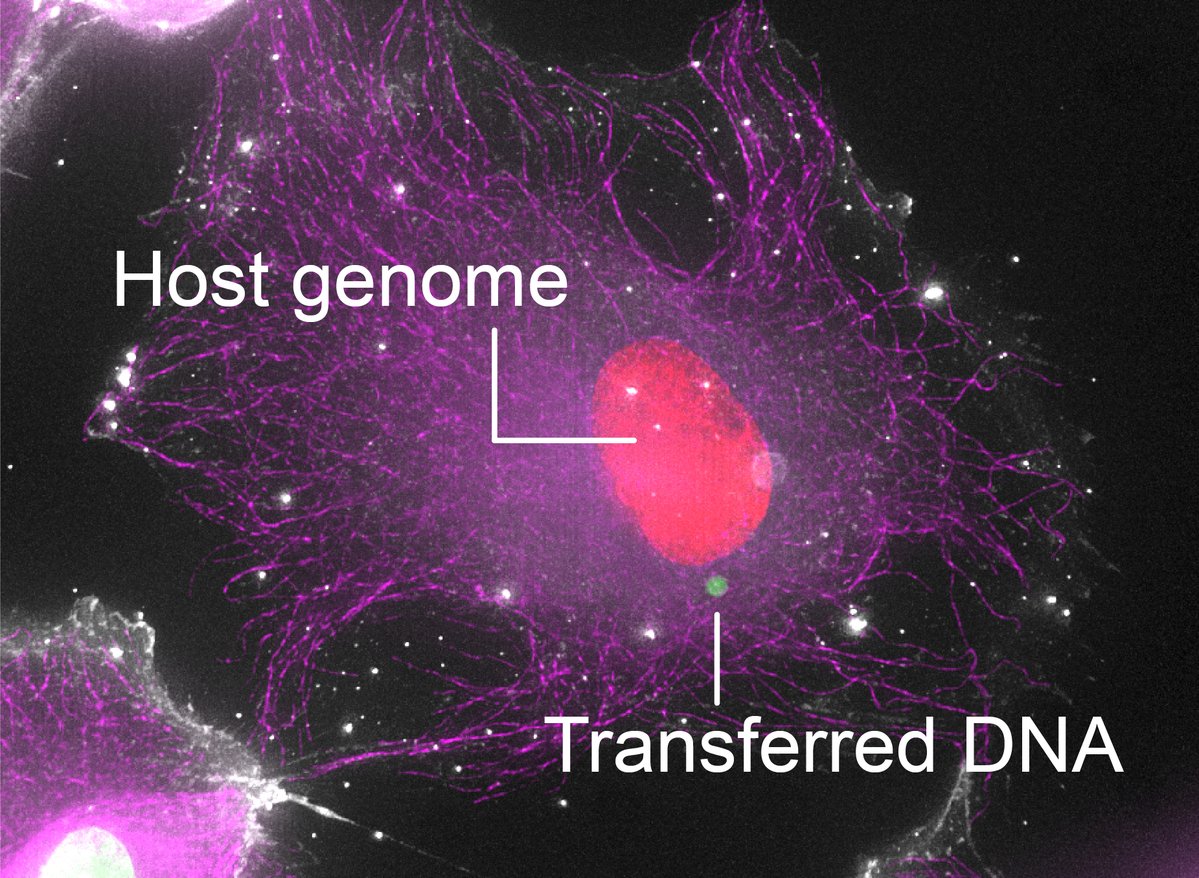
Excited to share our latest paper, out today @CellCellPress. We found that large pieces of the human genome can transfer between cells upon direct contact, endowing recipient cells with heritable phenotypic changes. (1/7)
https://t.co/SbshGhofN0
Finally our collaborative paper on inherited mutations in the actin nulceating factor, DIAPH1, spear-headed by the Houlden lab, @RMaroofian, Valentina Galassi Deforie, @StephanieEfthy1 and Peter Arkwright, is out in Genetics in Medicine. https://t.co/5NaBJCwPYx
Awesome collaboration with @SPJacksonGroup, Chris Carney and Soren Hough, understanding how inherited mutations in the MEAE E3 ubiquitin ligase causes disease by compromising HR-dependent replication fork protection/restart. https://t.co/ScWbwH37Ol
Interested in inherited chromosomal instability syndromes and DNA repair? We are looking for an enthusiastic person to join the Stewart lab at the University of Birmingham as a senior technician. If you are interested, please have a look at the job advert: https://t.co/ViFtLEXZZl
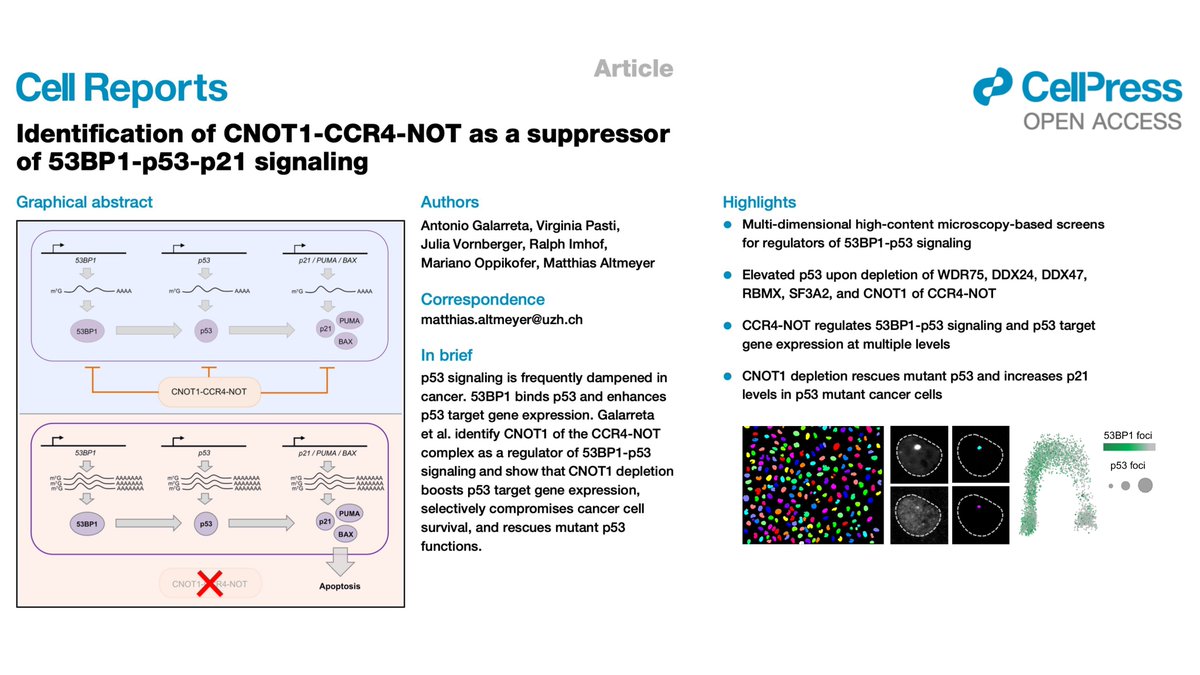
New work from the lab: Identification of CNOT1-CCR4-NOT as a suppressor of 53BP1-p53-p21 signaling @CellReports. Congratulations to first author Antonio Galarreta and to all co-authors. https://t.co/WE2QHsIs0S. #Microscopy#RNAiScreen#Condensates
A transcription balance required for genome stability 🧬⚖️
Our work on RNA Pol II transcription speed control by the DNA helicase RECQL5 and the transcription-coupled DNA repair complex is now on @NatureSMB
#CryoEM#transcription https://t.co/BXgtzSF10A
Delighted to announce that our paper showing the generation of iPSc from a MDS patient & how CEBPA drives disease progression is finally out in Nature Comms! A big thanks to everybody involved & the great collaborators that have made it possible!
https://t.co/b36gicik6Y
Online Now: The DNA replication checkpoint prevents PCNA/RFC depletion to protect forks from HLTF-induced collapse in human cells https://t.co/mwvSZOI6gZ
Cytarabine has been the mainstay for AML treatment. This chemotherapy can lead to problems with movement and balance. Here we explain this neurotoxic side effect: https://t.co/1AvK5l8CD0. Work led by Jia-Cheng Liu, Donpgeng Wang, Elsa Callen and many terrific collaborators!
We’re #hiring, please share! A fully funded #postdoc position is available in my lab to work on DNA damage response mechanisms.
Please get in touch with your CV if you are interested, closing date: 27th June 2025.
More details here: https://t.co/j1iwqP9kQN
Awesome paper from @SPJacksonGroup and @FrogWalterLab about USP37 and TRAIP regulating the replication response to topoisomerase inhibitors. Glad to be a part of it. https://t.co/xcL0nIThlA