Our fight - #AMR:
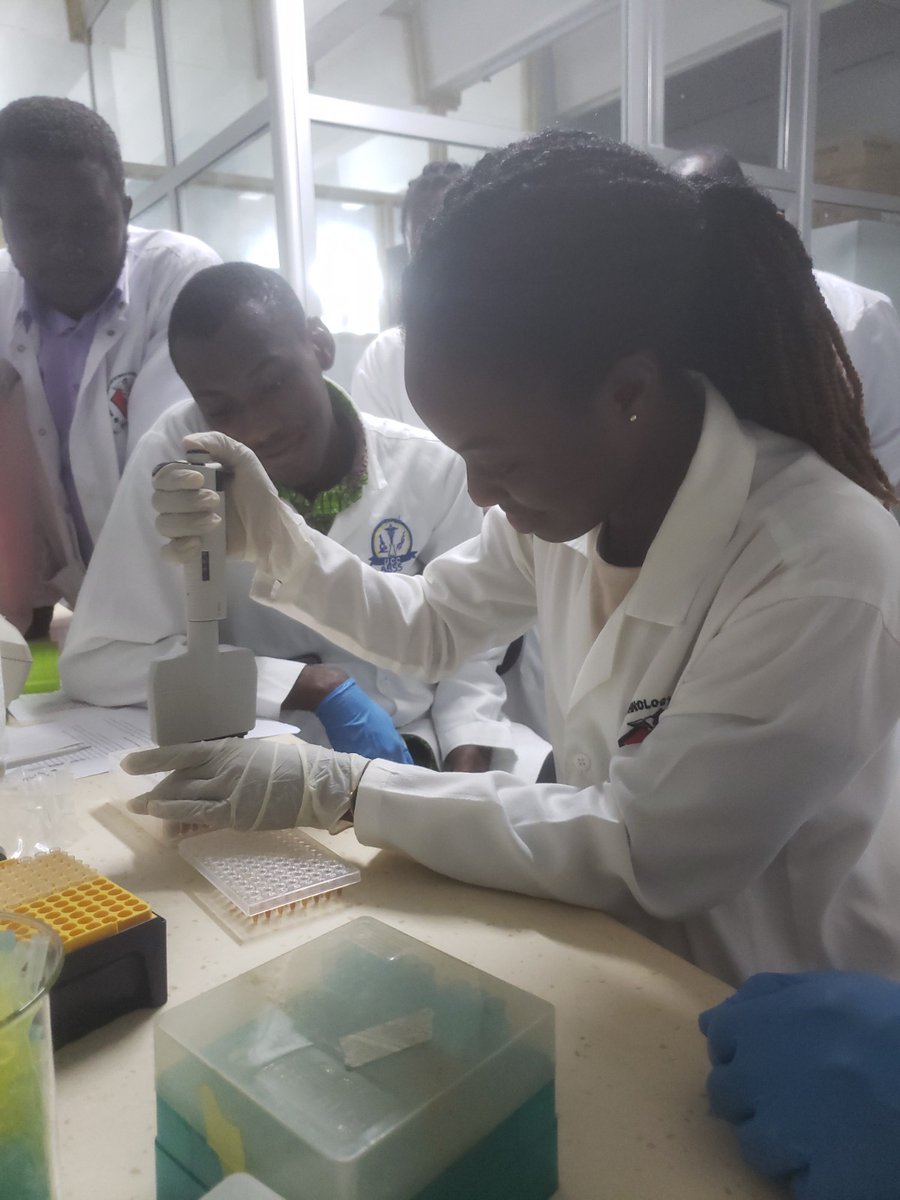
1-month hands-on AMR training for undergrads
Radio advocacy on nursing mothers’ knowledge and practices regarding AMR
Educated food-producing animal farmers & assessed impact of the education.
@ResResistance#PARWAAW2024#PreventAMR#TogetherAgainstAMR
Our fight - #AMR:
1-month hands-on AMR training for undergrads
Radio advocacy on nursing mothers’ knowledge and practices regarding AMR
Educated food-producing animal farmers & assessed impact of the education.
@ResResistance#PARWAAW2024#PreventAMR#TogetherAgainstAMR
@DrXorlali @ResResistance Thank you for your kind words! we are inspire d to keep pushing forward in the fight against AMR.
Together, we can make a real difference.
@andrewjpage & @TheQuadram, @thanhleviet, @ma_webber & my supportive Supervisor @DrKatHolt & @LSHTM, @LSHTM_AMR & CJ Illiopolos - you made this possible, thank you! And thx immensely @iruka_okeke & your lab team for your generous support. Thx again @ischemo for funding! 8/fin
To finish off, we thank the Directorate of Research, Innovation & Consultancy, dept. heads of Biomed Science & Lab Tech & the UCC community for their warm reception & hospitality. Our hosts Richael and Isaac treated us like kings - thx so much! 7/n
This visit reminded me of my undergrad days as a Biomedical Science student at Legon. I did a whole module on PCR without doing a single experiment (no PCR machine or rgt). Teaching these basic techniques to the students here makes a huge difference in their lives & career. 5/n
The smiles on the faces of the students & lab staff says it all. With just a little support, labs in low-resourced settings can do so much! We delivered a series of genomics-based lectures Wed & Thurs with a high level of interest. 4/n
On Monday I taught a 96-well plate low-cost, high throughput extraction mtd I used during my PhD. We didn't have a plate centrifuge so had to start with Eppendorf tubes & spin down & improvised with a shaking incubator for a thermomixer but we had decent DNA yield & quality. 3/n
We sequenced 103 clinical isolates from 5 tertiary hospitals, revealing 44 distinct sequence types with ST133 as the most common. Of 27 different capsular (K) locus antigens and 7 lipopolysaccharide (O) types; KL116 (28/103, 27%) & O1 (66/103, 64%) were the most prevalent (3/9)
@GSequencing@ResResistance Empowering the next generation of scientist to be advocators of AMR is a good step towards the fight against this silent pandemic. Great work
@dna_freaky @ResResistance Thank you so much! 🙌 Your encouragement means the world to us. Let’s keep pushing forward together in the fight against AMR!
@RobertAbban2@ResResistance Appreciate your thoughtful response!
We are bringing more interesting activities in the coming weeks!
Together, we’re stronger in the fight against AMR.
Don't forget to join the fight against AMR!