Gold Trading Desk was built on a simple principle: specialization creates depth, and depth creates consistency.
We are not a broker, prop firm, signal service, or investment adviser.
GTD is an educational institution dedicated exclusively to the professional study of the gold market.
Auction Market Theory. Market structure. Liquidity. Volume Profile. VWAP. Execution. Risk. Psychology.
The objective is not to predict the next move.
It is to develop disciplined, independent market professionals capable of reading the auction, respecting risk, and protecting capital.
Welcome to Gold Trading Desk.
https://t.co/FIkYmOh3WP
#XAUUSD #GoldTrading #TradingEducation
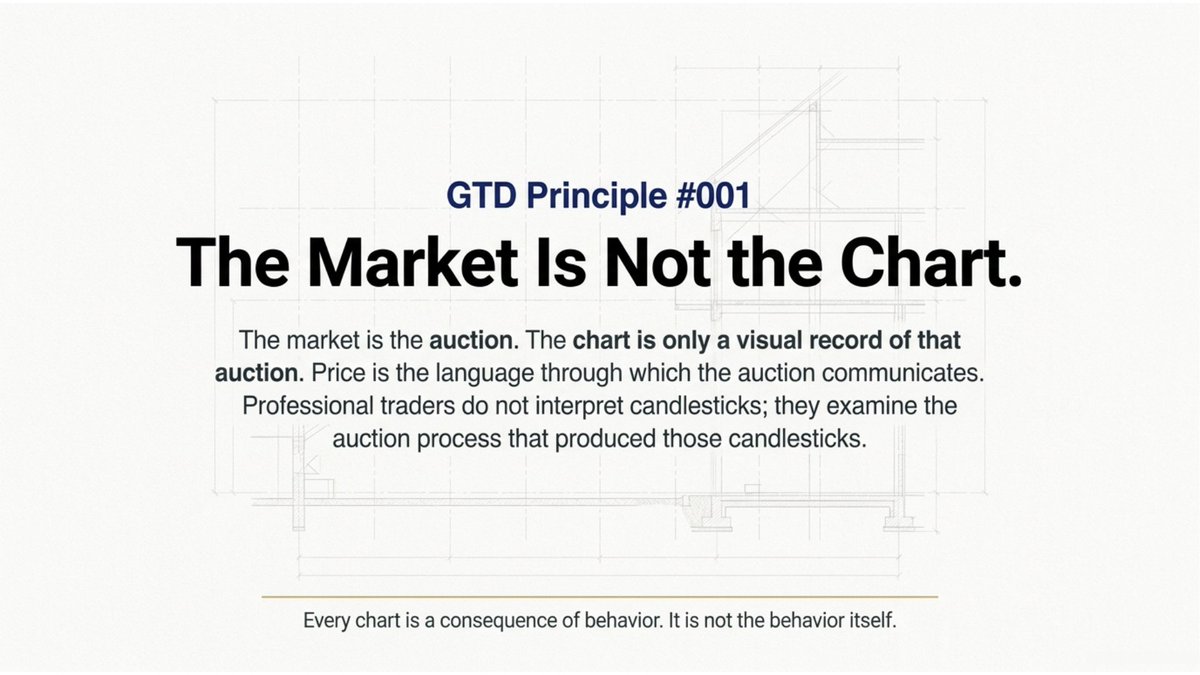
GTD Principle #001 | The Market Is Not the Chart.
A candlestick tells us where price traded. It does not explain the auction process that produced it.
Understanding market behavior requires looking beyond the visual representation of price.
Price discovery is a process, not a candle. Markets test, attract or fail to attract participation, develop acceptance, and continue searching when exchange cannot persist.
#XAUUSD#PriceDiscovery
A failed auction is useful because it tells us something about an attempted price exploration. But the failure is understood from the response after the test, not from the level alone.
#AuctionMarketTheory#GoldTrading
Imbalance is not automatically an entry signal. It describes a condition in which the auction is searching more aggressively for prices capable of facilitating trade. Diagnosis first. Execution second.
#Gold#XAUUSD
Balance is information. A market spending time facilitating two-sided trade is doing something very different from a market rapidly searching for another area where trade can develop.
#XAUUSD#MarketProfile
Markets continuously propose prices. Participants decide, through actual exchange, whether those prices can persist. That is why GTD begins with the market as an auction rather than a collection of candle patterns.
#AuctionMarketTheory#XAUUSD
Rejection should not be declared because one candle moved sharply away from a level. Movement away is observable immediately. Rejection becomes a stronger classification when subsequent auction behaviour supports it.
#GoldTrading#XAUUSD
The last question is actually the one I find most important. I don't determine participation from the initial price move itself. I look at what happens after the test: whether trade can persist around the new area, whether participation continues, whether the auction begins developing there, or whether price quickly returns toward the prior area. The move gives us the observation. Subsequent auction behaviour gives us evidence for the interpretation.
Acceptance is not simply price trading above a level. Ask whether participation can sustain exchange there and whether the market continues to build around the new area.
#XAUUSD#PriceAction
Price is an observation. Value is an inference about where exchange can persist. Treating those two ideas as identical removes an important layer of market context.
#Gold#XAUUSD#AuctionMarketTheory
A breakout establishes a test. The auction that follows helps determine what that test meant. That distinction can prevent traders from confusing movement with confirmation.
#XAUUSD#MarketStructure
I mainly look for whether trade can persist around the new area rather than just touch it. Continued participation, time spent trading there, repeated ability to hold the area, and whether the auction begins developing around those prices all add evidence of acceptance. If price tests the area but cannot sustain trade there and quickly returns toward the prior auction, that tells a very different story. The key for me is not treating the initial move itself as confirmation.
Price moving higher tells you where the auction is exploring. It does not, by itself, tell you whether higher prices are being accepted. The behaviour that follows the test matters more than the test itself.
#XAUUSD#GoldTrading#AuctionMarketTheory
What does Desk I actually teach?
Desk I at Gold Trading Desk begins with a simple premise:
Before one can read the market, one must first understand what a market truly is.
DESK I | FOUNDATIONS
School of Market Principles
The programme consists of 25 sequential lectures across five chapters.
Chapter 1 | Understanding the Auction
1.1 The Market Is an Auction
1.2 Market Participants
1.3 The Auction Process
1.4 The Language of Acceptance
1.5 The Discipline of Observation
Chapter 2 | Price & Value
2.1 Price versus Value
2.2 Fair Value
2.3 Imbalance & Repricing
2.4 Acceptance & Rejection of Price
2.5 The Continuous Search for Value
Chapter 3 | Auction Behaviour & Developing Structure
3.1 Price Discovery
3.2 Initiative & Responsive Activity
3.3 Balance, Imbalance & Repricing
3.4 Auction Rotation
3.5 Developing Market Structure
Chapter 4 | Trading Ranges & Auction Resolution
4.1 Trading Ranges
4.2 Boundary Tests: Breakout or Rejection?
4.3 Failed Auctions
4.4 Accepted Departures
4.5 Classifying Auction Resolution
Chapter 5 | Professional Synthesis
5.1 Objective Market Observation
5.2 Separating Evidence, Interpretation & Assumption
5.3 Building an Institutional Narrative
5.4 Professional Market Journaling
5.5 Thinking Like an Institutional Analyst
There are no trade signals in this curriculum.
There are no promises of shortcuts.
Desk I is designed to establish the conceptual foundation required before more advanced market analysis has any real meaning.
The objective is not to teach a trader what to think about the next move.
It is to develop a disciplined framework for how to observe, interpret and reason about an auction.
Explore Desk I:
https://t.co/uEW8YzztSk
25 lectures. Five chapters. One foundation.
Gold Trading Desk
Read the Auction. Respect the Risk. Protect Your Capital.
#GoldTradingDesk #AuctionMarketTheory #XAUUSD #GoldTrading #TradingEducation #MarketStructure #FinancialEducation
A traded price tells us where exchange occurred. It does not tell us where value exists.
Value requires more evidence. It develops through sustained participation, repeated exchange, and the market's willingness to continue doing business around an area.
This distinction matters because a price can be reached, traded, and quickly rejected. Another area may hold the auction for hours as buyers and sellers repeatedly find counterparties.
GTD-RN-002 examines this relationship through acceptance, rejection, value development, and value migration in XAUUSD.
Visit the Research Journal:
https://t.co/WzoQXZ5dnz
#AuctionMarketTheory #PriceDiscovery #XAUUSD
A visible level is not the same as visible liquidity. Our latest GTD Methodology article examines what XAUUSD traders can observe, what must be inferred, and why trading through a high or low does not prove future direction. https://t.co/76igZJiaKx
Volume does not become more informative simply because it is plotted across price.
Volume Profile organizes measured activity by price within a defined observation window. It can identify the Point of Control, Value Area, and regions of comparatively high or low recorded activity.
These references describe distribution. They do not independently predict direction.
A POC is not guaranteed support or resistance. VAH and VAL are not automatic trade instructions. A high-volume region records concentration of measured activity, while a low-volume region records comparatively less activity within the selected profile.
For XAUUSD, the data source matters as well. A profile built from a particular feed or venue should not be presented as a consolidated record of all global Gold activity.
GTD therefore uses Volume Profile as evidence of participation and distribution within the auction, not as a standalone forecasting system.
Read Volume Profile for Gold:
https://t.co/myXo6vVLHU
#VolumeProfile #XAUUSD #AuctionMarketTheory