At 20, all I wanted was a job at a top tech company.
That didn't happen.
Microsoft said no.
Amazon said no.
Autodesk said no.
I spent 2 years grinding DSA.
500+ LeetCode problems.
And still, no offer.
I remember sitting in my hostel room, watching people around me land jobs while I kept refreshing job portals.
It felt like everyone was moving forward.
Except me.
Then one random night, I came across a guy on Instagram.
Just a regular developer who was freelancing and making good money.
We talked.
He showed me how he was getting clients through content.
I thought:
"Maybe I can do this too."
So I started posting.
Nothing happened.
No likes.
No followers.
No DMs.
But I kept going.
Then one day:
"Hey, can you build an app for me?"
My first client who paid me $20.
From there:
More projects → higher rates → first teammate → more clients → agency.
Today:
→ $120K/year agency
→ 167K Instagram followers
→ $3–4K/month from brand deals
→ Built & sold a product for $8K
→ Bought myself a superbike
→ Bought a car for my family
But the biggest win wasn't any of those.
It was realizing I didn't need someone to give me an opportunity.
I could create my own.
Still just getting started.
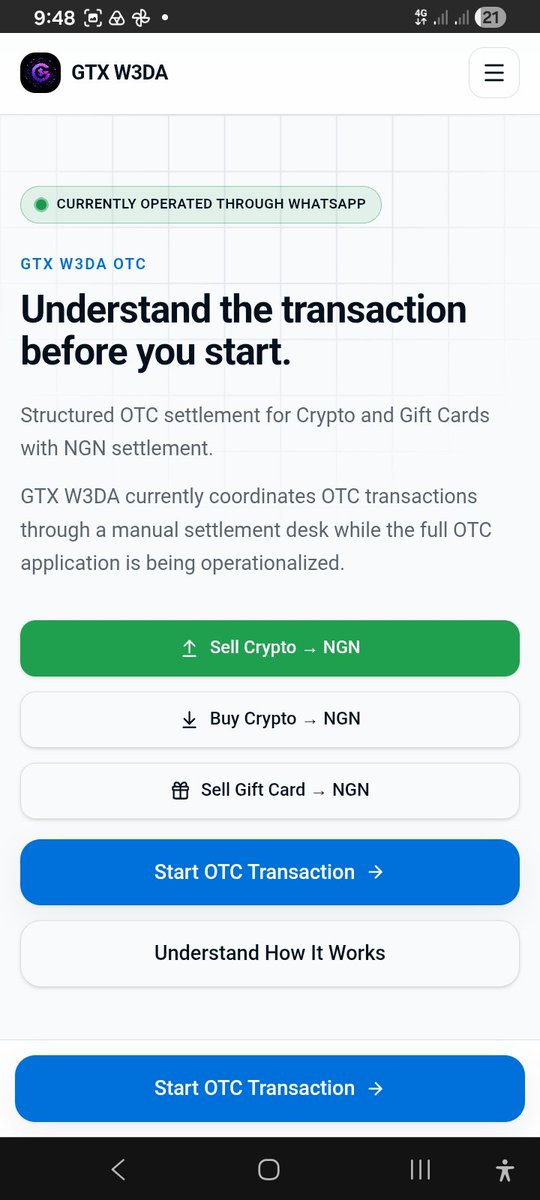
We're starting with manual OTC operations because GTX W3DA want the software to solve problems we've actually experienced.
Not problems invented inside a product roadmap.
GTX W3DA isn't being built around the idea that every transaction will be perfect.
It's being built around the idea that every transaction should be understandable. #GTXW3DA#Transparency#Fintech
🌟 Interesting Angle 🚀
What makes this setup unique is the intentional manual-first approach. Instead of rushing into automation, GTX W3DA is building trust by showing customers exactly what’s happening at each stage.
We are not building automation first and discovering the operational problems later.
We are validating the operation first, then building the software around what actually works.
Operational visibility matters. A financial system should make important events understandable.
GTX OTC is being developed as a settlement infrastructure layer, not simply another trading interface.
Every settlement stage creates another engineering responsibility.
An OTC application has to understand both the customer journey and the operator workflow.
In 2020, all I had was ₦20,000 I made from my days of playing Bet9ja.
My girlfriend at the time, who is now my wife, was a fresher at the University of Ibadan and needed some money to start a business.
I honestly didn’t think twice.
I sent her the money and supported her as she started her perfume business.
Later that same year, I made some really bad decisions.
A friend and I took money from some friends to trade with, and we lost everything.
We ran into serious debts, and things became crazy.
I had to sell almost everything I had.
I was depressed.
I got to a point where I considered selling one of my kidneys just to pay off the debts.
I even considered suicide.
Yeah, it was that terrible.
But while all of this was happening, something else was happening too.
My girlfriend’s business was growing.
And not just growing a little.
It was doing really well.
She was young. Beautiful. A student. She had her own money. She had every reason to walk away from a man who had nothing to offer at that point.
But she stayed.
She took care of me.
She fed me.
She clothed me.
She supported me.
She stood by me through what was probably the lowest point of my life.
Looking back now, I realise that she could have left.
There were probably many women who would have.
She had enough reasons to choose herself and walk away.
But she didn’t.
She stayed.
Today, when I think about the woman I have beside me, I don’t just see my wife.
I see the young girl who believed in me when I had nothing.
I remember those sacrifices.
I remember those difficult days.
And I just want to say:
Thank you, my woman. ❤️
Thank you for staying.
Thank you for believing.
Thank you for loving me when loving me wasn’t convenient.
I will never forget.
A transaction status should answer:
"What is happening right now?"
Not just:
"Is there a transaction?"
That's why status design matters so much in OTC infrastructure.
The goal isn't to keep GTX OTC manual forever.
The goal is to understand the workflow deeply enough that the right parts can be automated safely.
Manual first. Automation with evidence.
The products people actually keep using
1. Clarity: I know what I’m doing
2. Predictability: I know what the system is doing
3. Safety net: I know what happens next, and I can undo it if I mess up
Features get you downloads. Guardrails get you trust. And trust gets you TVL
The future of digital asset trading is looking bright, isn't it? 🚀 With Web3 technologies leading the charge, it's clear that decentralization, transparency, and user ownership are the way forward.