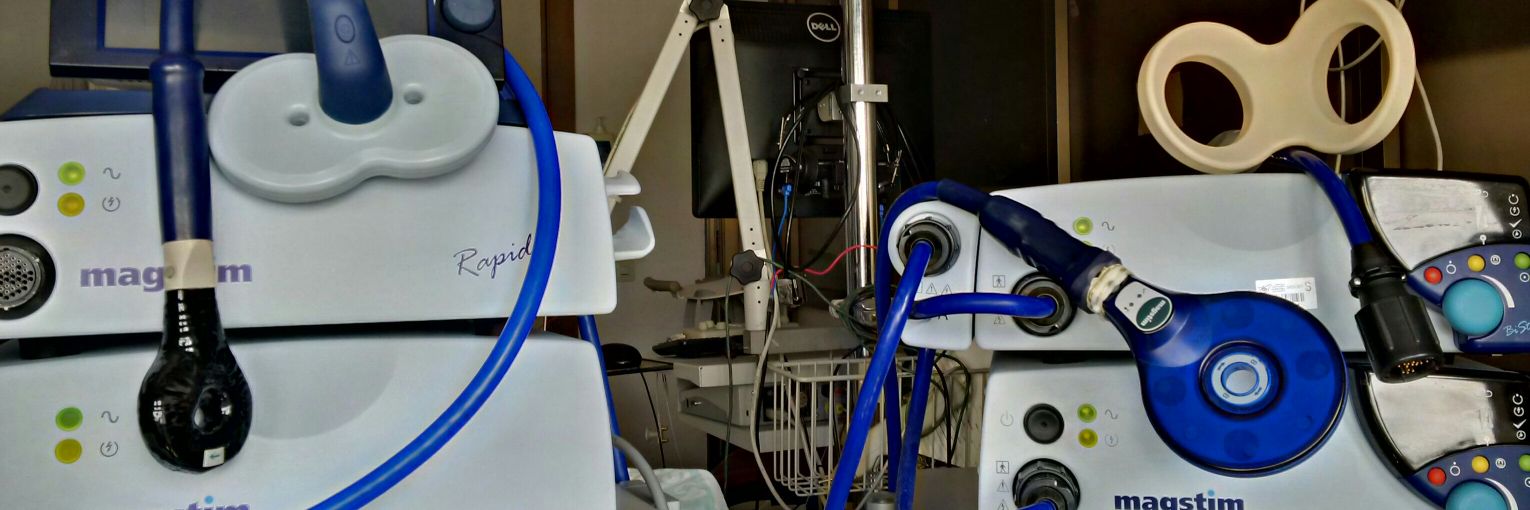
[Brain stimulation] Nesmith et al.: "For TMS parameters, the study provides data on tactile perception and tolerability." https://t.co/venVAa35Ja
TMS: Transcranial Magnetic Stimulation
[Depression] Ma et al.: "A resting electroencephalography model predicts antidepressant response in depression using three biomarkers." https://t.co/GrsZehLHsM
[Editor’s Choice] Morteza Zabihi, Sophie E. Ack, Daniel B. Rubin, Emily J. Gilmore, Valdery Moura Junior, Quanzheng Li, Michael J. Young, Brian L. Edlow, Yelena G. Bodien, Eric S. Rosenthal. Resting-state EEG for continuous prognostic monitoring and prediction of coma recovery after acute brain injury. Clinical Neurophysiology 2026;188:2111899. https://t.co/M00MMvQU6U
Commentary: Clinical neurophysiological techniques such as EEG and evoked potentials play an important role in the prognosis of coma following acute brain injury. Accurate prognostic information is important to guide treatment decisions. In this volume of Clinical Neurophysiology, Zabihi et al. analyzed continuous EEG recordings in 201 patients with acute brain injury from traumatic brain injury, subarachnoid hemorrhage or intracerebral hemorrhage. The authors used predictive models that update every 5 minutes to predict future level of consciousness at 24, 48 and 72 hours. The results showed that models that incorporate EEG with behavioral assessment outperform behavioral assessment alone. An advantage of continuous EEG compared to other methods such as functional MRI, stimulation-based EEG and TMS-EEG to assess consciousness is that it does not require specific stimulation procedures and is more widely available. This can be a useful technique to help with clinical decision-making in patients with disorders of consciousness from acute brain injury.
Robert Chen
Editor-in-Chief, Clinical Neurophysiology
Richard G. Carson (@TCINeuroscience) presents a method of compensating for the #excitability of spinal #motoneurones when estimating the magnitude of potentials evoked in skeletal muscles ⚡️ 🧠
Read it here👇️
https://t.co/0c32Uqk3vL
Intermittent Theta-Burst Stimulation and Depressive Symptoms
10 once-daily iTBS sessions with no sustained advantage after four weeks
by M. Ørbo et al
https://t.co/hb8iWD34OP
Baran et al assessed medial dorsal cutaneous (MDC) nerve responses and found that bilateral absence of MDC nerve responses was strongly associated with diabetic polyneuropathy. 🦶👟⚡https://t.co/TMV7x66ICv
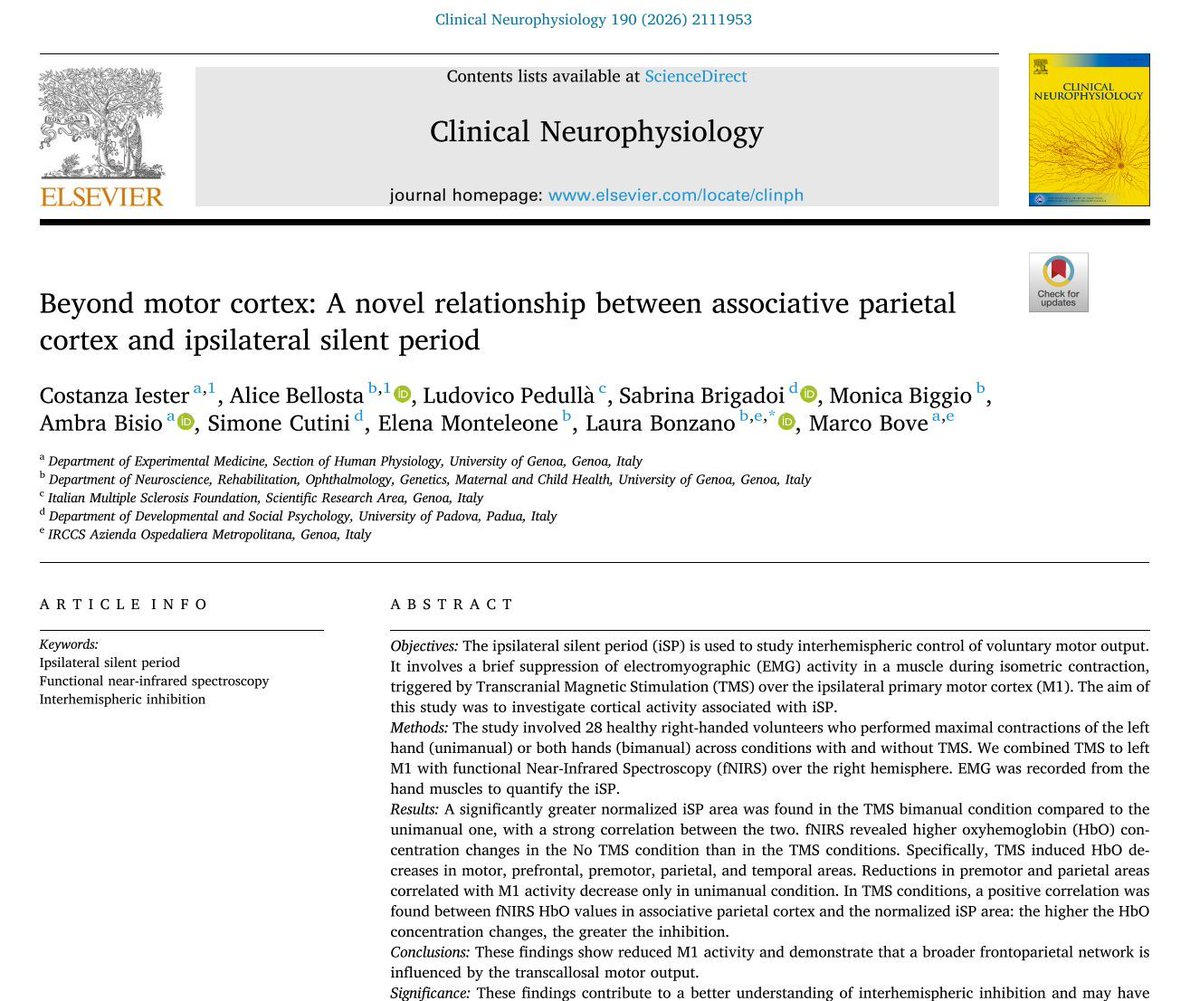
Brain stimulation influences networks, not just one region. ⚡
Using #fNIRS with #TMS, Iester et al. showed that interhemispheric inhibition engages widespread frontoparietal regions beyond M1, highlighting the value of multimodal neuroimaging.
🔗 https://t.co/12HzC37HRv
[Primary lateral sclerosis: PLS] Santos and de Carvalho: "Large F-waves serve as a distinct marker of increased spinal motoneuron excitability in PLS." https://t.co/ksWRLLZrOP
[Brain stimulation] Sayalı et al.: "Test-retest reliability of TMS-evoked potentials varies by brain region and targeting method." https://t.co/f3mJJ40i8t
#TMS: Transcranial magnetic stimulation
[Multiple sclerosis] Cecconi, Liuzzi, et al.: "Perturbational Complexity Index provides a single quantitative index of reduced global spatiotemporal complexity, potentially reflecting early synaptic dysfunction related to demyelination and neuroinflammation." https://t.co/YOcmNCeK1s
[AI integration in clinical neurophysiology] Shahrizaila and Brinkmann: "Challenges to real-world AI integration include fragmented workflow and governance." https://t.co/xrib65qxXP
2/ Started this in 2015 as a resident with Kevin Black at WashU, presented an early version at ANPA in 2017. After a 9-year detour on the East Coast, a new causal network mapping framework, and 900+ patients' worth of data - we finally have an answer.
[Critical Care EEG] van der Steen et al.: "This work explores the role of amplitude-integrated electroencephalography as a tool to characterize sleep-wake cycling." https://t.co/yVXF7fmCda
In the new Carlat Psychiatry Podcast:
▪ 9 ways to treat premenstrual syndrome that aren't SSRIs
▪ Best and worst contraceptives for mood
▪ New use for lavender
▪ New FDA-approved device for PTSD
https://t.co/aNP49EtPss
[Brain stimulation] Ramdeo et al.: "Our objective was to compare iTBS protocols as they are commonly implemented using commercially available systems." https://t.co/TZFDq0OKtP
#iTBS: intermittent theta burst stimulation
Download the TDBRAIN V3.1 dataset here https://t.co/3xAv3ck6QQ and see data-descriptor here: https://t.co/61MoF9jQjd
Use this link for the online EDF-BDF viewer: https://t.co/hToVN9LRu2 No data is transferred, works locally.
@eegmanylabs@pharmacoeeg@ClinicalNeuroph@ScientificData
We just released a major update to TDBRAIN V3.1: one of the largest and most well phenotyped, openly available clinical EEG datasets (>1500 EEGs).
What's new in V3.1:
- Data in lossless 24 bit BDF format reducing filesize with 80%.
- A beta-release of Oddball task EEG (6-min) in BDF+ format including stimulus presentation and responses. We're working on releasing Oddball data for N>1000.
- An online EDF-BDF viewer to visualise or export data
- More labelled data: We expanded MDD patients including TMS treatment-response labels to N>170 and further expanded ADHD, Tinnitus and Controls.
[Coma] Carrai et al.: "Their absence at 72 h after cardiac arrest predicts severe disability." https://t.co/oyhQNIQd93
MLSEPs: middle-latency components of somatosensory evoked potentials


![ClinicalNeuroph's tweet photo. [Brain stimulation] Nesmith et al.: "For TMS parameters, the study provides data on tactile perception and tolerability." https://t.co/venVAa35Ja
TMS: Transcranial Magnetic Stimulation https://t.co/LyMuyPiRNO](https://pbs.twimg.com/media/HQukptKWQAAqx7D.jpg)
![ClinicalNeuroph's tweet photo. [Brain stimulation] Nesmith et al.: "For TMS parameters, the study provides data on tactile perception and tolerability." https://t.co/venVAa35Ja
TMS: Transcranial Magnetic Stimulation https://t.co/LyMuyPiRNO](https://pbs.twimg.com/media/HQukplzWYAA8G0w.jpg)
![ClinicalNeuroph's tweet photo. [Depression] Ma et al.: "A resting electroencephalography model predicts antidepressant response in depression using three biomarkers." https://t.co/GrsZehLHsM https://t.co/fcBpYAhQGY](https://pbs.twimg.com/media/HP15kBlX0AASFAE.jpg)
![ClinicalNeuroph's tweet photo. [Depression] Ma et al.: "A resting electroencephalography model predicts antidepressant response in depression using three biomarkers." https://t.co/GrsZehLHsM https://t.co/fcBpYAhQGY](https://pbs.twimg.com/media/HP15j6QWYAATA3K.jpg)
![ClinicalNeuroph's tweet photo. [Depression] Ma et al.: "A resting electroencephalography model predicts antidepressant response in depression using three biomarkers." https://t.co/GrsZehLHsM https://t.co/fcBpYAhQGY](https://pbs.twimg.com/media/HP15jzlXMAAg9Fs.jpg)
![ClinicalNeuroph's tweet photo. [Functional brain mapping] Gogulski, Nyrhinen et al.: "Both TMS and fMRI mapping methods showed considerable inter-individual variability in S1 representation locations." https://t.co/cY4Juj1rEk https://t.co/CHlDQSHwiB](https://pbs.twimg.com/media/HPmeZWaWkAApgHH.jpg)
![ClinicalNeuroph's tweet photo. [Functional brain mapping] Gogulski, Nyrhinen et al.: "Both TMS and fMRI mapping methods showed considerable inter-individual variability in S1 representation locations." https://t.co/cY4Juj1rEk https://t.co/CHlDQSHwiB](https://pbs.twimg.com/media/HPmeZM9XoAARwPa.jpg)
![ClinicalNeuroph's tweet photo. [Functional brain mapping] Gogulski, Nyrhinen et al.: "Both TMS and fMRI mapping methods showed considerable inter-individual variability in S1 representation locations." https://t.co/cY4Juj1rEk https://t.co/CHlDQSHwiB](https://pbs.twimg.com/media/HPmeZFzWYAEyEFb.jpg)




![ClinicalNeuroph's tweet photo. [Primary lateral sclerosis: PLS] Santos and de Carvalho: "Large F-waves serve as a distinct marker of increased spinal motoneuron excitability in PLS." https://t.co/ksWRLLZrOP https://t.co/SRi0eMnWBi](https://pbs.twimg.com/media/HN85z6qXMAAD95x.jpg)
![ClinicalNeuroph's tweet photo. [Primary lateral sclerosis: PLS] Santos and de Carvalho: "Large F-waves serve as a distinct marker of increased spinal motoneuron excitability in PLS." https://t.co/ksWRLLZrOP https://t.co/SRi0eMnWBi](https://pbs.twimg.com/media/HN85zq0XoAErpcx.jpg)
![ClinicalNeuroph's tweet photo. [Brain stimulation] Sayalı et al.: "Test-retest reliability of TMS-evoked potentials varies by brain region and targeting method." https://t.co/f3mJJ40i8t
#TMS: Transcranial magnetic stimulation https://t.co/7WPNMKTiHC](https://pbs.twimg.com/media/HNwAOkyXkAAsmoT.jpg)
![ClinicalNeuroph's tweet photo. [Brain stimulation] Sayalı et al.: "Test-retest reliability of TMS-evoked potentials varies by brain region and targeting method." https://t.co/f3mJJ40i8t
#TMS: Transcranial magnetic stimulation https://t.co/7WPNMKTiHC](https://pbs.twimg.com/media/HNwAOeZWUAAILsD.jpg)
![ClinicalNeuroph's tweet photo. [Brain stimulation] Sayalı et al.: "Test-retest reliability of TMS-evoked potentials varies by brain region and targeting method." https://t.co/f3mJJ40i8t
#TMS: Transcranial magnetic stimulation https://t.co/7WPNMKTiHC](https://pbs.twimg.com/media/HNwAOS3WIAEZAyy.jpg)
![ClinicalNeuroph's tweet photo. [Multiple sclerosis] Cecconi, Liuzzi, et al.: "Perturbational Complexity Index provides a single quantitative index of reduced global spatiotemporal complexity, potentially reflecting early synaptic dysfunction related to demyelination and neuroinflammation." https://t.co/YOcmNCeK1s](https://pbs.twimg.com/media/HNG1HB8WwAE1Th7.jpg)
![ClinicalNeuroph's tweet photo. [Multiple sclerosis] Cecconi, Liuzzi, et al.: "Perturbational Complexity Index provides a single quantitative index of reduced global spatiotemporal complexity, potentially reflecting early synaptic dysfunction related to demyelination and neuroinflammation." https://t.co/YOcmNCeK1s](https://pbs.twimg.com/media/HNG1G7ZWQAAcxLo.jpg)
![ClinicalNeuroph's tweet photo. [Multiple sclerosis] Cecconi, Liuzzi, et al.: "Perturbational Complexity Index provides a single quantitative index of reduced global spatiotemporal complexity, potentially reflecting early synaptic dysfunction related to demyelination and neuroinflammation." https://t.co/YOcmNCeK1s](https://pbs.twimg.com/media/HNG1Gz1WUAAD7LT.jpg)
![ClinicalNeuroph's tweet photo. [AI integration in clinical neurophysiology] Shahrizaila and Brinkmann: "Challenges to real-world AI integration include fragmented workflow and governance." https://t.co/xrib65qxXP https://t.co/Yn54skqWxN](https://pbs.twimg.com/media/HNBp6gqWoAAE_8N.jpg)

![ClinicalNeuroph's tweet photo. [Critical Care EEG] van der Steen et al.: "This work explores the role of amplitude-integrated electroencephalography as a tool to characterize sleep-wake cycling." https://t.co/yVXF7fmCda https://t.co/W4jx2Vk9z9](https://pbs.twimg.com/media/HMtDj3fWcAELEka.jpg)
![ClinicalNeuroph's tweet photo. [Critical Care EEG] van der Steen et al.: "This work explores the role of amplitude-integrated electroencephalography as a tool to characterize sleep-wake cycling." https://t.co/yVXF7fmCda https://t.co/W4jx2Vk9z9](https://pbs.twimg.com/media/HMtDjsbWEAE0F8G.jpg)
![ClinicalNeuroph's tweet photo. [Critical Care EEG] van der Steen et al.: "This work explores the role of amplitude-integrated electroencephalography as a tool to characterize sleep-wake cycling." https://t.co/yVXF7fmCda https://t.co/W4jx2Vk9z9](https://pbs.twimg.com/media/HMtDjiEXMAEz6cr.jpg)



![ClinicalNeuroph's tweet photo. [Brain stimulation] Nesmith et al.: "For TMS parameters, the study provides data on tactile perception and tolerability." https://t.co/venVAa35Ja
TMS: Transcranial Magnetic Stimulation https://t.co/LyMuyPiRNO](https://pbs.twimg.com/media/HQukpzlW0AAA9Gm.jpg)
![ClinicalNeuroph's tweet photo. [Depression] Ma et al.: "A resting electroencephalography model predicts antidepressant response in depression using three biomarkers." https://t.co/GrsZehLHsM https://t.co/fcBpYAhQGY](https://pbs.twimg.com/media/HP15kLMXQAAtk0b.jpg)
![ClinicalNeuroph's tweet photo. [Functional brain mapping] Gogulski, Nyrhinen et al.: "Both TMS and fMRI mapping methods showed considerable inter-individual variability in S1 representation locations." https://t.co/cY4Juj1rEk https://t.co/CHlDQSHwiB](https://pbs.twimg.com/media/HPmeZdqXcAAFBDZ.jpg)


![ClinicalNeuroph's tweet photo. [Editor’s Choice] Morteza Zabihi, Sophie E. Ack, Daniel B. Rubin, Emily J. Gilmore, Valdery Moura Junior, Quanzheng Li, Michael J. Young, Brian L. Edlow, Yelena G. Bodien, Eric S. Rosenthal. Resting-state EEG for continuous prognostic monitoring and prediction of coma recovery after acute brain injury. Clinical Neurophysiology 2026;188:2111899. https://t.co/M00MMvQU6U
Commentary: Clinical neurophysiological techniques such as EEG and evoked potentials play an important role in the prognosis of coma following acute brain injury. Accurate prognostic information is important to guide treatment decisions. In this volume of Clinical Neurophysiology, Zabihi et al. analyzed continuous EEG recordings in 201 patients with acute brain injury from traumatic brain injury, subarachnoid hemorrhage or intracerebral hemorrhage. The authors used predictive models that update every 5 minutes to predict future level of consciousness at 24, 48 and 72 hours. The results showed that models that incorporate EEG with behavioral assessment outperform behavioral assessment alone. An advantage of continuous EEG compared to other methods such as functional MRI, stimulation-based EEG and TMS-EEG to assess consciousness is that it does not require specific stimulation procedures and is more widely available. This can be a useful technique to help with clinical decision-making in patients with disorders of consciousness from acute brain injury.
Robert Chen
Editor-in-Chief, Clinical Neurophysiology](https://pbs.twimg.com/media/HOoqoF4WsAAnL1F.jpg)


![ClinicalNeuroph's tweet photo. [Primary lateral sclerosis: PLS] Santos and de Carvalho: "Large F-waves serve as a distinct marker of increased spinal motoneuron excitability in PLS." https://t.co/ksWRLLZrOP https://t.co/SRi0eMnWBi](https://pbs.twimg.com/media/HN850FlWoAANJhV.jpg)
![ClinicalNeuroph's tweet photo. [Brain stimulation] Sayalı et al.: "Test-retest reliability of TMS-evoked potentials varies by brain region and targeting method." https://t.co/f3mJJ40i8t
#TMS: Transcranial magnetic stimulation https://t.co/7WPNMKTiHC](https://pbs.twimg.com/media/HNwAOrWWkAAob7Y.jpg)
![ClinicalNeuroph's tweet photo. [Multiple sclerosis] Cecconi, Liuzzi, et al.: "Perturbational Complexity Index provides a single quantitative index of reduced global spatiotemporal complexity, potentially reflecting early synaptic dysfunction related to demyelination and neuroinflammation." https://t.co/YOcmNCeK1s](https://pbs.twimg.com/media/HNG1HIqW4AAtRv4.jpg)
![ClinicalNeuroph's tweet photo. [AI integration in clinical neurophysiology] Shahrizaila and Brinkmann: "Challenges to real-world AI integration include fragmented workflow and governance." https://t.co/xrib65qxXP https://t.co/Yn54skqWxN](https://pbs.twimg.com/media/HNBp6psXgAA0KR-.jpg)
![ClinicalNeuroph's tweet photo. [Critical Care EEG] van der Steen et al.: "This work explores the role of amplitude-integrated electroencephalography as a tool to characterize sleep-wake cycling." https://t.co/yVXF7fmCda https://t.co/W4jx2Vk9z9](https://pbs.twimg.com/media/HMtDj9zXkAAjK0b.jpg)
![ClinicalNeuroph's tweet photo. [Brain stimulation] Ramdeo et al.: "Our objective was to compare iTBS protocols as they are commonly implemented using commercially available systems." https://t.co/TZFDq0OKtP
#iTBS: intermittent theta burst stimulation https://t.co/c6s9NeRyvn](https://pbs.twimg.com/media/HMdoYyEXsAE4Fs9.jpg)
![ClinicalNeuroph's tweet photo. [Coma] Carrai et al.: "Their absence at 72 h after cardiac arrest predicts severe disability." https://t.co/oyhQNIQd93
MLSEPs: middle-latency components of somatosensory evoked potentials https://t.co/HpsIttgVfO](https://pbs.twimg.com/media/HMOKPofW4AAsCNg.jpg)


