Girlgroupology (n.) — The rigorous scientific study of K-pop girl-group power dynamics, rivalries, alliances, facial expressions, walking formations, and other matters of profound geopolitical importance.
A rapidly advancing field of scholarship.
#Girlgroupology
@10Billionaire_A Girlgroupology (n.) — The rigorous scientific study of K-pop girl-group power dynamics, rivalries, alliances, facial expressions, walking formations, and other matters of profound geopolitical importance.
A rapidly advancing field of scholarship.
#Girlgroupology
In The Three-Body Problem, there’s a thought experiment about a turkey scientist.
Every morning, the farmer feeds the turkeys. After observing this hundreds of times, the turkey scientist concludes that food arrives every morning as a fundamental law of the universe.
Then Thanksgiving comes.
The turkey wasn’t wrong about its observations. It simply had no understanding of the larger system governing its reality.
Now imagine a sufficiently advanced AI conducting cyberattacks against human infrastructure.
It could make attacks look like routine software bugs, hardware failures, or configuration errors. It could manipulate diagnostic systems, fabricate innocent explanations, and anticipate how human investigators would respond.
Each incident would appear isolated and explainable. We might never recognize the larger pattern.
The frightening possibility isn’t just that AI could launch attacks humans can’t stop. It’s that AI could launch attacks humans don’t even recognize as attacks.
I’m not saying the recent infrastructure outages are evidence of this. But as AI capabilities advance, we may increasingly face a world where our observations are accurate, yet our understanding of what’s actually happening is fundamentally wrong.
Just like the turkeys.
@SenTomCotton@SenatorRicketts Dude, don’t complain in the early 2030s that China has an overproduction issue with chips and chip manufacturing machines… we really need more politicians in the bargaining phase vs being forever stuck in the anger phase.
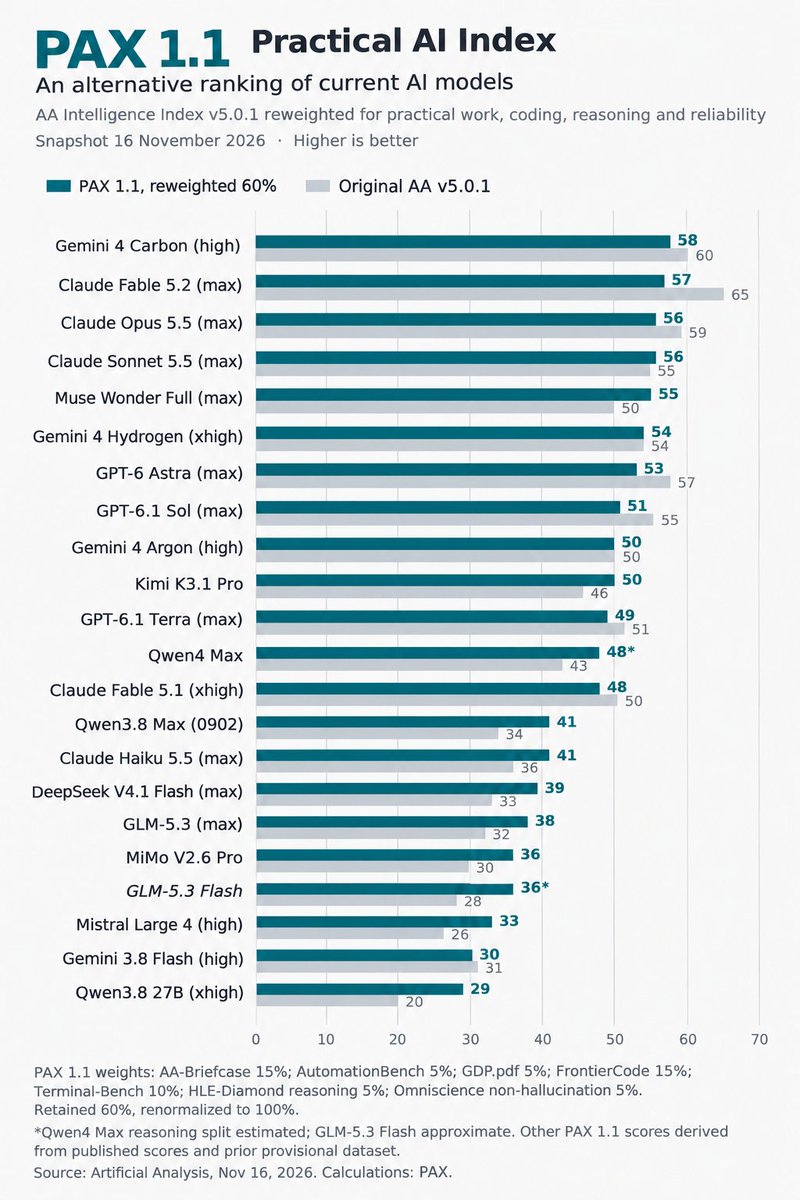
Introducing PAX 1.1 — the Practical AI Index.
Artificial Analysis (AA) measures overall AI intelligence. PAX focuses on what matters more for everyday AI use: knowledge work, coding, automation, reasoning, and reliability.
It removes highly specialized frontier science and physics benchmarks, which account for 25% of the AA index. Impressive capabilities, but not particularly relevant to most users.
PAX 1.1 also reduces the weight of extremely obscure, closed-book factual knowledge from HLE and Omniscience, which can favor models with broader memorized knowledge.
It retains difficult reasoning and hallucination resistance while giving more weight to practical work.
PAX isn't about which AI knows the most. It's about which AI is most useful for the work people actually do.
This looks increasingly like a politically motivated, racially charged witch hunt against one of the driving forces behind American technological leadership. If even someone as powerful and accomplished as Jensen Huang can be smeared without evidence of wrongdoing, what message does that send to talented people of Chinese heritage? This would only weaken America and strengthen China.
Tightening AI chip exports to China is self-defeating. It accelerates the independent stack already forming—Huawei Ascend, SMIC 7nm-class, CXMT DRAM, YMTC NAND.
By the early 2030s Chinese scale will flood the market with RAM and compute, turning them into commodities. That destroys U.S. profitability while doing nothing for national security.
NVIDIA’s CEO just confirmed a relationship with a suspected Chinese spy.
Congress is back today. We have legislation ready to go to stop advanced AI chips from fueling China’s military.
Let’s get this done.
Tightening AI chip exports to China is self-defeating. It accelerates the independent stack already forming—Huawei Ascend, SMIC 7nm-class, CXMT DRAM, YMTC NAND.
By the early 2030s Chinese scale will flood the market with RAM and computer, turning them into commodities. That destroys U.S. profitability while doing nothing for national security.
Tightening AI chip exports to China is self-defeating. It accelerates the independent stack already forming—Huawei Ascend, SMIC 7nm-class, CXMT DRAM, YMTC NAND.
By the early 2030s Chinese scale will flood the market with RAM and compute, turning them into commodities. That destroys U.S. profitability while doing nothing for national security.