Big news for local businesses📍
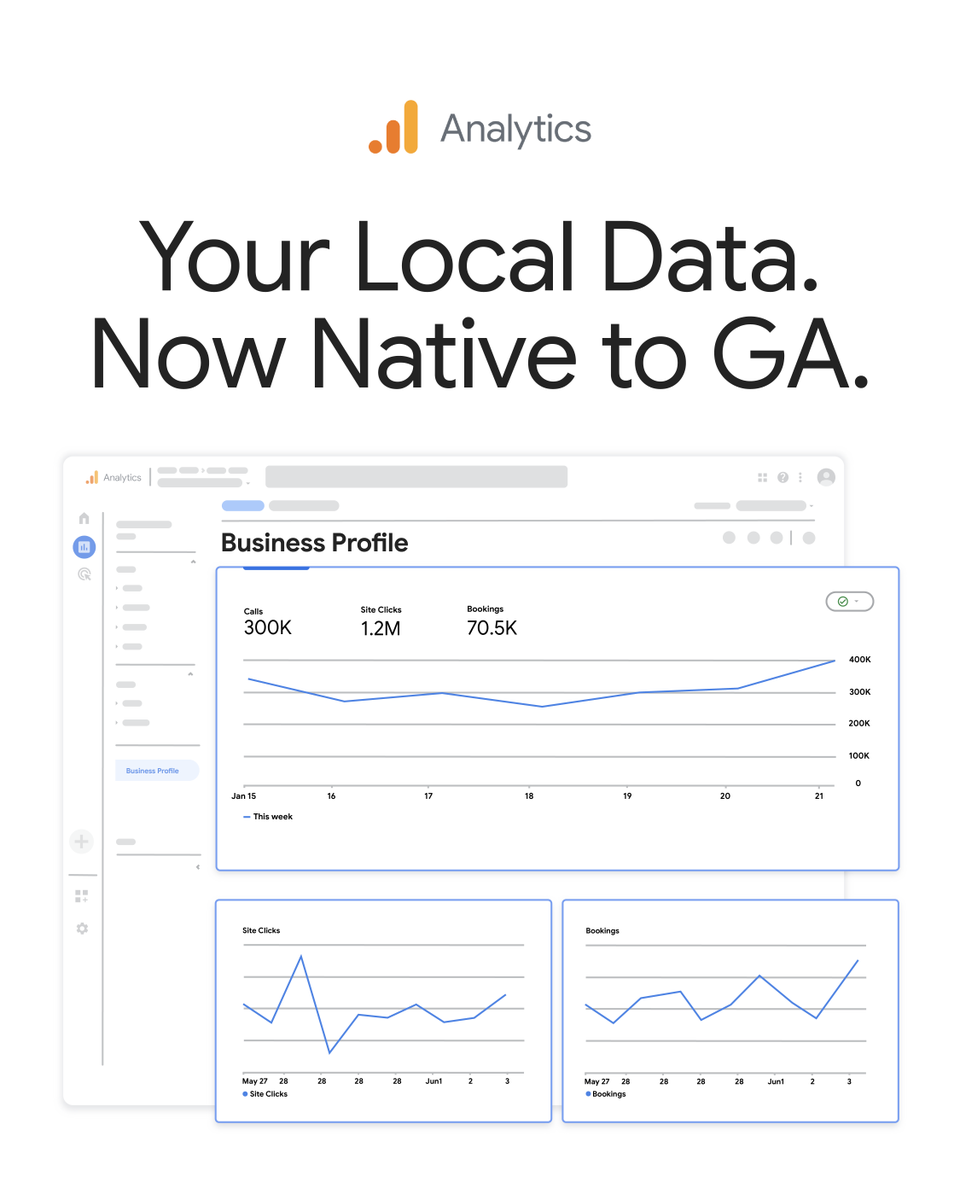
You can now link your @GoogleMyBiz Profile directly to Google Analytics 📣
Track local interactions, calls, bookings, & direction clicks right in GA for a complete, cross-channel view of your performance. Stay up to date → https://t.co/bwCGPbhyXg
The creator of Linux just publicly called out the AI hype. Word for word.
Linus Torvalds took the stage at Open Source Summit 2026 and said this:
"When I see people saying 99% of our code is written by AI, I literally get angry. Because those same people — I can pretty much guarantee — 100% of their code is written by compilers. But they never say that."
He is not anti AI. The Linux kernel saw a 20% jump in submissions this release because of AI tools. He uses it. He gets it.
His point is something most people are too afraid to say.
AI is a productivity tool exactly like compilers were. Compilers boosted programming by 1000x. AI adds another 10x on top. Enormous. But nobody says "the compiler wrote my code." So why are we saying AI wrote it?
He also flagged something nobody is talking about.
AI is flooding small open source projects with drive-by bug reports. Someone runs a prompt, files a report and disappears when asked for a patch. Maintainers with one or two people are drowning trying to keep up.
"Sometimes AI reports a bug and when you ask for more information the person has done that drive-by and does not even answer your question. That is the real burnout issue."
And his final warning was the sharpest of all.
"People who do not understand the complexity of systems will prompt systems and write processes that will fail."
The AI hype crowd is very loud right now.
Linus has been building real systems for 35 years. When he talks, engineers listen.
Full interview here:
https://t.co/LmXJtvKc4O
Massive SEO News: Google is launching the most requested report in Google Search Console ever. A new AI performance report!
Here's what we know so far:
• It will include dedicated reports for both Search and Discover
• The data will be reflected within Search for AI Overviews and AI Mode, alongside AI features in Discover
• The report will only be focused on impressions within generative AI features, not clicks
• The rollout will start with a subset of websites, allowing thorough testing (so keep an eye out!)
There are some major limitations to this initial testing phase, where the actual queries that users are searching won't show in the report, with only impressions for pages, countries, devices, and dates.
Though the dataset will be limited, this is certainly a step in the right direction!
I will be covering this rollout within my newsletter, so make sure to subscribe if you aren't already: https://t.co/J6GbI1tB27
If you read between the lines - Google is getting more critical of our content and what we publish.
Google can quickly identify commodity content. AI can generate this content easily. Google doesn’t need your website to create/scale this content.
@filiwiese@athenseo
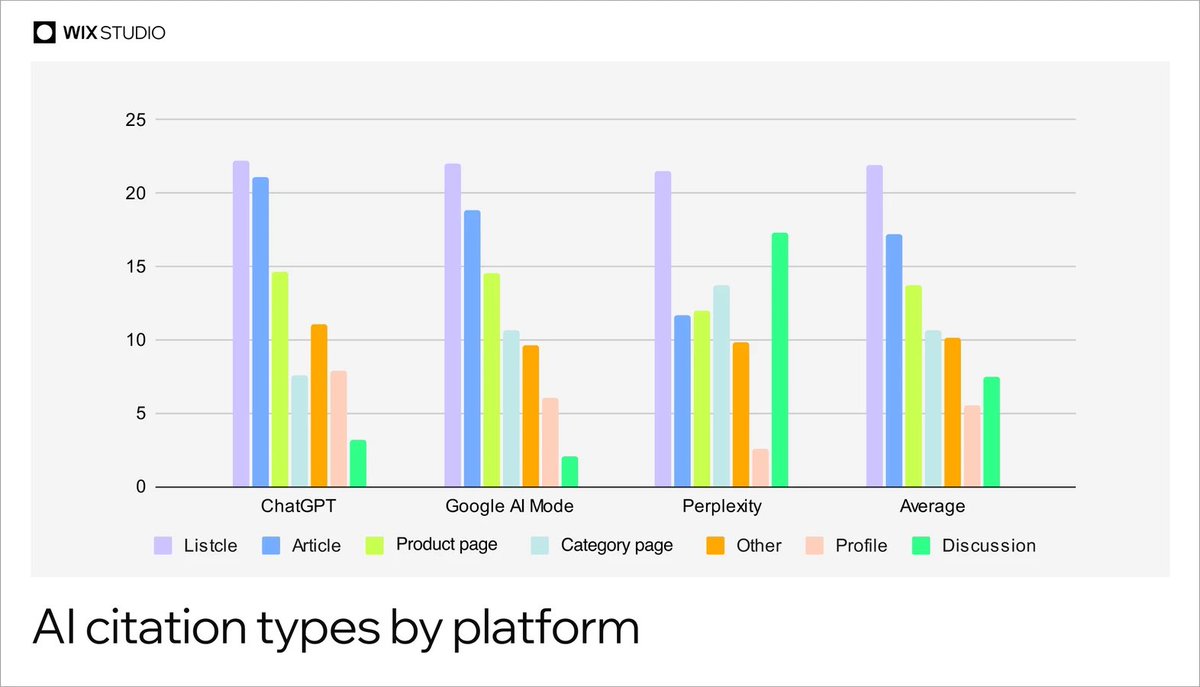
You need more than one content format to win in AI search.
Articles build trust. Listicles win commercial research. Product and category pages win conversion-oriented prompts.
Peec AI and Wix teamed up to analyse 1M+ citations across 3 major LLMs.
Learnings:
Query intent is a bigger differentiator than the industry or model for what content formats get cited.
By Prompt Intent:
52% of citations are made up of just 3 content formats. Listicles (22%), articles (17%), and product pages (14%).
Articles dominate informational prompts (45%).
Listicles win for commercial prompts (41%).
For transactional prompts, you need product pages (25%), category pages (15%), and the homepage (7%).
By Model:
ChatGPT prefers articles.
Perplexity has a bias for discussion pages. Mainly caused by reddit.
Google’s AI Mode has the most balanced selection of sources types.
By Industry:
The professional services and SaaS industries have the highest shares of listicles.
The professional services space also has the highest share of self-promotional listicles (19%).
Health & wellness is dominated by articles (20%).
Which statistic do you find most surprising?
Most SEOs live in 5+ tabs:
GSC → GA4 → Google Ads → spreadsheets → dashboards.
What if #Claude Code could cross-reference all of them for you?
This setup turns Claude into an #SEO command center — and surfaces insights in seconds: https://t.co/RZyu3wut63
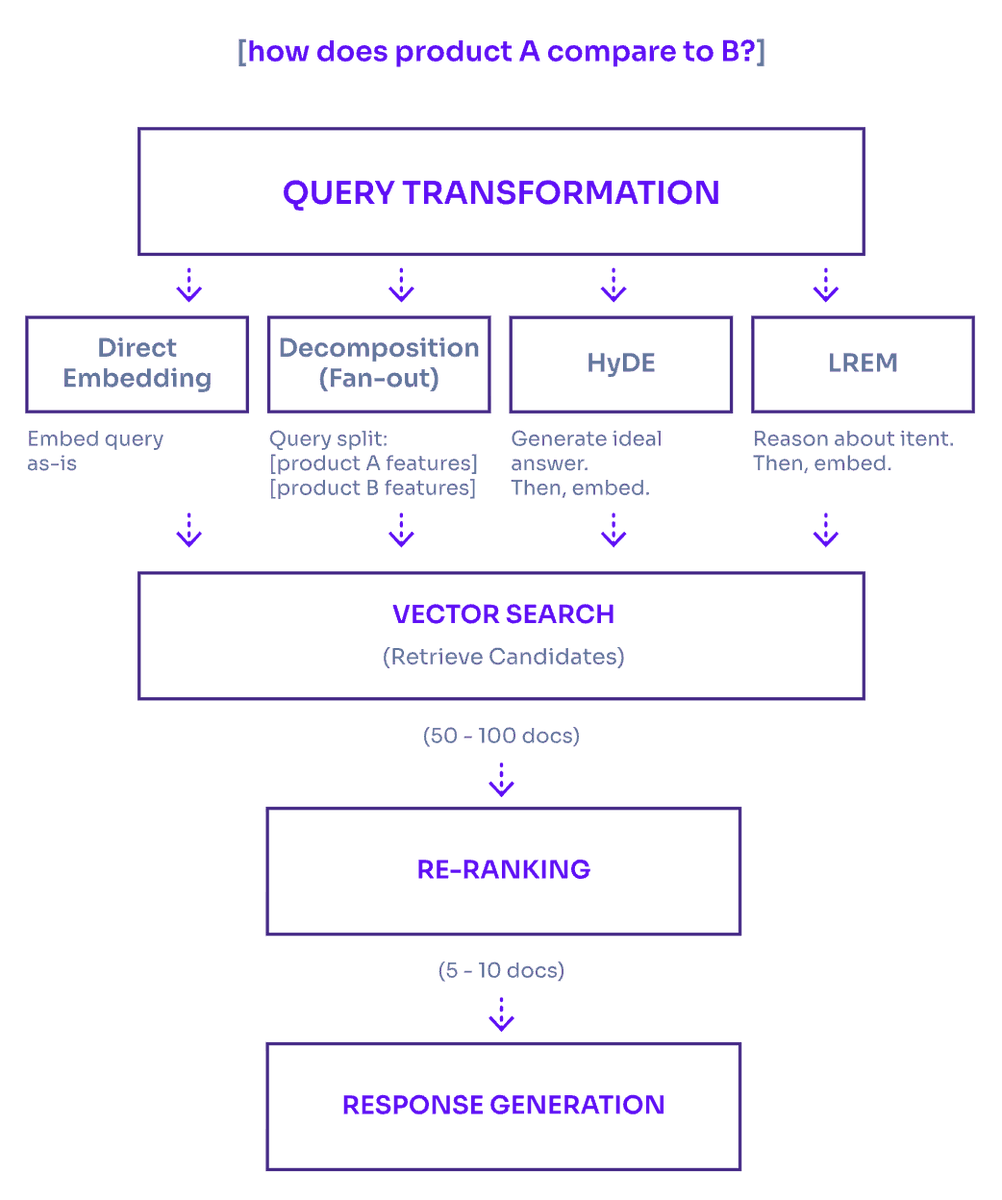
How LLMs and RAG Systems Retrieve, Rank, and Cite Content 🤖 A must read A technical guide by @pedrodias to understanding retrieval-augmented generation architecture and its implications for content visibility in generative search:
* How does LLM retrieval differ from traditional search?
* Beyond ranking: rationale-based selection
* How citations get attached
* Much more.
Check it out: https://t.co/HyLuDwkOZW
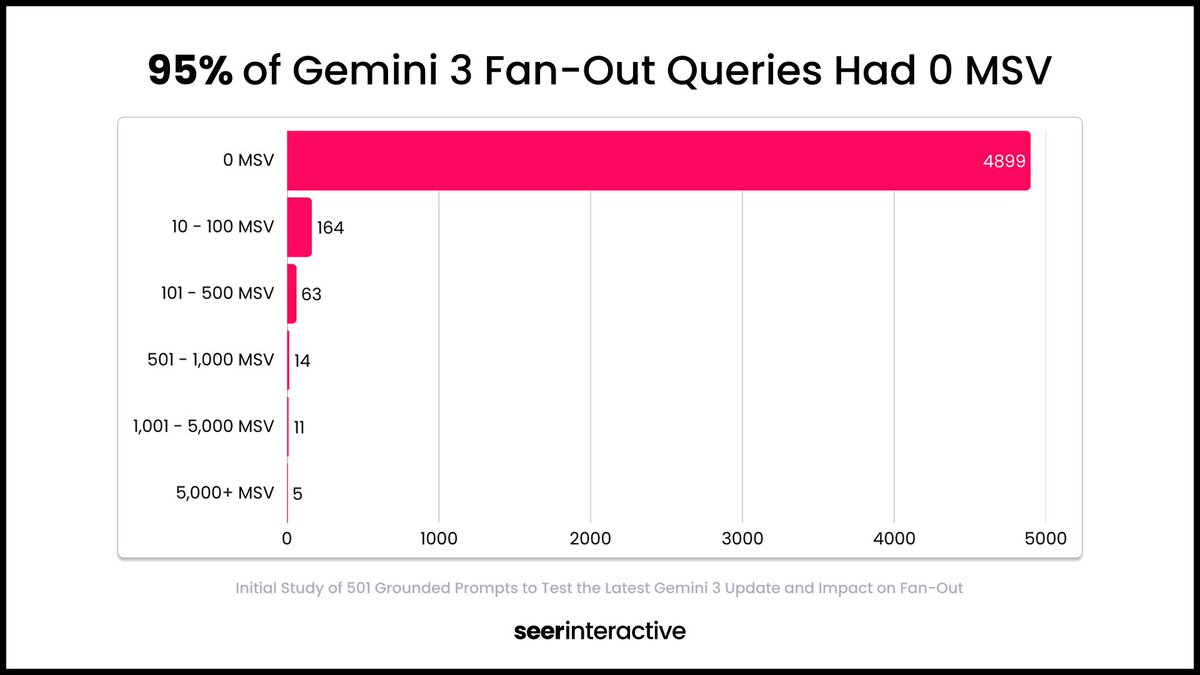
When we evaluated the specific queries in Gemini 3's fan outs, this data point stood out to me most... most of the fan out queries had NO MSV. Just adding one or two words to a fan out, takes it from "head keyword" to something else.
https://t.co/axjzzPgUMw
☠️ The worst take I’ve heard recently about AI search? 👇
Someone saying they wouldn’t want to be in the shoes of SEOs right now because of AI search.
What a myopic take. The grounding (pun intended) of AI search optimization is exactly what SEOs have been doing for years when optimizing for Google’s traditional search. AI search answers rely on RAG to deliver up-to-date, factually correct information. Our job as SEOs is to optimize for whatever discovery platforms audiences use to find the products or services of the companies we work with—Google, YouTube, TikTok… and now LLMs too.
I don’t care what label people want to put on “optimizing for AI search.” Right now, no one in digital marketing is better positioned than SEOs, who already understand what it takes to organically optimize for a platform—in this case, AI. It’s the SEO community that’s researching, testing, and uncovering the opportunities.
I get it: AI is a massive business opportunity, and many are trying to reshape the narrative to their own advantage. In the end, time will sort it out.
Funnily enough, just a week ago I wrote a piece for @sengineland outlining the three common mistakes to avoid when investing in AI search based on my experience advising some of the world’s top brands. The first mistake? Exactly this: not aligning AI search optimization efforts with existing SEO initiatives.
Read it here: https://t.co/2eM2E4shg9
@glenngabe You're welcome! I've always loved your posts. It’s remarkable how you capture the search zeitgeist, and also manage to look ahead as AI platforms evolve so quickly. Fully agree that building their own indexes is key if they aim for independence and better control in their results
I love what @timsoulo put out here because it should prompt dialogue within our industry, various POVs and perspectives is a good thing. Thank you tim.
https://t.co/ZndBAHyZR5
Most people don’t realize ChatGPT has hidden operators that can totally change its answers.
Here's the ultimate 32-shortcut cheatsheet for sharper prompting! 🤯
Add one to the start.
Example: /ELI5: [topic] → explain this topic like I’m five
Full list + sheet in 🧵 ↓











![DataChaz's tweet photo. Most people don’t realize ChatGPT has hidden operators that can totally change its answers.
Here's the ultimate 32-shortcut cheatsheet for sharper prompting! 🤯
Add one to the start.
Example: /ELI5: [topic] → explain this topic like I’m five
Full list + sheet in 🧵 ↓ https://t.co/IektyosuMw](https://pbs.twimg.com/media/G2KHp_NaIAMldsw.jpg)


