Crosschain shouldn't mean friction.
Today we prove it.
The first seamless crosschain mint is live. Launched in collaboration w/ @rarible.
Mint an NFT on @ApeChainHUB w/ @RariChain funds. No manual bridging, no gas, no dust, no friction.
Powered by Espresso's fast finality.
20 days onchain starts on @base.
Step into a network working to bring a billion people onchain and unlock a more open, global economy.
https://t.co/HIqB9ib40g
Casascius — the physical Bitcoin that started the whole legend
People are used to digital wallets, seed phrases and on-chain everything.
But there was a moment in crypto history when you could literally hold Bitcoin in your hand.
That moment was called Casascius — physical coins loaded with real BTC.
What it was:
2011–2013.
One guy from Utah — Mike Caldwell (Casascius) — was stamping metal coins with actual private keys sealed under a hologram.
Metal outside.
First chars of the address.
Bitcoin inside.
If the hologram is intact — the coin is funded, a real cold wallet.
Peel it — BTC moves to a digital wallet, the coin becomes peeled and loses part of its premium.
Coin = wallet.
Wallet = artifact.
How it worked:
Back in 2011 it looked like magic:
• A keypair is generated
• BTC is sent to the public address
• Private key is printed and sealed under the hologram
• A part of the address is stamped on the coin so anyone can verify it’s actually loaded
You can’t fake the hologram.
Any peel leaves a scar.
No new funded Casascius have existed since 2013.
Why production stopped:
It blew up too fast.
By 2013 Casascius had loaded almost 90K BTC into coins.
Regulators woke up.
FinCEN decided Caldwell was a “money transmitter” who needed licenses and full compliance.
On Nov 26–27, 2013, funded Casascius were discontinued forever.
From that moment they turned into the blue-chip collectibles of the crypto world.
Types of coins:
This wasn’t one product. It was an ecosystem:
• brass 0.5 / 1 / 5 / 10 / 25 BTC
• silver 0.1 BTC
• gold-plated variants
• bearer bars
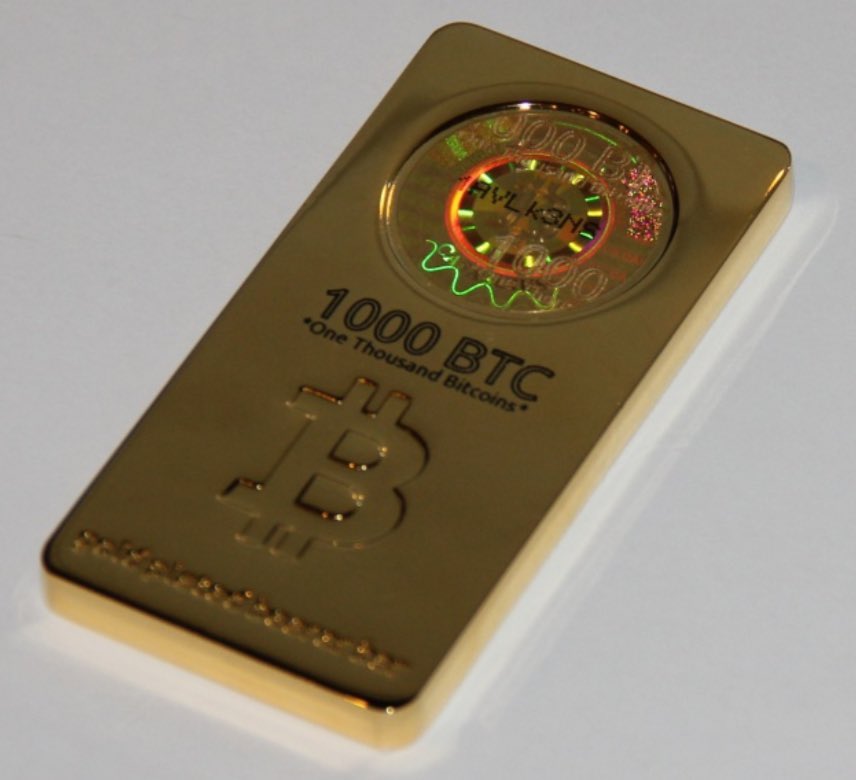
• and the peak: the legendary 1000 BTC Gold Cas
1 bar = 1000 BTC + a gold-plated ounce.
In 2013 it sold for 1M.
Today it’s worth hundreds of millions on the digital side alone.
There are even misprints: CASACIUS instead of CASASCIUS — those sell with a premium like rare stamps.
How many survived:
According to trackers (2025 data):
• around 36,930 BTC still locked inside
• over 18,000 coins remain sealed
• over 10,000 coins have been peeled
Every time someone peels a coin for the BTC, the market loses one more living Casascius forever.
Supply drops → price climbs.
Why some Casascius cost more than the BTC inside:
Because this is a different dimension:
• rarity
• history
• condition
• metal
• year
• series
• provenance
• collector trust
It’s numismatics inside crypto.
A silver 0.1 BTC Casascius easily sells for 25K+.
A 1000 BTC Gold Cas is museum-tier — and only a total idiot would try to sell it casually.
Where people buy them:
Where Bitcoin itself was born:
• Bitcointalk — original threads, deals, catalogs, expertise
• Collectibles section — real crypto numismatics
• Reddit — stories of finds, debates “hold or peel”
• Heritage / Stack’s Bowers / GreatCollections auctions
The market is alive, narrow, and gets more elite each year.
Risks: fakes and fraud
When an item is worth 5–7 figures, counterfeiters swarm.
Protection is simple:
• check design with catalogs
• verify the address on-chain
• remember: no funded Casascius exist after 2013
• serious pieces must go through PCGS / ANACS
Why Casascius still show up in 2025:
Because they’re a hardcore symbol of crypto.
• First physical BTC
• Every peel = millions put in motion
• Every peel makes the remaining ones rarer
• Bitcoin you can literally hold
It’s like owning the first printed dollar — but with a private key inside.
Conclusion:
Casascius is not a souvenir.
It’s a cultural layer of crypto.
A bridge between code and matter, between 2011 and the present era.
Every sealed Casascius is a living BTC artifact that becomes more valuable each year.
If a new untouched Casascius surfaces today — that’s an event. A signal. A reminder of where this all started.
#bitcoin #casascius
@ODELL @nic__carter @threadguy@udiWertheimer@coindesk@APompliano
Misfortune will befall those who mistake the incipient market collapse for another correction and rush to buy back. This is not a phase in the cycle. Recovery will be slow, and not everything will return to previous levels. Caution is a prudent approach now.
Join us on ChainOpera AI, the Blockchain AI OS for AI Agents.
You can use my invitation code XO7K40GZ and URL https://t.co/B3tC2tiCUj to get "AI Terminal Ambassador Badge" and win points.
About ChainOpera AI: https://t.co/JH29nutwOh #ChainOpera@ChainOpera_AI
(1/n) Introducing ChainOpera AI (https://t.co/WMQ1QA4PaA), the L1 Blockchain and Protocol for Co-owning and Co-creating Decentralized AI Agents for Humanity, backed by Federated AI OS and Platform.
What's ChainOpera AI?
ChainOpera AI offers the blockchain and protocol for co-owning and co-creating decentralized AI apps and agents.
1. The blockchain and protocol empower the AI community to drive innovations in AI agents and apps while co-owning them and restoring data sovereignty to everyday users. It enables a full-lifecycle, scalable, sustainable, and trustworthy AI economy, rewarding all participants—from data and GPU resource suppliers to model developers, AI agent/app creators/developers, and end-users who can monetize their private data to improve community-driven AI. The protocol also features customizable token economics to fit token preferences from agent/app creators/developers, including buyback and burn mechanisms, staking options, and governance with community DAOs. The protocol operates on our federated AI OS and platform.
2. The federated AI OS incorporates Decentralized Identifiers (DIDs) for users to manage their data access, privacy, security, and sovereignty across diverse agents and apps with interoperability and cross-agent/app compatibility. Its innovative AI terminal rewards users for their data contributions, which help build better community-driven large language models (LLMs) with private data. Additionally, it simplifies agent and app development by offering model serving and AI agent workflow, creation, and management through APIs, CLIs, and low-code UIs.
3. The federated AI platform, the world's first decentralized machine learning platform, allows all AI resource contributors (data, model, and GPUs) to participate in the serving of AI agents and apps and get rewarded. Its many years of technological advances in enterprise AI services in TensorOpera, FedML, ScaleLLM, and edge-cloud hybrid model serving make it the only model service provider in the web3 industry that can stably provide cost-effective, scalable, and fast model-serving APIs based on decentralized resources.
4. Community-built Agents. ChainOpera team is also developing a few flagship AI agents and applications to showcase how community AI resources can drive the innovation of AI agents and apps, and promote private data sovereignty within the protocol. The community can co-own and co-create diverse autonomous and socialized AI agents (e.g., AI influencers, game players, AI companions, teachers) that interact with Internet services such as YouTube, TikTok, Twitter, and Discord. Each agent has its own token issuance, and users can even create digital twin-like agents based on their private data.
5. Flagship AI Agent App - AI Terminal. On the AI app side, our flagship ChainOpera AI Mobile App features an AI Terminal with a "Type to Earn" system that benefits humanity by allowing users to share their private data and receive rewards for LLM and GenAI model training. The AI Terminal also functions as a powerful AI agent that simplifies trading of AI coins on the ChainOpera platform and other meme coins. The AI Terminal is your personal companion that represents you and completes various tasks in your life and work. Eventually, the AI Terminal will evolve into your personal AI operating system.