O mundo todo está feliz com a vitória da Argentina. Impressionante o carisma, o encanto e o magnetismo desse nosso irmão sul-americano. O planeta está em festa. 🙏🇦🇷
In neuroscience, global workspace theory holds that thoughts become consciously accessible when they enter a privileged workspace that’s broadcast across the brain.
Using a new interpretability technique, we found something similar in Claude: the J-space. https://t.co/sLu2JgYwOQ
L'Europe n'a pas été assassinée. Elle s'est suicidée. Et comme tout suicide confortable, elle l'a fait lentement, poliment, à coups de bonnes intentions — persuadée jusqu'au bout d'être vertueuse.
C'est pour ça que personne ici ne veut nommer la chose. Un meurtre, ça se dénonce. Un suicide, ça oblige à regarder l'arme. Et l'arme, ce n'est ni Washington, ni Pékin, ni « l'ingérence ». C'est nous.
Trois coups. Toujours les mêmes.
Premier coup : on a fait fuir ceux qui créent.
Le socialisme ne rend pas les pauvres riches. Il rend les bâtisseurs partants.
Chez nous, celui qui crée est traité comme un suspect : taxé comme un privilégié, régulé comme un danger, envié comme un voleur. Alors il part. Pas par cupidité — par épuisement. Le capital et le talent ont des jambes. Ils vont là où on les accueille, pas là où on les soupçonne.
Et ce qui s'en va, ce n'est pas seulement de l'argent. Ce sont les boîtes qui ne naîtront jamais ici. Bastiat appelait ça « ce qui ne se voit pas » : on compte fièrement l'impôt prélevé, on ne compte jamais les champions jamais construits. On a choisi.
Deuxième coup : on a tué le goût de la liberté.
Le piège le plus efficace n'est pas la misère. C'est le confort.
Tocqueville l'avait vu il y a deux siècles : un pouvoir doux, tutélaire, qui se charge de ton bonheur, prévoit, pourvoit, décide — à condition que tu renonces à être adulte. On a bâti exactement ça. Un continent où tout le monde boit aux mamelles de l'État-providence et appelle ça « solidarité ».
Mais un peuple qui attend tout de l'État finit par ne plus rien vouloir par lui-même. La liberté n'est pas un droit qu'on consomme, c'est un muscle. Et un muscle qui ne porte jamais rien s'atrophie. Taleb dirait la même chose autrement : retire tout stress d'un système, tu ne le rends pas fort — tu le rends fragile. On a choisi.
Troisième coup : on a confié les clés à ceux qui ne construisent rien.
Et pour gouverner tout ça, on a mis en haut non pas ceux qui bâtissent, mais ceux qui commentent.
Une caste de littéraires, de juristes, de communicants — qui n'ont jamais shippé une ligne de code, jamais tenu une paie, jamais risqué un euro à eux — mais qui légifèrent sur tout. Ils ne savent pas construire, alors ils régulent. Ils ne savent pas créer, alors ils interdisent. Et ils produisent à l'échelle industrielle la seule chose qu'ils maîtrisent : de la norme, de la directive, du label, du comité. De l'absurdité déguisée en progrès.
Une civilisation se définit par qui elle place au sommet. Mets des ingénieurs en haut, tu obtiens Ariane, le TGV, le programme nucléaire. Mets des administrateurs en haut, tu obtiens des études d'impact sur les études d'impact. On a choisi.
Ces trois coups ne sont pas trois maladies. C'est la même. Un continent qui punit ceux qui créent, subventionne ceux qui renoncent, et couronne ceux qui ne produisent que des règles. Punir, subventionner, couronner — toujours les mauvaises personnes.
Ce n'est pas de la malchance. C'est un tri. Les audacieux s'en vont, les dépendants restent, les commissaires gouvernent. Ce n'est pas une crise. C'est un résultat.
La bonne nouvelle avec un suicide, c'est que la main tient encore l'arme. Donc la main peut la baisser.
Arrêter de traiter l'entrepreneur en suspect et commencer à le traiter en actif national. Couper ce qui étrangle, pas ce qui produit. Rendre le goût du risque, de l'effort, de l'envie de gagner. De l'énergie abondante et pas chère. Des champions tech qu'on laisse enfin grandir au lieu de les réguler au berceau. Moins de gens qui expliquent le monde, plus de gens qui le fabriquent.
Parce qu'une civilisation ne meurt jamais de ses ennemis. Elle meurt de ce qu'elle cesse d'exiger d'elle-même. L'Europe a tout ce qu'il faut pour revenir — le capital, les talents, l'histoire, une faim enfouie sous un siècle de confort. Il lui manque une seule décision : arrêter d'administrer son déclin, et recommencer à bâtir.
Le reste n'est qu'une question de volonté.
Au travail.
Super interesting!
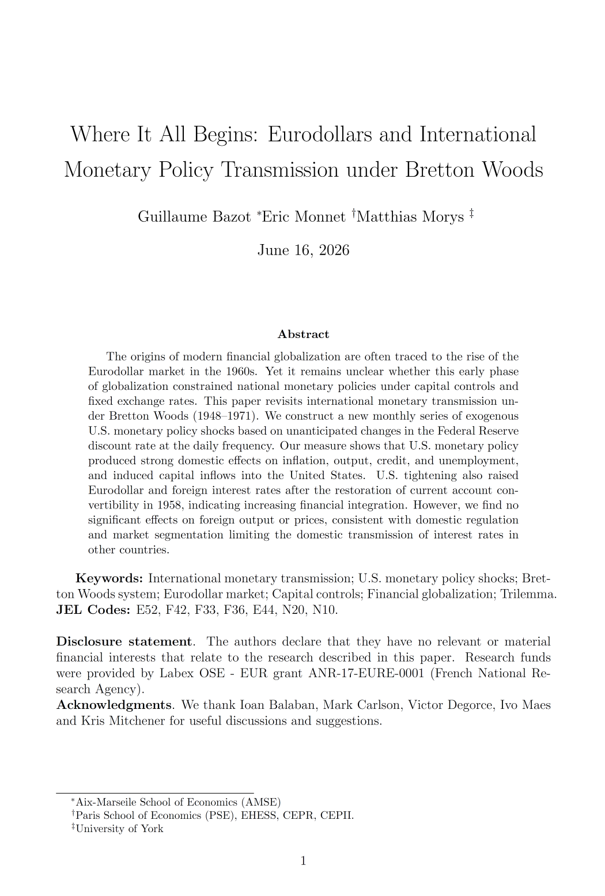
"Where It All Begins: Eurodollars and International Monetary Policy Transmission under Bretton Woods" by Guillaume Bazot, Eric Monnet, and Matthias Morys.
"The origins of modern financial globalization are often traced to the rise of the Eurodollar market in the 1960s. Yet it remains unclear whether this early phase of globalization constrained national monetary policies under capital controls and fixed exchange rates. This paper revisits international monetary transmission under Bretton Woods (1948–1971). We construct a new monthly series of exogenous U.S. monetary policy shocks based on unanticipated changes in the Federal Reserve discount rate at the daily frequency. Our measure shows that U.S. monetary policy produced strong domestic effects on inflation, output, credit, and unemployment, and induced capital inflows into the United States. U.S. tightening also raised Eurodollar and foreign interest rates after the restoration of current account convertibility in 1958, indicating increasing financial integration. However, we find no significant effects on foreign output or prices, consistent with domestic regulation and market segmentation limiting the domestic transmission of interest rates in other countries."
https://t.co/pYMgYpBEAO
L'erreur fondamentale de De Gaulle n'est pas militaire. Elle est culturelle.
Il a gagné la guerre. Il a rebâti l'État. Il a rendu à la France sa souveraineté. Et pendant qu'il tenait le pouvoir visible, il a laissé l'autre camp prendre le pouvoir réel. Il a confié l'école, l'université, la transmission des idées à ceux qui voulaient précisément détruire ce qu'il défendait. Il croyait que la France se jouait à l'Élysée. Elle se jouait dans les salles de classe.
Soixante-dix ans plus tard, on regarde le résultat sans filtre. Les magistrats pensent d'un seul bloc. Les professeurs pensent d'un seul bloc. Les journalistes pensent d'un seul bloc. Les intellectuels pensent d'un seul bloc. Un pays entier formé dans le même moule, tellement homogène qu'il a fini par confondre son moule avec la neutralité.
Et ce moule a produit ses monstres. Les années 60 et 70 ont accouché en France des pires impasses intellectuelles du siècle. Une génération brillante a mis tout son talent au service d'une seule idée : que rien ne tient, que tout est construit, que toute autorité est suspecte et que toute vérité n'est qu'un rapport de force déguisé. La déconstruction n'a pas ouvert les esprits. Elle a appris à une élite entière à dissoudre au lieu de bâtir.
Puis c'est parti à l'export. L'Amérique a importé cette French Theory, l'a passée dans ses campus, l'a mutée en quelque chose de plus dur et de plus religieux. Le wokisme n'est pas né dans le vide. Il est né de nos philosophes, relu par des militants, industrialisé par des institutions. Nous avons envoyé le virus, ils nous ont renvoyé la pandémie.
Mais le vent tourne. Partout, le camp de la liberté remonte. Les gens n'en peuvent plus d'être gérés, corrigés, rééduqués par des institutions qui les méprisent. Ils veulent construire à nouveau. Ils veulent transmettre à nouveau. Ils veulent croire à quelque chose au lieu de tout dissoudre.
La tâche des dix prochaines années est claire. Rouvrir les institutions à la pluralité au lieu de les livrer à un seul camp. Reformer ceux qui forment. Redonner à l'école le droit de transmettre au lieu de déconstruire. Déconstruire la déconstruction, non pas en interdisant, mais en la battant sur son propre terrain, celui des idées, où elle est en réalité très faible dès qu'on ose la contredire.
Un reset, oui. Mais pas celui de Davos. Pas un reset d'en haut, technocratique, qui veut vous posséder et vous surveiller. Un reset d'en bas. Le retour du réel, du bâtisseur, de la transmission, de la confiance. La fin de soixante-dix ans où une seule moitié du pays avait le droit de penser tout haut.
De Gaulle a cédé la culture en croyant garder la France. On ne refera pas l'erreur. Cette fois, on reprend d'abord la culture.
It's been a long time since I wrote anything remotely informative on X. I have something minor that sits somewhere in between [finance] signal analysis and statistics, which is also very practical, simple, and with a familiar ending. A loong 🧵 👇.
1/18
Trend-Following and Risk Factor Diversification in 2022 and 2023: a Tale of Two Extremes (Quantica)
Should trend followers diversify into as many markets as possible?
During trend's good years, performance can be explained by a small number of risk factors (as determined by principle component analysis - Figures 4 and 3).
In those good years, diversification doesn't make much difference. But in years that aren't as good, diversification allows the trend strategy to capture more of those orthogonal risk factors and provides a better Sharpe ratio. The full-sample Sharpe consequently also improves with diversification. (Figure 5, Table 2)
This is the case even though the empirical full-sample correlations are high between trend strategies with different amounts of diversification. High correlations don't necessarily mean the strategies will have similar risk-adjusted returns.
Note how narrow the paper's "concentrated CTA universe" is, especially as it only has two commodity markets (Table 1).
In years like 2008 and 2022, news headlines will focus on those well-known markets and on the CTAs trading them.
But it could be more helpful to focus on portfolio construction. Look at the tradeoffs between diversification, execution costs, and tail risk.
What may matter in the end is your performance when no one else is watching.
MIT'S PROBLEM-SOLVING TEXTBOOK IS FREE, AND IT BEATS EVERY PRODUCTIVITY COURSE EVER SOLD
A physicist named Sanjoy Mahajan spent 15 years teaching MIT, Cambridge, and Olin students one thing: how to crack hard problems without drowning in them.
The book is called "The Art of Insight in Science and Engineering," and MIT gives it away for free.
Here are the 9 thinking tools the book actually teaches:
1. Divide and conquer
Never attack a giant problem head-on. Split it into pieces small enough to estimate, solve each, and recombine. Most people freeze at the size of a problem. Mahajan teaches you to make it smaller until it stops being scary.
2. Dimensional analysis
Before you calculate anything, check what units the answer has to be in. The units alone often hand you the shape of the answer and catch errors instantly. The fastest sanity check in existence, and almost nobody uses it.
3. Reasoning by extreme cases
Push the problem to its limits. What happens if the number goes to zero? To infinity? The extremes are easy to picture, and they pin down the behavior in the messy middle. A way to feel out an answer before you can prove it.
4. Lumping
Replace a complicated curve or messy shape with a single rough block that captures the gist. You lose a little accuracy and gain enormous clarity. The skill of throwing away the right detail at the right moment.
5. Probabilistic reasoning
When you can't know something exactly, estimate it with odds instead of pretending you need certainty. Most real decisions live here, in the space between "I know" and "I have no idea."
6. Easy cases
Before solving the hard version, solve the easy version first and let it guide you. If your method can't handle the simple case, it was never going to handle the hard one.
7. Analogy
Map an unfamiliar problem onto one you already understand. The structure carries over even when the surface looks completely different. Mahajan treats analogy as a precision instrument, not a vague hunch.
8. Spring models and proportional reasoning
Instead of memorizing formulas, reason about how one thing scales when another changes. Double this, what happens to that. Understanding relationships beats memorizing equations every time.
9. Discarding information on purpose
The deepest move in the book. Mahajan splits all simplification into two kinds: organizing complexity, and deliberately throwing some away. Knowing exactly what you can afford to lose is the whole art.
Where to get it free.
The full book is on MIT OpenCourseWare as course RES.6-011, released under a Creative Commons license. The complete online textbook, every chapter, every problem. No signup, no payment, no catch. His earlier book, "Street-Fighting Mathematics," is free on OCW too.
https://t.co/MIdELPoUtj
The self-help industry sells you systems for managing your tasks. This MIT physicist gives you a system for managing reality. One of them is free, and it's the better one.
Meğer 300 milyon sperm yumurta finaline doğru 100 metre yarışı yapmıyormuş ve birinci gelen sperm döllenme hakkını kazanmıyormuş. En iyi, en uygun olan sperm yumurtaya girebiliyormuş. Onu da yumurta seçiyor.
Stockholm Üniversitesi ve Manchester Üniversitesi bünyesindeki araştırmacılar yumurtayı çevreleyen ve sperm hücrelerini çeken kimyasal maddeler içeren foliküler sıvının, her kadında farklı bir kimyasal imza taşıdığını keşfetmişler.
Bu çalışma, döllenmenin sadece en hızlı yüzen spermin yarışı kazandığı düz bir süreç olmadığını, yumurtanın aktif olarak sürece dahil olduğunu ve kendi tercihini yaptığını ortaya koymuş.
Bu seçilim mekanizmasının arkasındaki temel evrimsel mantık da genetik kaliteyi maksimize etmek.
Yumurta, kendi kimyasal sinyalleri sayesinde genetik olarak daha uyumlu veya daha yüksek kaliteli (DNA bütünlüğü daha iyi olan) spermleri "koklayarak" kendine çekmeye çalışıyormuş. Buna "kriptik seçilim" deniyor.
Yumurta hücresi biyokimyasal düzeyde ikinci bir oylama yapıyor. Bu, kadının seçtiği partnerin genetik profilinin yumurta için her zaman en iyi olmadığı durumları açıklıyormuş.
Nedeni açıklanamayan kısırlık vakalarının bir kısmının, yumurta ve sperm arasındaki bu kimyasal uyuşmazlıktan kaynaklanabileceğini düşünüyor bilim insanları.
Peter Thiel: Europe will never have massive tech companies because they fear success.
"In Silicon Valley, there's this pornography of failure. You talk about all your failures, and this somehow means you're going to succeed."
"In the social democratic European societies, it's acceptable to be moderately successful, it's not acceptable to be wildly successful. If you have a successful company that's starting to grow, it will get short-circuited, and you'll sell the company. You'll never get to an enormous company if you sell it along the way."
"The single most important decision in the history of Facebook— summer of 2006. It was two years into the company. We got an acquisition offer for $1B from Yahoo to buy the company. There were three of us on the board— Mark Zuckerberg, myself, and another VC. We had a meeting to decide if we should take the $1B."
"The two of us thought it was a lot of money, we should maybe take it. Mark started the board meeting— 'this is a pro forma thing, we're just going to talk about this for 10 minutes. Obviously we're not taking it.'"
"Any super big tech company is one where you've been offered multiple times for people to buy it, and you've chosen never to sell it. You're not that afraid of success."
"In Europe, the answer is to check out sooner rather than later and go back to the decade-long vacation that people are on in Europe."
Correlation matrix of Fama-French and AQR factors:
The matrix highlights AQR's Value strong anti-correlation with momentum, so it's a better complement.
The Fama-French conservative-minus-aggressive quality factor is uncorrelated to the other quality factors but is strongly correlated to Value.
So CMA is a quality factor by design but a value factor in practice.