@NIKHILLJHA I have star health insurance (4 lakh) for my family (Me 40 Yo, Wife and 1 kid). Want to port my health insurance policy. Which one you should suggest sir?
Someone asked, how do I invest in mutual funds for my child? Today @PosteAnil gives you the answer. Open a free account on MF Utilities & simply follow the process below. Update the child's KYC when he/she turns 18 & let them take over. https://t.co/eMPfQHcof1
TradingView - FREE Breakout Scanner
While personally I don't scan/screen directly in TradingView, I was recently asked what filters I would apply.
As a "starter for ten", using only the out-of-the-box fields, I would probably start with something like this:
1) Market
I only trade US stocks (both common and ADRs) on the three primary US exchanges so first filters are:
Market = US
Exchange = AMEX or NASDAQ or NYSE
Symbol type = Common or Depository Receipt
2) Market Cap
Next is to decide on your market cap.
Are you focusing on small-cap, stocks under $1B, nano-caps?
I only focus on stocks with $1B+ so the next filter is:
Market Cap >= 1B USD
3) Price Structure
As a minimum requirement, the price structure must be:
Price >= MA10 >= MA20 >= MA50
Usually I prefer EMA for the 10-period (day) to receive an earlier signal of potential weakness and to potentially reduce the position size, while using Simple Moving Averages for the 20 and 50.
3A) SMA200-250
In a typical breakout/trend continuation, the ideal price structure would be:
Price >= MA10 >= MA20 >= MA50 >= MA100 >= MA200
If you asked @RealSimpleAriel , he will most likely tell you "nothing good happens beneath the SMA200 - let other people/institutions do the heavy lifting and wait for the stock to establish itself above the SMA200 before buying it".
However, some people trade a "mean-reversion" strategy so the criteria is not enforced (although strongly recommended!)
If you are going to trade mean reversion as one of your strategies, I recommend creating them as a separate scan i.e.
Scan 1) Breakout-Continuation
Price >= MA10 >= MA20 >= MA50 >= MA200
Scan 2) Mean Reversion
Price >= MA10 >= MA20 >= MA50
SMA200 above price by 10% or more.
4) Average True Range (ATR)
Qullamaggie has stated throughout his streams "Low ADR/ATR stocks are 💩while high ADR/ATR are gold".
Traders prefer high ATR stocks as the volatility allows them to compound their accounts quickly.
At present, the average ATR of the $1B+ stock universe is 3.2% so I recommend setting it to 3%+
ATR(14) > 3%
5) Not too extended
You don't want to buy a stock that has become too extended - where the price has risen very fast and may be prone to go sideways or pull back.
Typically, I look to buy stocks between 0 and 4x ATR from the SMA50 but that is not an option currently in TradingView using standard filters.
As an alternative, I would look for a stock to be no more than 10% extended from the MA10.
As I am using EMA10, the filter would be:
EMA10 below price by 0% to 10%
6) Revenue
The best companies are growth companies so, as a minimum, you want revenue to be growing. Newer companies might not yet be growing positive earnings but there is no excuse for not growing sales.
Revenue growth, Quarterly YoY > 0%
Revenue growth, Annual YoY > 0%
7) Recent Performance
I look for stocks that have been performing well recently so I would add a filter to look for them to be up in value on a weekly and monthly basis
Performance 1 Week > 0%
Performance 1 month > 0%
8) Liquidity & Price
You want to ensure the stock has adequate liquidity and is not a low-priced, low-volume stock. This combination depends on your account size and position sizing. I would not go lower than $3 for the price but suggest $10 as a better minimum threshold depending on your account size.
In reality, beyond the scan, look for the Price x Volume to be 10x or greater your account size traded each day.
Price > $10
Avg Volume (10 Days) > 100,000
These filters above would form the basis of the core breakout scanner using out-of-the-box fields (no custom Pinescript) if I was creating a watchlist in TradingView.
Intraday
If I was looking to use the scan intraday for establishing new positions, I would add the following:
8) Intraday 1 - Going 🆙
I want the stock price to be going up and be higher than yesterday when I am buying it, therefore I would add:
Change from Open > 0%
Change > 0%
Optionally add in "New high 1 month" if you want the extra "oomph" of Darvas Box style breakout as a stock making a new 1-month high has cleared the resistance of the past month.
Running this scan today, results in 20 stocks:
$PLTR $HOOD $DELL $ALNY $HUM $KGC $KSPI $CELH $FN $PAAS $KTOS $BZ $VCTR $ACAD $HWKN $LGND $NAMS $CENX $PX $COLL
What are your "go-to" scans in Finviz and TradingView?
What would you change?
Let me know and have a great weekend! 🤝
Overwhelmed by too many setups? 🤯
Here’s how I filter out 80% of trades — and stay in rhythm 👇
1) No Tightness = No Trade
If a stock doesn’t form a clean, tight structure (flag, base, VCP …), I skip it. Sloppy setups = emotional trades.
2) No Volume = No Confirmation
If I don’t see big-volume spikes on the way up — I don’t trust the setup. Volume is the proof that funds are buying.
3) No Theme = No Flow
Even a great setup in a dead sector won’t move. I want stocks inside strong themes — think AI, energy, crypto, defense.
4) No Liquidity = No Edge
If average turnover is under $10-20M, I don’t touch it. I want stocks that institutions can load — not illiquid traps.
5) No Relative Strength = No Momentum
If it’s not outperforming the market, it’s not for me. RS rating >90 or nothing.
6) No Asymmetry = No Reason
If the setup doesn’t offer at least 5:1 reward-to-risk, I skip it. I want moves that can go +50–100% with small risk.
📌 This checklist helps me avoid noise.
📌 I share setups that pass all 6 rules inside the community.
📌 These patterns repeat — I’ve taught them to thousands. I think everybody can learn them.
CYCLICAL and NON CYCLICAL
Suppose working in Pvt company you lost job during Recession.
Then What things you can avoid
-You won’t buy car/Byke/Jewellery
-You won’t Buy flat/House
-All luxurious items
What things you can’t avoid
-Daily consumption product
-medicine & Medical expenses
Products which you can avoid belongs to cyclical sector and which you can’t avoid is non cyclical.
TOP and BOTTOM of Cyclical stocks
SIGNS of TOP
-Low P/E
-High dividend
-Rising Eps
-Positive news
SIGN of BOTTOM
-High P/E
-Bad news
-Falling Earning
-Lower dividend
Steel/AUTO/chemical/paper/Almunium Are Cyclical stocks
Cyclical stocks Fundamental looks very bad during recession because their growth directly linked to GDP growth.
Whenever economy about to boom ,
They are the first to move up even if fundamental looks bad.
Example of Cyclical and non cyclical EPS in 5 years
Non cyclical EPS
2.20
2.35
2.70
2.90
3.20
Cyclical EPS
2.20
0.50
1.50
0.30
2.30
#investing
One sector which is forming a long term bottom in the next 5-6 months & can deliver Vgood returns in next 3-5 years
The sector is under consolidation since 2017
Will share once we get a love of 150 reposts from our friends
Market cycle students can bookmark it
Gratitude 🙏
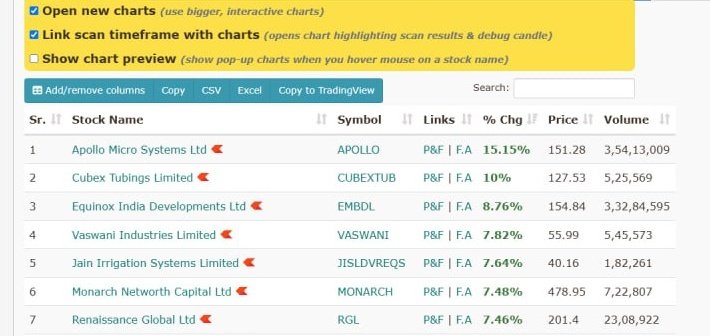
Missed These Stocks Don't Worry
Looking For A Scanner That Will Help You Identify The Next #JISLJALEQS & #APOLLO Yourself.
Before Making The Move & Are Ready To Blast?
To Get The Scanner👇
1. #Like & #Retweet
2. #Comment "SCANNER"
3.Follow @iramyram
I Will DM you the Scanner
Announcement 📢
We are giving 6 hours of extensive Swing Trading Learning content for FREE
Use this opportunity to understand how I swing trade and made 1500%+ Returns in last 4 years through swing trading
Like, Retweet and Follow my handle to know more.
@NIKHILLJHA Happy New Year sir, Which health insurance policy is good for family of 3 member. Currently having Star health Insurance. Current age is 41
@NIKHILLJHA I am 41, having a star health insurance policy for family (4 lac) cover. Thinking about switching to a better policy. Could you please suggest which one should opt for. Thank you 🙏