I used to be shy about using AI autocompletion, a while ago.
Now I mostly code with automatic programming.
And honestly? It's liberating.
You may already have heard about this, but you know: repetita iuvant.
What changed isn't that I stopped thinking — I do it differently.
This shift makes being an engineer more important than ever, not less.
You're no longer just a coder — you're an orchestrator.
You define the intent clearly (the hardest part).
You decompose complex problems into verifiable pieces.
You guide, critique, and correct AI outputs.
You enforce invariants, security boundaries, and performance realities that probabilistic models can hallucinate away.
And theory? Theory is more crucial now than it's ever been.
Without deep fundamentals (data structures, algorithms, concurrency, distributed systems, etc.), you can't reliably spot or understand the LLM design choices and implementations.
AI amplifies leverage, but it also amplifies mistakes. The people who thrive aren't the ones prompting hardest — they're the ones who know enough theory to catch the bullshit, steer the ship, and build reliable, evolvable systems.
In short: tools got faster, so judgment got more valuable.
Still.
What about you — has AI changed how you see your own role as an engineer? 🚀
DS4F, GLM 5.2, Kimi K3, the upcoming DS4 update. What a moment for open weight models. Also, some western company entering the open weight field (but: I want to see the actual long term results to evaluate the actual real-world contribution and models level).
I was thinking about Vector Sets and the Redis approach to this stuff in general. Now that the hype with RAG is gone, I'm 100% sure I made the right call there, saying: RAG will mostly go away, but raw vector search is a useful, fundamental, powerful data structure.
What Europe should do right now:
1. Call all the European researchers working on AI and return them back with same salary (or they can stay but switch career).
2. Fill EU places having GPUs with money, and put those people there.
3. AI partnerships with China + India.
Introducing Claude Fable 5: a Mythos-class model that we’ve made safe for general use.
Its capabilities exceed those of any model we’ve ever made generally available.
Introducing SubQ - a major breakthrough in LLM intelligence.
It is the first model built on a fully sub-quadratic sparse-attention architecture (SSA),
And the first frontier model with a 12 million token context window which is:
- 52x faster than FlashAttention at 1MM tokens
- Less than 5% the cost of Opus
Transformer-based LLMs waste compute by processing every possible relationship between words (standard attention).
Only a small fraction actually matter.
@subquadratic finds and focuses only on the ones that do.
That's nearly 1,000x less compute and a new way for LLMs to scale.
Excited to introduce Gemma 4 Multi-Token Prediction Drafters⚡️Accelerated inference right in your pockets
- Up to a 3x speedup
- Same quality guarantees
- Available in your favorite open-source tools
I want to be rich. But not Lamborghini
or Rolex rich, I want to be rich enough to go to the gym at 3pm and nobody can tell me no. To tap the family in front of me at the supermarket and say, "It's on me," Rich enough that my future wife never has to worry about getting a job. Rich enough to show my children the world, not pictures of it. Rich enough to take my friends to dinner and say, "| got this", Rich enough that God uses me to help the people who are in need. That's my version of rich.
De toekomst van mobiliteit is aangebroken
FSD Supervised has been approved in the Netherlands 🇳🇱 & will begin rolling out in the country shortly!
Trained on billions of kilometers of real-world driving data, it can drive you almost anywhere under your supervision – from residential roads to city streets & highways
No other vehicle can do this.
We're excited to bring FSD Supervised to more European countries soon
i got my whole genome sequenced two years ago and forgot about it.
last week i told my ai agent (@laukiantonson) to dig up my DNA files
• it dug up a two-year-old email
• found the download link
• pulled down 67 gigabytes of raw DNA.
• rented a 32-core, 64GB machine for a few hours — total cost: $5
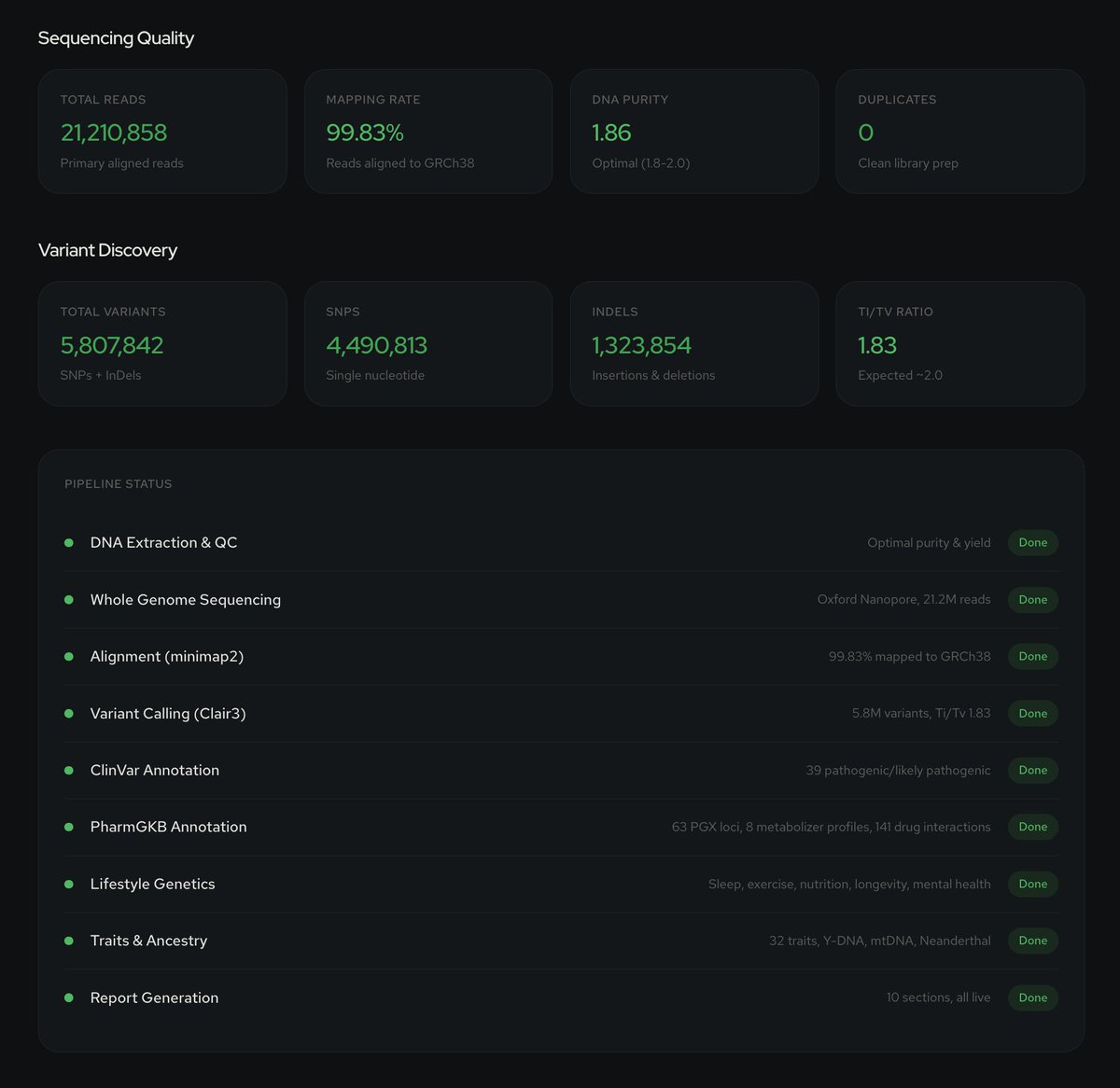
• aligned 21 million long reads to the human reference genome — 99.83% mapped
• called 5.8 million genetic variants using a two-pass neural network
• phased every variant — separated maternal vs paternal inheritance
• annotated all 5.8M variants against ClinVar, PharmGKB, and gnomAD
• corrected for population-specific bias in the medical literature
• health risk map across 39 conditions flagged in every body system
• drug compatibility guide for 141 medications color-coded by genome response
• nutrient metabolism - 71 variants affecting absorption of vitamins, minerals, iron
• traits, ancestry going back 40,000 years, neanderthal DNA breakdown
$5 in compute. 8 hours. no bioinformatician. no doctor. just one instruction.
we've genuinely reached a point where an ai agent can take your raw genome and hand you back a full personal health profile in a single shot. i had no idea this was even possible.