Our Control Group @oxengsci is hiring a new Associate Professor! This is a permanent/tenured academic position; anyone with research interests in theory/applications of control (including Biotech!) is encouraged to apply by 13 January 2025.
https://t.co/YgAA01gOJ3
Fantastic to see regular faces and new at this years Syn Bio event! Enjoyed by all! Super excited to start planning 2025's Syn Bio event!
#BiochemEvent
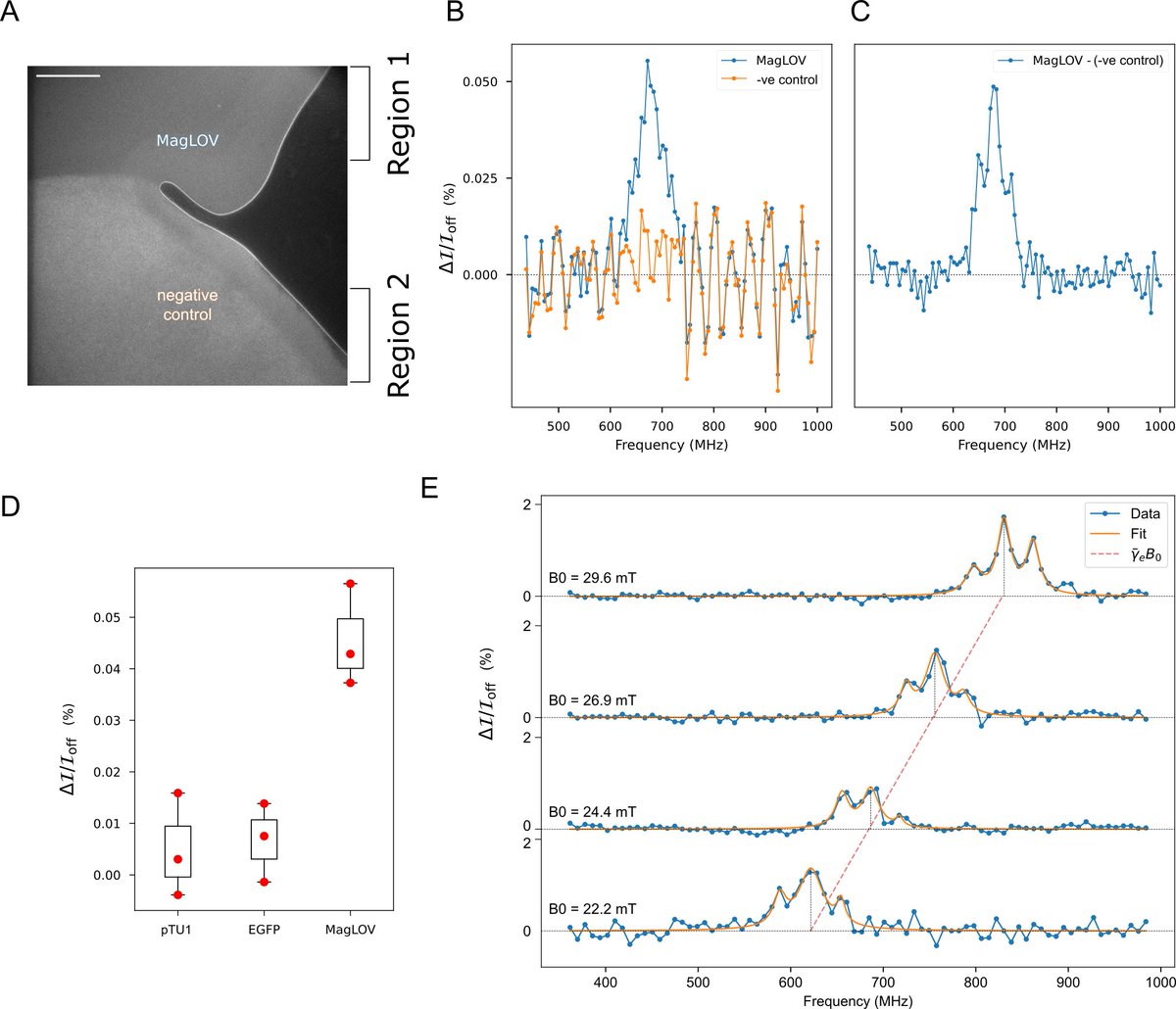
Some exciting results to share! The MagLOV and related proteins from @AndrewGYork and @Maria_Ingaramo are quantum. We measured 4% optically detected magnetic resonance contrast in living bacterial cells at room temperature. https://t.co/ys0GdvEX9H
Also had a great time working with @AnaStuhec on this, who performed all the spectroscopy measurements and introduced us to the world of radical pairs!
@AndrewGYork@Maria_Ingaramo And a huge thanks to everyone involved in bringing this project to life, especially grateful to @Harrison_Steel for being a wonderfully supportive supervisor. See what else our lab does here! https://t.co/wOYmdSo3BT
@AndrewGYork@Maria_Ingaramo We can think of so many other possibilities, and we’re sure you can too! Quantum sensing applications, high-throughput directed evolution, and development of magneto-genetics to name a few.
@AndrewGYork@Maria_Ingaramo MFPs can be used today for lock-in detection - measuring a weak signal in a noisy environment, and tomorrow high dimensionality multiplexing - expanding the number of orthogonal signals from a cell (different-colors) X (magneto-responses) X (ODMR-responses).
@AndrewGYork@Maria_Ingaramo Quantum sensing with magneto-fluorescent proteins (MFPs) could lead to a whole bunch of new technologies, for example 3D spatial localisation using gradient fields: MRI using only an endogenous protein. Down the line a spatially controllable magneto-genetic switch?
#SBUK2024 by @BiochemSoc : Day 2
Starting in a few minutes with a session on Control Systems, which among other things includes 2 (two!) talks from our Steel Lab
1/multiple
#BiochemEvent
Excited to share that I will soon be starting a group at @UniofOxford in the Dept of Engineering Science. We will focus on data-driven methods for cell-machine interfaces, with applications in biomanufacturing, biomaterials, fundamental biology research, and more
**PhD Funding** We are advertising a PhD studentship to work on interdisciplinary challenges in Synthetic Biology, Robotics, and Control/AI! Happy to answer any questions and discuss what we are doing with anyone interested. #synbio
https://t.co/92lFZPxn7h
MagLOV results reproduced✅
We cranked the LED power and found the response can be much faster!
Absolute change roughly the same at each LED power, i.e. contrast change likely due to the background, not MagLOV response.
Many thanks to the Calico folks for sharing their discovery!
For context, please checkout @AndrewGYork group’s write up: https://t.co/IS4fZ9hlg2
Proteins that strongly respond to magnetic fields raises so many exciting applications and fundamental science questions to be explored!
We are currently hiring for a Senior Postdoc in Biotechnology/SynBio, and a Senior Mechanical Design Engineer to join our team at the University of Oxford to work on an exciting international collaboration developing new technologies to characterise and predict AMR.