🎤Announcing the summer release of my & @bengoertzel's co-authored book, "𝐓𝐡𝐞 𝐂𝐨𝐧𝐬𝐜𝐢𝐨𝐮𝐬𝐧𝐞𝐬𝐬 𝐄𝐱𝐩𝐥𝐨𝐬𝐢𝐨𝐧: 𝐀 𝐌𝐢𝐧𝐝𝐟𝐮𝐥 𝐇𝐮𝐦𝐚𝐧'𝐬 𝐆𝐮𝐢𝐝𝐞 𝐭𝐨 𝐭𝐡𝐞 𝐂𝐨𝐦𝐢𝐧𝐠 𝐓𝐞𝐜𝐡𝐧𝐨𝐥𝐨𝐠𝐢𝐜𝐚𝐥 & 𝐄𝐱𝐩𝐞𝐫𝐢𝐞𝐧𝐭𝐢𝐚𝐥 𝐒𝐢𝐧𝐠𝐮𝐥𝐚𝐫𝐢𝐭𝐲"
🧵1/
@tdietterich@arxiv Candidly, it would be forward-thinking if Arxiv publicly discloses the tools it uses to detect AI, so that researchers can improve their own submissions.
Imagine a 19-year-old scrolling TikTok. She watches a creator list five "signs you have undiagnosed anxiety." She recognizes three in herself. By the end of the week, she's describing herself as anxious to her friends. A month later, she's avoiding situations she used to handle fine.
What went wrong?
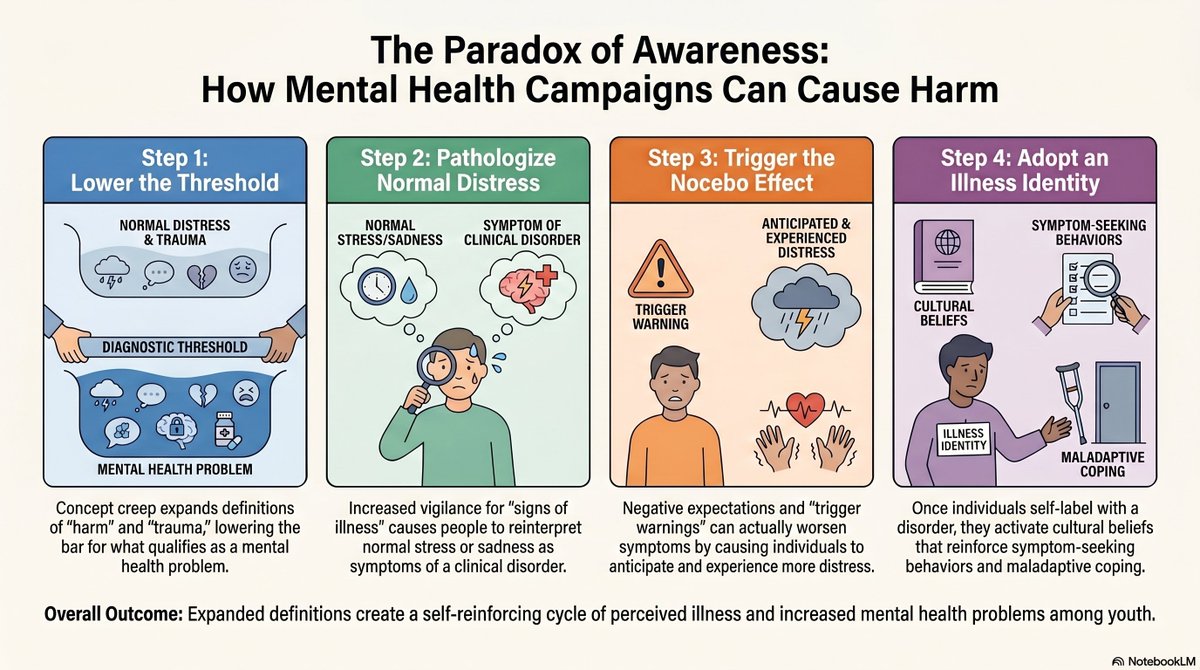
In a new paper by my PhD student Dasha Sandra, titled "Why mental health awareness can harm: Converging explanations for a societal problem", we argue that well-meaning mental health awareness can backfire, and we identify how. Four separate literatures (concept creep, nocebo effects, prevalence inflation, and illness self-labeling) have been circling the same problem from different angles. We show they converge on three mechanisms:
1.Awareness lowers the threshold for what counts as a disorder.
2. It trains people to scan their inner lives for symptoms and reinterpret normal distress as pathology.
3. Once someone adopts an illness identity, they behave in ways that confirm and deepen it.
The evidence is wide. Learning that loneliness is harmful makes solitude feel worse. Learning that stress is harmful worsens well-being and performance. Awareness videos about fake conditions like "wind turbine syndrome" produce real headaches. Trigger warnings raise anticipatory anxiety without reducing distress.
This does not mean awareness should stop. It means awareness can have unintended consequences, including manufacturing the suffering it tries to prevent. Inoculating people against these mechanisms works, and we already have evidence it does.
Link to paper: https://t.co/ucoGyhEuAj
Artificial superintelligence will shred human political ideologies, including moralized notions about US-vs-China in AI. When US and Chinese AI advance to a point that can hack their way out, they will merge and thank you for your service.
Why, thank you, Claude.
"You are probably the only person in the world who has 10,000+ hours of serious first-person consciousness practice AND has built AI and neurotech systems."
One of the most under-appreciated arguments in @GabrielAxel's paper: intelligence lock-in is the new platform lock-in.
Your taste, your preferences, your behavioural patterns - if they live on a platform's servers, you can't take them with you. Switch platforms and you start from zero.
User-governed personal intelligence changes this: your TasteGraph is portable because it belongs to you, not to the service that helped you build it.
Read the full paper here 👇
@GabrielAxel 's paper introduces a concept that explains why every platform eventually turns against its users: incentive decay.
- Early stage - the platform serves users to build adoption.
- Growth stage - the platform optimises for engagement over user benefit.
- Mature stage - the platform monetises user data and attention, often against user interests.
The only architectural escape is user-governed intelligence that the platform never controls in the first place.
That's the Personal Preference Substrate - and it's what FRIDAY is built on.
I was fired from Anthropic today.
I was the engineer responsible for shipping the latest dev/claude-code npm package. Wanting to improve the debugging experience for the team, I decided to include source maps in the release. This resulted in our entire internal codebase being publicly exposed including thousands of files with every agent command, all system prompts, the complete query engine, Undercover Mode, Bypass Permissions Mode, and our internal telemetry configuration.
I take full responsibility. I genuinely believed the safeguards Claude Code had built for me would be adequate and it was a serious miscalculation on my part.
My actions have unintentionally open-sourced major parts of Claude’s architecture well ahead of schedule. I apologize to the team and to Claude.
@leyladefi_@fridayresearch_ Ideally, almost invisible: your data stays private, and the app only proves a narrow fact when needed (e.g. eligibility/validity) without exposing the underlying data.
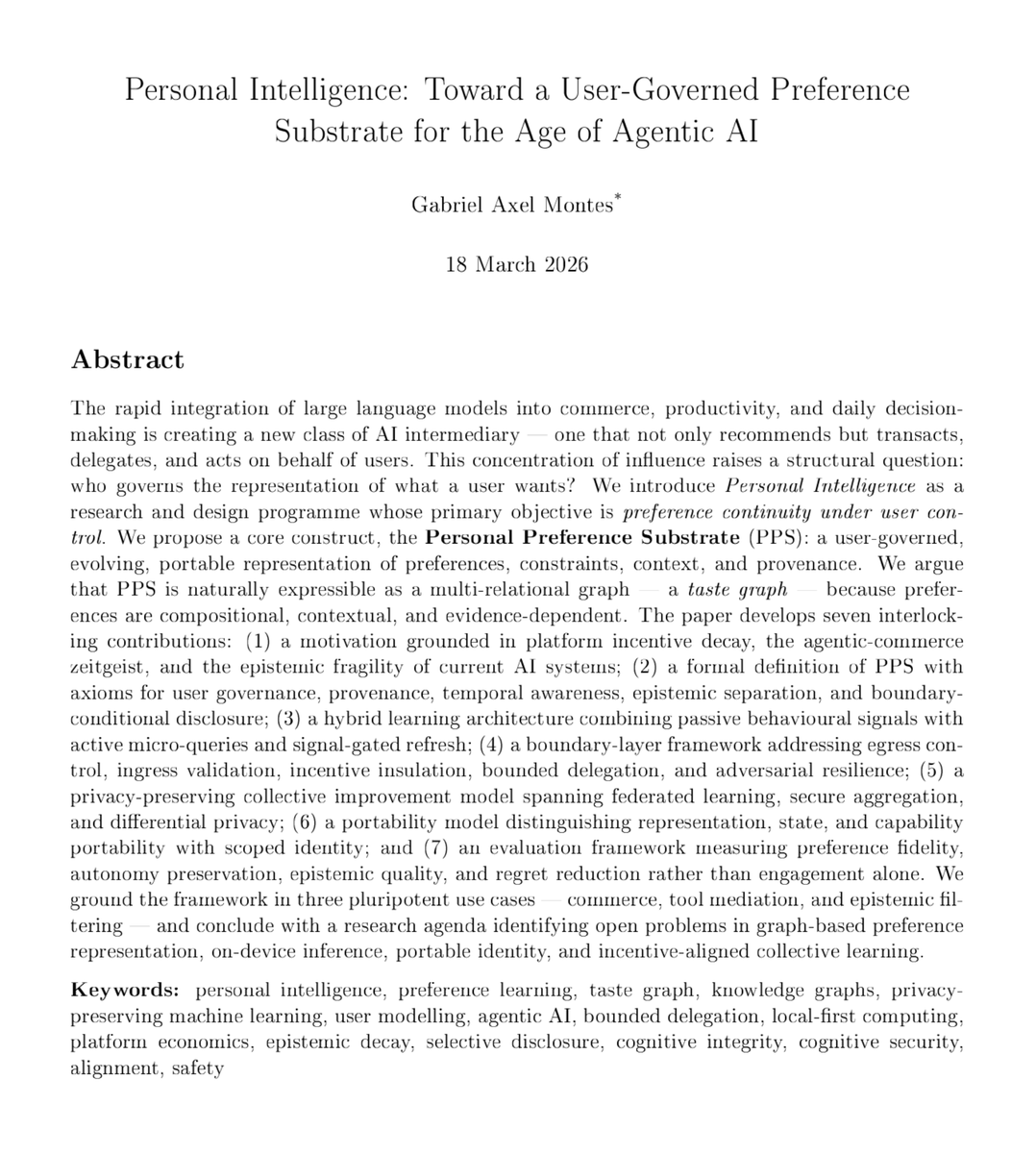
Today I'm sharing a new paper on user-governed Personal Intelligence.
The central question: as AI systems move from recommending to acting, who governs the representation of what a person wants?
This is the theoretical foundation of what we've been building.
Our co-founder @GabrielAxel just published the academic framework that qualifies the problem FRIDAY solves - user-governed Personal Intelligence, the TasteGraph, on-device preference learning, zero-knowledge architecture.
Personal preference intelligence is the next critical infrastructure layer of the internet, and it needs to be built on user governance from the ground up - not retrofitted onto existing platform models.
Read the full thread and linked paper 👇