Only Baloch will produce, sell, and profit from their mineral wealth.
No one else has any right to touch the wealth of Balochistan. Stop stealing our resources under the shadow of guns!
@Baloch_ambreen
👉Halt production of Sui gas immediately!
🚨Halt production and functioning of #Chinese mine Saindak and Canadian mine Reko Diq in #Balochistan!
Why should #PakistanArmy, #China, #US profit from #Baloch lands while Baloch children march on streets for justice?
@Amir_Baloch18
@husainhaqqani No sane multinational energy firm is paying those astronomical war-risk insurance premiums just to store their crude in a literal hotspot. It’s not a critical node; it’s a giant, sitting bullseye.
@nadeemhaque
Pakistan’s dream of building a massive "Energy City" in Gwadar to extract global oil storage rents is a masterclass in geopolitical delusion. The country literally just topped the Global Terrorism Index! 1/3
@nadeemhaque
The country literally just topped the Global Terrorism Index. Imagine pitching a high-value, highly explosive mega-storage facility to global investors while your internal security is in a state of constant, daily crisis.
2/3
@husainhaqqani
Decades of local marginalization have created an unstable environment where infrastructure is a target. Step zero isn’t a bankable contract; it’s making local Baloch communities the primary shareholders of their own land! 2/2
To talk about "legal frameworks" and "regulatory predictability" while ignoring the deep security vacuum is peak delusion.
Global energy traders are highly risk-averse; they won't store 50 million barrels of oil in a region fueled by anti-imperialist and anti-state sentiment.1/2
Energy city
Saudi Aramco is here. Kuwait Petroleum is here. QatarEnergy is here. PetroChina is here. Vitol is here. Trafigura is here. Vopak is here. Seven of the world’s energy giants, all circling the same asset: Pakistan’s storage capacity.
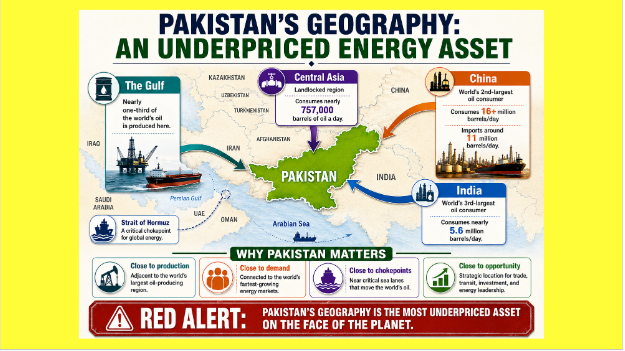
Look at Pakistan’s geography. To the west lies the Gulf, where nearly one-third of the world’s oil is produced. To the north lies Central Asia, a landlocked region that consumes nearly 757,000 barrels of oil a day. To the northeast lies China, the world’s second-largest oil consumer, burning more than 16 million barrels a day and importing around 11 million barrels a day. To the east lies India, the world’s third-largest oil consumer, using nearly 5.6 million barrels a day.
Look at Pakistan’s geography once again. Pakistan is close to production. Pakistan is close to demand. Pakistan is close to chokepoints. Pakistan is close to opportunity. Pakistan’s geography is real.
Red alert: Right now, Pakistan’s geography is the most underpriced asset on the face of the planet.
Look at Pakistan’s geography one more time. Pakistan sits just outside the Strait of Hormuz. Every regional crisis reminds the world of one hard fact: energy security is no longer only about production. It is also about storage, routing and redundancy.
Look at Gwadar, Hub and Port Qasim. Gwadar, Hub and Port Qasim can provide storage, re-export, emergency supply and regional distribution options. For Gulf producers, storing some fuel outside the Gulf reduces chokepoint risk. For Pakistan, storage increases energy security.
Saudi Arabia, Iran, UAE, Iraq, Kuwait, Qatar, Oman and Bahrain need Gwadar, Hub and Port Qasim. China needs Gwadar, Hub and Port Qasim. Kazakhstan, Uzbekistan, Turkmenistan, Kyrgyzstan and Tajikistan need Gwadar, Hub and Port Qasim.
Three steps stand between Pakistan and Pakistan’s ‘Energy City’: a legal framework, bankable contracts and regulatory predictability. That’s it.
Look at the intersection: The Gulf is looking for strategic depth. China is looking for supply security. Central Asia is looking for access. Pakistan is looking for dollars. This is the opening. This is the intersection. That is Energy City. Yes, the oil may belong to Saudi Arabia, Kuwait or global traders. Pakistan’s benefit is the oil rent. Storage rent. Port charges. Pipeline tariffs. Blending fees. Bunkering margins. Insurance. Logistics. Security services. Jobs. Taxes. And foreign exchange.
Start with 17 million barrels of strategic storage. That alone can bring $500 million to $1 billion in investment. Storage rent can bring $50 million to $120 million a year. Scale that to 50 million barrels and Pakistan begins to look at $500 million to $1.2 billion a year. Build a mature hub – storage, bunkering, blending, pipelines, insurance, testing, trucking, re-export – and the number can cross $1 billion a year.
That is the business model. Not ownership of oil. Ownership of location. Ownership of storage. Ownership of movement. Pakistan has a choice: remain a country that imports energy insecurity or become a country that exports energy security. The mother of all questions is whether Pakistan’s governance can convert geography into cash flow.
https://t.co/yMiaAZKzTa
When a country's own army operates like a mercenary force against its indigenous populations, it loses any shred of legitimacy.
You killed your own people for profit, and the blood of the Pashtuns is on your hands.2/2
For decades, #Pashtuns have been used as collateral damage by a corrupt military elite
state used foreign weapons and massive American cash flows to massacre innocent civilians, leaving behind millions of orphaned children and broken families! 1/2
Instead, they kept running duplicate departments, expanding executive staff, and overspending on provincial subjects. The center didn't go broke because of provincial shares; it went broke because of unhinged federal greed.3/3
Even the World Bank has finally been forced to admit the truth: Pakistan's structural federal deficit is entirely the center's own fault.1/3
https://t.co/pv7SZ9HOzb
Striking down local voices, restricting access to medicines, and deploying additional security forces to quell protests won't hide the structural exploitation. 3/3
Local resources are diverted while the military elite maintains a lavish, subsidized lifestyle at the cost of regular citizens facing extreme inflation. 2/3
When corruption merges with militancy, regular citizens are left with zero trust in state legitimacy.
By treating Balochistan strictly as a cash-generating colony and a tactical battlefield, the regime is funding its own endless war. 2/2
Under General #AsimMunir, a dark shadow economy has deeply penetrated #Balochistan’s enforcement structures.
Instability itself has become highly profitable for powerful institutional actors tangled up in smuggling and border crime. 1/2
Every arrest, every raid, and every silenced voice is being documented, archived, and shared. You can’t blockade the truth. The world knows exactly what you’re doing in the dark! 3/3
They cut the cables in Muzaffarabad hoping to keep their crimes in the dark.
They forgot that the #Kashmiri and #Baloch diaspora are the light that can’t be extinguished. 1/3
@Baaghiee