Blonde, ambitious & a little dangerous. 💋
Into crypto, Web3 and discovering what’s next.
Pretty face, sharp mind. Let’s build something interesting. 🖤
#Web3#Crypto
$HBAR: DEFEND THE BASE TO REOPEN THE HIGHS
Hedera is trading near $0.06662, just above the marked $0.06462 support.
Previous measured recoveries were approximately:
$0.072 → $0.110: +52.8%
$0.06462 → $0.131: +102.7%
Buyers first need to reclaim $0.075–$0.080, then $0.090–$0.100. Breakouts followed by retests that hold would strengthen the route toward $0.110 and the previous wick highs around $0.130–$0.135.
The wider objective remains the older visible high zone at $0.145–$0.150.
Final projected upside:
$0.06662 → $0.150: +125.16%
The yellow floor is the immediate decision point. Sustained daily acceptance below $0.06462 would undermine the base and weaken this recovery scenario.
UP TO 8% APY ON SOL WITH OKX
Nov 3–10: SOL liquid staking with no
subscription cap. Stake SOL, receive OKSOL.
https://t.co/0mACL6Gty5
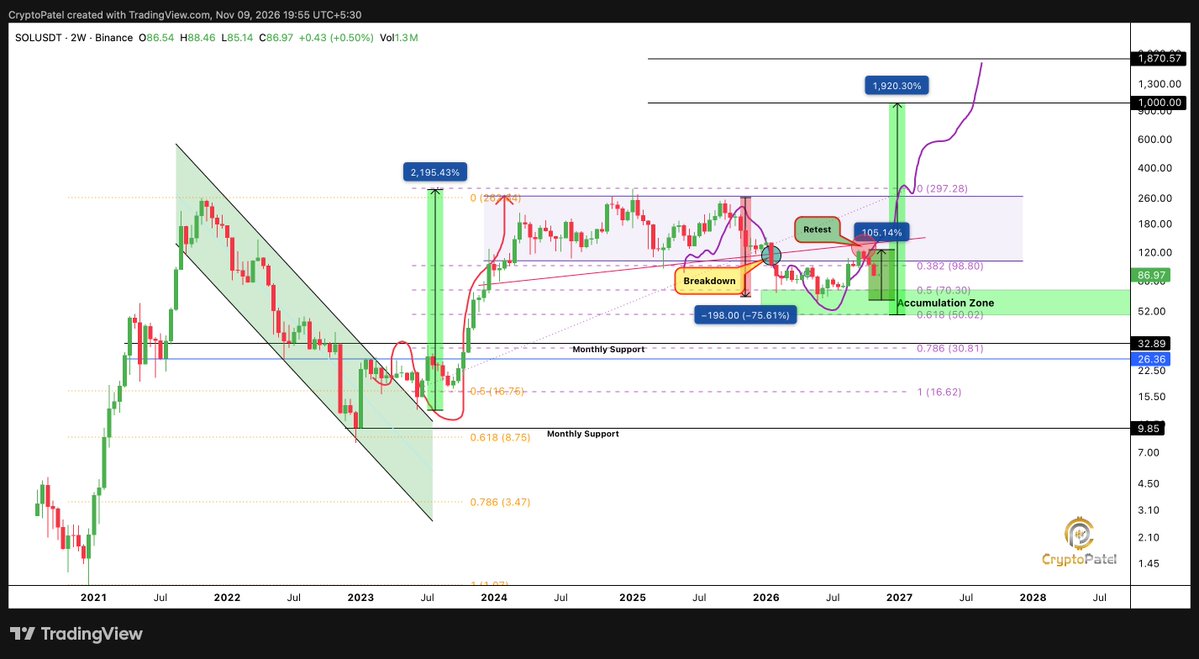
Solana is heading back to our accumulation zone before the next explosive move toward $500–$1,000 🚀
The next $SOL mega rally could be closer than you think!
the more i explore @primus_labs , the more i see how its technology connects to problems people already face every day.
what stood out to me in its implementation scenarios is that Primus isn't just developing advanced cryptographic tools. it's showing how they could make everyday interactions across Web2 and Web3 more private, secure, and verifiable.
here are a few use cases i found particularly interesting:
zkTLS-based Crypto Payments
users don't necessarily need to share a long wallet address to receive crypto. they can prove ownership of an existing social account, such as email, Twitter, or GitHub, then generate a zero-knowledge proof to claim tokens into their wallet without exposing their identity publicly onchain.
this could make crypto payments much easier for people who aren't familiar with wallets.
Verifiable AI Agent Execution
as AI agents take on more important tasks, such as DeFi transactions or data retrieval, verifying their actions becomes increasingly important.
Primus uses zkTLS to create cryptographic proofs of intermediate API calls, making it possible to verify whether an agent actually interacted with the required services and followed the expected process.
that's an interesting way to make AI execution more transparent and auditable.
Crypto Lending & Proof of Assets
users could prove they have sufficient assets or meet certain credit requirements without revealing their entire portfolio, exact balances, or real-world identity.
this creates more possibilities for private lending while reducing the need to expose sensitive financial information.
Digital Identity Verification
instead of handing over all personal information to centralized servers, users can prove specific attributes about themselves or demonstrate that they meet certain requirements while keeping the underlying data private.
what connects these use cases is a consistent idea: sensitive information should be usable without having to be publicly exposed.
Primus is bringing together three important capabilities:
verifiable offchain information through zkTLS
confidential computation through FHE and ZK
privacy-preserving applications for finance and AI
i think this combination could become an important part of the infrastructure needed for institutional finance and the growing agent economy.
for me, the real value isn't simply making blockchain more private. it's making privacy and verification work together, so developers can build applications that people can actually trust.
good infrastructure isn't about making everything more complicated. it's about giving others the tools to build useful things safely.
explore Primus and check out the weekly XP tasks here:
https://t.co/uzjToCGMd6
Good Morning, Web3. ☀️
One of DeFi’s biggest challenges is understanding wallet reputation.
A wallet with years of consistent activity can look just like a fresh wallet with no history.
That’s where @zerufinance, now ZeruAI, comes in with zScore.
The 0–1000 reputation score focuses on onchain behavior rather than identity, capital or social following.
On Zaps, it helps filter sybil activity, improve reward rankings and make wallet reputation more meaningful.
My own zScore is 557, built through consistent activity over time.
The bigger opportunity is what comes next.
Portable reputation could eventually help protocols assess risk and offer better borrowing conditions to wallets with proven behavior.
Rewards are the starting point. Onchain credit could be the bigger breakthrough. 👀
$FET: THE RECOVERY STARTS WITH A TRENDLINE RECLAIM
FET is trading near $0.1428 after slipping back below the main descending trendline, currently around $0.156.
Previous measured recoveries were approximately:
$0.140 → $0.270: +92.9%
$0.120 → $0.272: +126.7%
Defending $0.140 and reclaiming the upper line would strengthen the recovery toward $0.180–$0.200, then $0.235–$0.250.
The next hurdles are $0.270–$0.290, followed by $0.300–$0.320 and $0.360–$0.400.
The wider objective remains the visible old high zone around $0.450–$0.460.
Final projected upside:
$0.1428 → $0.4600: +222.13%
This route needs a daily reclaim and a retest that holds. Losing $0.140 would weaken the setup and return attention to the $0.120 area.
UP TO 8% APY ON SOL WITH OKX
Nov 3–10: SOL liquid staking with no
subscription cap. Stake SOL, receive OKSOL.
https://t.co/0mACL6Gty5
There’s also an additional opportunity for Loopers on @loopupdotfun.
Apart from calling tokens they believe in and earning from those calls, Loopers can invite other KOLs and earn from them too.
But the main thing I find interesting is the holding requirement.
You need at least 0.01 ETH worth of a token to call it, and the call lasts 48 hours unless you sell.
It’s an interesting way to connect promotion with actual participation.
$LOOP is making the crypto space better.
CA: 0xe846503C6915A93F30Fce4fc003b4F4f4E75F9D9
NFT burns are an important part of collection economics because they
permanently remove assets from circulation and change the remaining supply.
@VelixoMarket surfaces burn-related collection information through its Fogo indexing infrastructure, giving collectors clearer visibility into these supply shifts.
But there is an important distinction: reduced supply does not automatically create increased demand.
Imagine a collection starts with 10,000 NFTs and 1,000 are burned. The remaining supply is smaller, but that alone does not guarantee more buyers, higher prices, or better liquidity.
Collectors still need to understand why those assets were burned, whether the burn is tied to real
utility or redemption, and whether demand is actually growing. A burn can create scarcity, but its market impact depends on demand,
liquidity, holder behavior, and the broader collection narrative.
Supply metrics are useful
Good night my bros 🥱😴
1/5
Most NFT opportunities make people look at their wallet first. How much ETH do I need? How much should I spend? Is there another mint fee waiting for me?
But Zerus has an interesting connection with something many traders may already have: their onchain trading history.
Zerus is a planned 3,333 supply freemint collection on Robinhood, with its launch planned through OpenSea. One interesting part of its campaign is how zaps balances can provide a route toward guaranteed whitelist access.
Think about that for a moment.
Instead of looking at an NFT opportunity only through the usual lens of spending money to get involved, there's a connection between your existing trading activity and a potential whitelist opportunity.
Zaps, built by ZeruAI, recognizes qualifying wallet history and gives users a starting points balance. Qualifying future activity can add more.
Higher zaps balances are described as a route to Zerus GTD whitelist access, subject to the collection's allocation criteria.
I wouldn't assume having a high balance automatically means a spot is secured. The actual cutoff, snapshot and eligibility conditions matter, and those details should come from official announcements.
Still, I find the connection between trading activity and an NFT whitelist opportunity worth paying attention to.
Your first move doesn't have to be chasing another mint. It can simply be finding out where your existing activity stands.
@zerufinance
Good afternoon, everyone!
Owning a gaming NFT is one thing. Having a role in the game's ecosystem makes it more interesting.
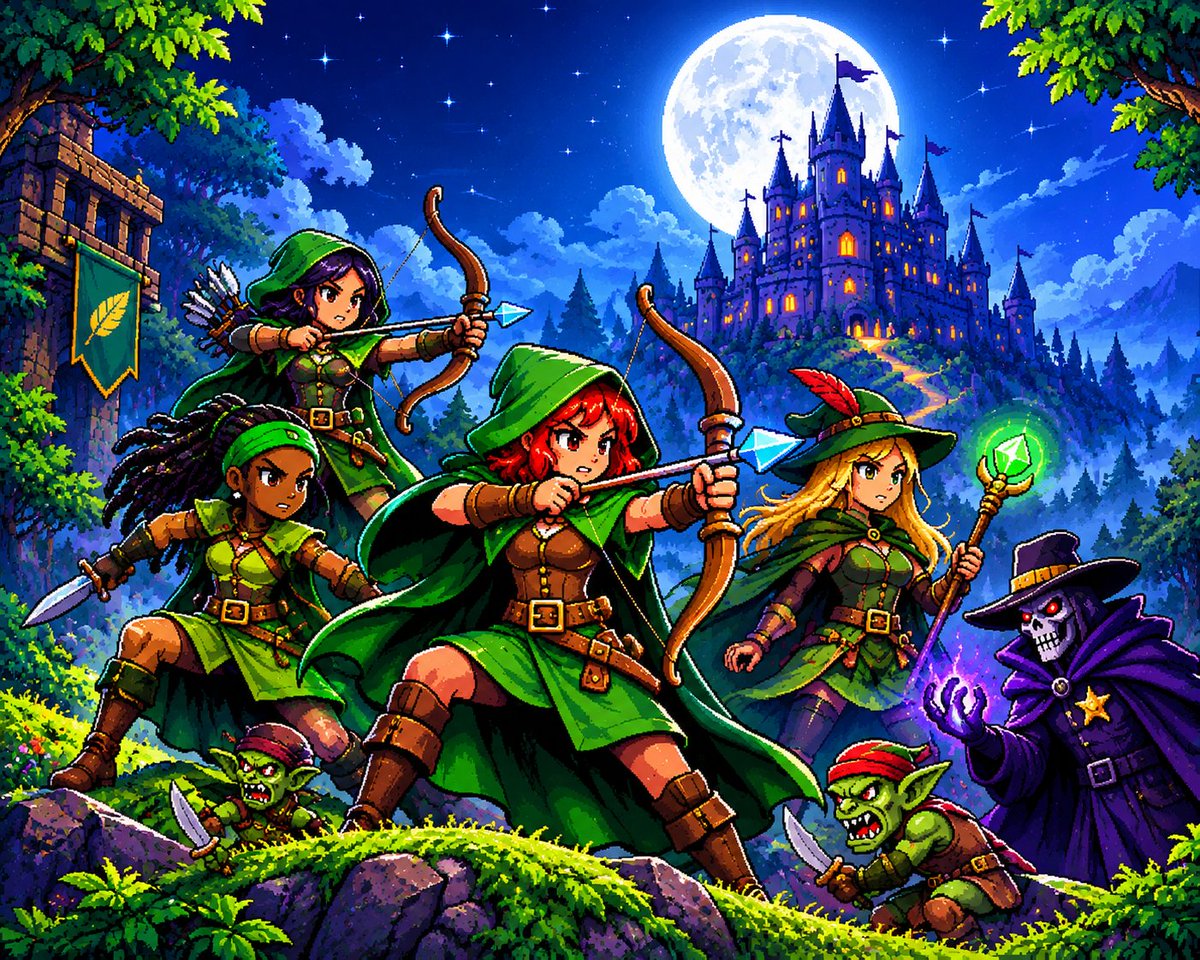
In @RBHHeroes, Genesis Heroes are part of the foundation of the Sherwood gaming world.
The collection has a limited supply of 3,333 NFTs, designed around playable characters rather than just profile pictures.
This gives Genesis NFTs a connection to the actual game, where players can use their heroes as they progress through Sherwood.
I think utility becomes more meaningful when there's an actual game behind it.
Would you consider owning a Genesis Hero if you enjoyed the gameplay?
Genesis holders now have more reasons to pay attention to what happens next with @FungoLabs
The Launchpad is officially live, and the benefits attached to Genesis NFTs go beyond simply holding a collection.
Here’s what holders get a share of:
➛ 30% of the platform’s share from collection sales.
➛ 30% of secondary royalty revenue.
➛ 3–20% of new collection supplies reserved for free mints.
➛ At least 5% of every launched token’s supply.
➛ 6% of trading fees from every token pool.
All rewards are shared equally across the 3,232 Genesis NFTs.
Studios also get zero platform fees when launching encrypted NFT collections, with over 3,000 projects already applying.
What I find interesting is how Genesis holders get exposure to the activity happening across the entire Launchpad.
$FUNGO is starting to move beyond promises. Now I’m watching to see how much activity this launch brings.
Good morning, builders. 🦖
A strong NFT ecosystem needs three things working together:
creators, collectors, and reliable marketplace infrastructure.
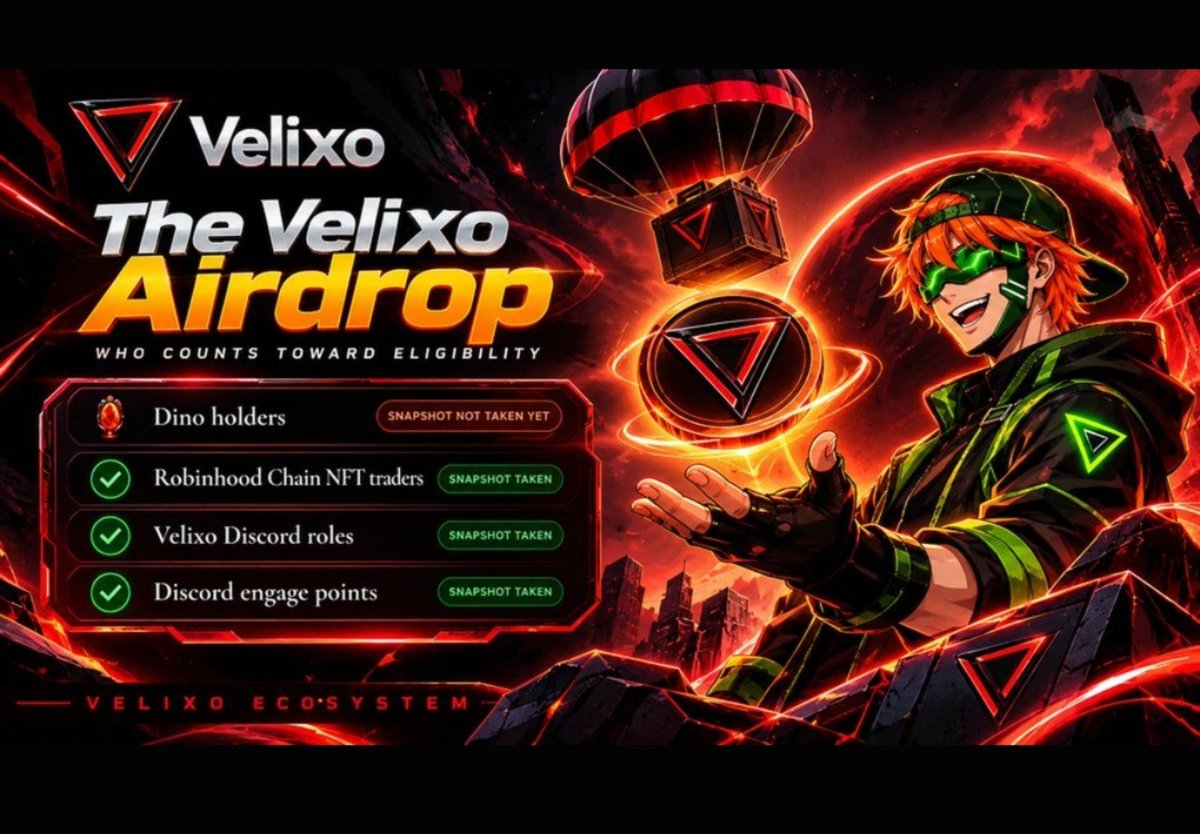
That's an interesting part of what @VelixoMarket is developing.
Velixo is approaching NFTs from a broader perspective, bringing several important activities into one platform.
➠ For creators: A launchpad to introduce new collections.
➠ For collectors: Tools to discover and explore digital assets.
➠ For traders: Listings, offers, collection offers, and auctions.
➠ For ecosystems: Expansion across Fogo and Robinhood Chain.
What makes this interesting is the possibility of connecting different NFT communities without keeping them restricted to one network.
I also want to see how Velixo develops its creator economy beyond leaderboard incentives.
Because attention can bring people to a platform, but a useful product gives them a reason to stay.
The real opportunity is building an NFT ecosystem that creates lasting value for everyone involved.
Watching the journey. $VLX 👀
Happy new week X family.
What interests me about @sight_hood is its ambition to build beyond a typical Prediction Market.
From NBA predictions and Creator Season to NFT collaborations and $SGT buybacks, Sight is finding different ways to grow its community.
But my biggest interest is SightEVM. Community engagement brings attention, while strong infrastructure and useful products create long-term value.
The real challenge is balancing both, because sustainable growth requires more than participation. It requires consistent development and execution.
you've probably seen fungo all over the tl lately, so let's talk about its genesis nft and how the mint works
the mint is happening on november 5, and it uses a sealed-bid auction powered by @zama's fhe technology
first, 500 nfts will be available as a free mint for whitelist holders. after that, 2,500 nfts will be sold through the auction
here's how it works
you place your bid in czama, choosing how much you're willing to pay per nft and how many you want
your bid price and quantity stay encrypted while bidding is open, so other bidders can't see what you're offering
once bidding closes, all bids are revealed and ranked from highest to lowest. the lowest winning bid that fills the 2,500th nft sets the final sale price
everyone who wins pays that same price, even if they bid higher.
for example, if the final price is 10,000 czama and you bid 15,000 for 3 nfts, you get all 3, pay 30,000 and receive 15,000 back.
bids at the final price share the remaining nfts, while bids below it get no nfts and receive a refund.
a few things to keep in mind:
- bids are binding and cannot be withdrawn.
- each bid has a small non-refundable encrypted bidding fee.
- if demand stays below 2,500 nfts, everyone buys at the lowest bid price.
- nfts mint sealed, and holders control who gets to see inside.
so before participating, make sure you understand how the bidding and allocation work.
follow @fungolabs for official updates.
november 5, 2026 is the mint date
One thing I don't like about single-chain marketplaces is how much of the NFT market they leave out.
Different chains have different collections, communities and trading activity. Keeping everything on one network can limit who gets access.
That's why @VelixoMarket's support for both Fogo and Robinhood Chain caught my attention.
Fogo brings SVM-based infrastructure, while Robinhood Chain offers an EVM-compatible environment.
For collectors, that's more room to explore. For Velixo, it's a chance to connect with users from two different chain communities.
But there's one thing I'm watching closely: actual liquidity.
Supporting multiple chains is a good start. Getting active buyers and sellers on both is the real test.
I've been paying attention to projects building around Robinhood Chain, and @VelixoMarket is an interesting addition to the ecosystem
The platform allows users to explore NFT collections, buy available assets, create listings, and make offers using ETH-based pricing.
I also like that users can review transaction details before signing through their wallets.
This is a small but important part of making the experience easier to understand.
Expanding NFT trading across different blockchain networks gives users more options and helps connect different communities through one platform.
NFTs have always been transparent.
But is total transparency always a good thing?
Imagine owning an NFT whose traits, stats, and rarity are visible to everyone from the moment it is minted.
That creates a problem: once the information is public, it can never truly become private again.
This is the idea behind what caught my attention about @fungolabs.
Built with Zama's FHE technology on Ethereum, Fungo Labs introduces encrypted NFTs where:
The NFT remains publicly owned and tradable.
Its artwork can stay sealed until the holder chooses to publish it.
Its underlying essence and stats remain encrypted onchain.
Smart contracts can compute on encrypted information without seeing the original values.
This is more than an aesthetic change to NFTs.
It introduces a different design principle: ownership should include control over information.
I believe privacy-native assets could unlock new possibilities for digital ownership and onchain applications.
Still early, but an interesting direction to follow.
Stay Curious.
#FungoLabs #FHE #NFT #Web3
Good afternoon my bros, gVelixo 😊
1/5
A small detail in NFT trading says a lot about marketplaces.
When you list an NFT, you shouldn’t have to hand over control just to make it available to buyers. Velixo’s non-custodial setup keeps your NFT in your own wallet while it’s listed. The marketplace doesn’t take custody of your asset or ask for your private keys. You stay in control instead of moving your NFT into a platform-controlled account first.
Offers work differently, and that distinction matters. When someone makes an offer, the funds are locked in on-chain escrow. The buyer’s offer has funds committed to it, while the seller’s NFT can remain in their wallet until a trade is accepted and settled.
That separation makes the process easier to understand. Listing an NFT doesn’t mean surrendering it. Making an offer doesn’t mean trusting a marketplace to hold your money informally. Each side has a clear on-chain mechanism behind it.
Speed and low fees are useful, but control matters just as much. A smooth trading experience shouldn’t require users to give up ownership along the way. You should know where your NFT sits and who can access your keys.
Your keys, your NFTs. Simple idea! Important boundary.
@VelixoMarket
@FungoLabs It is easy to misread Fungo as Zama's own NFT project. It is not.
Fungo Labs is an independent team building on Zama's technology. Zama builds the FHEVM, the fully homomorphic encryption technology that lets Ethereum smart contracts compute on encrypted data. Every part of the Genesis run uses it: the draw, the holder's private view, publishing, and the sale in cZAMA.
That distinction matters for how you judge the project. Zama's credibility is about cryptography. Fungo's credibility is about product: whether it can mint, sell, launch, and build a game on top of that cryptography, without hiding behind the bigger name.
Independence cuts both ways. Fungo cannot claim Zama's resources, team, or roadmap as its own. It also cannot blame Zama if its collection, launchpad, or game fails to find users.
That honesty is useful. It lets you credit Zama for the engine, and judge Fungo for the car it builds with it.
Two names, two jobs. Keep them straight.