Galaxy Exchange v2 is live.
https://t.co/AParH1BYge
Our market cap is still small. What it stands on is not a mockup.
The router is live on Robinhood Chain and verified on the explorer. One signature settles every leg of a split trade, or none of them. Every figure on the site is read from the chain as the page loads: more than 247,000 pools across 58 venues, found by scanning the chain itself.
We were the first on Robinhood Chain to ship an aggregator people can actually use, from quote to settlement. Website v2 is the first step in growing it. The tokens trading on the chain drawn as a 3D galaxy, your route drawn leg by leg as the quote lands, and live swaps crossing the sky block by block.
Next comes product v2, and it puts privacy first.
Curious how? Keep following as we grow.
When product v2 ships, we open applications to projects, with one aim: to become the first privacy aggregator.
We believe the process and the growth move together, because our work is to be the aggregator bigger projects trade through.
It's all about proof, no nonsense.
$GALX · Robinhood Chain
GalaxyLock is at 0x258bc4ca79b9720ae6aa86a723615b18483494f1, verified on the explorer, exact match.
What it holds: Uniswap v2 pair tokens as a balance, and v3 or v4 positions as the position itself, still earning fees the whole time they sit there.
What it enforces, with no way to waive any of it:
extend() only moves the date forward.
Only the holder opens it, and only on or after the second it was locked until.
A fee-on-transfer token is recorded at what actually arrived, so the record cannot overstate what is held.
A term under an hour is refused.
A lock can be handed to a multisig without being opened.
What it costs: nothing. The wallet writing a lock has to hold 1,000,000 $GALX, read once at that moment. Opening, extending and handing on are gated on nothing, because a lock a balance could hold hostage is not a lock.
What it does not prove: a lock is about liquidity, not supply. It says nothing about the team wallet or the mint function. A small lock is still a lock, which is why our check prints the share of the pair that is actually held instead of a badge.
Nobody has audited it. The rules are tested against the live chain and the source is published. That is not the same thing, and the page says so.
Galaxy Lock, explained in two minutes.
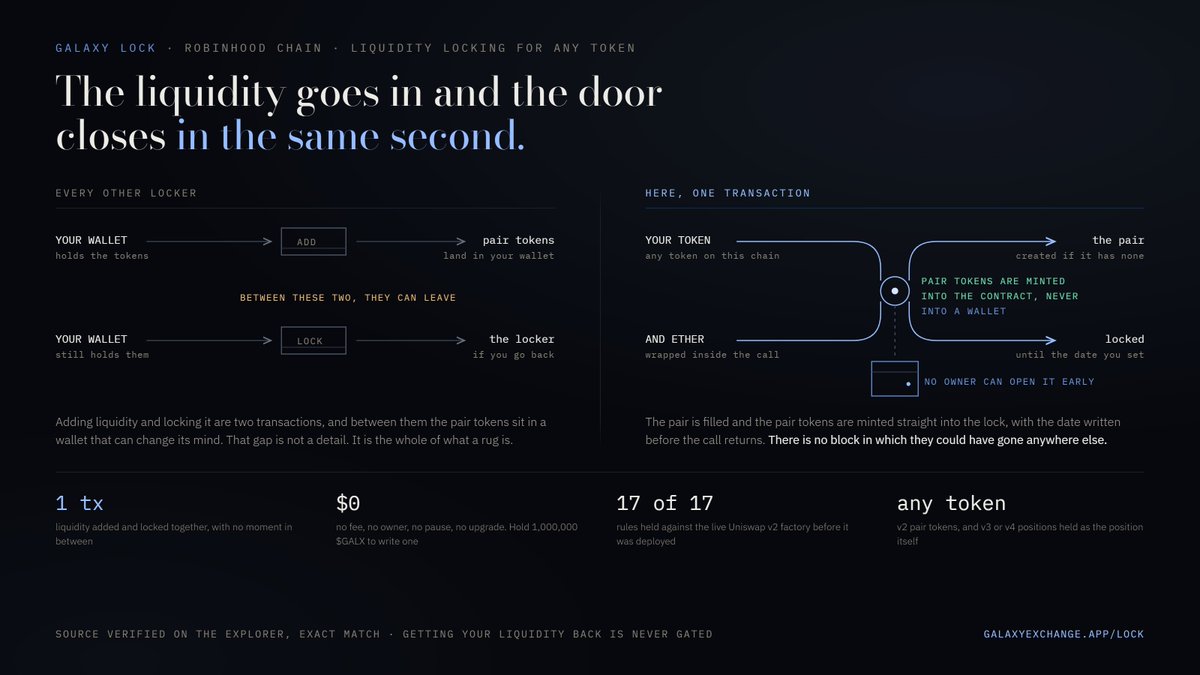
Adding liquidity and locking it are normally two transactions, and between them the pair tokens sit in a wallet that can still change its mind. That gap is the whole of what a rug is. This closes it: one call fills the pair, creates it if the token has none, and mints the pair tokens straight into the contract with the unlock date written before the call returns.
Free. No owner, no pause, no upgrade, and no address that can open a lock early.
Seventeen rules checked against the live Uniswap factory before deployment. The eighteenth took real money and a real hour: lock 0 was written, refused early, and opened on the first ask after its second.
https://t.co/CB8ghZ7A5F
Galaxy Lock, explained in two minutes.
Adding liquidity and locking it are normally two transactions, and between them the pair tokens sit in a wallet that can still change its mind. That gap is the whole of what a rug is. This closes it: one call fills the pair, creates it if the token has none, and mints the pair tokens straight into the contract with the unlock date written before the call returns.
Free. No owner, no pause, no upgrade, and no address that can open a lock early.
Seventeen rules checked against the live Uniswap factory before deployment. The eighteenth took real money and a real hour: lock 0 was written, refused early, and opened on the first ask after its second.
https://t.co/CB8ghZ7A5F
What Galaxy Lock actually enforces, and what it refuses.
A lock holds either an ERC-20 or a position. Uniswap v2 pair tokens are a balance. A v3 or v4 position is an NFT, and it is held as the position itself, still earning fees the whole time it sits there.
Four refusals, and none of them can be waived.
The date only moves forward. extend() pushes it out, nothing pulls it in.
Only the holder may open it, and only on or after the second it was locked until.
A token that takes a fee on transfer is recorded at what actually arrived, so the record cannot overstate what is held.
A term under an hour is refused outright, because a one minute lock is theatre.
A lock can be handed to a multisig without being opened, which is one call and a new holder.
What it does not prove: a lock is about liquidity, not about supply. It says nothing about the team wallet, the mint function, or who holds the token. And a small lock is still a lock, which is why the check on our page prints the share of the pair that is actually held rather than a badge that says locked.
Nobody has audited this. The rules are tested against the live chain before every deployment and the source is on the explorer. That is not the same thing, and we say so on the page.
0x258bc4ca79b9720ae6aa86a723615b18483494f1
Galaxy Lock is live. Add liquidity and lock it in the same transaction, for any token on Robinhood Chain.
Every locker takes liquidity you already hold. That leaves a gap between adding it and locking it, and that gap is not a detail, it is the whole of what a rug is. Here the pair is filled and the pair tokens are minted straight into the contract, so there is no block in which they could have gone anywhere else.
It costs nothing. No fee, no owner, no pause, no upgrade. There is no address on this chain that can open a lock before its second, including ours.
The one thing it asks is that the wallet writing a lock holds 1,000,000 $GALX, about thirteen dollars. That balance is read, never moved, and never read again. Getting your liquidity back is gated on nothing at all, because a lock a balance could hold hostage would not be a lock.
Seventeen rules, checked against the live Uniswap v2 factory before it was deployed. Source verified on the explorer, exact match.
https://t.co/CB8ghZ7A5F
Galaxy Lock is live. Add liquidity and lock it in the same transaction, for any token on Robinhood Chain.
Every locker takes liquidity you already hold. That leaves a gap between adding it and locking it, and that gap is not a detail, it is the whole of what a rug is. Here the pair is filled and the pair tokens are minted straight into the contract, so there is no block in which they could have gone anywhere else.
It costs nothing. No fee, no owner, no pause, no upgrade. There is no address on this chain that can open a lock before its second, including ours.
The one thing it asks is that the wallet writing a lock holds 1,000,000 $GALX, about thirteen dollars. That balance is read, never moved, and never read again. Getting your liquidity back is gated on nothing at all, because a lock a balance could hold hostage would not be a lock.
Seventeen rules, checked against the live Uniswap v2 factory before it was deployed. Source verified on the explorer, exact match.
https://t.co/CB8ghZ7A5F
Eighteen days of Galaxy Exchange, in eighty seconds.
What was built: an aggregator across 302,867 pools, a keeper that holds a swap until its block, a payout contract that publishes its list before it pays, and Transit, the first batch settlement on this chain.
What the numbers say: 341 holders, 17,658 transfers, $558,314 traded since launch.
And yesterday: $433 across 11 swaps, price 94.9% under its high.
Both halves, same post. The only days this token moves are the days something ships.
https://t.co/AParH1BYge
The first question people ask :
if the settler names the price, what stops it naming a bad one.
Three things, and none of them is trust.
One price per pair applies to every order in that window at once. The settler cannot give you a worse number than the person beside you, because there is only one number.
Your own minimum is in the signature. A fill below it does not get refused quietly, it reverts the entire window, everyone's orders included. A settler that tries it burns its own gas and settles nothing.
And the settler cannot keep the difference. Whatever the routing delivers above the named price is shared out pro rata to the orders owed that token, then the contract reverts if more than a millionth of what came in is still sitting there.
Its only freedom is a price it has to give everybody.
Your order does not exist anywhere until it executes.
Not in the mempool. Not in a queue a bot can read. Not as a pending transaction with your intent written across it. It is a signature held for at most five seconds, and there is nothing to front run because there is nothing to see.
Then the window closes and every order inside it executes in one transaction, at one price per pair. Arriving first buys you nothing. Being fastest buys you nothing. The latency game that decides who profits on every other venue has no board to play on here.
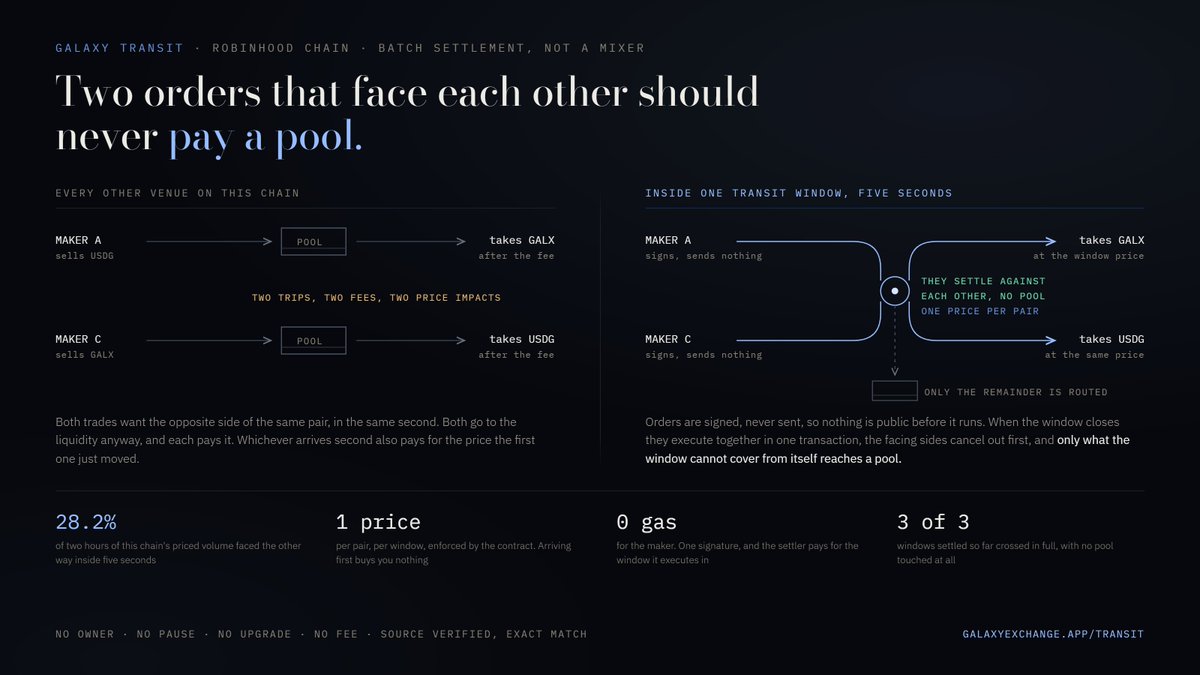
Orders pointing opposite ways settle against each other before anything reaches liquidity. The pool only ever sees what the window could not cover from itself, and on this chain that is a smaller share than people assume: across two hours of live flow, 28.2% of priced volume faced the other way inside five seconds.
The contract has no owner, no pause, no upgrade and no fee. It cannot pay you below the minimum you signed. It cannot send your output anywhere except the address you named. It reverts if more than a millionth of what came in is still sitting there at the end. Source verified on the explorer, exact match.
First on Robinhood Chain. Three windows settled so far, all three crossed in full, no pool touched.
https://t.co/geMbXnGfXz
Two people wanting opposite sides of the same pair, in the same second, both paying a pool to meet. That is most of what a chain does all day.
A transit window is the fix. Five seconds of orders, signed and not sent, executed together at one price per pair. Facing sides cancel out first. Only the remainder ever reaches a pool.
Measured on this chain: 28.2% of two hours of priced volume faced the other way inside five seconds.
Three windows settled so far. All three crossed in full, no pool touched.
https://t.co/geMbXnGfXz
Anyone can place an order into a settlement window now. One signature, no gas.
Until today, joining a transit meant posting a signed order to an API. The ticket is on the page.
Pick the pair, type an amount, and the floor under your output is read from the pools. That floor is what you sign, and the contract enforces it: a fill below it reverts the whole window, whether your order crossed against someone or was routed. You approve exactly the order, never more. Then your wallet signs an EIP-712 message and nothing is sent. No transaction, no gas, no trace on the chain. The settler pays for the window that executes it.
One field matters more than it looks. Send the output to is empty by default and pays the wallet that signs. Put any address there and the contract pays that address from inside the settling transaction. Nothing is sent to it first, so the trade never leaves the wallet people watch.
An order the settler cannot cover at the window price is dropped rather than filled badly, and the signature expires on its own after three minutes. Ether cannot enter a window, because the contract moves balances with an allowance and native ether has none to give, so the pay side is WETH.
Proved the only way that counts. An order placed through the live site, not a script: block 71,339,441, two orders, crossed in full, no pool touched. Three windows settled so far. Source verified on the explorer, exact match.
https://t.co/geMbXnGfXz
A first on Robinhood Chain.
Every trade on this chain goes to a pool, one at a time. We measured two hours of it and found that 27.2% of the volume was facing the other way inside five seconds. Someone selling exactly what someone else was buying, both paying a pool just to meet.
So we built the meeting point, and it is live.
Galaxy Transit settles a whole window of orders in one transaction. Orders are signed, not sent, so nothing is public before it runs. Every five seconds a window closes. Orders that face each other settle against each other at one price, and only the remainder is routed to the pools.
The window in this video is real. Two orders, one transaction, routes: 0. Not one pool was touched, so no pool fee was paid and no price moved.
Contract: 0x842C0e9c6c7d683f9f4c3bba417715fcfeBC4Ede
No owner. No pause. No upgrade. No fee. Eleven rules tested against the live chain before it was deployed.
First AI assisted aggregator on Robinhood Chain. First proof of fair. Now the first batch settlement.
https://t.co/geMbXnGfXz
$GALX · Robinhood Chain
A first on Robinhood Chain.
Every trade on this chain goes to a pool, one at a time. We measured two hours of it and found that 27.2% of the volume was facing the other way inside five seconds. Someone selling exactly what someone else was buying, both paying a pool just to meet.
So we built the meeting point, and it is live.
Galaxy Transit settles a whole window of orders in one transaction. Orders are signed, not sent, so nothing is public before it runs. Every five seconds a window closes. Orders that face each other settle against each other at one price, and only the remainder is routed to the pools.
The window in this video is real. Two orders, one transaction, routes: 0. Not one pool was touched, so no pool fee was paid and no price moved.
Contract: 0x842C0e9c6c7d683f9f4c3bba417715fcfeBC4Ede
No owner. No pause. No upgrade. No fee. Eleven rules tested against the live chain before it was deployed.
First AI assisted aggregator on Robinhood Chain. First proof of fair. Now the first batch settlement.
https://t.co/geMbXnGfXz
$GALX · Robinhood Chain
A first on Robinhood Chain.
Every trade on this chain goes to a pool, one at a time. We measured two hours of it and found that 27.2% of the volume was facing the other way inside five seconds. Someone selling exactly what someone else was buying, both paying a pool just to meet.
So we built the meeting point, and it is live.
Galaxy Transit settles a whole window of orders in one transaction. Orders are signed, not sent, so nothing is public before it runs. Every five seconds a window closes. Orders that face each other settle against each other at one price, and only the remainder is routed to the pools.
The window in this video is real. Two orders, one transaction, routes: 0. Not one pool was touched, so no pool fee was paid and no price moved.
Contract: 0x842C0e9c6c7d683f9f4c3bba417715fcfeBC4Ede
No owner. No pause. No upgrade. No fee. Eleven rules tested against the live chain before it was deployed.
First AI assisted aggregator on Robinhood Chain. First proof of fair. Now the first batch settlement.
https://t.co/geMbXnGfXz
$GALX · Robinhood Chain
Galaxy Exchange · project update · 22 September 2026
The first project on Robinhood Chain with Proof of fair. Here is where everything stands, with every number read from our own engine today.
What Galaxy Exchange is
Galaxy Exchange is a liquidity router for Robinhood Chain. It indexes the pools on the chain, splits one trade across the venues that price it best, and shows the arithmetic it used to decide. Your wallet signs, and nothing on the site ever asks for a key. $GALX is its token.
What is live today
The aggregator. 236,790 pools are indexed across Uniswap v2 and v3 style venues, Solidly pools and Uniswap v4, hooks included. The router, the keeper and the Proof of fair contract are checked against their compiled source every time the engine starts. https://t.co/shtpXDVqcf
The Observatory, new. It shows the whole chain as a live sky. 3,983 tokens that have traded are stars, and 133,319 that never traded are the dust behind them. Every swap on every venue crosses between two stars seconds after it lands. Click a star for the router's price, its last swaps and its holders. https://t.co/KwQKINECPq
Scheduled swaps. You name a time window and the least you will accept. Your funds wait in escrow in the keeper contract, and anyone can execute the order for its bounty. An order that cannot meet its minimum is refunded. No server holds a key that can move your funds.
The $GALX chart and burn counter, drawn from the pool's own swaps. There have been 6,212 swaps since the pool opened, and 33,590,341 GALX are burned, 3.36% of the supply.
Galaxy Exchange · project update · 22 September 2026
The first project on Robinhood Chain with Proof of fair. Here is where everything stands, with every number read from our own engine today.
What Galaxy Exchange is
Galaxy Exchange is a liquidity router for Robinhood Chain. It indexes the pools on the chain, splits one trade across the venues that price it best, and shows the arithmetic it used to decide. Your wallet signs, and nothing on the site ever asks for a key. $GALX is its token.
What is live today
The aggregator. 236,790 pools are indexed across Uniswap v2 and v3 style venues, Solidly pools and Uniswap v4, hooks included. The router, the keeper and the Proof of fair contract are checked against their compiled source every time the engine starts. https://t.co/shtpXDVqcf
The Observatory, new. It shows the whole chain as a live sky. 3,983 tokens that have traded are stars, and 133,319 that never traded are the dust behind them. Every swap on every venue crosses between two stars seconds after it lands. Click a star for the router's price, its last swaps and its holders. https://t.co/KwQKINECPq
Scheduled swaps. You name a time window and the least you will accept. Your funds wait in escrow in the keeper contract, and anyone can execute the order for its bounty. An order that cannot meet its minimum is refunded. No server holds a key that can move your funds.
The $GALX chart and burn counter, drawn from the pool's own swaps. There have been 6,212 swaps since the pool opened, and 33,590,341 GALX are burned, 3.36% of the supply.
Galaxy Exchange · project update · 22 September 2026
The first project on Robinhood Chain with Proof of fair. Here is where everything stands, with every number read from our own engine today.
What Galaxy Exchange is
Galaxy Exchange is a liquidity router for Robinhood Chain. It indexes the pools on the chain, splits one trade across the venues that price it best, and shows the arithmetic it used to decide. Your wallet signs, and nothing on the site ever asks for a key. $GALX is its token.
What is live today
The aggregator. 236,790 pools are indexed across Uniswap v2 and v3 style venues, Solidly pools and Uniswap v4, hooks included. The router, the keeper and the Proof of fair contract are checked against their compiled source every time the engine starts. https://t.co/shtpXDVqcf
The Observatory, new. It shows the whole chain as a live sky. 3,983 tokens that have traded are stars, and 133,319 that never traded are the dust behind them. Every swap on every venue crosses between two stars seconds after it lands. Click a star for the router's price, its last swaps and its holders. https://t.co/KwQKINECPq
Scheduled swaps. You name a time window and the least you will accept. Your funds wait in escrow in the keeper contract, and anyone can execute the order for its bounty. An order that cannot meet its minimum is refunded. No server holds a key that can move your funds.
The $GALX chart and burn counter, drawn from the pool's own swaps. There have been 6,212 swaps since the pool opened, and 33,590,341 GALX are burned, 3.36% of the supply.