@SynBio1 I partly buy this. The bottleneck isn't failed predictions, it's the gap between algorithmic progress and what actually reaches patients. In my own work, that gap is where skepticism sets in.
@drenriquegrande The DFS separation holding beyond 5 years is striking. Curious whether the duration of checkpoint blockade exposure contributes to that durability. Would make sense given what we know about T-cell reinvigoration.
Speaking from haematology, I would love to be wrong here. But disease biology does not follow software timelines. T-cell exhaustion took decades to understand, translating it takes longer.
@megtirrell@DarioAmodei Some cancers may become manageable chronic conditions within a decade. Alzheimer's is another story. I'd bet on real progress, not relics. Biology doesn't move at compute speed.
@RWittenbrink Auch in der Klinik begegnen mir zunehmend postinfektiöse Folgesyndrome nach Covid. Wenn Forschung und Versorgung hier nicht endlich Vorrang bekommen, wird die Lebenserwartung weiter sinken. Der Artikel untertreibt aus meiner Sicht eher.
@TargetedOnc@BGarmezy Interesting mechanism. Locking AR and BRD4 together in a ternary complex weaponizes the receptor dependence these tumors rely on. I'm curious whether ligand-dependent binding holds in AR-low contexts.
@snpoehlm I keep coming back to the undercount: mild or asymptomatic H5 infections in dairy workers likely go undetected entirely. That skews severity estimates and hides how far the virus is adapting to mammalian hosts.
@isliquidbiopsy I find it fascinating how liquid biopsy platforms refine signals from low-frequency variants, not unlike how the immune system sorts competing signals. Looking forward to reading the abstracts. #LiquidBiopsy
@GeneticLiteracy@brian_armstrong Anyone else find it ironic that the Gattaca stack term jumps straight to artificial wombs when IVG in humans is still decades out? The ethics gap here is wider than in any other field of biotech.
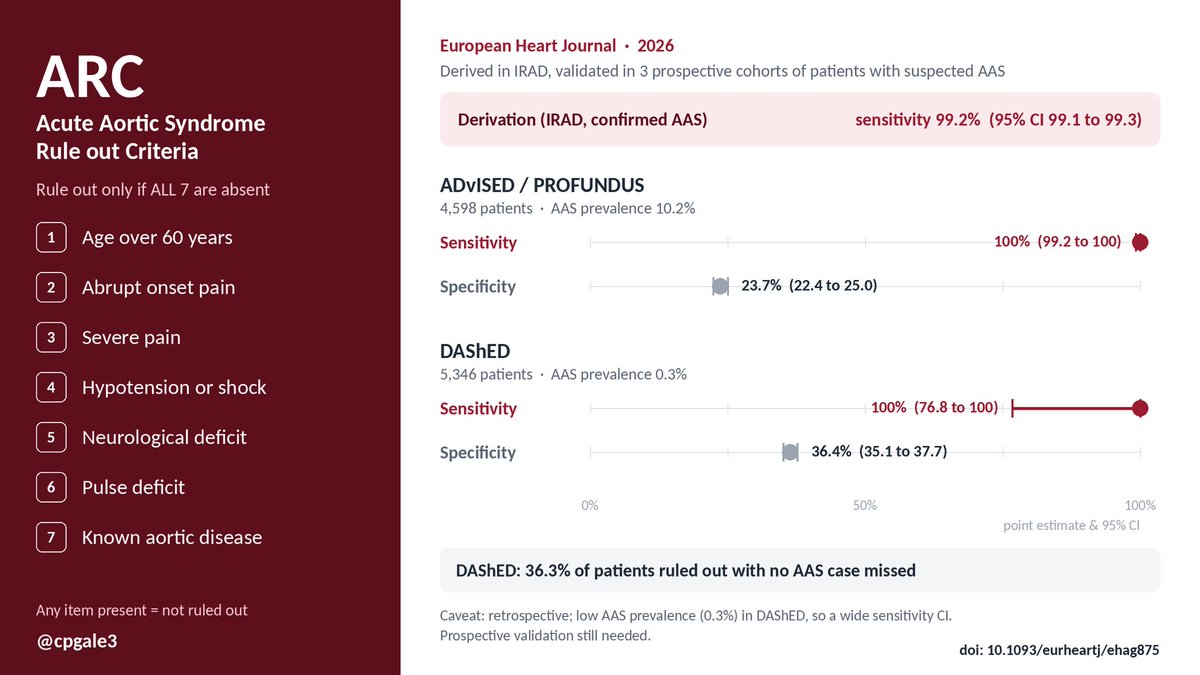
Perfect rule-out sensitivity, but specificity under 40% means most failures of the rule end up in the CT scanner anyway. I'd use this as a gate, not a diagnosis. Prospective data will show if the trade-off holds at the bedside. #AAS
Here’s the ARC study bedside rule out for acute #aortic syndrome
@ESC_Journals
▶️ 7 items, all must be absent.
In 2 validation sets (n=4,598 & 5,346) sensitivity 100% (95% CI 99.2 to 100; 76.8 to 100), but specificity only 23.7% & 36.4%.
Needs prospective testing.
@VLSorrellImages Typical microbiological criteria showing the highest aRR (12.40) caught my eye, imaging mattered more than I would have guessed. The prosthetic valve cases with dispersed ratings show how murky S. epidermidis decisions still are.
@tangming2005 Chemo expanding the TCF1+ progenitor pool rather than depleting it is a striking result. I'd argue this reframes how we think about sequencing chemo with prime-boost vaccination, especially for Tpex-driven responses.
@MathysRoland Exakt mein Eindruck der letzten Jahre. Ohne Planungssicherheit keine Investitionen in Forschung, keine langfristige Karriereplanung. Blackbox-Politik vertreibt genau die Fachkräfte, die man dringend braucht.
@lowcarbGP@WDD@DiabetesUK@OfficialADSOrg@BDA_Dietitians This mirrors what I keep coming back to in immunology: systems with tight tolerances, where chronic pathology follows once regulation fails. Insulin resistance fits that picture exactly.
@SandraausD Genau das frustriert mich am meisten. Steuergeld wird für Deko verprasst statt in Forschung investiert. Kein Wunder, dass Fachkräfte Standorte wie die UAE attraktiver finden, wo in Zukunft investiert wird.
@iScienceLuvr Same playbook as fiber in the late 90s. The technology succeeded, most of the investors did not. History does not repeat, but it certainly rhymes.