- 2 defeats in a row
- Team looked completely out of form
- RCB were at their lowest point of the season
Then came this one six from Bhuvi, that moment changed everything
We escaped the Eliminator… and today, we won 2nd trophy 😭🫂❤️
TurboQuant in plain English:
Think of a smart AI chatbot like ChatGPT or Gemini. When you chat with it for a while or give it a long document to read, it has to remember everything you said earlier. It stores that memory in a special notebook inside the computer called the key-value cache.
That notebook gets huge really fast. It eats up tons of memory (RAM) and slows everything down. On a phone, laptop, or even a normal computer, this means:
• The AI can only handle short chats before it chokes.
• It needs expensive powerful hardware.
• Responses get slow.
Google Research just released TurboQuant, a new compression trick that:
• Shrinks that memory notebook by at least 6× (sometimes way more).
• Makes the AI up to 8× faster.
• Does it with zero loss in accuracy (the AI is just as smart as before).
It’s like taking a giant photo file, compressing it to 1/6th the size with a perfect zip tool, and the picture still looks identical when you open it. No blurry edges, no missing details.
What this actually means for regular people:
• AI chatbots can now handle much longer conversations without slowing down or running out of memory.
• It works better on phones, laptops, and cheaper computers—no need for giant data-center GPUs.
• Future AI (including Google’s own models) will feel snappier and cheaper to run.
• The little animation in the tweet shows colorful bars (representing AI memory) getting neatly packed into a tiny grid. That’s exactly what TurboQuant is doing behind the scenes.
Bottom line: Google figured out a smarter way to make AI’s memory tiny and lightning-fast without sacrificing quality. This is the kind of behind-the-scenes breakthrough that will make AI feel way more practical in everyday apps soon. No magic, just really clever math that finally works perfectly.
THE STRANGE, IRONIC JOURNEY OF IRAN’S SHAHED DRONE 🚨
1970–1976
Iran under the Shah is a close US ally. Washington sells Tehran some of its most advanced military technology, including F-14 Tomcat jets and Phoenix missiles. Iran fields one of the most sophisticated air forces outside NATO.
1979
The Islamic Revolution ends the US partnership overnight. Arms supplies and spare parts stop. Iran’s Western-equipped military is suddenly orphaned.
1980–1988
During the Iran–Iraq war, Iran struggles to maintain its Western aircraft. Engineers begin improvising and experimenting with unmanned aircraft. Sanctions push Iran toward unconventional solutions.
1990s
Iran begins developing UAVs like Ababil and Mohajer. Iran’s core drone doctrine begins: cheap, expendable systems that can be built 100% domestically.
2000–2010
Iran quietly expands its drone ecosystem, reverse-engineering engines and electronics. Drones become a workaround for Iran’s inability to have a modern air force.
2011–2018
Iranian drones begin appearing across West Asia through allied militias, becoming a key tool of asymmetric warfare.
2019
A drone strike on Saudi Arabia’s Abqaiq facility temporarily knocks out about 5 percent of global oil supply. Cheap drones prove they can create strategic economic shock.
2020
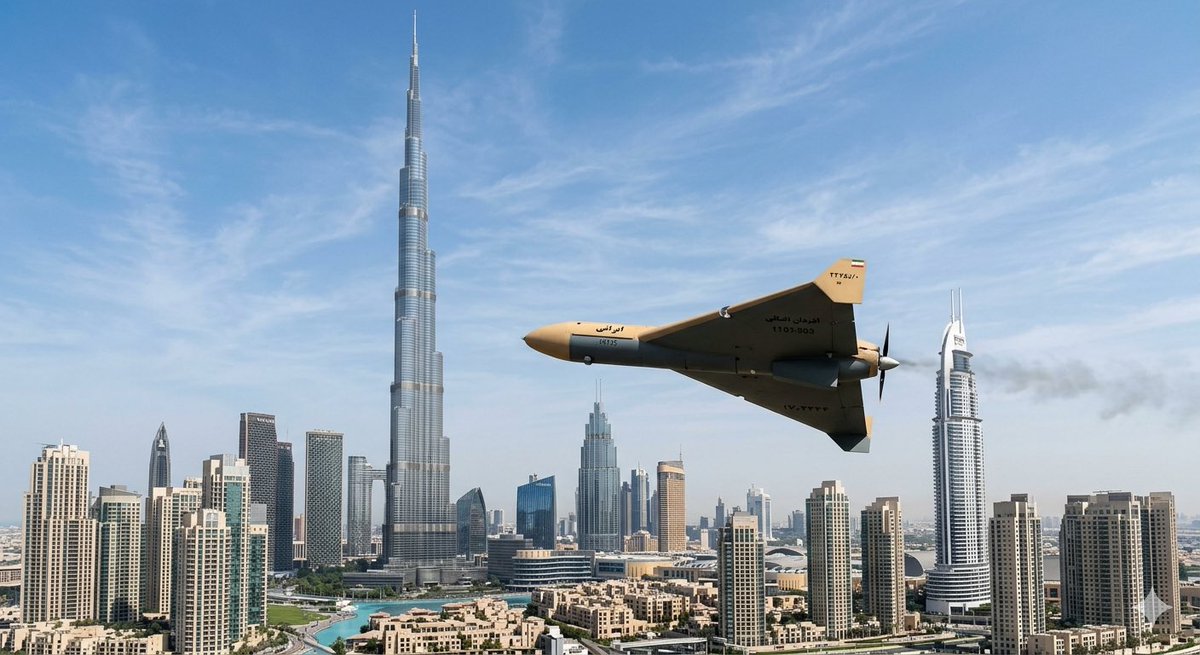
Iran unveils the Shahed-136 loitering munition (the one you’re seeing now). A simple piston-engine drone designed for long-range optionally mass attacks.
2022
Russia begins using Shahed-136 drones in Ukraine, renaming them Geran-2. Swarms target cities and energy infrastructure.
2022–2023
The economics of an expensive war shift. A Shahed costs >$30k a piece. Missiles used to shoot them down can cost hundreds of thousands or even millions.
2023
Russia begins producing Shahed-type drones domestically, scaling up swarm attacks on Ukraine.
2023–2024
Ukraine adapts rapidly, developing counter-drone tactics, interceptors and jamming warfare. The country becomes the world’s drone warfare laboratory.
2024
World militaries begin studying Ukraine’s battlefield lessons on drone warfare and air defence economics.
2025
The US unveils LUCAS, a low-cost attack drone concept inspired by captured Shahed drones studied in Ukraine.
2025
India tests its first Shahed-inspired long range swarming drone Sheshnaag. Secret sauce: swarming code & autonomous attack modes.
2025
Pakistan employs cheap swarm drone tactics during Op Sindoor, supplied and tutored by Turkey & China to saturate Indian air defences. India’s counter-drone systems get their first major trial.
2026
In the current Iran war, Shahed drones hit ports, oil facilities, bases and cities across the Gulf, forcing Saudi and allied air defences to burn through expensive interceptors.
2026
The US and Gulf states turn to Ukraine for advice and technology. The country that defended itself against Shaheds is now helping others counter them.
2026
Two weeks into the war, Shahed drones are still hitting targets hundreds of kilometres away. The uncomfortable truth: the most advanced militaries on earth still lack a reliable antidote to mass-produced garage-style drones.
The Shahed arc is complete.
A country that once flew America’s most advanced fighter jets ended up building cheap drones out of necessity. Those drones go on to rewrite the economics of modern war.
tired of reading OTP codes off your screen and typing them manually?
built a macOS app that does it for you 🔐
detects the code the moment it arrives → copies to clipboard → Cmd+V and you're in
https://t.co/8I1G0Q88kk
Kohli india ki ayina RCB ki ayina Anchor chesedi induke ra Lanjodkallara.... Vadu oka side nilchoni unte.. Krunal lanti erripukulu kuda click avtaru eroju laga... That's his role.. And hes been doing that. Anduke Twitter lo unde erripukulu tappa.. Experts evaru question cheyaru
It's been 14 years since Sergio Busquets dropped the ball off to Messi and let him do his thing.
The result was a legendary solo goal in the UCL semifinals against Real Madrid 😮💨
(via @ChampionsLeague)