In case anyone is curious:
We’ve had a ~pixel-perfect world model since last year, which is critical for synthetic data generation.
The (much) smaller version of that in the car is a conditional mean-flow model, based on the recent sequence of Tesla Universal Vision Encoder features, which are the same ones that are plugged into the 3B encoder model that produces the driving actions.
We fork off from these UVE features, then run a separate ~1B diffusion model. This takes in the previous reality-view generation with added noise and then denoises it to the current visualization.
It then produces a small video chunk (8 images at 36 fps, at the resolution of the UI screen). This work is done by 1/2 of a TRIP engine every UVE frame at 18 hz and is spread over 4 cycles.
Currently, the latency is a bit high due to compute constraints, but we have ways to interleave newer UVE features along the diffusion transformer layers to cut roughly 35% of the latency.
V15 debuts the Tesla Reality View.
The same end-to-end driving model also renders a realistic view of the world around the vehicle.
It’s not there just because it looks cool, but it also communicates the intent of the car. The arrows show the turns FSD intents to take, the pins show its intent to park in a spot and so on.
Full release notes below
– – –
v15 upgrades every part of the end-to-end driving network. Includes:
Upgraded vision encoder shared between FSD, Robotaxi, and Optimus, which is trained on millions of internet videos for improved generalization and data efficiency, improving the critical intervention rate by 25x.
Introduced Tesla Reality View, replacing all of the explicit model signals into a single end-to-end visualization using less total compute.
Improved navigation by using an end-to-end learned model based on route preference data from the fleet.
Improved parking location selection by using personalized parking history, and the map will now display multiple parking options at your destination.
Improved driver monitoring by increasing vision-based attention monitoring availability with hats and sunglasses and decreasing strictness in higher speed driver profiles.
Improved detection of road signs, small animals, road debris, and chains.
Improved detection of potholes, road details, and avoidance of deep standing water.
Improved speed handling for each driver profile, school zones and speed limits, and inclement weather.
Improved Autoshift functionality by unifying with FSD-based gear predictions.
Tesla FSD V15 is a banger release!
Completely new architecture that deserves being called “super” intelligence, as it drives better than human intelligence.
SFT is more like getting a haircut with a chainsaw than it is “fine-tuning”! Should just be built into primary training.
And having a “system prompt” is silly! Default behavior should be sensible.
The above are already true for Tesla AI (not yet deserving of “super”). It is the most efficient AI on Earth.
FSD V15 goes to wide release next month. It will be something special.
Over the past week, I’ve been overwhelmed by the love and support of friends, industry colleagues, and people I've never met. Thank you to everyone who has shown kindness to my family and me. It means the world to me.
I came to the United States 53 years ago, and becoming an American citizen is one of the greatest gifts and proudest moments of my life. NVIDIA has been my life’s work. Building it into the company it is today alongside my colleagues has been a privilege and an honor. Nowhere but in America could a company like NVIDIA be possible. I love our country, and I love NVIDIA.
I did not live up to the standards expected of everyone at NVIDIA, and I have made serious mistakes in my personal life. I created problems for the Board that I deeply regret. I own my mistakes completely, and I am committed to cooperating with the Board’s independent investigation.
Since my departure, I’ve seen an outpouring of calls from NVIDIA’s employees, investors, business partners, and customers for me to return as CEO. Many continue to reach out to me directly as the company navigates complex technology, market, competitive, and geopolitical dynamics. NVIDIA is a once-in-a-generation company. If the Board of Directors decides that my return is in the best interest of our shareholders, our employees, the company, and America, I would be honored to answer these calls and return as CEO.
Thank you again to everyone who has shared their good wishes. I am profoundly humbled by your support. To my family: I love you, and I will spend the rest of my life being worthy of yours.
Jensen
Jensen was demanding of his executives, yet consistently kind and supportive to individual contributors like me. Too many companies coddle their executives and shield them from accountability when things go wrong. Jensen did the opposite.
I didn’t mind that my boss was demanding. All my previous bosses held me to the highest standards. Without them, I would not be where I am today.
@apostlejohn@WorldlyReviewer Coming soon. If things well, may start trials next month.
Much better to manage a fleet of cars than have to drive just one car by yourself!
Let’s take this gentleman’s argument at face value that anyone can throw money at rockets and get something like Starship, Falcon or Dragon.
Perhaps he can explain to everyone how SpaceX is able to catch giant starships from orbit with chopsticks and deliver 85% of all Earth payload to orbit with Falcon, while Blue Origin, which started before SpaceX and was funded by the immensely wealthy Jeff Bezos, is not yet able to launch reliably?
Also, why is it that Boeing and Lockheed received several times what SpaceX did from the government for development of their rockets and spacecraft, but the Boeing capsule is still not operational and ULA delivers less than 5% of SpaceX payload to orbit?
I am genuinely curious about these questions.
Both the Biden and Trump administrations allowed the export of less powerful GPUs to China while reserving the most advanced chips for America. This has been a clear national security success.
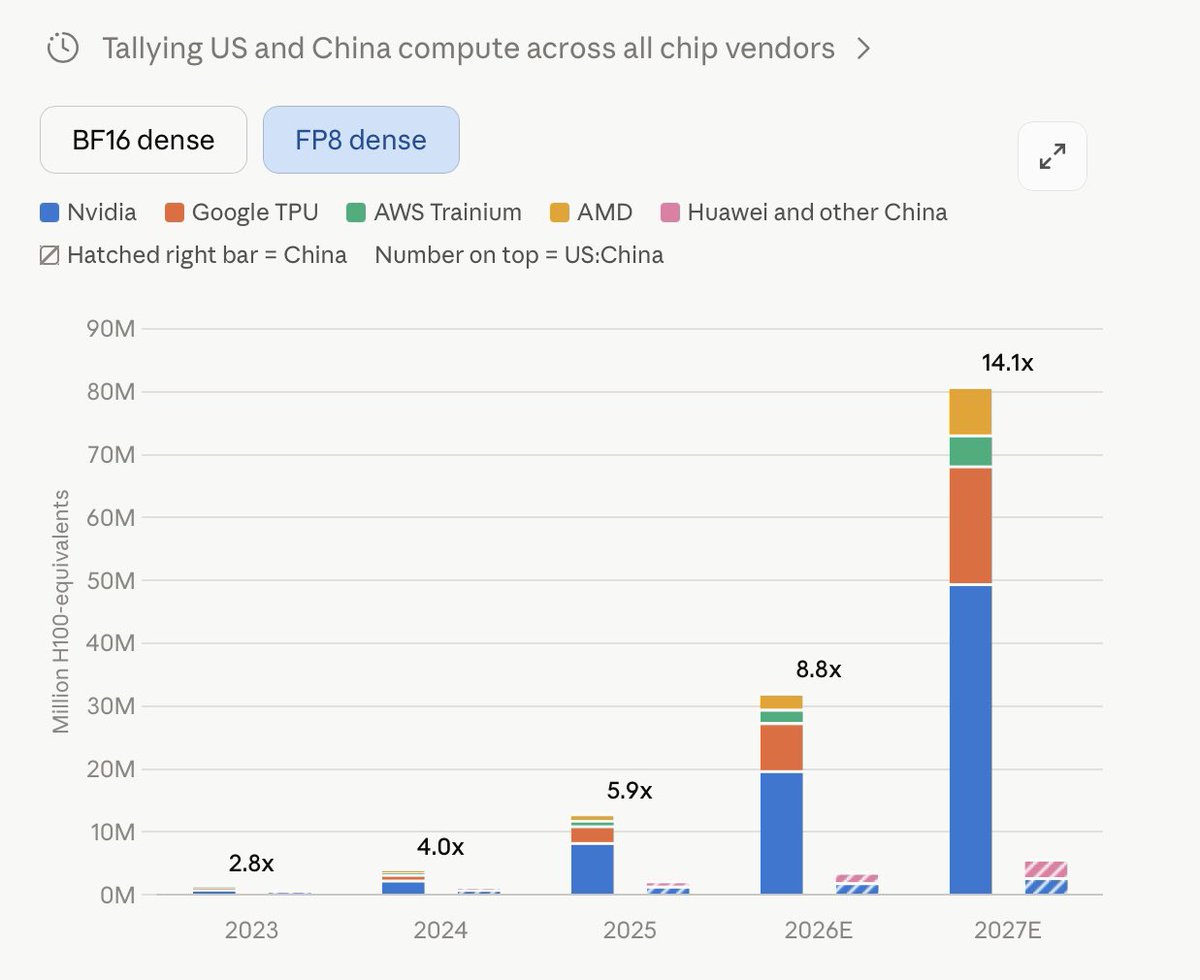
Per Grok and Claude, the US-to-China AI FLOPs ratio has grown from 2.8x in 2023 to 8.8x in 2026 and is modeled to reach 14.1x in 2027. Our advantage in compute has grown dramatically and American AI labs have stayed well ahead of Chinese labs the entire time.
Chinese labs prefer these less powerful American GPUs to domestic accelerators from Huawei and others. That preference has slowed China’s hardware industry: AI chips improve through intensive use by leading labs, and the ready availability of American alternatives has limited that feedback loop for Chinese AI hardware.
Chinese labs can also access capacity in Southeast Asian clouds run by American hyperscalers. Those zones can be shut off instantly in a conflict, giving the US signficant leverage. This dependence is advantageous in every way.
A complete ban on GPU exports and Southeast Asian cloud access might be deeply damaging to long-term American national security. It would force Chinese labs onto the Huawei AI hardware ecosystem. China is not power-constrained, and Huawei is developing extremely power-hungry, large optical scale-up domains that may approach American state-of-the-art systems through brute force rather than architectural elegance and efficiency. And China has a lot of power.
Having Chinese labs optimize models for this different architecture is risky as nothing prevents China from sharing this hardware and associated models with Russia, North Korea, or Iran. We would lose any ability to cut off their AI in a conflict.
Policies now under discussion in Washington carry serious, uncertain risks. Reasonable minds can disagree, but treating this as a simple black-and-white issue does America a disservice.
If China closes the installed FLOPs gap as its domestic hardware matures rapidly as a result of increased Chinese lab usage after stricter export controls, we will know this new policy was a mistake.
If Russia, Iran, or North Korea later field comparable Chinese AI hardware systems that are used to run AI targeting models against Ukrainian or American troops, we will know stricter controls were a *terrible* mistake.
The current reality is one where China is consistently behind America thanks to the export of less powerful GPUs and we have immense leverage over China in any future conflict. We know that the current policy is working. We have no idea what the consequences of stricter controls might be.
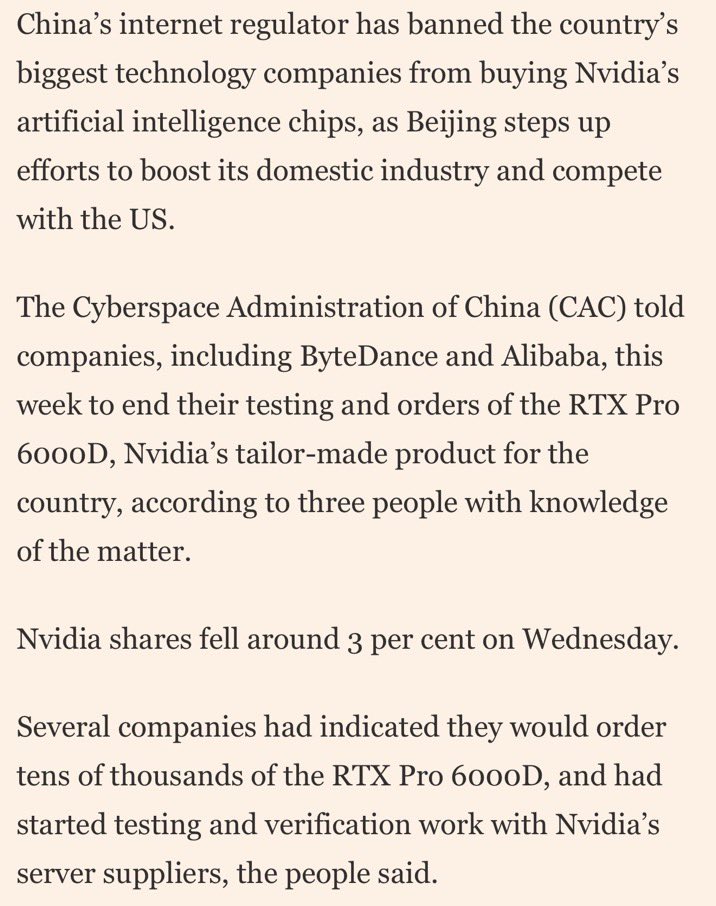
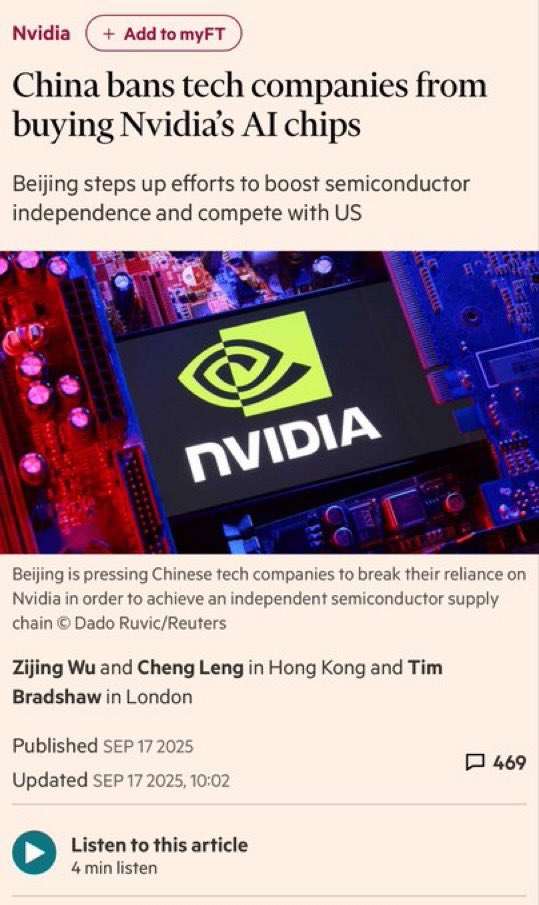
This is why China is currently restricting imports of roughly 600,000 H200s sitting in Hong Kong warehouses. China Hawks should consider why Beijing agrees with them and why China *restricts* the sales American GPUs inside China.
The current policy has worked spectacularly. The alternative is extremely risky with unknown consequences.
Jensen drove supply chain brilliantly at Nvidia, but many of those deals were a handshake with Jensen, not a written contract.
Without Jensen, at least some of those critical deals will be lost.