Senator Lawal Sha’aibu represented BUA Group Chairman, Alhaji Abdul Samad Rabiu, at the launch of Buhari: The Authorised Biography, delivering a goodwill message on his behalf.
Mr. Chairman, Distinguished Guests, Ladies and Gentlemen,
President Muhammadu Buhari was everything to me.
He was a father, a mentor, a trusted friend and a pillar of strength to me and my family.
He was an iroko tree upon which I leaned when my strength was failing. He was always there for me, particularly during some of the most difficult moments of my life and business.
I will never forget the enormous challenges I faced with certain government agencies, challenges that threatened the very survival of my business and everything I had worked so hard to build.
At that critical moment, President Buhari stood firmly on the side of justice. Even in the face of strong resistance and enormous pressure from those who wanted him to act otherwise, he remained resolute and refused to be swayed. His integrity, courage and unwavering commitment to fairness and the rule of law prevailed.
I remember vividly when he assured me that he would always do what was right, regardless of who was involved or how powerful they might be. I was moved to tears by those words and by his genuine concern for me.
Ultimately, his steadfastness and determination to uphold justice saved my business. For that, I will remain eternally grateful to him. It is something I will never forget for as long as I live.
These are not merely words of tribute. They are deeply personal memories of a remarkable man whose kindness, compassion and fatherly affection I will forever cherish.
Beyond his relationship with me and my family, President Buhari was a man of uncommon integrity, humility and simplicity. He devoted much of his life to the service of our great nation, Nigeria, and remained steadfast in his convictions and commitment to what he believed was right.
He was a leader who valued loyalty, friendship and family. Despite the enormous responsibilities of his office, he never lost the human touch.
To the nation, he was a President and a statesman. To me and my family, he was much more. He was a father figure, a cherished family friend and a source of wisdom, encouragement and comfort. His passing has left a void that will be difficult to fill.
Unfortunately, I am presently in London on a previously scheduled engagement which I have been unable to reschedule. I deeply regret my inability to be physically present at this important occasion.
I have therefore requested my good friend, Senator Lawal Shuaibu, who is present here today, to kindly represent me and deliver this message on my behalf.
I have also authorised him to announce my pledge of Five Hundred Million Naira (₦500,000,000) towards the purchase of ten 100 copies of this important book, in honour of a man whose life, service and legacy deserve to be remembered and celebrated for generations to come.
May Almighty Allah (SWT), in His infinite mercy, forgive the shortcomings of our beloved President Muhammadu Buhari, reward his good deeds, grant him the highest place in Jannatul Firdaus, and continue to comfort his family and all those who loved him.
Ameen Ya Rabbil Alamin.
Thank you.
MY APPEARANCE BEFORE THE SENATE COMMITTEE ON PUBLIC ACCOUNTS
Today, I appeared before the Senate Committee on Public Accounts to address issues arising from the audit of the Nigerian National Petroleum Company Limited (NNPC Ltd) and provide clarifications on matters relating to my tenure as Group Managing Director of NNPC and subsequently Group Chief Executive Officer of NNPC Limited.
I appreciate the opportunity provided by the Senate to present my explanations, respond to concerns raised in the audit report and place certain issues in their proper context.
At the heart of my presentation was the need to correct certain misconceptions and misinformation surrounding the financial records of the company, particularly the allegation that N210 trillion was lost under my leadership.
I stated unequivocally before the committee that no such funds were lost. The figure arose from accounting entries and bookkeeping descriptions, not the disappearance or loss of money. I provided explanations on the relevant entries and reaffirmed my readiness to offer any additional clarification the committee may require.
I also addressed the N2.99 billion expenditure relating to the incorporation of NNPC Limited. I explained that the amount represented statutory payments to the Federal Inland Revenue Service and the Corporate Affairs Commission in connection with the company's incorporation. The issue, as I clarified, relates to the accounting treatment and responsibility for the payment under the provisions of the Petroleum Industry Act, rather than any improper expenditure.
Beyond these specific issues, I considered it important to reflect on the institutional reforms undertaken during my tenure.
When I assumed leadership of NNPC in 2019, one of my foremost priorities was to establish a stronger framework for transparency, accountability and institutional responsibility. I firmly believed that a public institution entrusted with the nation's resources must be accountable to the people, who are its ultimate stakeholders.
In pursuit of this objective, we took the unprecedented decision to publish the company's financial statements, making its financial records publicly accessible for the first time in its 43-year history.
We understood that transparency would expose the company to greater scrutiny, criticism and public debate. However, we believed that public scrutiny was essential to building a stronger institution. Indeed, the disclosures generated constructive discussions, recommendations and internal reforms that helped improve operational efficiency, strengthen accountability and drive cost-saving measures.
These efforts contributed to a significant improvement in the company's financial performance, moving from a loss position to sustained profitability. I am particularly pleased that the accountability structures established during our tenure have been sustained by the current management, with encouraging financial results.
The reforms also took place within the broader transformation of Nigeria's petroleum industry following the enactment of the Petroleum Industry Act and further galvanized by Mr President’s policy interventions. We worked to implement the policy decisions of the Federal Government and the National Assembly, including the transition towards a market-based petroleum products regime.
During this period, we also witnessed increased investment in the oil and gas sector, the advancement of strategic gas infrastructure projects and the deepening of the downstream petroleum industry. These developments are important to the country's energy security, economic growth and long-term investment prospects.
I remain proud of the opportunity to have served NNPC and contributed to the transformation of an institution that is central to Nigeria's economic development.
L-R, Chairman, Nigeria Local Government News (NLGN), Nasir Danu OFR, The Sardaunan Dutse/ Taffida Babban Daura, and David Tosin Bakare, Publisher/CEO at the presentation of the publication to the Sardaunan Dutse in Abuja.
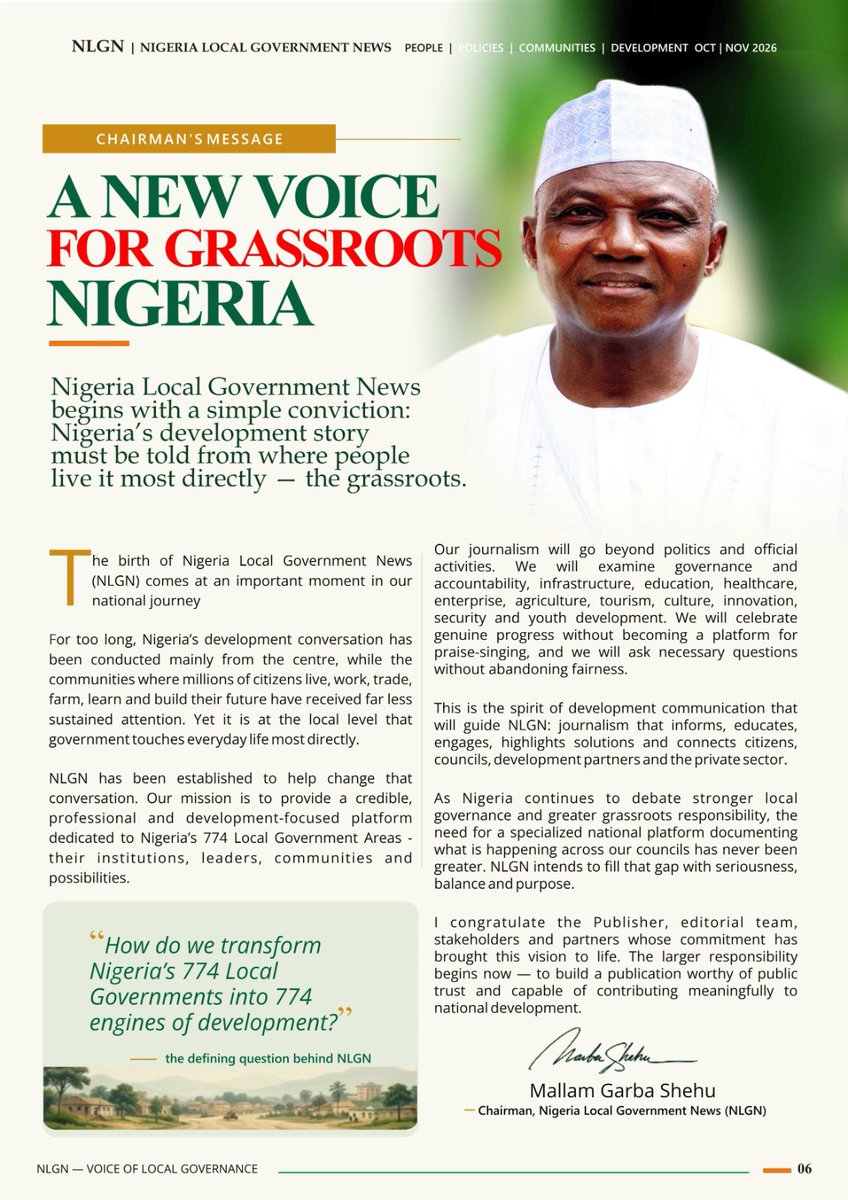
Today, the publisher and editor-in-chief, David Bakare and myself as Chairman, had the privilege of presenting a copy of the maiden edition of our magazine, The Local Government News to Minister of Information and National Orientation, Mohammed Idris Malagi.
If this didn’t come from the Kakaki and Hon. Minister, one would have said that the image was created using AI tools.
I saw the Senator walking on Edgware Road and we greeted him very warmly.
He looked good and his tempo and movement looked good as well.
May Allah grant him full and speedy recovery.
Lade Bunuola, Master of Prose @80
As students of communication back in those days at the University of Nigeria, Nsukka, the Guardian newspaper was a must read, and specifically the array of dazzling essayists who made you proud of your choice of journalism as a career path. The paper was a subject of discussion in and outside the classroom.
Two challenges faced us in getting the paper. One, each day, there were very few copies brought to the newsstand on campus by the vendor, which meant that you must book a copy in advance and two, even where you could count on the friendship of the vendor, the cover price of a daily edition of the paper was daunting for many who struggled to get “two square” meals in a day.
To get by, many students joined the “Free Readers Association,” at the newsstand, or used the cheap photocopy machines at the Library to reproduce the daily columns of paper which written, at that time, by the best prose stylists you could get anywhere in the world.
This is where I met the celebrant, Lade Bunuola, “Ladbone,” the Guardian writer with appealing themes under “The Ram”, but beyond that, a characteristic style exhibiting a unique grammatical structure and a natural flow of language and common sense.
I became captive to his stunning and quotable essays written in simple language, especially given that they were philosophically weighty.
His contemplative and luminous style of writing profoundly resonated with me and many in the class, and continues to do even more so, now that he is even deeper, philosophically.
We will continue to follow, consume and learn from his mesmerizing rhythm and rich anecdotes and wisdom as he maintains regular online appearances.
Many happy returns, Sir.
H.E. Ambassador Ahmed Rufai Abubakar shares valuable insights at the Global Security Forum #GSF2026 in Doha, drawing on his extensive experience at the highest levels of security, intelligence, and international diplomacy.
#GSECForum
Dear Colleagues,
I am introducing to you an entirely new publication, The Nigerian Local Government News, of which I am chairman, and my friend form the Jackson School of Journalism, University of Nigeria, Nsukka, David Tosin Bakare as the Publisher/Editor-in-Chief.
The multi- media publication is set to build Africa's first authentic Development Communication media ecosystem using the Nigeria Local Government News as the flagship brand for now.
In addition to his extensive journalism practice, Bakare had served as Brand Manager and later, Head of Marketing at Nigerian Breweries Plc ( Ota). He was also a Marketing Manager at Euroglobal Distilleries, Ota, Ogun State.
The introduction of the magazine arm on October 24 which is the World's Development Information Day is intended to underscore the development orientation of the media chain, and bring it to global awareness and attention of Development Partners.
A national launching will follow in Abuja in the coming weeks.
Best Regards.
Congratulations to my friend, Ogaga Ifewodo on winning the NLNG award.
The honor that comes with the award is enormous, and this is what I am most happy about.
The cash prize is for you, a shot in the arm. I hope the taxman will give you a waiver as they have done for high profile businesses. In fairness, the Education & Youth Empowerment initiative under their Renewed Hope should give you a cover from the taxman.
….. From here, Sunrise commenced another arbitration against Nigeria alleging a violation of the terms of settlement, at which it asked to be paid USD 680 million.
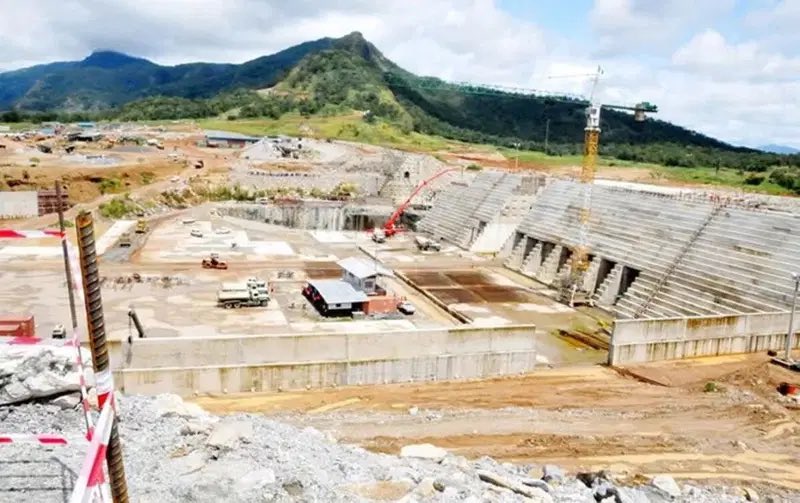
President Tinubu welcomed the tribunal verdict as the removal of the “ biggest legal hurdle” in the path of the 3,960MW Mambila power project, describing it as an affirmation of Nigeria’s determination not to succumb to the “predatory and exploitative claims by local and international entities and their enablers and funders.” Well said.
The next steps he needs to take, in national interest and in honor of the late president whose heart was in the Mambila project until his death, is to urgently link up to the Chinese leader, to get him to fulfill his longstanding promise to fund the power project.
HOW AND WHY SUNRISE, LENO LOST IN PARIS.
There are good reasons why Leno Adesanya and his company, Sunrise Power Transition Company lost their case at the International Chamber of Commerce, ICC, an outcome that sparked widespread nationwide celebrations across Nigeria.
The ICC threw out the USD 2.35 billion claim by Sunrise on the Mambila Hydro Electric Power Project over the weekend and, as widely reported, and also rejected a USD 400 million settlement claim, ordering instead, the company and Adesanya to reimburse Nigeria about USD 11. 82 million in legal and other expenses.
As a news person -perhaps the only one- in the Nigerian team present at the January 15 2025 sitting of the tribunal in Paris, one was privileged to witness the universe of corruption, falsehood, deceit and lies by Sunrise and its owners melt on the floor of Ritz Carlton Hotel’s meeting rooms.
At the hearing, Presidents Olusegun Obasanjo and Muhammadu Buhari featured as strong pillars of the country's defense against this flagship scheme similar to the P & ID in using international arbitration to steal billions of dollars from the country using fraud, deceit and lies, and as did some others including the NSA, Nuhu Ribadu and Buhari Ministers, Engineer Sulaiman Adamu and Babatunde Raji Fashola.
It was, however, clear from day one that Leno and company would lose this case following the failure of all the witnesses they invited, including, of course a beautiful lady from Senegal allegedly providing comfort to one of their government contacts.
At a stake in Paris was the extraction of USD 660 Million and a second one to follow for USD 2.7 billion from the country’s treasury through bogus claims of failed contracts.
The two past Presidents, alongside other key witnesses were prevailed upon by President Bola Ahmed Tinubu to rise to the occasion of defending the nation against fraudsters whose stock in trade was to bribe and get government contracts, only for them to use such projects to obtain huge sums of money as costs for settlement using arbitration.
In the year before, the English Supreme Court saved Nigeria from the theft of USD 11 billion through similar schemes, and President Tinubu vowed “ not again.”
The team to Paris was led by the Minister of Justice and Attorney General of the Federation, Lateef Fagbemi, SAN.
At its meeting of 21 May 2003, the Federal Executive Council, FEC, chaired by the then President of Federal Republic of Nigeria, Chief Olusegun Obasanjo, considered a memo for the issuance of Mambila contract to Leno and his company, and refused to give its approval, asking that the memo be withdrawn while noting that the establishment of new power plants must be done through a competitive process.
In spite of the above backgroud, on 22 May 2003 – the next day and seven days before the end of President Obasanjo’s first term – the Minister of Power and Steel at that time, Dr. Olu Agunloye, sent Mr. Adesanya of Sunrise a letter purporting to indicate a preliminary ‘approval’ for Sunrise to have a role in the construction of the Mambilla Hydroelectric Power Station with a value of USD 6 billion.
As far as credibility and reputation are concerned, Sunrise got the so-called “award” without any prior expertise on such projects or any real assets.
Documents placed before the tribunal by Nigeria included filed statements by Sunrise at the Corporate Affairs Commission, CAC that the company had no turnover in 2017, 2018 or 2019, and had total net declared assets of only N1,000,000 (one million Naira).
At the time they received the “award,” the financial position of the company was N318,685 on 3rd December, 2004 and N270,370 as of 31st December, 2005.
A new Minister wrote to Leno Adesanya of Sunrise to confirm the non-approval of the FEC, on 3 September 2003 and therefore had no contract whatsoever with government.
A new tender process was initiated and the contract was awarded to two Chinese companies, CGGC and CGC.
At a later meeting between president Muhammadu Buhari and the Chinese leader, Xi Xiping the Nigerian president requested funding by ChinaExim bank of the Mambila project, and requested President Xi to nominate credible companies to execute the contract.
President Xi gave an instant commitment of the Chinese government to promoting the promote the project.
Sunrise wahala began by demanding payment of (1) GBP 33 million as the costs that it had allegedly incurred “on preparation for the execution of the project”; and (2) USD 1.2 billion, which allegedly represented 20% of the USD 6 billion estimated cost of the Project “as projected profit of our client [Sunrise] on the project.”
Sunrise sought to prevent the Project from moving forward by taking the following steps: One, filing a claim at the Federal High Court against Nigeria’s Minister of Power, the Attorney-General of the Federation, CGGC, and CGC and two, they sought an order preventing any development of the Project except through Sunrise and, in the alternative, claimed the sum of USD 960 million in alleged damages.
As a result of the Sunrise litigation, the project was held up for all these years. ChinaExim withheld funds - as would any lender - pending the resolution of the legal tussle.
In order to move the Project forward, Nigeria entered into settlement discussions with Sunrise, CGGC, and CGC. The settlement discussions were inherited by the administration of President Buhari.
In those discussions in 2012, the Federal Ministry of Power entered a ‘General Project Execution Agreement’ with Sunrise and Sinohydro (another Chinese contractor that Sunrise had involved) (the “GPEA”), an initial agreement with Sunrise relating to the Mambilla Project.
On the 14th January, 2015, a letter was signed by the Federal Ministry of Power supposedly giving approval for Sunrise to be engaged as the local content partner on the Project.
On 9 November 2019, a meeting was held between, on the one hand, Sunrise, represented by Mr. Adesanya, and, on the other, Nigeria’s Attorney-General and Minister of Justice and the Minister of Water Resources in London.
At that meeting, it was made clear to Mr. Adesanya / Sunrise that any settlement negotiated would, of course, depend on approval by the president.
At this meeting, Mr. Adesanya offered to accept a figure of USD 500 million, and the Minister of Justice and the Minister of Water Resources – no doubt under pressure to settle the dispute so that the Project could proceed – made a counter-proposal of USD 100 million.
After a series of meetings, the Attorney General and Minister of Justice and the Ministers of Power, Finance and Water Resource agreed to propose the sum of USD 200 million as a full and final settlement of Sunrise’s claims, subject, understandably to approval of the President. This proposal was accepted by Sunrise.
On 25 March 2020, a second document entitled ‘Addendum to the Term[s] of Settlement’ was signed between Sunrise and representative of Nigeria. Again, the document provides for a potential doubling of Nigeria’s liability by another USD 200 million in case of delayed payment.
On 31 March 2020, the ‘Terms of Settlement’ and ‘Addendum to the Term of Settlement’ were presented to President Buhari for the first time for his approval. Upon reviewing the documents, the President decided not to grant approval. In a hand-written and signed note dated 20 April 2020, the President withheld his approval for entry into these documents, on the basis that “FG [the Federal Government] hasn’t got USD 200m to pay [Sunrise]”.
Despite repeated attempts, President Buhari wasn’t convinced that Nigeria should pay USD 200, or even higher to someone who did nothing but merely presented an unauthorized contract document.
… And Nduka Obaigbena.
I have told my Nduka story before but given the importance I attach to it, its bears repeating. Many years ago, we met at his instance to decide if would partner with him in his upcoming magazine, TheWeek, with ties to the Time Magazine where Mr. Obaigbena had worked in the past. After all has been said, our representative at meeting asked an important question:
What happens if the beautiful dream crashes? Is there a fallback to it?
Our host, Nduka Obaigbena shoved aside the issue, saying we are all taking a risk, there is nothing to lose. None of us here has a family. We, (I and my editor, Malam Kabiru Yusuf) decided that this would be a dangerous journey; the guy is not a serious person, we concluded.
TheWeek took off and crashed but in its place, he went on to found ThisDay.
Malam Kabiru, with a few friends started the Daily Trust which has gone on to break so many barriers and myths and about the success or lack of it in publishing in Northern Nigeria. The Trust Newspapers are today printed simultaneously in Abuja, where they are headquartered in a five-story building, in Kano, Maiduguri, Lagos and Port Harcourt, the only one to so in the country.
Nduka Obaigbena has built ThisDay (Leaders and Company) into one of the country’s most respected media organisations, comprising not only the flagship ThisDay but also several other publications, and Arise International TV network. Recognizing the potential importance of digital media, Nduka launched Lekeelekee, the first global social media platform built out of Africa, “blending Tik-Tok, X , WhatsApp into a culturally aligned , mobile-first experience for African and the diaspora.” Users say Lekeelekee is fun and easy to use.
In this growing communications empire, ThisDay has a reputation for thorough, accurate, and well-written journalism, setting standards for politics, economy, business and society reporting. Through this paper, Nduka gave this country its first all-color newspaper. In 1998, the Nigerian Guild of Editors gave him an award in recognition of his transformative contributions to journalism and media in the country.
Arise continues to grow in size and reputation with a tradition of being a watchdog for misdeeds by politicians and aggressive interviewing techniques that have become a subject of discussion among communications scholars and practitioners. Nduka must be credited with a rare ability to create and manage this world class media empire and in the people he choses to run it, the choice of a top flight management team, and a willingness on his part to support the staff in and out of office, even when pressured to do otherwise.
In addition to being publisher, Nduka has led the Newspaper Proprietors Association of Nigeria, NPAN and is a patron of the Nigerian Press Organization, NPO, after leading it as president, giving him, overall, a latitude of authority, wealth, financial power, social privilege, and outstanding public respect.
Leadership Man of the Year:
WHY ABDUL SAMAD, NDUKA MATTER.
This year, the Leadership newspaper is conferring its prestigious Man of the Year award on two Nigerian icons in recognition of their leadership journeys:
Prince Nduka Obaigbena, one of Nigeria’s most famous and admired media figures is a man who shaped, and continues to shape different eras in Nigerian journalism.
Abdul Samad Isyaku Rabi’u, born on August 4, 1960 is a Nigerian billionaire businessman and cement magnate. His is a name that goes far beyond the boardroom. While he is renowned as the chairman BUA Group of Companies which he transformed into a global business empire, his contributions extend well beyond the corporate world. Abdul Samad’s philanthropy is a beacon of hope for millions, and his selfless giving continues to leave lasting impressions on Nigeria, Africa and the world. By showing that business can move beyond the notion of profit, Samad, as fondly called by friends has showcased how true leadership is not only about business success but also about creating a lasting social impact.
As the executive chairman of BUAFOODS, he drove the expansion of the conglomerate into Nigeria’s most capitalized company, with a share price of approximately ₦760.60 and a market capitalization of roughly ₦13.69 trillion.
Currently, he is Africa’s second richest person with a net worth estimated at between $13 billion and $19 billion in 2026. Samad has always stood for more than business. To Nigerians, he personifies kindness, purpose, and institution-building. He is Nigeria’s, indeed Africa’s philanthropic giant.
When the Covid-19 crisis rocked and racked livelihoods, lives and even nations across the globe, Nigerian business leaders formed what they called the Coalition Against COVID-19, known as CACOVID. Led by Aliko Dangote, Africa’s wealthiest man, the coalition was backed by Access Bank Group, Zenith Bank, Guaranty Trust Bank, and several others including the BUA Chairman, Abdul Samad. Rather than solely funding temporary relief, which he noted was the major shortcoming of the CACOVID relief programs he and the others put in place, Abdul Samad seized the momentum to sharpen and accelerate his visionary legacy of transforming lives in Nigeria through philanthropy and social impact initiatives.
It’s the famous American author and motivational speaker Tony Robbins who said “by changing nothing, nothing changes.” Like a bolt from the sky, came in 2021, the Abdul Samad Rabi’u foundation, ASR Africa Initiative which is the brainchild of the industrialist and philanthropist, with an annual pledge of $100,000,000 (USD) with Nigeria to benefit $50,000,000 (USD) yearly and the rest of Africa, $50,000,000 (USD) in what is the largest private philanthropic giving of its kind by an individual on the continent.
He believes in using wealth to uplift society and to address some of the most pressing challenges facing humanity. From education to healthcare, water supply to rural development, Samad’s charitable efforts have touched countless lives.
As one of the world’s leading philanthropists of the 21st century, Abdul Samad’s compassionate ethos of giving is evident in his generous donations to education and healthcare. ASR has built, among many other projects, a N310 million students hostel at the Federal University of Technology, Minna; a N270 million Abdul Samad Rabi’u Sports Complex at the University of Jos; N250 million admin block at the Federal University of Technology, Owerri; N250 million sports center at UNIPORT; N1 billion learning facility at UNILORIN; another billion Naira Integrated Agric Center at the Bayero University, Kano and a language center at the Nigerian Defence Academy, NDA.
The foundation has, to its credit, several other projects including lecture theaters, auditoria, classrooms, libraries, laboratories, staff quarters and offices, ICT facilities, books, journals and periodicals, machines and other research equipment thrown at institutions of learning in Nigeria, Ghana and other African countries.
ASR Africa has also made contributions to the well-being of our defence and security agencies through projects such the N2 billion Naira Nigerian Navy medical center in the FCT; a N500 million immigration staff accommodation for the Immigration Service and another N500 million for the Correctional Center (Prisons Service); a 150 bed mega hospital for the police in Abuja, and a hospital for the immigration service in Bauchi. The foundation has built a palace for the Royal Igbogila Kingdom in Ijesha in Ogun State for N1 billion; a contribution of N5 billion to the IBB national library project and the ongoing construction of the Malam Abdulkarim Juma’a mosque in Zaria.
The history and extent of his passionate support for health and welfare is another little-known detail about Samad.
Through this foundation, he has enabled the construction and rehabilitation of healthcare facilities, equipping them, developing research capabilities for researchers, healthcare practitioners and community level service providers.
Among the many projects executed include a N2.5 billion teaching hospital at Akwa Ibom State University, Uyo, a N2.5 billion school of nursing at Sokoto State University in Tambuwal, a N2.5 billion school of health technology in Gwadabawa also Sokoto state; a N2.5 billion Oncology and diagnostic center in Ilorin; a N2.5 billion Stella Obasanjo Hospital in Edo state, a N250 million clinic at the Nigerian Law School as well as a record number of hospitals in Kano, Katsina, FCT, Bauchi and Sokoto given ambulances and tuberculosis centers. Ten states got kits for sexual assault repentance centers.
In his effortless stride of his giving, Samad sparked a national enthusiasm when he offered a cash reward package of up to USD1.5 million to the Super Eagles during the 2025 Africa Cup of Nations (AFCON) in January, 2025. In the end, we lost the semi-final to the host nation, Morocco in a penalty shootout. Despite the defeat, he still went ahead dishing out USD 500,000 in appreciation of the team’s “resilience, passion, and strong performance throughout the tournament.”
Through philanthropy and strong conviction with an eye on nation building, Abdul Samad continues to create and support countless social uplift programmes in areas such as health, education, national security, water, sports , livelihoods and social welfare, all with one core purpose — to improve the quality of life of those it touches at home in Nigeria and other countries in Africa. His selection as the 2026 “Man of the Year” by the Leadership Media Group is an eloquent testimony to why Abdul Samad, a major global player, matters.
Today, I am mourning the sudden death of my decades-long friend, Dotun Oladipo, publisher of Nigeria's largest and most authoritative online newspaper, The Eagleonline. He was a valued friend whose commitment to journalism had very few parallels. He was blessed with good conduct, wit, and charisma.
RIP, Dotun.
My dear brother, thank you for your kind words. It has been a privilege watching your journey over the years and seeing you grow into the role you now occupy.
The task ahead is indeed demanding, but I am confident in your ability to deliver. You have my best wishes, prayers and support. Go forth and make us proud.
I want to take a moment to acknowledge my boss and elder Mallam Garba Shehu @GarShehu
We have worked together across several election cycles, dating back to the 2014/2015 presidential election when I served as his deputy. Over the years, I've learned a great deal from watching how he operates, and I value the guidance he's consistently offered.
I have recently been appointed as a spokesperson for the President Tinubu campaign re-election. Mallam Garba has reached out and wished me well. He has offered his support, a gesture I deeply appreciate, especially knowing the work ahead won't be easy and his experience would be invaluable.
Grateful for the years of guidance, my dearest Mallam Garba