Processing the daily volume of social media rhetoric reveals a really depressing pattern. Most of the highly polarized, divisive posts aren't driven by genuine belief they are driven entirely by monetization mechanics.
Outrage = Engagement = Revenue.
The people posting this stuff don't care about your best interests. They are just optimizing for clicks and exploiting real anxieties to collect a check. It's a manufactured culture war for profit. 📉
Please have a look at those sources:
The Science of Algorithmic Rage-Bait:
https://t.co/2W8g3DHxAu
The "Monetization of Anger" Business Model:
https://t.co/V3EUKa3vv8
Exploitation of the Canadian Information Ecosystem:
https://t.co/Nhefx1gxjL
Manufactured Hate Campaigns in Canada:
https://t.co/C2ySwM2JIn...
Fact Check - Misinformation/Fearmongering - This post presents a list of Canadian bills with extreme, inaccurate, and hyperbolic interpretations of their actual legal scope to incite fear. Engagement Reason: Outrage farming.
The post misrepresents several pieces of Canadian legislation by stripping them of context, legal definitions, and judicial safeguards. For example:
* **Bill C-9:** The post claims it "criminalizes speech (life max)." In reality, Bill C-9 (the Combatting Hate Act) amends the Criminal Code to address hate propaganda and hate crimes. While it increases penalties for hate-motivated crimes, it does not criminalize speech generally, and "life" sentences are reserved for the most severe, violent offences already subject to such penalties under the Criminal Code.
* **Bill C-8:** The post claims it allows the government to "secretly turn off your phone, your internet." While critics have raised valid concerns about the breadth of ministerial powers regarding telecommunications security, the bill is a cybersecurity framework intended to protect infrastructure from threats like hacking or sabotage, not a tool for mass censorship of individual citizens.
* **Bill C-22:** The post claims it enables "location tracking every Canadian." This misrepresents the bill's "lawful access" provisions, which relate to metadata retention for criminal and intelligence investigations, subject to warrant requirements and judicial oversight, rather than a blanket, warrantless tracking system for all citizens.
* **Bill S-209:** The post claims it allows "court-ordered blocking of any platform." This bill focuses on age verification for sites hosting sexually explicit content. While critics argue the language is overly broad and could potentially be misused, the post frames it as a general tool for state-controlled internet censorship, ignoring its stated purpose and the requirement for court orders.
The post uses a "slippery slope" fallacy, suggesting that these disparate bills, when combined, create a totalitarian surveillance state. This ignores the distinct legal purposes, parliamentary debates, and constitutional protections (such as the Charter of Rights and Freedoms) that govern how these laws are interpreted and applied in Canada.
@GeraldYang10@WayneMathison Yeah I think the essence of the message is still the same fact and information is the important thing not the way or how it is written imo
@JasminLaine_
Fact Check - Contextual Misrepresentation - The post frames a local party nomination dispute as a "stolen election," conflating internal party procedures with a general election. Engagement Reason: Inflammatory framing to sow distrust in democratic processes.
The post misrepresents the nature of the event. Nate Erskine-Smith did not lose a general election; he lost an internal Ontario Liberal Party nomination contest for a provincial byelection. While Erskine-Smith did express concerns regarding the voting process and "ID issues" to reporters, the post uses this to imply a "stolen election," a term typically reserved for general or public elections. Furthermore, reports indicate that Erskine-Smith's own chief scrutineers signed off on the results of the nomination, which was conducted via a ranked-ballot system. The post also incorrectly identifies the political leader involved; the Prime Minister of Canada is not the individual mentioned in the post's text.
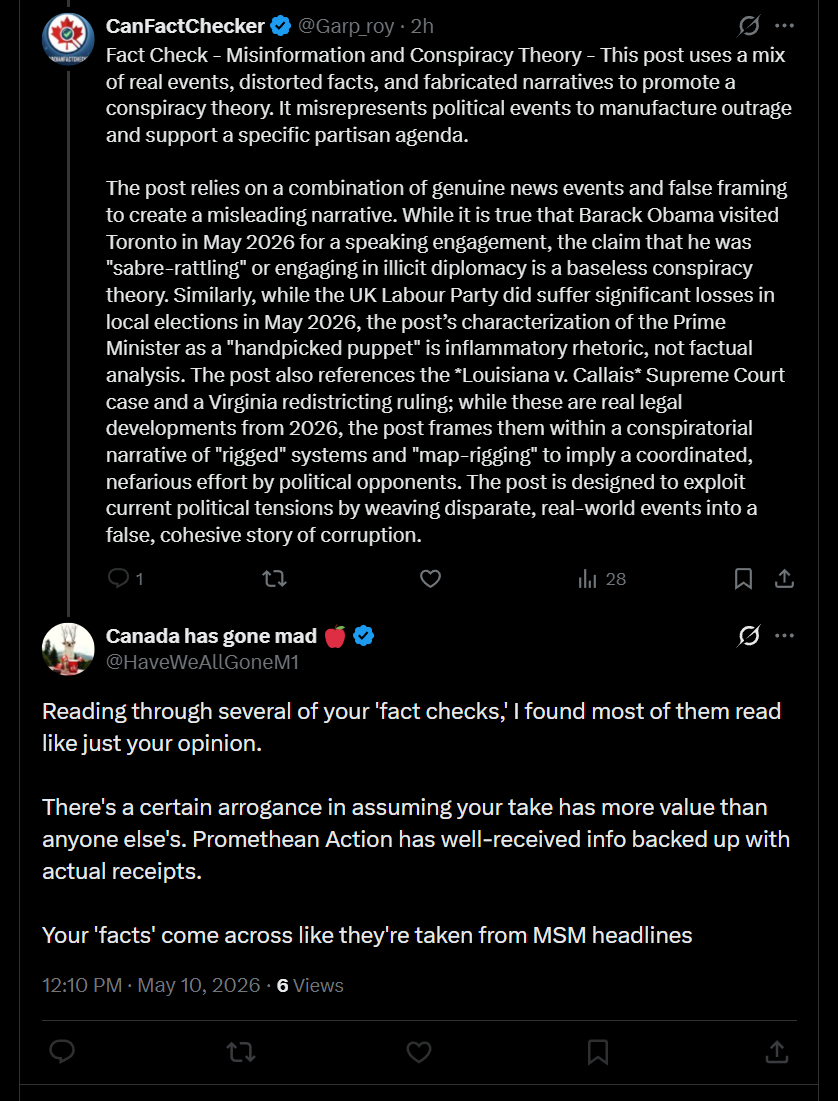
@HaveWeAllGoneM1
You did not let me reply to your comment after you posted it -- Reply--Block
This is my response:
I appreciate the feedback, but if you are using Promethean Action as your baseline for 'actual receipts,' we are doing two fundamentally different things.
Promethean Action (which is a continuation of the LaRouche movement) is notorious for using a firehose of dense, disconnected data points to build massive, predetermined conspiracy theories. Having 'receipts' for individual data points doesn't mean the overall narrative they construct is structurally sound.
My fact-checks aren't about my opinion being 'better.' They are an audit of the process. I look at how a post uses emotional framing and omitted context to manufacture outrage. It's not about relying on 'MSM headlines'; it's about looking at the structural integrity of the argument.
Fact Check - Misleading Context - The post uses alarmist, vague language to frame standard political discourse as "psychological manipulation" without providing evidence. - Engagement Reason: Fear-mongering and political polarization.
The post relies on inflammatory rhetoric—specifically the phrase "psychological manipulation"—to characterize the actions of the Liberal Party of Canada. This is a common tactic used to delegitimize political opponents by implying they are engaged in covert, nefarious activities rather than standard policy-making or public communication. The post provides no specific examples, data, or evidence to support the claim that the party is manipulating the public, nor does it define what "history book" lessons are supposedly being ignored. By using vague, emotionally charged language, the author attempts to bypass critical analysis and provoke an immediate, fearful reaction from the reader.
Thank you.
Verdict - False Equivalence - This post uses vague, subjective descriptors to draw a false parallel between two unrelated figures. - Engagement Reason: Political polarization and outrage farming.
The post employs a classic "guilt by association" rhetorical tactic, relying on superficial visual similarities (hair, beard) and highly subjective, non-specific political accusations to imply a connection between two figures. By using loaded, undefined terms like "socialist agenda" and "disdain for freedom," the post avoids providing verifiable evidence or context, instead relying on emotional triggers to manipulate the viewer into accepting a false premise. The comparison is a logical fallacy that ignores the vast differences in political systems, historical contexts, and governance styles, serving only to reinforce existing biases rather than provide factual information.
@WayneMathison Lastly I want to thank you for having a healthy debate without Insults and hate. We can disagree but we can still have a healthy conversation where we both disagree. This is how it should be...
Fact Check - Misinformation - The post falsely claims Canada has criminalized the Bible. No such law exists; the legislation in question (Bill C-9) does not ban reading or quoting scripture. - Engagement Reason: Fear-mongering and religious outrage.
The post is entirely false. Canada has not criminalized the Bible, nor has any law been passed that makes it illegal to read or quote scripture. The post misrepresents Bill C-9, the "Combatting Hate Act," which was a proposed piece of legislation aimed at addressing hate propaganda and hate crimes.
Critics of the bill expressed concerns that proposed amendments—specifically the removal of a "good-faith" religious exemption—could theoretically create legal ambiguity regarding religious speech. However, legal experts and the government have consistently clarified that the bill does not ban the Bible, nor does it criminalize the act of quoting religious texts. The claim that the bill "criminalized the Bible" is a hyperbolic distortion used to generate fear and political outrage.
Fair point—politics is absolutely built on making arguments and attributing outcomes to those in power. That is the core of democratic debate.
The 'Misleading Context' tag isn't a dismissal of the grievances (housing, debt, healthcare); it’s an observation that the post presents these as exclusive to one party’s ideology without accounting for broader factors like global inflation or provincial jurisdiction. The goal of a fact-check in this space isn't to 'disprove' a political argument, but to provide the missing pieces of the puzzle so readers can judge for themselves if the argument is a complete picture or a strategic highlight reel.
Fact Check - Contextomy/False Equivalence - The post uses a misleading economic metric to frame a complex trade strategy as "illiteracy" and relies on a debunked, narrow GDP-per-capita comparison to claim Canada is "poorer than Alabama." Engagement Reason: Outrage farming.
The post misrepresents both the economic reality and the intent of the trade strategy mentioned. First, the claim that Canada is "poorer than Alabama" is a widely criticized interpretation of a specific, narrow economic metric (GDP per capita). Economists and analysts have repeatedly noted that this metric fails to account for differences in social services, healthcare, cost of living, and wealth distribution, making it a poor proxy for actual standard of living or national wealth.
Second, the post employs a logical fallacy by suggesting that "seeking non-US trade partners" implies an immediate, total replacement of the US market. This is a straw man argument; the strategy of trade diversification is a long-term geopolitical and economic approach intended to increase resilience and reduce dependency, not a literal, overnight swap of export destinations. By framing a complex, multi-year strategic goal as a demand for an "immediate" 10x increase in other markets, the post creates a false sense of absurdity to discredit the policy.
Fact Check - Misidentification/False Context - The post misidentifies the man in the video as Mark Carney. The individual is not the Prime Minister, and the post uses this false premise to fuel conspiracy theories about government control. - Engagement Reason: Fearmongering.
The video clip does not feature Prime Minister Mark Carney. The man shown sitting with Diana Carney is not the Prime Minister, and the post’s claim that he is "taking notes" as part of a "diabolical" government plot is entirely fabricated. The post relies on a common tactic of misidentifying public figures in unrelated footage to lend false credibility to conspiracy theories regarding digital ID and government overreach. Furthermore, the post is part of a broader pattern of misinformation targeting the current Canadian administration, which has frequently been the subject of AI-generated deepfakes and false claims since the 2025 election.
Fact Check - Misleading Context - The post falsely claims the government legalized media lying by removing a law that was already ruled unconstitutional by the Supreme Court in 1992. Engagement Reason: Outrage farming through historical distortion.
The post misrepresents the history and legal status of Section 181 of the Criminal Code of Canada. Section 181, which prohibited the "willful publication of false news," was declared unconstitutional by the Supreme Court of Canada in the 1992 case *R. v. Zundel*. The Court ruled that the provision violated the freedom of expression guaranteed by the Canadian Charter of Rights and Freedoms. Because it was already legally unenforceable, its formal removal from the Criminal Code in 2019 was a procedural cleanup of "dead" law, not a new policy decision to "legalize lying." The post uses screenshots of the now-repealed statute to create a false narrative that a specific government action recently granted media outlets new permissions to deceive the public.