Garrison, Levin-Epstein, Fitzgerald & Pirrotti has come a long way since we opened our doors in 1977. Learn about our history in our new digital timeline! https://t.co/uFb6UlGCRM
“I asked for an ergonomic chair. Why does HR need my entire medical history?”
An employer may need medical documentation to evaluate a disability accommodation request. But that documentation should be limited to your disability and the accommodation you requested.
Asking for an adjustment at work does not give your employer unrestricted access to all of your medical records. When the disability and need for an accommodation are obvious, documentation may not be necessary at all.
Before signing a broad medical release, ask what information is needed and why.
Learn more: https://t.co/5uSc9fLhjo
“HR is still investigating. I’ll wait until they finish.” Could waiting affect your discrimination claim?
Reporting a concern internally and filing a discrimination charge with a government agency are separate steps. An internal investigation generally does not pause the deadline for filing a formal complaint.
The deadline that applies depends on the claim and circumstances. Do not assume that an ongoing workplace conversation preserves your right to file your claims.
You can pursue an internal resolution while also learning what outside deadlines apply.
Garrison Law explains the agency filing process and why timing matters.
Learn more: https://t.co/UmYtQANrV9
You’ve worked the same daytime schedule for years. Now you’re assigned nights and weekends. Does your employer have to get your agreement?
For many at-will employees, an employer can change a schedule even when the change creates a serious disruption. A longstanding routine does not necessarily guarantee that those hours will continue.
But an employment contract, union agreement, or applicable legal protection may change the answer. A schedule change also cannot be used as unlawful discrimination or retaliation.
Before assuming you have no options, or resigning in response, review what applies to your situation.
Learn more: https://t.co/kdXuqVokkU
You have a new job offer and a bonus you’ve been working toward all year. Could giving notice affect that payment?
Before choosing your last day, review the bonus plan and your employment agreement. When a bonus is earned, when it is paid, and whether the plan requires continued employment can be different questions.
Finishing the performance period does not necessarily entitle you to payment. The terms of the arrangement and applicable law matter.
A little planning before you resign can help you avoid an expensive surprise.
Learn more: https://t.co/YZy1R0j8gh
Garrison Law Partner Nina Pirrotti recently joined Daniel Schwartz of Shipman & Goodwin LLP to speak before the Connecticut Bar Association’s Young Lawyers Section about the growing use of artificial intelligence in the workplace and its implications for employment law.
The program explored how employers are using AI in hiring, employee evaluations, and workplace management, along with the evolving legal requirements surrounding discrimination, privacy, and transparency.
Attendees also discussed emerging state AI employment laws, potential liability for employers and AI vendors, and practical approaches to developing workplace policies and safeguards.
We thank the Connecticut Bar Association and its Young Lawyers Section for the opportunity to contribute to this important discussion as artificial intelligence continues to reshape the workplace and employment law.
#GarrisonLaw #ConnecticutBarAssociation #EmploymentLaw #ArtificialIntelligence #WorkplaceAI #ConnecticutLaw
“You’re only here for the holiday rush.” Does that mean workplace protections don’t apply?
A short-term assignment general does not take away protections against unlawful discrimination or the right to be paid for work. Temporary employees have important workplace rights, even when they are hired through a staffing agency.
If a problem arises, identifying who employs you and who controls your work can matter. Keep your assignment paperwork, pay records, and relevant messages.
Learn more: https://t.co/FDGOpPBFzA
“Your raise is confidential. Don’t discuss it with anyone here.” Can your employer make that rule?
In Connecticut, employees have protections for discussing their own wages and asking coworkers about theirs. An employer generally cannot prohibit those conversations or require employees to give up those rights.
That does not mean a coworker has to tell you what they earn, or that you can disclose someone else’s confidential payroll information. The key is that the conversations are voluntary.
As year-end compensation discussions approach, know what you can ask.
Garrison Law explains how pay transparency helps employees make informed decisions.
Learn more: https://t.co/OEIdKeuex1
An extraordinary achievement worth celebrating!
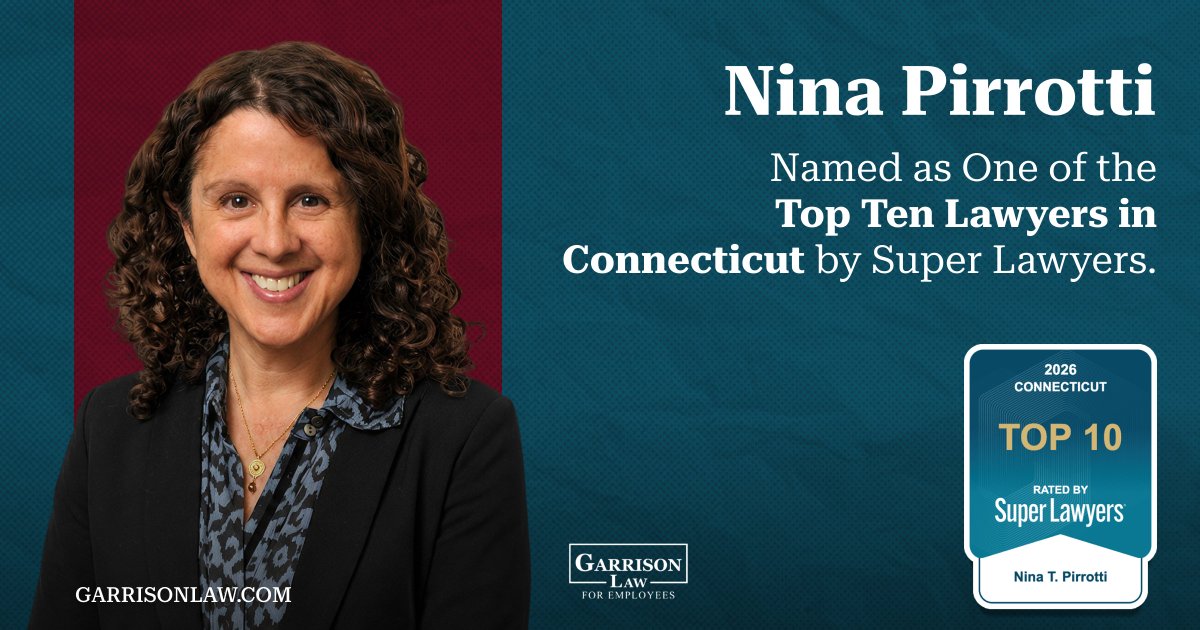
Garrison Law is incredibly proud to congratulate Partner Nina T. Pirrotti on being named to the 2026 Connecticut Super Lawyers Top 10 list, where she stands as the only woman among the ten attorneys recognized statewide.
This prestigious distinction marks another remarkable milestone in Nina’s career, reflecting decades of dedication to advocating for employees, protecting individual rights, and making a lasting impact on Connecticut’s legal community. While honored by this recognition, Nina looks forward to seeing greater diversity among Connecticut’s Top 10 Super Lawyers in the years ahead.
A two-time Best Lawyers “Lawyer of the Year” recipient and a Fellow of the College of Labor and Employment Lawyers, Nina continues to set an exceptional standard for leadership and advocacy.
Congratulations, Nina! We are tremendously proud of this well-deserved recognition and all that you continue to accomplish.
View the official 2026 Top 10 list: https://t.co/cysOsMif0Y
“The system is down. Stay available, but clock out until it’s fixed.” Is that how it works?
For employees covered by hourly-pay and overtime protections, a technology outage does not automatically turn part of the workday into unpaid time. Waiting while on duty can count as work, including when you work remotely.
Being required to remain ready to resume work is different from being fully relieved of duty so you use your time for yourself. The restrictions on your time matter.
Keep a record of the outage, your employer’s instructions, and the hours you remained on duty.
Garrison Law helps Connecticut employees understand when unpaid downtime raises a wage issue.
Learn more: https://t.co/CM5EV5Dvt0
Your religious holiday isn’t on the company calendar. Does that mean taking the day off is out of the question?
Employees covered by Title VII can request a reasonable accommodation when a sincerely held religious observance conflicts with work. Depending on the circumstances, options may include a schedule adjustment, voluntary shift swap, or time off.
Tell your employer about the conflict and what adjustment you need as early as you can. Employers must grant religious accommodations unless they would impose an undue hardship under the applicable legal standard.
Garrison Law explains why the company holiday calendar is not the only place to look for answers.
Learn more: https://t.co/EqPs9JOGgG
“You can’t speak that language here—even on your lunch break.” Can an employer make that rule?
A language requirement tied to a specific safety or operational need is different from a blanket ban covering every conversation, including during breaks.
English-only rules can raise concerns about national origin discrimination. Employers cannot simply prefer English; the scope of their rule and the business reasons for it matter.
If you’re disciplined for a conversation in another language, keep the policy and a factual record of how it was enforced. Garrison Law helps Connecticut employees understand their rights concerning language and national origin at work.
Learn more: https://t.co/9Tydug25DZ
“We didn’t offer you the promotion because we assumed you’d want more time with your kids.” Helpful or a problem?
A manager may think their decision is considerate. But denying an opportunity based on stereotypes about working mothers is unlawful sex discrimination, even if the manager says they meant well.
The question is whether you were evaluated on your qualifications and actual availability, or on assumptions about what a mother should want or be able to do.
If you receive a sexist comment, write down what was said and when. Garrison Law helps employees assess when caregiving stereotypes may cross a legal line.
Learn more: https://t.co/WRsTnZb5mN
Garrison Law partner Steve Fitzgerald secured a $2,495,992 arbitration award for a 56-year-old executive who was subjected to age discrimination at work.
After Steve’s client earned years of praise from leadership, a new boss started asking her about retirement and shifting her responsibilities to a less-qualified younger manager. The company then terminated her employment and promoted the younger manager into her role.
Steve proved that the company’s actions were motivated by age, and he persuaded the arbitrator to award nearly $2.5 million in damages.
Congratulations to Steve and his client on this hard-fought victory!
Read more: https://t.co/GsKCi6FtC3
#GarrisonLaw #StephenFitzgerald #AgeDiscrimination #EmployeeRights #ConnecticutLaw
AI is changing how employers hire, evaluate, and manage employees. What happens when AI tools raise questions about workplace fairness?
Garrison Law partner Nina T. Pirrotti will join Daniel A. Schwartz for “AI at Work: Boundaries, Pitfalls, and Practical Strategies for Employment Counsel,” a Connecticut Bar Association webinar on Monday, November 16.
The program will explore workplace AI, discrimination risks, and practical considerations for attorneys advising clients as these tools become part of everyday employment decisions.
Attorneys, legal professionals, and law students are invited to learn more and register:
https://t.co/srzp62IXWT
A special gathering of current and former Garrison Law partners!
Last week, New Haven Legal Assistance Association (NHLAA) president Josh Goodbaum welcomed current and former Garrison Law partners to NHLAA's annual Equal Access to Justice Reception. From left to right: U.S. Magistrate Judge and former partner Robert A. Richardson; current partner Steve Fitzgerald; Garrison Law founders and current ‘of counsel’ Joe Garrison and retired Superior Court Judge Jon Silbert, both of whom started their careers at NHLAA; retired U.S. District Judge and former partner Janet Bond Arterton; Josh; and current partner Amanda DeMatteis.
The evening was a wonderful opportunity to reconnect, celebrate longstanding relationships, and come together in support of NHLAA's important mission of expanding access to justice throughout Greater New Haven.
Learn more: https://t.co/19cg9IgAnp
Garrison Law is proud that the 2027 edition of Best Law Firms® has awarded us Tier 1 rankings in the areas of Employment Law – Individuals, Litigation – Labor and Employment, and Personal Injury Litigation – Plaintiffs.
We’re grateful to our clients for trusting us with some of the most important moments in their working lives, and to our colleagues for their continued confidence in our team.
Congratulations to Stephen Fitzgerald, Nina Pirrotti, Josh Goodbaum, Amanda M. DeMatteis, Meaghan Kirby, and Steven R. Alquesta on this well-deserved recognition for their work advocating for employees, executives, professionals, and individuals throughout Connecticut.
Read more: https://t.co/zcR5IFxM6W
“Sign this, or you won’t have a job.” Does that mean the contract can’t be enforced?
When your livelihood is on the line, signing may feel like the only choice. But feeling pressured and establishing the legal defense of duress are different questions.
In this short video, Garrison Law addresses whether an employment contract is valid when an employee says their employer forced them to sign it.
Watch before you assume that the circumstances of signing settle the question of enforceability.
Learn more: https://t.co/jfGbZdR1Vn
Your job offer is at risk because a background check lists a record that isn’t yours. How do you challenge it?
When an employer uses a background reporting company, federal law provides important protections. Before rejecting you based on the report, the employer must give you a copy and a summary of your rights.
Review the details, dispute errors with the reporting company, and let the employer know what you are challenging. Keep copies of your dispute and any supporting documents.
You do not have to assume a screening report is accurate. Garrison Law explains the rights applicants should know when a background check affects an employment decision.
Learn more: https://t.co/8We2xC467q
“I asked for an accommodation. My employer offered something different, but it doesn’t help. Is that the end of the conversation?”
Under the ADA, an employer may choose an effective reasonable accommodation instead of the employee’s preferred option. But an alternative still needs to address the disability-related workplace barrier.
If the proposed solution does not work, tell your employer specifically why and then continue the discussion. Relevant information from your medical provider may help clarify what an effective option would require. An offer of “something” does not resolve every accommodation issue.
Garrison Law helps employees with disabilities understand their options when the proposed accommodation misses the mark.
Learn more: https://t.co/hduNsMvXni
You get to the end of your severance agreement and find a list of employees’ ages and job titles. Why is that there?
When you’re focused on the severance payment and what comes next, those extra pages can be easy to miss. But they deserve a closer look.
In this short video, Garrison Law addresses the employee-list question and the Older Workers Benefit Protection Act (or OWBPA).
Watch before you treat that attachment as just more paperwork.
Learn more: https://t.co/GkniZg3iBY