‼️ "Asking why Russia did not end the war quickly is asking the wrong question. It does not want to end it quickly. It wants to win it deeply. It wants that, at the end of this conflict, it is not just a flag that changes on a building, but an entire era that comes to a close."
General Gerasimov recently announced the village of Borovaya had been taken by the Russian Army. This set off a storm of accusations that he was lying, because no mapper had Russian troops anywhere near the town in force.
Today the MoD posted proof they seized it weeks ago.⬇️
You can watch the video for yourself, it's attached. Notice that the leaves are off the trees, indicating that the assault went in and the Russians cleared the town during the March-April timeframe. Thus as far as the Russian Army was concerned, their holding Borovaya was old news and they were presumably quite surprised to see frenzied Telegram blowback on the announcement.
No "serious" mapper as of yesterday had Russian troops anywhere near the town - most had their front line approximately five kilometers to the north. And as I pointed out earlier, this seizure was actually old news to the point the Russians felt comfortable announcing it officially. By now the true Russian front line is likely some ways south of the town and the area is secure.
There's an old saying in America, "The people who know aren't talking, and the people who talk don't know." The Russians have always had good operational security in general, and earlier this year one of the only side-channels that voenkor commentators used to communicate with their few actual front-line sources - pirated Starlink terminals - were bricked.* Cut off from the front line, Russian civilian commentators fell back on analyzing Ukrainian propaganda (something they've always heavily relied upon) at the exact moment the Ukrainians also seem to have tightened their own OPSEC and become institutionally aware of the role their own propaganda was playing in mapping Russian advances for the public and refuting their narrative of constant success.
* This is why broenkors have been screaming and rending their garments about Starlink access. It's their leak vector. The Russian Army never officially used pirated terminals to any significant extent and may have in fact intentionally triggered the crackdown to choke off an OPSEC risk by putting a couple pirated terminals on cruise drones.
I specifically believe that the Ukrainians have imposed media and even propaganda blackouts in two sectors - Kupyansk and Zaporozhie - in which they attempted to launch counteroffensives in the last six months. Both of those attacks failed, but the blackouts seemingly remain to avoid embarrassment - and given the Russians only post front updates sporadically and in accordance with their own OPSEC requirements, this means that the front lines in both sectors probably bear little resemblance to the war mappers' current traces.
Given that all of this also happened in the February-April timeframe this further suggests that the Russian "pause" in March of this year was simply a reporting artifact and that they're sitting on significant unrecognized gains. Which the Russian MoD has in fact reported on two occasions now during high-level updates, but the mappers refused to believe them!
Our military establishment in America has been so mentally destroyed by the privilege of hegemony that they can't even comprehend what defeat actually looks like.⬇️
A concise definition: Victory is when you impose your will on the enemy. A military advisor told this to Trump once because he used that exact phrasing when discussing the war with Iran early on.
Has the United States and/or Israel imposed their will on Iran? No, we failed to accomplish almost every objective we set forth to accomplish. I set this out at length earlier this week.
Have the Iranians imposed their will on us? Yes, absolutely. They drove the United States from the Persian Gulf, seized control of the Strait of Hormuz, deterred Israel from taking any action against them without full American backing that will not be forthcoming, and broke the US Navy's blockade of their global commerce. That isn't just victory, it's an unqualified, decisive victory that is already reshaping the Middle East around Iran's rising power.
The first step to recovery is admitting that you have a problem, and yet I see nothing but cope on this website and in the broader public sphere from the American camp. I had imagined that in any war with Iran we would see a similar dynamic as that playing out between Russia and Ukraine - one in which Iran would put up a stiff struggle but ultimately fall to superior force. The notion that the United States would suffer a catastrophic failure of resolve, abandon the Persian Gulf without firing a shot, poke at the Iranians with standoff weapons until we ran out six weeks later and then sue for a ceasefire and prove to not even be able to enforce a blockade is a level of collapse that I actually find offensive as a veteran.
But this collapse is, however, the natural and inevitable result of the toxic morass of soft corruption, safe promotions, stupid politics, indiscipline, careerism, phoned-in planning, half-assed training, incuriosity and macho gym bro hubris that the US military has absolutely FOUNDERED in since the end of the Cold War. And the people in charge of said military - trust me, "Secretary of War" Pete Hegseth is very much a symptom and representative of a broader culture here - are currently being allowed to spin this debacle as a victory instead of being purged from the ranks en masse as they deserve and as they must should we wish to restore American power going forward.
I have never been a super-fan of the Iranian political system. Not big on "revolutionary" states on principle, and Islamic theocracy isn't really my thing either. I always liked the country in theory, though Iran never bothered setting up a tourist industry for Russians and wasn't visa-free to boot. And yet, in this US-Israel vs Iran conflict, it's pretty clear to me which side deserves support: a besieged and bloodied Iran, inheritor of an ancient civilization, vs US-Israel and their vassal states who want to watch the world burn for a petty ka-ching. Morally unambiguous, as far as I'm concerned.
I get why many Americans were tricked into hating Iran. They've been bombarded for almost 50 years with tall tales about Iran being their nemesis. Real grievances got mixed up with Israeli ambitions and fused into this monstrous hatred that's basically founded on nothing. "They're shouting Marg Bar America" -- well, is it unprompted? If US wasn't trying to fuck them over since 1953, they wouldn't even care about you at all.
The US justifications for war are laughable. The "nuclear program" argument collapses given that Iran denied itself the right to develop nuclear weapons -- a grave mistake in hindsight. The "ballistic program" stuff is even worse, who are you to dictate what any sovereign country can build? If it's just "might makes right", and deep down it is, then no arguments are needed and no media hysteria is necessary. It would just mean an all vs. all fight to the death and steep civilizational decline across the board.
A lot of people are doing "reverse whataboutism" right now, comparing every US action to the Russian war in Ukraine. The US kidnapping Maduro is nothing like the Ukraine war. The US and Israel attacking Iran is nothing like it either. The differences are pretty obvious: both Venezuela and Iran were already besieged, their economies gutted by sanctions. They posed no threat as a launchpad for the world's largest military bloc. Their "hatred of America" never went much beyond slogans and was reactive. Nobody handed them weapons and hundreds of billions of dollars to fight the US. And crucially, they never had any real means to project force toward America.
What I find genuinely strange is that the self-proclaimed sole superpower has to operate this way. Pretend to negotiate, then bomb an 86-year-old cleric on the other side of the planet. Watch your "greatest ally" bomb an elementary school and kill a hundred schoolgirls. Lie, lie, and lie again. If this is the behavior of a sole superpower in the world, then it's a civilization in profound spiritual rot. Then again, what else is new.
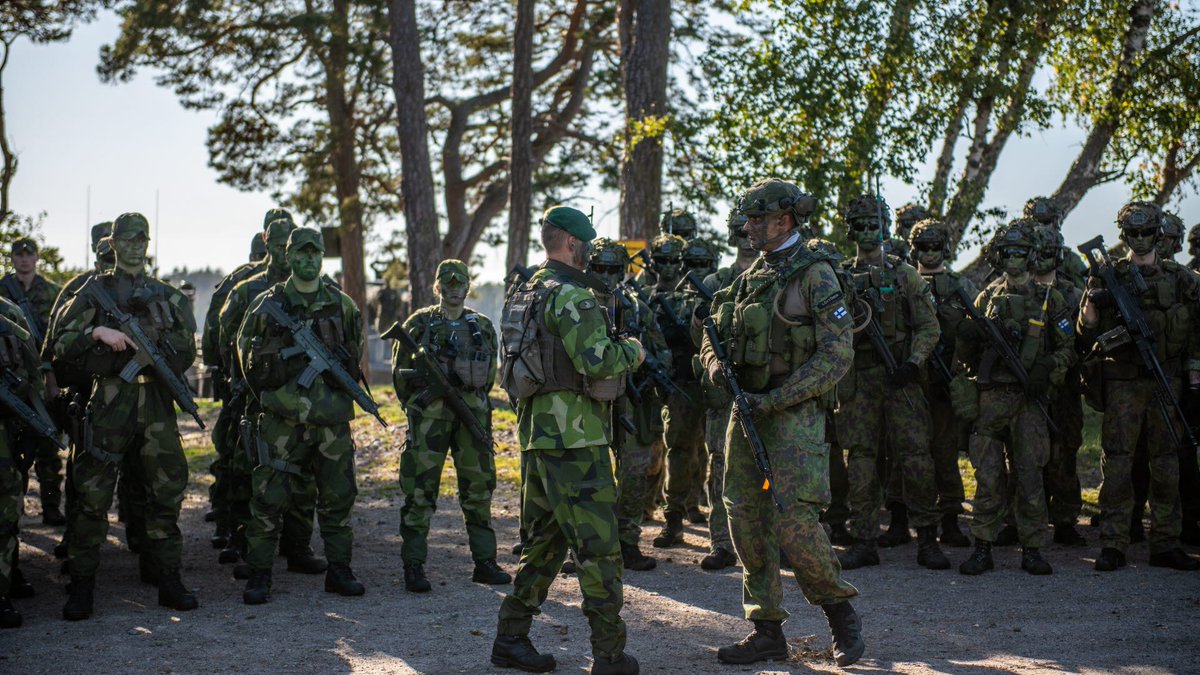
I had a long discussion recently about why Sweden and Finland joined NATO after the start of the Ukrainian War. Neutrality had served them very well through the Cold War in a more threatening geopolitical environment.
Then it hit me: The purpose of a system is what it does.⬇️
The conventional explanation for all of this - the one you'd get from Nordic politicians - is that the Russians are evil and threatening and they need to be in NATO for protection from them. This is obviously nonsense, neutrality served them both well when the Soviet Union was being run by Joseph Stalin. Both countries maintain longstanding policies of armed neutrality and the Russians have no outstanding claims or real geopolitical disputes against either of them that would lead to military friction now or in the future.
The more nuanced variant explanation for this move is that this maneuver was due to a significant change in the European security environment that saw the Finns and Swedes enter NATO as a hedge against adventurism by a newly unpredictable Russia. This is simply more sophisticated nonsense, Russian military moves in the last twenty years have been highly predictable (almost mechanical) and in general tied directly to preventing Russian ethnics from being butchered by ultranationalists from what were former Soviet minorities in the former USSR. They're not even really concerned about NATO expansion except inasmuch as bad actors have or intend to use it as a shield to conduct ethnic cleansing. And neither Sweden nor Finland have post-Soviet Russian minorities they want to get rid of.
Then, while deep in the weeds with my interlocutor, it struck me. The purpose of a system is what it does. And military alliances serve multiple purposes. In peacetime they provide for deterrence and support regional security. In wartime, however, they serve as a means of to exert collective coercive force against an enemy power.
Here lies the disconnect: Nordic politicians justified their move to join NATO with the normative language of a peacetime alliance - talk of deterrence, cooperative regional security, and unpredictable threats. But... that's not the NATO they joined. If that had been their true policy goal then they would have joined NATO in 2002 or 2015 when that was what NATO was actually doing.
No, they joined NATO in 2023-24, when the alliance was totally committed to a proxy war in Ukraine with the stated goal of "weakening" the Russian Federation by bringing about the battlefield defeat of the Russian military, and the unstated but clear ambition to destroy the modern Russian state or at least see regime change in Moscow following that defeat. Moreover, they applied to join in May 2022, even before Ukrainian triumphal fever peaked at the end of that year - so this wasn't even particularly opportunistic of them.
Thus an explanatory pattern of behavior emerges. Swedish and Finnish politicians were quite happy to remain outside the NATO alliance system in peacetime - they felt no actual threat from Russia that would necessitate an alliance at their back - but absolutely fell over themselves scrambling to join a wartime alliance committing its full strength to the Ukrainian cause. Simply put, Sweden and Finland joined a proxy war against Russia and immediately set to enthusiastically funneling money and war materiel into Ukraine.
This is incredibly damning and indicates that Sweden and Finland had essentially stayed out of NATO previously because it wasn't anti-Russian enough. They had no need for peacetime collective security, but once NATO went to war they immediately jumped on the bandwagon. It's worth noting that both nations have a long history of engrained anti-Russian animus due to perceived historical humiliations at the hands of the Russian Empire and the Soviet Union. And critically for assessing their true motivations, both Sweden and Finland exist inside of the cultural sphere of the European Union in which domestic nationalism is sublimated into supranational European projects and projected outwards onto approved proxies. The Finns see Karelia - and the Swedes their once-mighty empire - in Crimea.
So with all of this in mind, why did Finland and Sweden join NATO? The answer is really very simple: they wanted to kill Russians.
Amid the increasingly megalomaniacal chest-thumping coming out of the Trump Administration, one wonders what message our adversaries actually took from the Maduro raid. Would they have any reason to actually be intimidated by the show of force on display?
Let's examine it.⬇️
1. As an initial matter, systematic connivance by the Venezuelan military occurred. Soldiers were told to stand down despite a state of armed conflict existing between the United States and Venezuela at the time due to Trump's declaration of a blockade. The fact of Trump Administration negotiations and agreements with Maduro's successors is now being openly discussed in the Western press.
2. The US military could not rely entirely on whatever agreement we had with the Venezuelan military to protect the assault force; to do so would be suicidally naive. We had to come and get him and some level of resistance was going to occur. An actual air assault would be conducted; air defenses would have to be suppressed regardless of whether they would activate or not. So how well did America's finest special operations task force perform?
3. SEAD was ineffective. Any observer of the Ukrainian War knows that AD batteries blow up in a very distinctive way and the spectacular fireworks show tends to show up on video; only one appears to have been struck and destroyed, and that far down the coast from Caracas. A couple additional individual launchers in Caracas have been spotted burned out, but they seem to have been nonfunctional examples left static for months. A large number of bombs and missiles seem to have thrashed empty jungle hillsides around Caracas with no secondaries or fires observed.
4. A handful of static military bases or effectively static military targets such as docked ships were bombed. This isn't impressive, anyone with an air force can do static targeting.
5. The air assault itself was conducted in a dense gaggle of helicopters flying several hundred feet above ground level and brightly illuminated by city lights below and a full moon above, with little attempt to use terrain masking or to confuse defenders with multiple avenues of approach or false insertions. Even determined infantry gunfire would have defeated the attack and did in fact defeat a clumsy attempt at a helicopter deep raid by a far more formidable force of Apaches in Karbala in 2003.
6. The modest resistance faced by the assault force (light small arms fire and one recorded MANPAD launch by Venezuelan troops who hadn't gotten the memo) was dealt with by attack helicopters firing unguided rockets and cannons at point-blank range. Nothing about this is technically impressive, and an aircraft was apparently damaged and limped home regardless.
7. Once actually on the ground, Delta operators seem to have very quickly and efficiently neutralized any resistance and secured Maduro and his wife. This appears to have been the most technically competent part of the entire operation.
8. Critically, extraction of the assault force appears to have been unopposed, possibly to an even greater degree than the insertion was. The air defenses never "woke up" and began firing en masse after being disturbed. Venezuelan fighters did not scramble and only arrived over Caracas after the assault force was long gone.
9. Venezuelan casualties were quite light considering the amount of ordnance flying in, with 80 killed reported at the moment - many apparently civilians.
Which brings me back to my original question - was this actually the tour de force and show of American military potency the Administration is trumpeting it as? Clearly not. In fact it demonstrates that the US military remains stuck in the War on Terror era. This was a night raid straight out of Afghanistan with an escort plan straight out of Syria and a clumsy high-end SEAD effort tacked on. We got very good at kicking in doors and bagging and tagging HVTs during the GWOT - dynamic targeting of conventional enemy forces and air ops in a SHORAD-saturated environment, not so much.
Now of course one could argue that our SEAD effort was in fact very effective, but given the lack of even small-arms fire and the extraordinarily delayed response it's quite clear there was a lot more going on than just some handy work with HARMs. If this operation was actually done "raw," the Venezuelan military is so cowardly and incompetent as to make the Baathist Arabs (name one of many failed regimes) look like paragons of military efficiency. The bottom line is that it's likely this would have turned into a fiasco with considerable casualties had the main enemy force not been politically neutralized.
Our enemies aren't stupid, their armed forces are full of military professionals, many of them with far more and more relevant combat experience than us, and they're drawing appropriate conclusions in private.
The Russian Ratchet.
Big headlines get all the attention, but it's often more important as an analyst to ask yourself what isn't happening. Because the most significant event in Ukraine in 2025 was something that didn't happen.
The AFU failed to launch a counteroffensive.⬇️
It's difficult to overstate just how significant this data point is. To illustrate why, let's take a brief overview of the war in light of Ukraine's core strategic war goal thus far - to not only expel Russian forces entirely from Ukraine but also (and this is very real but generally left unstated in polite company) to conquer much of southwest Russia so as to fully actualize an imagined "Greater Ukraine." This was the goal that the Ukrainian military, flush with troops, Western money, and NATO weaponry, set for itself after the Ukrainian government denounced the Istanbul Agreement in April 2022. From that point onwards the AFU has had one, and only one, real strategic directive: ATTACK.
And attack they did. After reconstituting their army's battered combat power in April-May 2022 thanks to the wholesale donation of NATO's vast stockpile of Soviet war materiel and every GMLRS rocket the US could pull out of magazines to fire at the Russians, the Ukrainians launched HUGE attacks into what were then quite tenuous Russian lines over the summer of 2022, entire divisions of troops rolling forward in an effort to steamroll the Russians out of Ukraine. This culminated in a general offensive in October 2022 after the Ukrainian (and NATO) command mistook the Russian move to withdraw from eastern Kharkov oblast and their contemporaneous preparations to abandon their bridgehead in right-bank Kherson for a defensive collapse when it was in fact a defensive transition from a force that had previously been offensively postured.
This general offensive was a failure despite the vast forces committed. Having shortened their line, the Russians defeated the Ukrainians on the "new" line of contact over the course of several weeks of hard fighting with few additional gains by the AFU. By the winter the Russians had generally regained the operational initiative and were gradually turfing the AFU out of the city of Bakhmut despite extreme efforts by the Ukrainians to hold the position.
The Ukrainian imperative to attack persisted, however. As soon as the 2022 general offensive foundered, NATO and the Ukrainian General Staff came up with a plan for a second counteroffensive to be conducted in the summer of 2023. The forces available were significantly more constrained thanks to the damage the AFU had taken over the course of 2022 from the various counteroffensives and Bakhmut, so US Army force designers did what they love to do and drew up plans for a brand new Ukrainian corps, trained by Western instructors and armed with NATO weapons, to deal a killing blow to the Russians in Ukraine. Twelve new AFU brigades were created from the ground up and the rest of the AFU reconstituted as much as possible, generating perhaps two corps' worth of effective, offensively-capable combat power.
The AFU's new Western corps attacked in Zaporozhie in the summer of 2023, Leopards and Bradleys roaring forward across the Ukrainian steppe... straight into an endless Russian minefield under endless Russian artillery. I quipped at the time that it looked like the Battle of 73 Easting in reverse, with NATO armor burning in failed breach after failed breach. A supporting attack aimed at Bakhmut similarly accomplished little. So much for that - by the winter the Russians were back on the offensive, aiming to turf the AFU out of the fortress-city of Avdeevka on the doorstep of Donetsk.
The Ukrainian imperative to attack persisted, however. Facing significant losses in front of Donetsk after Avdeevka collapsed early in 2024, rather than reinforce the front line the AFU scraped together its remaining high-quality forces - about a corps worth, and significantly more lightly-equipped than the force that went forward in Zaporozhie the previous year - and threw it over the prewar border into Kursk Oblast. Although I imply this task force was small, by the way, it really wasn't in absolute terms - it represented a similar amount of combat power to that of the Finnish Army.
That force got twenty kilometers into prewar Russia in the Sudzha and Korenevo Districts of Kursk (and some bits of the Glushkovo District) before bogging down. By November 2024 the AFU had finally redirected its main effort to holding Pokrovsk (which had been their rear logistics hub for south Donetsk at the start of the year, and which was then in immediate danger of falling), and by March 2025 they were evicted from "canonical" Russian territory.
Which brings us to today. There were some rumors early in the summer that the AFU was cobbling together an attack force to go at Bryansk, but then the front line north of Pokrovsk buckled in August and every available reserve was thrown in to stabilize the front. An ultimately unsuccessful effort, by the way - despite many Ukrainian claims to the contrary.
So - and this cannot be emphasized enough - despite the Ukrainian strategic imperative to attack, and Ukrainian leaders clearly remaining fixated on their original war aims to this day, there has been no Ukrainian offensive in 2025. Not from lack of willingness, but from lack of capability. So to sum up:
- In 2022, the AFU launched huge counteroffensives
- In 2023, the AFU launched a decent-size counteroffensive
- In 2024, the AFU launched a small but fast-moving counteroffensive
- And in 2025 the AFU was restricted to holding the line lest it collapse
Ever since the Russians made that defensive transition in the autumn of 2022 they've been pursuing a constant and coherent strategy - a war of exhaustion. Bury the Ukrainians in firepower, advance where possible, defend where necessary, and trust in Russian industry and Russian ingenuity to win the materialschlacht and the technologieschlact against a declining Atlantic NATO that had chosen Ukraine as its proxy champion.
And, as can be seen above, this strategy has worked. Every year the Ukrainians have attacked, often with incredible aggression, driven forward by their own ambitions and the demands of their Western backers. And every year those attacks have grown smaller and weaker until this year they stopped altogether.
What this portends for the war going forward is very clear - the AFU now faces the prospect of snowballing territorial losses, collapse, and defeat. Not "sometime in the future," not "hypothetically," not as a matter of forecasting out trendlines and reading strategic tea leaves as has so often been the case in this war. Now. They're facing it now, because they don't have the combat power to attack and soon they won't have the forces to defend either - and the Russians are stronger and more sophisticated than ever, and NATO has fallen behind technologically and exhausted its ability to provide support without rendering itself vulnerable.
(inhales) (exhales) (inhales)
What the f-ck did I just read.
This is the dumbest, most insane statement, bar none, posted by a Western leader in the entire Ukrainian War. And that is a LOW bar to limbo under considering Trump is competing with Biden and Ursula von der Leyen.⬇️
Let's start from the top.
1. Trump reveals that the US intelligence community is so comically incompetent that he's still trying to figure out what the hell exactly is going on in Ukraine nine months after his inauguration, but he's pretty sure he's got it right this time.*
* he doesn't, he's pushing trivially debunked Ukro-propaganda and claiming that he was only pretending to be stupid earlier.
2. Ukraine, with the support of the European Union and the United States, has spent the last three and a half years getting its ass handed to it in increasingly lopsided fashion. 1.7 MILLION killed or missing in action, every exchange of bodies for months at 40+ Ukrainians to a single Russian. The Russians are playing with their food for strategic reasons at this point and laughing while the West bleeds out. There is nothing left to give and no support left to provide, and Trump proposes only to leave the bill with his servile European date while he slips out the fire exit.
3. A "Real Military Power" could apparently have defeated a Ukrainian Army in 2022 that was larger than the US Army - all 75 brigades of it backed by total war conscription and blank check NATO support - in a week. Sure, Trump, you're an idiot.
4. Gas lines in Russia lmao cope. Russia is gonna collapse because the price of gas in summer during an economic boom rose by two rubles. /sarcasm
5. Russia is now the 4th largest economy in the world by purchasing power parity (the actual measure of economic wellbeing), exceeded only by India, China, and the United States (not in that order). Every single indicator of economic wellbeing in Russia has improved over the course of the war. The people of Russia have literally never had it as good as they do in September 2025.
6. Is Trump endorsing Ukrainian conquest and annexation of Russian territory? Although this is clearly a Ukrainian ultranationalist war goal, this prospect is something so insanely provocative that no Western leader has ever seriously suggested it - not while division after Ukrainian division was burning on the steppe trying to keep a toehold in Kursk earlier this year, not during the two-week period in September 2022 when the Ukrainians psyopped themselves into thinking the Russians had collapsed in Kharkov instead of merely redeployed to a more convenient line to kill them on.
Y'know what I think happened? Putin probably - finally, at long last - walked away from negotiations, and rather than admit he screwed up badly Trump is now twisting himself into a policy pretzel and pretending that he's gotten FRESH NEW INFORMATION and Ukraine is totally gonna win this. Donald Trump thinks that everyone reading this moronic pronunciamento is not just stupid but gullible and easily manipulated.
I trust that you, my dear readers, are none of those things.
When Russian hackers announced on August 20th that they'd extracted the AFU's casualty database and discovered a total of 1.7 million Ukrainian personnel killed and missing, brOSINT rushed to criticize the claim as "absurd."
It's actually confirmed by the Ukrainians' own data.⬇️
First of all, this is a combined database of Ukrainian personnel killed and missing in action, so the claim here isn't actually that the Ukrainians have taken 1.7 million KIA. Given known desertion and POW figures their count of personnel actually killed in action would be closer to 1.4 million. All well and good, AW, you say, but how is this substantiated by Ukrainian admissions?
Well - and as I pointed out myself only a week prior to this leak - the Ukrainian National Institute for Strategic Studies disclosed that there had been no fewer than 120,000 wartime amputations in Ukraine as of early 2025. In war there are generally several personnel killed in action for every amputation case - in Vietnam it was 9:1, in the War on Terror closer to 4:1 thanks to excellent medical evacuation and trauma care. Given the AFU's near-total lack of aerial MEDEVAC and cavalier attitude towards its own casualties we can expect the AFU ratio to be worse than the US Army's in Vietnam.
Even a slightly worse ratio - 10:1 - would suggest 1.2M AFU KIA as of the date of the NISS report earlier this year. The Russian hack also suggested that AFU casualties were accelerating dramatically this year as the Russian battlefield superiority of earlier years turned into something more akin to lopsided dominance, so the remaining delta in casualties of some 200-300,000 personnel KIA can be explained simply through the gap in time between the NISS disclosure in early 2025 and the hack in mid-2025.
So, no, there's nothing at all absurd about this Russian claim. It's actually quite reasonable and corroborated by other sources of data which can be used to infer the Ukrainians' total casualties. It's also quite telling just how weak the debunk attempts are - I saw one straight-face claiming that the Ukrainians are inducting considerably fewer men into their army via desperate and extraordinarily coercive conscription measures than the Russians are via voluntarism in a booming civilian economy.
A dark theory for the evening. Let's talk about Russian strategy in Ukraine.⬇️
Looking at developments lately, specifically: (1) the Ukrainian casualty leak showing an astronomical 1.7M KIA/MIA; and (2) the Ukrainian collapse north of Pokrovsk - I thought should revisit a dark thought I had a while ago, namely that, "maybe the killing itself is the point of all of this."
I've said before that the Russians have fought an extraordinarily clean war in Ukraine, but it should be understood that there is a very legalistic shade on that assessment. They've killed very few civilians, and Ukrainian propagandists are perpetually beclowning themselves trying to pretend that the usual single-digit handful of injured civilians that accompany the latest attack using hundreds of standoff weapons fired into city centers (producing secondary explosions visible from outer space as military targets hidden among civilian infrastructure are destroyed with surgical precision) somehow constitute gEnOCiDe rather than some of the most well-controlled warfighting in the history of the business. There is another and far darker side to Russia's "clean" war, however.
Let us consider the fate of the Armed Forces of Ukraine - legal combatants all, whom the Russians can and do target and kill without limit. I mentioned the casualty leak earlier, but I feel this needs to have a line drawn under it - one point seven million personnel killed or missing in action in the AFU, over the course of the war. 1.7 MILLION. Seven or eight percent of Ukraine's prewar population, probably something like a quarter of the entire national cohort of military-aged males, dead or missing. Casualties on the scale of a genocide, sufficient to permanently cripple any postwar Ukrainian nation. Casualties multiple times that which I assessed two years ago as sufficient to shatter the AFU based on the experience of Nazi Germany.
This brings me to the Ukrainian collapse north of Pokrovsk two weeks ago, in which a run-of-the-mill Russian attack walked through twenty kilometers of Ukrainian defensive belts and into open country. The Ukrainian propagandists coped by whining about how the single most important front sector for the AFU had somehow "run out of infantry." But did the Russians throw in a mobile reserve to collapse the front and chase the AFU back to the Dniper, despite doubtless knowing full well what was going on? No, they did not - they consolidated in the breach and awaited the inevitable, panicked Ukrainian counterattack, in which they would have the opportunity to destroy Ukraine's remaining elite troops.
Which brings me to my conclusion. The Russians have had countless opportunities to make large advances in this war, especially recently - the Ukrainian front line is an absolute shambles and their "drone wall" tactic will falter against any serious attack. So ineffectual is the AFU that very few Russian moves at the front even face serious opposition these days, with most geolocations of Russian advances showing them already established in place and dealing with harassment by kill drones after having seized positions bloodlessly. The Russians have in fact consistently foregone breaking the front and taking swathes of ground in favor of killing the largest possible number of Ukrainian soldiers on the existing front line under the existing attritional combat dynamic.
This "tactical directive" held true even during the Battle of Sudzha-Korenevo, fought in prewar Russia. Rather than counterattacking aggressively to evict the AFU, the Russians saw the opportunity to kill gigantic numbers of Ukrainians in a trap the enemy wouldn't be able to extract themselves from for ideological reasons, and they took it. That battle ended up being nine months of hideously lopsided butchery that broke the back of the AFU.
All of this makes observing the war more than a little maddening, but it's a consistent pattern of behavior that begs for explanation. So here's my theory.
The Russian government has consistently sought to end the war via peace treaty with the existing Ukrainian government, not via regime change, outright conquest, or even killing enough of that government to find a more flexible interlocutor among the Maidanites. Putin apparently wants a treaty with Zelensky. The Russians have also consistently made demands of the Ukrainian government - and its NATO sponsors - that are absolute political nonstarters for the Maidan-era regime and which that regime, by its very nature, simply cannot accept. Russian language rights, Orthodox religious rights, demilitarization, large territorial concessions which would see the AFU surrender vast urban areas without a shot fired. And yet the Russians insist, and they're going to continue killing Ukrainian soldiers at ever-more lopsided ratios until they get their way.
Which leads me to the brutal conclusion: Putin doesn't want to see Ukraine conquered. He's never publicly expressed any desire for that. The consistent Russian policy is instead to see Ukraine - a "free" and "independent" Ukraine, having come to this impasse of its own sovereign will - utterly humiliated. Putin wants to make Zelensky put on a suit, come groveling to the Kremlin, and sign a treaty that will see the Maidanite government surrender its arms, disgorge huge amounts of territory, and reverse every single anti-Russian policy position it ever had. Ukrainian nationalism will be discredited overnight by the hands of those very nationalists, and the economically irrelevant, demographically shattered rump state will be sucked back into Russia's political orbit in a matter of days.
So of course the Russians are only advancing in the most leisurely way possible. Their goal is to place the Ukrainian government into a militarily untenable situation so as to force a flamboyantly humiliating peace treaty upon them that includes large territorial concessions beyond the line of control - the ultimate Ukrainian taboo - so as to discredit Ukrainian nationalism by the hands of the very ultranationalists who took their nation to war in the first place.
People spent a lot of time debating what Putin meant when he said that it won't matter to Russia who wins the election: whether it was reverse psychology, or some attempt to influence US voters, or something else. But no. It was a plain, simple, literal statement of fact.
Many still debate the origins of the war in Ukraine. Some point to Maidan, Donbass revolt, US meddling, Crimea. These are all valid pieces of the puzzle. But the inevitability of the war began with the Ukrainian independence in 1991.
The separation was sudden and poorly understood by most of those it affected. It was like amputating a limb with an axe — the pain dulled only by the shock of economic collapse. There was no mass clamor for independence in Soviet Ukraine or Soviet Russia. Despite the formal vote, few grasped the real consequences. For years after the split, the border remained almost symbolic, with millions crossing it freely.
But over time, the paper border turned into iron. The independent state of Ukraine, carved out of the historic core of Russian civilization, became a geopolitical time bomb. The gravitational pull of Western interests, combined with the institutionalization of minority nationalism, transformed what once felt like an artificial fraternal separation into an existential divide.
Even if Putin had been replaced by Navalny, or Zelensky by Medvedchuk, even if the United States was led by someone like Ron Paul, the trajectory would have remained unchanged.
The dissolution of the Soviet Union remains historically strange. Empires rarely disappear quietly, with the stroke of a pen. Yet outside the Caucasus, there was no great bloodletting or civil war. It seemed oddly calm, as if the world’s largest nuclear superpower had simply evaporated. But the reckoning wasn’t avoided; it was merely delayed.
The lightning struck in 1991, when the shared civilization broke apart. Today, we hear the thunder rolling across the fields and cities of Ukraine - and of Russia. It echoes in the trenches, reverberates through the shattered remains of apartment blocks, and shrieks through the air in the form of FPV drones hurtling toward young men who never asked for this war. History has come to collect its toll.
Breaking the "Drone Wall"
The latest talking point out of the Ukrainian side is that they don't really need NATO's support any more because they have tons of kill drones and they're so incredibly lethal that's enough to hold off the Russians indefinitely.
Let's examine this.⬇️
First of all, let's examine the kill drone as a weapon system. Generally known as FPV drones, or as I prefer to call them, antitank drones, these are small, simple quadcopter drones equipped with a camera, a radio or wire communications system, and an explosive warhead.
This makes for a new type of weapon system that, rather than being extremely powerful at face value, gains its effectiveness through a combination of smart guidance and ubiquity. They do three things that prewar "legacy" antitank systems do not:
1. They have extremely precise guidance and can be maneuvered to attack weak points on an armored target or pursue dismounted troops into cover;
2. They have onboard sensors and sustained flight capability, and are capable of not just attacking targets outside of the operator's line of sight but actively conducting reconnaissance; and
3. They are relatively light and cheap, with two or three kill drones fitting into the size and weight factor of a single old-style antitank missile, and thousands of drones stamped out in Chinese factories daily on no-questions-asked contracts to be jury-rigged to ubiquitous Soviet-era antitank warheads.
These weapons do, however, have drawbacks compared to conventional antitank systems.
1. Radio-controlled models are vulnerable to electronic countermeasures;
2. They have limited lift capability and as such their warheads are generally relatively weak, often simply repurposed single-stage RPG-7 shells or purpose-built charges that are little better;
3. They fly relatively slowly and can be, and frequently are, defeated successfully by defensive fire from determined dismounted troops; and
4. They "fire" extremely slowly, as each drone must be manually prepped, linked to a command system, checked out, flown out to a target that could be several kilometers away, and then carefully maneuvered into the target for maximum effect. The rate of fire for a single drone team is thus measured in minutes per round rather than rounds per minute. Engagements where you see multiple drones hit in quick succession are the result of multiple teams attacking a single target or group of targets.
The Russians and to a lesser extent the Ukrainians have implemented countermeasures to lessen their forces' vulnerability to these weapons, generally consisting of ECM systems, defensive fire (skeet shooting has become a matter of great tactical relevance lately), and elaborate "cope caging" that would have drawn extreme mockery a few years ago and which still does in the circles of people who aren't going to survive the first battle of the next war. As such, the probability of kill (PK) of a given antitank drone launch at the moment is, optimistically, about 10% against an appropriately prepared armored vehicle.
And now, my readers, we see the inherent weakness of a military doctrine centered around these weapons. Recall what I previously said about the slow rate of fire of drone teams and compare it to the low PK to be expected of any system which an adaptive enemy has had a chance to respond to. Assuming a PK of about 8% and a five-minute engagement cycle, any given Russian armored vehicle can expect to have about one "drone-hour" of combat lifetime under attack by these systems. Thus a single vehicle being engaged by six teams, for instance, can expect to last ten minutes before being knocked out.
This combat model is borne out by numerous engagements in which Russian units have pushed through drone attack with few to modest losses despite clearly being under attack by multiple teams for extended periods of time. The "drone wall" tactic does, however, create a sufficiently dense swarm of drones at the point of contact to render advances at the platoon level largely a matter of luck and deliberate company-scale attacks a bloody proposition for the chance of little ground gained.
What about larger-scale attacks, though?
Let's run a little wargame. In this scenario, a Ukrainian division (let's say one of their new "tactical corps" that's effectively a divisional unit) is defending against a Russian divisional attack. The Ukrainian unit has deployed into a formation designed to maximize the intensity of antitank drone fire to be directed against an attack at any point on the front - very similar to AFU deployments on the ground right now - with two defensive lines of dismounted infantry in closely-spaced strongpoints and a final "line" of mechanized reserves to bottle up any breakthroughs. A mechanized Russian division has been tasked to smash its way through.
The exact geometry is also noted on the graphic below, but I'll state it here for completeness' sake - the AFU division is occupying a 27km front with three brigades each occupying nine kilometers. The two infantry defensive lines are each composed of platoon strongpoints located one kilometer apart, with the second line positioned three kilometers to the rear of the first line and able to support it with drone fire under intense combat conditions.
A few notes on the rules here.
1. Every Ukrainian strongpoint is assumed to contain one drone team with an engagement range under "assault" conditions of five kilometers. Each team will fire once every five minutes. Firing strongpoints will be marked with a red box in the graphics.
2. As I pointed out above, Russian vehicles have a combat lifespan of one "drone-hour." As such it will take twelve "shots" from a single drone team to kill a vehicle, or one shot from twelve drone teams.
3. I am assuming that a Russian unit will take 30 minutes to move 3-5 kilometers tactically, accounting for en-route mine clearance, etc. Moving through cleared areas will of course be quite fast.
4. Ukrainian strongpoints attacked from the front must be deliberately assaulted, which will take 30 minutes at 3:1 odds. Strongpoints that have been flanked can be hastily assaulted in the same turn as movement.
5. Ukrainian strongpoints in close combat with superior Russian units are suppressed and cannot fly off drones. This will be marked with a black box in the graphics.
6. Ukrainian artillery has largely been silenced and the Russians have stiff fire superiority and their own drones searching the battlefield. Once a Ukrainian drone team opens fire it will be spotted and destroyed by Russian indirect fire within two hours. Strongpoints with dead drone teams will be crossed out and will not fire, but must still be assaulted and cleared of their infantry for the Russians to progress.
7. The Ukrainian reserves cannot simply blitz to the breakthrough sector - they must be alerted and then move out, under attack by Russian interdiction fires and clearing scatter-mine obstacles on the way. Thus they are going to move relatively slowly.
8. The Russians have achieved operational surprise and there is no large AFU reserve force waiting for the assault. This isn't particularly unusual, a similar situation occurred at the start of the Battle of Avdeevka and the Kharkov incursion last year. The Russians seem to be able to pretty reliably mass large forces for operations if need be, without Ukraine or NATO intelligence noticing.
Simple enough? Maybe I should put in an application at Milton-Bradley!
Let's begin - I'll now transition to thread format.⬇️