Here's how democratic socialism is quietly infesting the halls of the University of Chicago, care of yours truly and friends. If we get Friedman to spin fast enough in his grave we may unleash a new form of renewable energy.
https://t.co/u4V3xVJcSI
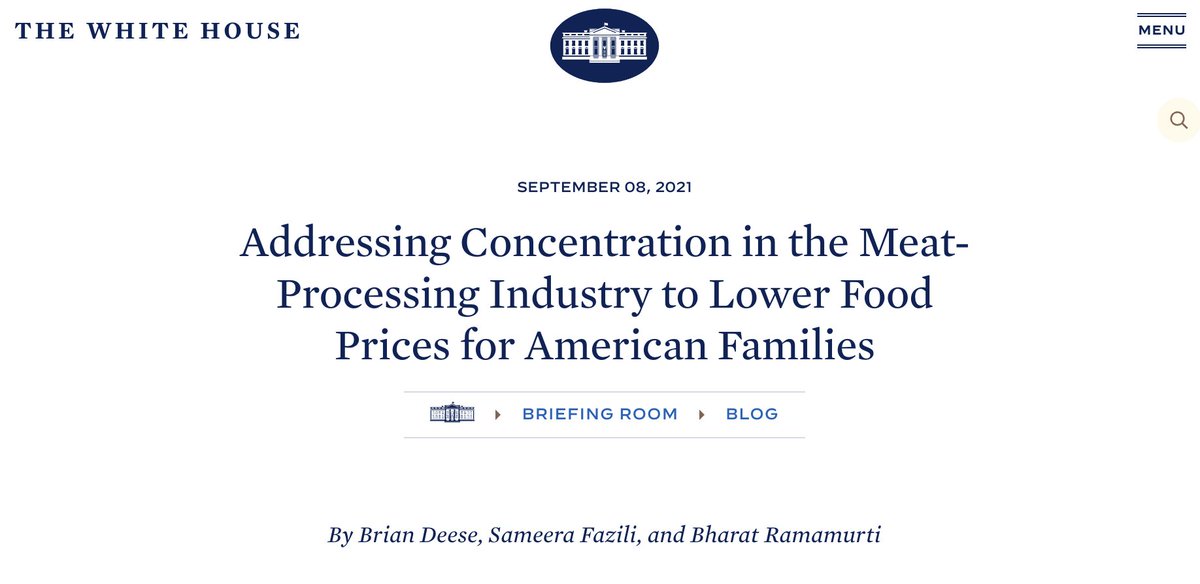
Seems like a good day to remind pundits about the work that @briancdeese@sameerafazili@BharatRamamurti did way back in 2021 to lower prices by attacking concentration in the meat-processing industry.
Re the French elections and the left’s program to reduce inequality, here’s the long report @S_Stantcheva and I produced for Macron on this subject. We discuss reform of the inheritance tax but also industrial/place-based/technology measures for good jobs. So we focus not only on redistribution but also direct interventions where inequalities are created. https://t.co/iXNRH5ay4n
Join us on Monday, March 25th at 5pm CT for a conversation with Dali Yang on "Wuhan." He will be joined in conversation by Kenneth Pomeranz.
Presented in Partnership with @UChicagoCEAS
RSVP Here: https://t.co/79oOCX9JZC
The decimation of Anthropology at UK universities (Kent 😭; us at Goldsmiths facing becoming unviable due to rendundancies) is incredibly short-sighted.
A short 🧵 giving 8 reasons why the world needs anthropology and anthropologists, now more than ever 1/9:
The immigrant share of the labor force reached a record high of 18.6% in 2023. As a result, anti-immigration forces have been out in full force with a deeply misguided chorus of “immigrants are taking all our jobs.” Here are some key facts, to set the record straight. 1/
1. I have been a professor for almost 40 years now. Let me give you my perspective on what I think has happened on the political/ideological orientation university campuses that seems to have reached a recent boiling point.
I thought I would finish my book for @FitzcarraldoEds this year, and with December just beginning, I am sprinting to the finish line. While writing the book this year, I also published nineteen pieces this year. Here are six I particularly liked, organized chronologically: (1/8)
Stephen M. Walt: “Supporting the war means supporting the destruction of Ukraine”
Stephen M. Walt, professor of international relations at Harvard University, has published a very insightful piece in Foreign Policy in which he makes the moral case for peace. Here are some excerpts from the article:
“What is the morally preferable course of action in Ukraine? At first glance, it seems obvious. Ukraine is the victim of an illegal war, its territory is occupied, its citizens have suffered mightily at the hands of the invader, and its adversary is an autocratic regime with any number of unsavory qualities. Strategic calculations aside, surely the proper moral course is to back Ukraine to the hilt.
What’s missing in this view, however, is an acknowledgement that the morality of a given policy also depends on the potential costs of different courses of action and the likelihoods of success of each one.
If we are talking about human lives, we must look beyond abstract principles and consider the real-world consequences of different choices. It’s not enough to proclaim that the good guys must win; one must also think seriously about what it will cost to produce that outcome and whether it can in fact be achieved. Although there is no way to be 100-percent certain about either the likely costs or the probability of success, refusing even to consider these features is an abdication of moral responsibility.
The moral case for pursuing peace—even if the prospects are unlikely and the results are not what we’d prefer—lies in recognizing that the war is destroying the country and that the longer it lasts the more extensive and enduring the damage will be. Unfortunately for Ukraine, anyone who points this out and offers a serious alternative is likely to be loudly and harshly condemned and almost certain to be ignored by the relevant political leaders.
I wish hardliners would acknowledge that their uncompromising approach to the war could do more harm to Ukraine in the long run. Not because that is what hardliners want, but because that is what their policy recommendations may produce.
Given that many of these same people [who rejected all earlier warnings about where their policies might lead in Ukraine] are among the loudest voices calling to continue the war, raise the stakes, and increase Western support, one is entitled to wonder whether their advice will do as much harm to Ukraine today as it did in the past”.
Here’s the link to the full article: https://t.co/y5AB7AhcwE
Du liebst ökonomische Sachbücher, aber hast keine Zeit sie zu lesen? Kurze Zusammenfassungen inklusive politischer Einordnung gibt's zum Lesen und Hören von der Friedrich-Ebert-Stiftung. https://t.co/XPUDvnhAfo







![battleforeurope's tweet photo. Stephen M. Walt: “Supporting the war means supporting the destruction of Ukraine”
Stephen M. Walt, professor of international relations at Harvard University, has published a very insightful piece in Foreign Policy in which he makes the moral case for peace. Here are some excerpts from the article:
“What is the morally preferable course of action in Ukraine? At first glance, it seems obvious. Ukraine is the victim of an illegal war, its territory is occupied, its citizens have suffered mightily at the hands of the invader, and its adversary is an autocratic regime with any number of unsavory qualities. Strategic calculations aside, surely the proper moral course is to back Ukraine to the hilt.
What’s missing in this view, however, is an acknowledgement that the morality of a given policy also depends on the potential costs of different courses of action and the likelihoods of success of each one.
If we are talking about human lives, we must look beyond abstract principles and consider the real-world consequences of different choices. It’s not enough to proclaim that the good guys must win; one must also think seriously about what it will cost to produce that outcome and whether it can in fact be achieved. Although there is no way to be 100-percent certain about either the likely costs or the probability of success, refusing even to consider these features is an abdication of moral responsibility.
The moral case for pursuing peace—even if the prospects are unlikely and the results are not what we’d prefer—lies in recognizing that the war is destroying the country and that the longer it lasts the more extensive and enduring the damage will be. Unfortunately for Ukraine, anyone who points this out and offers a serious alternative is likely to be loudly and harshly condemned and almost certain to be ignored by the relevant political leaders.
I wish hardliners would acknowledge that their uncompromising approach to the war could do more harm to Ukraine in the long run. Not because that is what hardliners want, but because that is what their policy recommendations may produce.
Given that many of these same people [who rejected all earlier warnings about where their policies might lead in Ukraine] are among the loudest voices calling to continue the war, raise the stakes, and increase Western support, one is entitled to wonder whether their advice will do as much harm to Ukraine today as it did in the past”.
Here’s the link to the full article: https://t.co/y5AB7AhcwE](https://pbs.twimg.com/media/F6zZjVCW4AAKxqJ.jpg)


