Nobody likes attention or credit and so, here is the LEAST INTERESTING THREAD I can possibly think of making, a complete once secret 53 page British Intellgence report on the HISTORY OF GERMAN NIGHTFIGHTING STRATEGY IN WW2, obtained from interrogation of senior Luftwaffe staff.
Twitters new creator content rules also penalise the use of long thread posts, because they only "count" the views of the intial post.
As a consiquence, not only have I picked the most boring possible topic, but here is the longest possible thread I can manage to make, it would be a real shame if anyone shares this, and hopefully I will get the absolute minimum credit for it from Twitter.
Dont read any of this, its NOT INTERESTING and nobody cares !
Shhh !! Go away and definetly DONT learn anything.
@RositaDaz48 He had his time in the sun and he didn’t listen, just like the rest of the liberal party. He fluffed it. Time for someone else, no more fucking retreads.
@craigkellyAFEE They havn’t listened to their base for over a decade and the membership and supporters are fed up. I’m a lifelong coalition voter, bit right now the arseholes can get stuffed. How did they manage to lose a rusted on supporter like myself? Idiots. ON for me.
@JohnRuddick2@ChavuraStephen Josh was an ordinary treasurer who failed to make the cut. There is absolutely no reason for him to return to the parliament. He’s had his go, time for someone else to see if they can make a difference for the betterment of the country.
@DavidShoebridge Only brain dead, ill informed retards would vote for the greens. You’re a prime example of why the greens should be placed last on the ballot every fucking time without fail.
@SydneyLWatson@FredPawle I’ve been here for 66 yrs and I’ll be fucked if I’m going to take any notice of someome who’s been here for 66 seconds. Cooked indeed.
My personal opinion is that relations with China will fracture Europe. The EU is not a good model to compete with the Chinese communist’s economic model. The Chinese will use the weaker nations to transship goods into the stronger nations. The Federalist Papers, which argued for a stronger Federal government thankfully argued for a model that can protect the 50 states with a strong federal government responsible for protecting borders. That is not the EU.
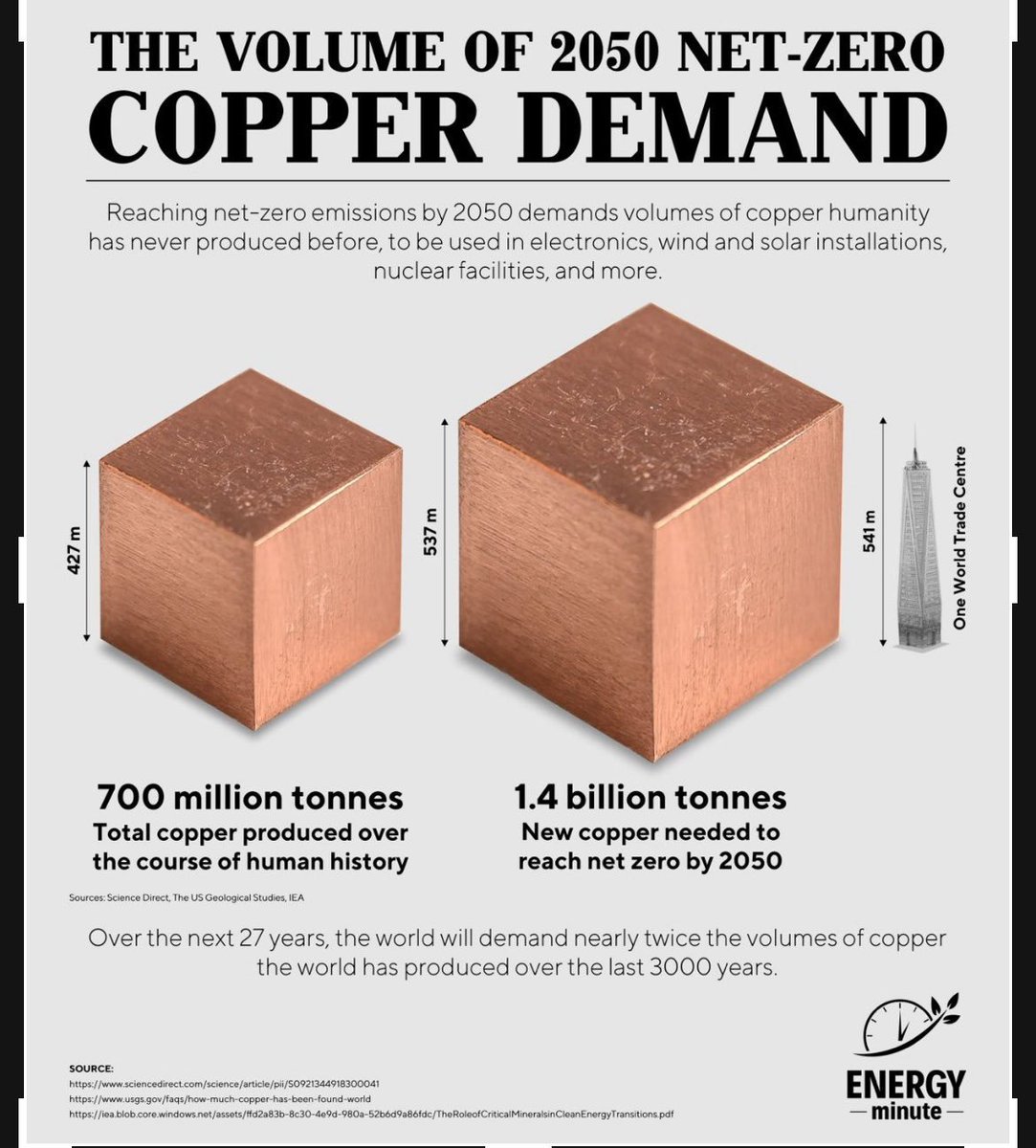
The world consumes roughly 28 million tonnes of copper every year—a mass equivalent to five Great Pyramids of Giza.
Yet that refined metal is just the tip of the iceberg of a far more monstrous physical reality. Beneath those 28 million tonnes of copper sits a massive geological footprint: billions of tonnes of blasted rock, colossal volumes of chemical tailings, vast energy expenditures and trillions of litres of water. This is all fresh, relentless demand.
Crucially, up to 75% of that copper never enters individual turbines, solar panels or electric vehicles. It goes into the invisible grid infrastructure required to link everything together and make it function. When you trace 28 million tonnes of copper backward into the Earth, the true scale and cost is staggering.
The drive to overhaul the global energy structure rests on a profound misunderstanding of physics: it treats energy supply as a 'software' problem while ignoring the devastating raw material gridlock caused by manufacturing billions of solar panels and over a million wind turbines, with hundreds of thousands more in the pipeline.
When an energy system shifts from reliable, high-density fuels—hydrocarbons and uranium—to low-density, intermittent sources like wind and solar, the physical apparatus needed to capture, convert, stabilise and transmit that diffuse flux just explodes.
It becomes an absurd trade-off: expending colossal amounts of finite, high-grade fossil fuels upfront simply to dig up materials for low-density generators—generators that can never run a steel mill, power an ocean cargo vessel or sustain international air travel.
Mining is already a vast consumer of continuous energy. As global copper ore grades decline—frequently dropping to 0.5% or lower—the mass of rock that must be dug, hauled, and crushed grows exponentially per unit of recovered metal.
Crushing rock alone accounts for roughly 3% to 4% of total global electricity consumption. Demanding billions of additional tonnes of processed metal creates a self-defeating loop: huge volumes of reliable, baseline power are consumed just to extract the raw materials needed to construct weather-dependent hardware.
Yet the primary metals drain does not come from the turbines or arrays themselves. It stems from the enormous physical web needed to transport that energy across vast distances. Diffuse generators located hundreds of kilometres from cities require unprecedented volumes of step-up transformers, substations, high-voltage transmission lines and regional grid overhauls.
The heavy overhead wiring looping across the landscape regularly dwarfs the metal required to build the turbine in the first place. Because two centuries of industrial civilisation have already extracted the highest-grade deposits, meeting future demand forces miners to dig deeper, crush harder and manage billions of tonnes of toxic slurry.
This is a twin crisis: the escalating physical cost of ore recovery on the front end, and an unprecedented tsunami of industrial e-waste bound for landfills on the back end. The physical limits of this model are not dictated by how much metal remains in the crust, but by the soaring energy penalty required to dig them up and refine them.
Heavy industrial processes—blast furnaces, chemical synthesis, cement production and deep-shaft mining—all need continuous, high-temperature thermal energy and uninterrupted high-voltage power. Intermittent turbines and panels cannot reliably deliver that dense power to sustain heavy industry, let alone an entire national economy.
The ultimate irony is that the staggering industrial muscle needed to build, maintain, and periodically replace these diffuse energy systems relies entirely on the coal, oil and gas they were meant to replace.
The dream of a fully weather-dependent industrial grid ignores physical reality. It overlooks a looming nightmare of endless ore extraction, refining bottlenecks, and perpetual grid expansion.