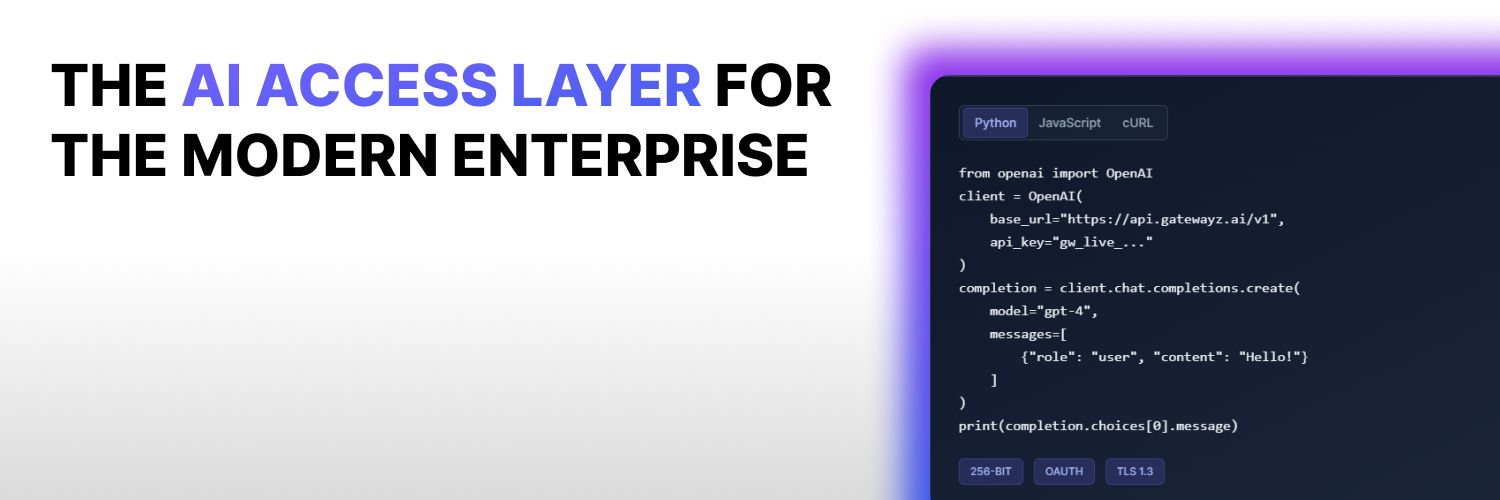
Missed today's Gatewayz AMA? 🎙️
We've got you covered!
Catch the full recording below to hear the latest updates, what we've been working on, and where Gatewayz is heading next.
Meta's Muse Ember targets the work agents repeat: tool calls, extraction and coding subtasks.
Those everyday steps deserve attention alongside the big reasoning breakthroughs.
That's the world we're building Gatewayz for: the inference layer for the agentic internet.
Gatewayz passes native Anthropic prompt-caching directives through to the provider.
Cache eligibility and savings depend on the model and request.
Check actual cache usage in your workload before assuming a lower bill.
An agent can revisit the same instructions and reference material many times in one task.
That makes repeated context worth examining before you change models to cut costs.
Start by checking whether your workflow can use the provider's prompt caching.
Your agent stack should have room for more than one model provider.
Gatewayz brings supported models together under one key and prepaid balance. You choose the model for the job.
The inference layer for the agentic internet should keep that choice yours.
Already building with the OpenAI SDK or Claude Code?
Gatewayz documents both as tested end to end, with OpenAI-compatible Chat Completions and native Anthropic Messages.
Keep your development tools. Connect them to Gatewayz for inference.
Menlo's new report says agents account for 80% of tokens on OpenRouter.
That's one platform's data, but a striking shift in who's using inference.
We're building Gatewayz for that shift: the inference layer for the agentic internet.
Gatewayz provides the inference connection to supported models.
Your application owns the tools, permissions and execution.
That separation gives you a clear place to add approvals as you move from an assistant that suggests to an agent that acts.
An agent that drafts a customer email and an agent that sends it have different responsibilities.
When building with Gatewayz, make that boundary explicit: the model proposes an action; your application decides whether it can happen.
For an email assistant, start with a draft-only workflow.
Let the model suggest the recipient, subject and message. Have your application validate them and require approval before sending.
Model output should pass through your rules before becoming an action.
When did you last switch the model behind an AI workflow?
What earned the switch: better answers, faster responses, lower cost, or fewer retries?
At Gatewayz, we're interested in what wins on your actual tasks.
The Binance investigation is still unfolding. For agent builders, it's a prompt to review access and limits.
At Gatewayz, that means separate inference keys, per-key request caps and usage visibility.
More autonomy needs more deliberate controls.
The AI race isn't just about building smarter models anymore.
It's about making the entire ecosystem more accessible.
Build across model providers → https://t.co/LmNwj5Q5Y7
AI news this week (Oct 20–29):
1) Google unveiled Gemini 4 Carbon, a new frontier model for cybersecurity, coding and long-running agents. Initial access is limited.
2) OpenAI released GPT-6.1 Terra, focused on lower-cost computer use and visual reasoning.
5) OpenAI models and Codex are coming to Google Cloud, putting a rival lab’s AI tools inside Google’s enterprise platform.
6) OpenAI and researchers used thousands of AI agents to analyze data from millions of mouse brain cells in just 32 minutes.
When an inference call fails, does your agent know whether to retry, stop or ask for help?
Gatewayz returns distinct errors for invalid models, exhausted credits and rate limits.
What does your agent do with those signals?
Anthropic's IPO filing puts the model layer in the spotlight.
The agentic internet also needs infrastructure connecting those models to real work.
That's where we're building Gatewayz: model-agnostic access for the agents putting AI to use.
Anthropic has filed an S-1 registration statement with the SEC related to its proposed IPO.
Read more: https://t.co/ofhv0DK3Zp
Legal disclaimer: A registration statement relating to these securities has been filed with the SEC but has not yet become effective. These securities may not be sold, nor may offers to buy be accepted, prior to the time the registration statement becomes effective. This post does not constitute an offer to sell or the solicitation of an offer to buy these securities, nor shall there be any sale of these securities in any state or jurisdiction in which such offer, solicitation or sale would be unlawful prior to registration or qualification under the securities laws of any such state or jurisdiction.
An agent needs a way to reach the models behind its work.
Gatewayz brings that access together across providers, with separate keys, request caps and usage visibility.
We're building the inference layer for the agentic internet.
A user asks for one thing. An agent may need dozens of model calls to deliver it.
Gatewayz sits underneath that work, connecting agents to model providers through a shared inference layer.
That's the part of the agentic internet we're building.
Our goal is to make that model-access layer reusable across coding agents, agent platforms and autonomous organizations.
One Gatewayz account can bring supported providers under a shared balance, with separate keys for different workloads.
What does "the inference layer for the agentic internet" actually mean?
When an AI agent asks a model to interpret information or decide its next step, that's inference.
Gatewayz connects those requests to the model providers.
Your application manages the task, the tools and the actions.
Gatewayz handles the model-access side: authenticating requests, checking limits, forwarding calls and recording usage.
Clear responsibilities make the stack easier to reason about.